Julian Steinke, Robert Van de Ketterij, Henk De Weerd, David Slater, Guido Band (2026). Silent Safety: Assessing the procedures regarding cavitation inception on naval vessels during a multi-day anti-submarine warfare exercise. In: Human Error, Reliability, Resilience, and Performance. AHFE Open Access, vol. 213, pp. 1–14. https://doi.org/10.54941/ahfe1007549
Cavitation is one of the strongest sources of underwater radiated noise (URN) caused by ships. Next to the ecological impact, preventing cavitation is essential for crews on naval vessels, as the URN caused by cavitation can be used by submarines to detect the ship. As this prevention process requires the crew of a vessel to act on cavitation information, it is necessary to understand the current cavitation-related processes on board. We conducted a FRAM based on a NATO anti-submarine exercise and compared the work as intended to the work as done by the bridge teams. The intended goal of the system is achieved, but the system lacks the resilience to cope with mistakes and unexpected events. Several workarounds in the work as done have been identified that are being used to relieve the strain on the system. The watch officer has the highest workload and frequently offloads tasks to others on the bridge. This lowers the workload but potentially causes problems that the overall system cannot mitigate.
Noise and sound in general play a major role in underwater warfare. Preventing sound emissions where possible is essential in anti-submarine warfare (ASW) to make a surface ship less detectable for a submarine. As the newest generation of submarines is being built, the world’s navies increasingly see the need for new surface ships specialised in ASW, for example the joint ASW Frigate project of the Belgian and Dutch Navy (Ministerie van Defensie, 2023). This study aims to chart how crews on current ships are preventing underwater radiated noise. Understanding the work environment and the processes on onboard will enable future research into methods for sound prevention for naval and civil applications.
Underwater Radiated Noise and Cavitation ASW has the unique characteristic that most detections happen through sound. Audio detection, especially via passive sonar, remains as the only option to locate another vessel without broadcasting one’s own position. Naval ship designers therefore continuously strive to limit underwater radiated noise (URN). At lower speeds, vibrations caused by engines and other machinery are the main source of URN, so shock absorbers and isolation structures are used to limit the transfer of these vibrations through the hull (Akram et al., 2022). At higher speed, cavitation takes over as the most significant source of URN (Arveson & Vendittis, 2000). Cavitation can be defined as vaporisation of water in the low pressure generated by the propeller blades moving through it, displacing enough water that the pressure drops below the vapour point, causing a bubble of vapour to form (Franc & Michel, 2006). This inherently unstable bubble will implode, causing a shockwave, and therefore noise. Although the cavitation inception speed (CIS) of a vessel is often assessed with noise measurements during the vessel’s service life, it is usually treated as being a fixed value. The actual CIS can vary significantly depending on for example sea state, water quality (Kawakami et al., 2003) and current and previous manoeuvres (Baena et al., 1978). Surface ships are much more susceptible to these factors than submarines in a dive as they are in a more dynamic environment at the water’s surface. In addition, CIS prediction methods for submarines have been proposed, but applying those methods to larger surface ships first requires more research (Jeong et al., 2022). This study is part of project CISCON (Cavitation Inception Speed CONtrol) which aims to understand cavitation of surface ships and develop models to predict cavitation inception in real time.
ASW Work Environment Information related to CIS should not only be predicted with improved precision; it should also be presented to the crew in an ergonomically optimized manner. The transfer of CIS information must be integrated in the high-pressure and high-risk work environment on board in such a way that the crew can efficiently prevent cavitation in all conditions; that is even if workload is high and crew deviate from standard procedures. To achieve that, it is necessary to investigate what the current procedures on board are, in particular those involved in detecting and preventing cavitation.
Steinke et al. (2025) charted the procedures regarding cavitation prevention by observing officers in training during ASW exercises in a simulator study and the conditions on board an active frigate. The study delivered a model of the work as imagined (WAI), that is, work by the book. In order to investigate the real-life conditions, or work as done (WAD), a longer ASW mission had to be assessed. In the current study we aimed to test the model developed in Steinke et al. (2025) and to synthesize a model of the procedures in real-life conditions. The physical bridge will be the boundary for this study, as they observe the environment directly and are usually in control of propulsion and thus have the largest direct influence on potentially reaching CIS. Although in a different location, the command centre is a relevant environment, some actions taken by the commanding officer (CO) might have to be included.
Silent Safety: Assessing the Procedures Regarding Cavitation Inception on Naval Vessels 3 Mental workload during long-term ASW missions fluctuates substantially. Most of the time, the crew of a vessel has to be vigilant for the appearance of potential enemy submarines in otherwise monotonic circumstances. However, if an enemy vessel gets detected, the crew must be able to act as fast as possible. This switch from a low-intensity monitoring task to immediate action on a sudden signal has been shown to be challenging, even after shorter periods of time (Kraut et al., 2023).
Although the personnel on board operates in shifts, performing the same task as one socio-technical system for weeks will induce operator fatigue (Cummings et al., 2013). This fatigue results in attentional lapses (Killgore, 2012) and increased performance variability in the operator (Dinges & Kribbs, 1991). Shifts in heightened-readiness states can also be longer than usual, resulting in sleep deprivation, which can further lower the operator’s performance (Bukhtiyarov & Chistov, 2013). In addition, sleep deprivation increases frustration and overall a negative bias in perception (Killgore, 2012), having a negative effect on the work environment as a whole. Even if watch cycles on board are rotated frequently, attention lapses are present in operators after only short term sleep deprivation (Lim & Dinges, 2010). Thus, with two seven-hour shifts, sleep deprivation may cause a deficit in sustained attention very rapidly.
Furthermore, the crew on the bridge will have to function in varying environmental conditions such as in rain, strong winds, high sea, fog, or at night. These are not just limitations for the lookout, but, if sufficiently dark, some conditions limit visibility on the bridge itself without illumination. At other times their tasks during ASW are of low complexity and low stimulation as most of the time nothing is happening while sailing on the open sea at comparably low speed. All in all, the potential of the crew getting bored and fatigued is high. Although self-reported boredom as a feeling is not sufficient as a performance indicator (Veitch et al., 2024) for short term trials (30 minutes) where the operator might be bored, but not yet fatigued, boredom has been linked to a decrease in performance in longer trials (Cummings et al., 2013). Especially when an operator needs to switch from a low-demand to a high-demand task, a longer time spent in the low- demand task lowers performance in the high-demand task and the switch between those two states (Thornburg et al., 2012). As operators on a warship might spend multiple days in a low-demand state, this effect has significant implications to the operational effectivity of the vessel.
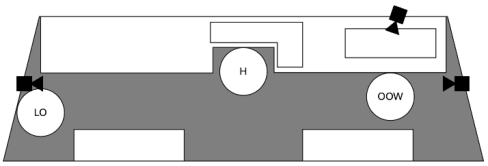
This study is based on the bridge of a Karel Doorman-class frigate, which is usually staffed by the helm, a lookout, and the officer of the watch (OOW). Figure 1 indicates their positions at a specific timeframe, but the situation on the bridge is dynamic. The OOW has the lead on the bridge and is governing the manoeuvring. They do not always remain at their workstation on starboard but might have to use other terminals on the bridge.
The OOW has the lead on the bridge and is governing the manoeuvring. They do not always remain at their workstation on starboard but might have to use other terminals on the bridge. This might be the case if, for example, other vessels within the fleet need to be contacted. The lookout is tasked to identify visible threats to the ship as well as the general surroundings. They will update the OOW continuously. Most of the time, only one lookout is
stationed, so they will change between the bridgewings on port and starboard. The helm operates the propulsion and steering. It must be investigated whether the physical movement of the lookout and the OOW have an effect on the communication on the bridge as well as with other parts of the ship.
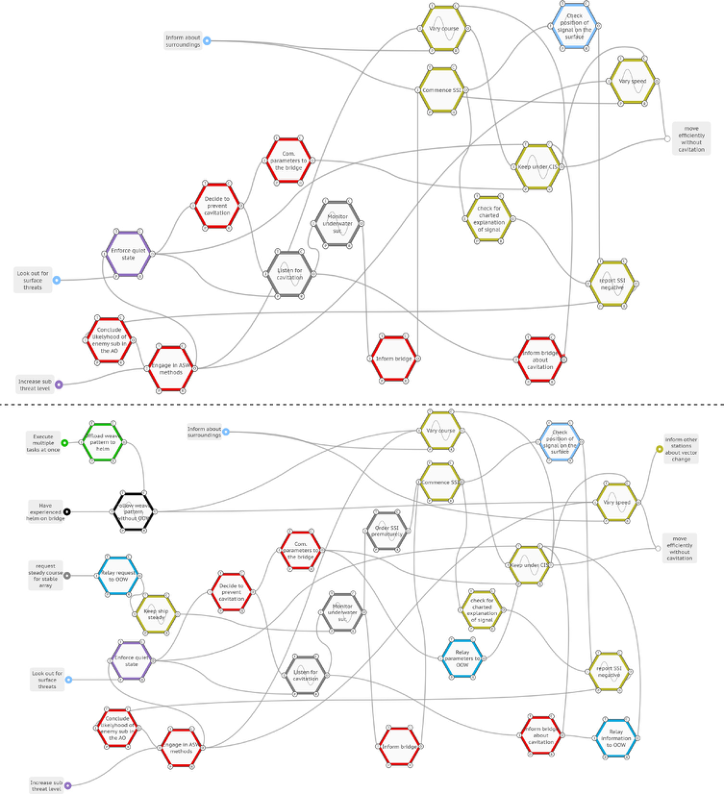
Cavitation Prevention Procedures Previous work used the Functional Resonance Analysis Method (FRAM) (Hollnagel, 2012) to build a model of the work-as-imagined, that is how the procedures on board are supposed to be executed (Figure 2, upper half). FRAM is well suited for this study, as it works well for analysing complex processes with potentially complex failure states, meaning that the system fails due to multiple elements within the system deviating from the intended operation.
The model includes the lookout and the OOW, as well as the CO and sonar operator (SO) in the control centre of the ship. In essence, the bridge crew’s two tasks in relation to cavitation are sailing the ship and looking out for submarines. The SO listens for submarines and will be the first to detect cavitation. The CO has the operational responsibility and communicates with both. If the SO detects an unknown signal, they report to the CO, who orders a sub-surface investigation. The bridge investigates on the surface and in the charts for any explanation. If this returns negative, the likelihood of an unknown submerged object increases. ASW doctrine then dictates that the ship keeps under CIS and follows a weaving pattern, thus altering speed and course to be less predictable. As described above, manoeuvring and sea state affect CIS, so the weave pattern will have an effect on the actual CIS. If the ship unexpectedly cavitates, the SO will report cavitation to the CO, who will signal the bridge to change speed. This will then be an alteration from the original pattern. The study by Steinke et al. (2025) identified potential variability in the system which could resonate in such a way that variability in multiple functions occurring at a time amplify each other and bring the system to a complex failure. The model shows a significant amount of variance in the complex functions executed by the OOW, meaning that the OOW’s role in the system is potentially brittle. It has to be investigated if there are indicators that this might happen and, if so, how such a failure state is mitigated in the current situation on board. The research questions this study will try to answer are (1) Can the model of WAD shown in Steinke et al. (2025) be replicated real life conditions, (2) what is the difference between WAI and WAD, (3) are there indicators for brittleness, and (4) how could the process support the bridge crew?
METHOD
As this study aims to build on the work by Steinke et al. (2025) by comparing the WAI and the WAD, it was necessary to collect data in real life conditions on board during ASW operations. The data for this study were collected during observations of 17 anti-submarine warfare exercises over 12 days on board a Karel Doorman class frigate of the Royal Netherlands Navy. These exercises were conducted during a larger combined exercise with other NATO forces.
Silent Safety: Assessing the Procedures Regarding Cavitation Inception on Naval Vessels 5 Participants and Materials
The participants recruited for this study consisted of multiple shifts of bridge personnel. A shift has at least three members; the officer of the watch, the helm, and a lookout. In total, 28 crew members were observed on the bridge of which included six officers, one officer in training, and 21 enlisted. The observed roles were the commander of the vessel, the executive officer, the meteorological officer, the navigation officer, officers of the watch, SOs, helmsmen, lookouts, communications operators, and machine gun crews. Due to the protection of the privacy of the individual participants and the observation of the crew as one unit, no individual demographics other than rank were recorded.
The setup of cameras was almost identical to Steinke et al. (2025). Three action cameras were installed on the bridge; one on each bridgewing and one midships (Figure 1). The midship camera was the only alteration to the referenced setup, as it was orientated more towards the station of the OOW. This had been done to record the verbal communication of the OOW more reliably against background noise.
Figure 1: Positions of the cameras on the bridge. Note: Marked are the default positions of the officer of the watch (OOW), lookout (LO), and helm (H).
PROCEDURE The entire crew was briefed about the study multiple days in advance by the commander of the vessel. The crew members on the bridge were fully briefed on the study and asked for informed consent as soon as they entered the bridge. The observations occurred during all ASW exercises while daylight was available. These exercises included multiple combined (i.e. fleet) exercises, either protecting a high value asset, denying access to a protected area, or hunting enemy forces. The adversary was either one or two submarines. During the observations, a varying number of surface ships were involved, ranging from one to four friendly surface ships. In total, the overall operation involved nine surface ships and four submarines, as well as various helicopters and marine patrol aircraft. One NH90 helicopter was permanently stationed on the observed vessel for sonar dipping.
All recorded crew members were fully debriefed via a debrief letter that was distributed to those participants by the executive officer of the vessel. This debrief also included contact details of the researchers to reach out to, if a participant would decide to withdraw consent.
Analysis The first step in the data processing was the transcription of all events in the recorded videos. All identifiable personnel were anonymized to their station and any specific, and therefore potentially classified, values and discussions were taken out of the data. The events were then coded according to the specific action that was executed by a crewmember.
The first step of FRAM is to define the essential functions. These functions include all specifically identifiable activities that are required for the system to fulfil its purpose within the predefined boundary. The boundary for the model was the bridge, but necessary functions in the command centre had to be included. In addition, the model also includes system-functions and auxiliary functions that are physically spread throughout the vessel, for example the communications centre.
The second step of FRAM is to determine the potential for variability in each function. The observed executions of the functions were used to describe each function’s output variability regarding time and accuracy. Time variability meaning the potential for the function to be executed on time or not. Variability in accuracy describes the precision of the output.
The third step of FRAM is the definition of the functional resonance based on interdependencies of the functions. As outputs can be aspects (Input, time, control, precondition, or resources) of other functions, these connections create a network representing the dependency between the functions of the system. This network also shows how the variabilities determined in the second step affect the network downstream.
The FRAM model was created using the FRAM model visualizer version 2.2.0 by Rees Hill (2024). The dataset included every specifically identifiable action executed by a crew member. These were then grouped in activities as defined in FRAM and formulated as functions. All functions involved in the process towards moving efficiently without cavitation were included in the model.
The model was then walked through with a group of crewmembers for verification. This group consisted of the commander, the first officer, two CO’s, three OOWs, one SO, and two helmsmen/lookouts (those two functions are done in rotation by a Sailor).
RESULTS
In total, 30 functions have been identified (Table 1). The functions were then grouped to the actor on board that executes them, thus the OOW, lookout, CO, SO, and the helm. In addition, some functions have been classified as systemic functions that are being executed by the joint cognitive system at large.
With eleven functions, the OOW executed the most functions. Six of these showed significant variability and one was a background function. Vary course was executed in a chosen weave pattern, thus following the
Silent Safety: Assessing the Procedures Regarding Cavitation Inception on Naval Vessels 7 pre-determined zig-zag pattern. The same applied to Vary speed, while the output, the selected speed, was also one of the boundary conditions affecting propeller cavitation. Both of these functions showed variability in time of output, as the execution of these functions was observed to be delayed in all observations.
In addition, fluctuations in CIS directly affected the executability of the predesignated speeds in the weave pattern. Keep under CIS, was directly affected by the upstream variability in vary course as well as all environmental factors affecting CIS. This resulted in the time of the output of Keep under CIS being too late. In addition, the accuracy of the output was not precise, as a lot of variables influencing CIS had to be considered by the OOW in the assessment of CIS. The OOW gave standing orders to the helm to follow the zig-zag pattern on their own in all observations. This was always done so the OOW could temporarily focus on other tasks, for example administration. Report SSI negative was observed to happen too early in all observations especially in poor visibility or with inexperienced lookouts. No visible contact was often assumed and reported before the lookout had reported back to the OOW. Finally, Keep ship steady for the towed sonar array was observed to be incompatible with planned vector changes, reducing the ability to use it. This was indicated by the SO calling the bridge to request a slower turn or different course in all observations. The lookout executed six functions. Check position of signal on the surface, Look out for surface threats, and Inform about surroundings exhibited variability in the precision of the output, as looking in the wrong spot accidentally resulted in an incorrect report. Additionally, the lookout relayed information to the OOW, if the OOW was not at their workstation. This was observed in all sessions.
The following functions were executed in the command centre. The SO executed three functions, two of which were showing variability. The two functions Listen for cavitation and Monitor underwater surroundings could not be executed at the same time, so the output could be too late.
TABLE 1: Identified functions with output variability indicators grouped by the executing role.
Table available in the original PDF paper.
Function Role Precision of Output Time of Output Engage in ASW methods CO Precise On Time Inform bridge CO Precise On Time
Decide to prevent cavitation CO Precise On Time Com. parameters to the bridge CO Precise On Time
Inform bridge about cavitation CO Precise On Time CO Precise On Time Conclude likelihood of enemy sub in AO
Helm Acceptable On Time
Follow weave pattern without OOW * Have experienced helm on bridge *, ** Helm Imprecise On Time
(Continued)
TABLE 1: Continued.
Table available in the original PDF paper.
Function Role Precision of Output Time of Output Look out for surface threats *, ** Lookout Acceptable On Time
Inform about surroundings *, ** Lookout Acceptable On Time Lookout Acceptable Too late Check position of signal on the surface *
Relay information to OOW Lookout Precise On Time Relay parameters to OOW Lookout Precise On Time
Relay request to OOW Lookout Precise On Time Commence SSI¹ OOW Precise On Time
Vary speed * OOW Precise Too late Vary course * OOW Precise Too late
Keep under CIS * OOW Acceptable Too late Keep ship steady * OOW Precise Too late
OOW Precise On Time
Check for charted explanation of signal Report SSI negative * OOW Precise Too early
OOW NA NA
Inform other stations about vector change Order SSI prematurely * OOW Precise Too early
Offload weave pattern to helm OOW Precise On Time Execute multiple tasks at once ** OOW NA NA
Monitor underwater surroundings * Sonar Precise Too late Listen for cavitation * Sonar Precise Too late
Sonar Precise On Time
Request steady course for stable array ** Enforce quiet state System Precise On Time
Move efficiently without cavitation System NA NA Increase sub threat level ** System Precise On Time
Note. *Variability of output. ** Background functions, i.e. functions without inputs. Potential variability of the output of each variable has been defined by the precision (precise, acceptable, or imprecise) and the time (too early, on time, too late, or not at all) of the output. 1 Subsurface Investigation.
The commanding officer executes six functions, but none show variability. Five of these are part of linear processes in the decision-making process at large.
Finally, two functions happened at an organizational level. Enforce quiet state triggered the entire process to prevent cavitation to avoid detection. Increase submarine threat level brought the ship in a raised state of readiness. This could be triggered by a detection, communication from another ship, or a warning from outside the fleet.
In total, six background functions have been identified. The only functions without output were the OOWs Inform other stations about a vector change and Move efficiently without cavitation, the goal function of the system. The model (Figure 2) shows all identified dependencies between the functions.
DISCUSSION
In the current study, procedures intended to prevent cavitation of a navy vessel were compared with observations in the naturalistic setting of an ASW mission. The model of the WAI as shown in Steinke et al. (2025) could be verified in this long-term study focussing on ASW only. The functions specifically intended for the procedures, including the processes of SSI, weave-patterns, cavitation detection, and propulsion management were all identified in the WAD.
Workarounds and Brittleness in Work as Done We also observed activities that deviate from the WAI. The additional functions identified in the WAD are used as workarounds. These functions show where the intended procedures exhibit brittleness, especially for the OOW. The results of this study indicate that the amount of workload placed on the OOW is often too high, as the OOW chooses to offload tasks to other personnel on the bridge. According to procedure, the OOW gives a command to the helm for every single change in the ship’s vector, while the lookout ensures that the intended manoeuvre is possible. The OOW often instructed the helm to follow the predetermined weaving pattern on their own as a standing order. This lowers the overall workload of the OOW, but induces multiple potential problems. This workaround requires an experienced helm, as they must be capable to execute the turns at the correct moment. Thus, offloading this task is not possible with inexperienced personnel. Even if the helm has the experience, this workaround places a task on them for which they are officially not qualified. In addition, as the verbal exchange of command and acknowledgement, ordering a new course and the helm steering towards that course, is not happening anymore.
In moments of high cognitive load, this can result in the OOW assuming, that the vessel is on a different course than it actually is. The mobility of the crew on the bridge revealed another workaround. Every station has their intercom, which is physically in place. The OOW will usually wear a headset during action, but it could be removed temporarily or simply not work. If the OOW for any reason is physically away from their station, incoming communication might get picked up by the lookout and relayed to the OOW. In addition, the OOW may choose to let the lookout answer a call on their behalf. This workaround requires the lookout to be in the vicinity of the OOW’s intercom when a communication is incoming, which is not their general task. In addition, it was also observed multiple times that the OOW put an incoming relayed message from the lookout on standby due to the OOW executing other tasks and then forgot about it. This causes a potentially important message to be delayed, as the lookout has to wait their turn.
Lastly, the operation of a towed sonar array for ASW requires the array to be steady, which is sometimes incompatible with manoeuvres planned in the weave pattern. A shifting array due to the ship changing course effectively deafens the SO.
After multiple days of ASW exercises, the crew voiced being tired and bored. This is to be expected as the crew on the bridge and in the command centre did the same tasks for two weeks straight. Every function was frequently rotated in watches, but still operated in two six-hour shifts per day.
Figure 2: FRAM model of the observed system of the work as done (bottom) derived from Steinke et al. (2025), compared to the model of the work as imagined (top). Note: Blue functions are executed by the lookout, green by the OOW, red by the CO, grey by the SO, black by the helm, and purple by the system at large. Sine waves indicate functions with variable performance.
Although they performed different tasks throughout these 12 hours per day, fatigue and finally general frustration showed at the end, as crewmembers complained and were visibly tired. This decreases the overall
Silent Safety: Assessing the Procedures Regarding Cavitation Inception on Naval Vessels 11 state of alertness and increases the potential for mistakes. In addition, it increases the overall variability of performance on a task (Dinges & Kribbs, 1991), inducing increased potential variability of output in all human functions in the system.
Implications for a Cavitation Management System The use of workarounds in the WAD show that the ASW procedures in the WAI are executed in general, but the WAI does not hold up to real life conditions. The workarounds, the additional functions in the WAD, are being used by the crew to keep the entire process running when additional tasks have to be executed. This is common, as the ASW procedures on the bridge are not executed in a vacuum. The system presented in this study puts a significant number of complex functions on the OOW, while they also have to execute other tasks. A cavitation management system (CMS) on the bridge could lower the workload of the crew on the bridge in the current system significantly, as it would substitute, or at least heavily support the OOW in their estimation of cavitation performance. The function keep under CIS was found to feature the most aspects and is also influenced the most by variability in the WAD, which was also observed in the WAI (Steinke et al., 2025). This function includes the OOW evaluating CIS and adjusting its value, if the goal is to keep just under the actual CIS instead of a predetermined CIS. With the actual CIS of the vessel known, the OOW would immediately know, whether an indicated vector would cause cavitation and adjust the intended vector accordingly. In addition, placing such an interface in sight of the helm would also enable that role to keep CIS in mind. This would also eliminate the workaround of having to relay cavitation information to the OOW, as the information would always be visible on the bridge.
In the current situation, the helm is usually not educated on cavitation, so the workaround of the helm taking over the execution of a weave pattern could inhibit sailing without cavitation. With an interface indicating CIS that would not be necessary, as the helm could simply compare the indicated value to the current and the planned speed. This also means that a CMS needs to be designed with the capabilities of OOWs and helmsmen in mind.
An interface displaying the actual CIS would make the entire system more resilient, as the crew on the bridge would have a way to compare the current speed and the planned speed to CIS. This could also enable the crew to estimate how CIS would be changed by manoeuvres or environmental factors.
Although this study has been conducted exclusively with data from the Royal Netherlands Navy and is therefore only directly applicable to their doctrine, as all military organisations have variations in their procedures and command structures. However, the overall process is by definition tentatively comparable to other NATO forces. In addition, cavitation management
can be relevant to commercial shipping as well. A CMS for commercial use would of course not be used for ASW missions, but the task of a CMS and what it would be used for on a bridge of a commercial ship would be the same as on a naval one.
CONCLUSION
This study compares the procedures in place for cavitation prevention during ASW missions and the actual execution of those procedures. Multiple workarounds have been found, which indicate how the crew on the bridge copes with the system’s brittleness. However, these workarounds have the potential to fail. In addition, the low-intensity and high-risk work environment on the bridge has a high potential of further straining the system through operator fatigue, sleep deprivation, and boredom. A cavitation management system could mitigate the high workload experienced by the crew during high- intensity phases, as it would support the crew with immediate knowledge of the actual CIS of the vessel at any given moment. Especially the OOW would benefit from such a system, as they execute a significant number of functions, as well as with the highest amount of variability. A well-integrated cavitation management system would also require a low number of adjustments within the procedures presented in the model.
LIMITATIONS AND FUTURE RESEARCH The cameras used for the observations did not have low-light capabilities and observations at night were not done. Although fatigue in general has been addressed, the present study cannot make conclusions about the influence of the crew’s circadian rhythm.
Future research must focus on developing concepts for an interface of a cavitation management system as suggested in this study. The present results suggest a support system that can be used by the bridge crew collaboratively. The offloading of navigational tasks on the helm should be supported, so a future CMS should be usable by the OOW and the helm. It is necessary to involve the capabilities and demands of both of these roles in the design process. The CMS has to indicate the CIS of the vessel in such a way, that the crew can adjust the chosen speed accordingly and is immediately able to judge, whether a planned course would cause cavitation.
ACKNOWLEDGEMENT
The completion of this study would not have been possible without the outstanding collaboration of the staff of the Royal Netherlands Naval College, who facilitated the collection of data during examinations of officers in training and shared their facilities with us and the crew of the Zr. Ms. Van Amstel for welcoming this research project on board without hesitation and for their enormous enthusiasm and support during and after the data
Silent Safety: Assessing the Procedures Regarding Cavitation Inception on Naval Vessels 13 collection. This study is part of WP3 of the Cavitation Inception Speed CONtrol project funded by the NWO file number KICH1.VE02.20.002. The study was approved by the ethical committee of Leiden University under reference numbers 2023-06-13-G.P.H. Band-V2-4788 and 2023-08-21- G.P.H. Band-V1-4948.
REFERENCES
Akram, P. A., John, B. M., Madathil, T. S., Shija, C., Abhirami, P., Mathiazhagan, A., Tide, P. S., & Ebenezer, D. D. (2022). Numerical Model of a Multi-layer Shock and Vibration Isolator. Oceans Conference Record (IEEE). OCEANS 2022. https:// doi.org/10.1109/OCEANSCHENNAI45887.2022.9775499 Arveson, P. T., & Vendittis, D. J. (2000). Radiated noise characteristics of a modern
cargo ship. The Journal of the Acoustical Society of America, 107(1), 118–129. https://doi.org/10.1121/1.428344 Baena, J. L. C., Basnez, J. F. N., & Hidalgo, J. M. (1978). Cavitation of Propellers in nozzle-rudders—Ifluence of rudder angle. INGENIERIA NAVAL, 46. https://trid. trb.org/View/79350 Bukhtiyarov, I. V., & Chistov, S. D. (2013). Effect of 24-h sleep deprivation on the
oculomotor reactions of a human operator. Human Physiology, 39(7), 741–745. https://doi.org/10.1134/S0362119713070062/METRICS Cummings, M. L., Mastracchio, C., Thornburg, K. M., & Mkrtchyan, A. (2013).
Boredom and distraction in multiple unmanned vehicle supervisory control. Interacting with Computers, 25(1), 34–47. https://doi.org/10.1093/iwc/iws011 Dinges, D. F., & Kribbs, N. B. (1991). Performing while sleepy: Effects of experimentally-induced sleepiness. In Sleep, sleepiness and performance (pp. 97–128). John Wiley & Sons. Franc, J.-P., & Michel, J.-M. (2006). Fundamentals of Cavitation. Springer Science
& Business Media. Hill, R. (2024). FRAM Visualizer (Version 2.2.0) [HTML]. Functional Resonance.
https://github.com/functionalresonance/FMV_Community_Edition (Original work published 2023) Hollnagel, E. (2012). FRAM: the Functional Resonance Analysis Method: Modelling Complex Socio-technical Systems (1st edn). Ashgate Publishing Company, England. https://doi.org/10.1201/9781315255071 Jeong, S. J., Hong, S. Y., Song, J. H., Kwon, H. W., & Seol, H. S. (2022). Numerical
method to determine the cavitation inception speed of a submarine propeller based on the noise obtained from bubble dynamics. Ocean Engineering, 245, 110464. https://doi.org/10.1016/J.OCEANENG.2021.110464 Kawakami, D., Qin, Q., & Arndt, R. (2003). Can water quality affect the lift dynamics of cavitating hydrofoils. Proceedings of the Fifth International Symposium on Cavitation. International Symposium on Cavitation. https://www.semanticscholar. org/paper/b3c31e8f6ee8b5a40fb9bbf285d9fdae7128b80e Killgore, W. D. S. (2012). Socio-emotional and Neurocognitive Effects of Sleep Loss.
In The Handbook of Operator Fatigue. CRC Press. Kraut, V., Motnikar, L., Mirnig, A., & Fröhlich, P. (2023). Assertive Takeover Requests: Immediate and Sustained Effects on Stress and Performance. ACM International Conference Proceeding Series, 103–111. https://doi. org/10.1145/3580585.3607174
Lim, J., & Dinges, D. F. (2010). A Meta-Analysis of the Impact of Short-Term Sleep Deprivation on Cognitive Variables. Psychological Bulletin, 136(3), 375–389. https://doi.org/10.1037/a0018883 Ministerie van Defensie. (2023, April 3). New Anti-Submarine Warfare frigates
in service from 2029—News item—Defensie.nl [News item]. Ministerie van Defensie. defensie.nl. https://www.defensie.nl/actueel/nieuws/2023/04/03/nieuwe- anti-submarine-warfare-fregatten-vanaf-2029-in-de-vaart Steinke, J., Band, G. P. H., van de Ketterij, R., & De Weerd, H. (2025). Silent Safety: Assessing cavitation-prevention procedures on board naval surface ships. The International Conference on Military Communication and Information Systems (ICMCIS) 2024. https://doi.org/10.14339/STO-MP-IST-205-41 Thornburg, K. M., Peterse, H. P. M., & Liu, A. M. (2012). Operator Performance
in Long Duration Control Operations: Switching from Low to High Task Load. Proceedings of the Human Factors and Ergonomics Society Annual Meeting, 56(1), 2002–2005. https://doi.org/10.1177/1071181312561418 Veitch, E., Alsos, O. A., Cheng, T., Senderud, K., & Utne, I. B. (2024). Human factor influences on supervisory control of remotely operated and autonomous vessels. Ocean Engineering, 299, 117257. https://doi.org/10.1016/j. oceaneng.2024.117257
LISTED IN THE AHFE DIGITAL BOOKSTORE CATALOGUE
Explore the complete digital volume
Human Error, Reliability, Resilience, and Performance
Read this individual research paper free through the original publisher, or explore the full digital proceedings book.
ISBN 978-1-964867-89-2
Explore this ISBN in the AHFE Bookstore ↗Listed in the July 2026 bookstore catalogue; search by ISBN to confirm current availability · Digital book purchase optional