Cross-cultural liaisons and advisors face numerous challenges understanding and adjusting to different cultures and working cross-culturally to accomplish capacity building goals. While pre-assignment culture-specific training is important, it cannot adequately prepare individuals for the full range of relevant information, requiring personnel to build and refine socio-cultural knowledge “on the ground.” Ethnography offers best practices for performing such cultural sensemaking in the field. Further complicating the issue, however, is the understanding that “culture” is not a unified whole, but rather a set of complex interacting systems; globalization, disconnections between politically and ethnically defined boundaries in host nations, and the interaction of cultural and practical or situational contexts mean that learning “culture” may not be sufficient. To provide sensemaking skills and interpretive tools that are actionable across cultural boundaries and accommodate social complexity we propose a Patterns of Life (PoL) framework that incorporates observable practices, social structures, interactions, and relationships not only among humans but also including the environment, objects, and non-human actors. We then outline our Ethnographically-informed Sensemaking Protocol (ESP), an iterative, reflective process drawing from ethnographic methods (e.g., participant observation and ethnographic interviewing protocols) to develop a holistic understanding of the human domain. We finally present an illustrative use case.
Ongoing trends toward globalization in a variety of industries, as well as increased U. S. government involvement in providing capacity-building and disaster relief assistance to partner nations has resulted in the deployment of individuals from a variety of fields and disciplines as subject matter experts, liaisons, and advisors overseas. These liaisons and advisors are selected on the basis of their technical or field expertise, but may have little or no previous cross-cultural experience, or knowledge of the particular cultural environment in which they are expected to operate. Additionally, in many cases do not know the language of the host-nation and must work through interpreters, thus complicating processes of adjustment and interaction, and placing additional emphasis on the need to interpret body language and other non-verbal forms of expression or communication (Zbylut, et al., 2008). Given the critical role of language and interpretation, it is essential for advisors to have as many tools as possible at his or her disposal in order to fully grasp the meaning of cross-cultural communications, meaning observational techniques and Cross-Cultural Decision Making (2019) recommendations as well as key points for consideration when speaking with others. The short terms of some of these assignments create an additional need for skills to facilitate quick yet detailed assessment of local needs and social systems.
In this paper, we leverage ethnographic expertise and provide sensemaking tools for reading the human domain that will be applicable across a range of complex environments in order to augment the capabilities of cross-cultural liaisons and advisors. We first outline the Patterns of Life (PoL) framework that extends beyond culture to incorporate a fuller sense of social complexity, defining particular environmental, behavioral, and contextual elements that facilitate accurately reading the human domain. We then present our Ethnographically-informed Sensemaking Protocol (ESP), a nested, iterative observational protocol drawing from inductive ethnographic and sociological methodologies. Finally, we provide a use case demonstrating the limitations of applying cursory or generalized cultural orientations and sensibilities to Key Leader Engagements, and illustrating how the application of PoL and ESP provide improved capability.
LIMITATIONS OF CROSS-CULTURAL TRAINING AND THE NEED FOR HUMAN DOMAIN SENSEMAKING A long history of research and training development across multiple domains (e.g., management, health care, and military operations) has been applied to define the knowledge and skills needed for cross-cultural interaction. Cross- cultural training programs and recommendations frequently include region-specific or culture-specific training; meta-knowledge of particular cultures has indeed proved useful in successful cross-cultural interaction, reinforcing use of this training component (e.g., Byram, Nichols, and Stevens, 2001; Leung, Lee, and Chiu, 2013). Much of this instruction is necessarily brief, however, and may operate on or lead to broad generalizations; in some cases, it may even consist of inaccurate information or erroneously apply Western models to foreign cultural groups. Such incorrect meta-knowledge of cultures can result in negative performance during cross-cultural interaction (Leung et al., 2013). Moreover, these short-term, overly simplified cultural training programs may inadvertently worsen learner stereotypes and give personnel a false impression of cultural knowledge and competence (Gertsen, 1990; Abbe and Halpin, 2010). Even where the knowledge gained is correct and appropriate, however, trainees may still face difficulty understanding the practical significance of these cultural concepts and translating that generalized information into applied performance.
Efforts to engender transferable cross-cultural competencies and augment insufficient or unavailable culture-specific training led to the development of “good stranger” culture-general training and the identification of aptitudes and skills related to a concept of overarching cultural intelligence (see Bhawuk and Brislin, 2000; Earley and Ang, 2003). The emphasis on empathy, openness, and perspective-taking emphasized in much of this training is useful, but ultimately both culture-specific and culture-general training appear to leave gaps in relevant cross-cultural skills, and evidence of effectiveness has been inconsistent (e.g., Littrell et al., 2006; Puck, Kittler, and Wright, 2008; Abbe and Halpin, 2010). Furthermore, like culture-specific training, culture-general training may rely on broad generalizations or frameworks like Hofstede’s cultural dimensions, which have come under some criticism for their accuracy and validity (e.g. Erez and Earley, 1993; McSweeney, 2002) and may lead trainees to develop a conception of static national culture that does not adequately prepare them for interactions with real individuals.
Ultimately the concentrated nature of much cross-cultural training, whether region-specific or general, cannot fully prepare an advisor or liaison for the demands of dynamic, ongoing interactions in a complex foreign environment. While it may indeed provide a useful foundation to ease culture shock and facilitate adjustment, as well as a starting point, cross-cultural workers need to augment and revise their knowledge on the ground during the course of their job. Recent research on cross-cultural competency has begun to incorporate cultural learning and sensemaking as a necessary skill to fill this gap (e.g., Rasmussen, Sieck, Crandall, Simpkins, and Smith, 2011; Sieck, Smith, and Rasmussen, 2013; Osland and Bird, 2000; Sands, 2012; Queensland Health, 2010; Byram, et al., 2001). Currently, however, existing training programs and recommendations have yet to provide specific instruction on how exactly trainees should perform such sensemaking.
We propose that ethnographic methods present just such skills and processes for robust human domain sensemaking. Cross-Cultural Decision Making (2019)
Weick (1995) explains sensemaking as a process through which individuals develop plausible explanations based on their knowledge and perceptions, and that it is an enacted process (i.e., the sensemaker’s presence and activities affect the state of the environment and the progression of the situation). Ethnography, as “a scientific approach to discovering and investigating social and cultural patterns and meanings in communities, institutions, and other social settings” depends on the researcher as instrument and sensemaker to observe and interpret the complex events and meanings in a cultural group (Schensul, Schensul, and LeCompte, 1999, p. 1). Like sensemaking, ethnography is framed and shaped by pre-existing information and experiences. Furthermore, a key methodology within ethnography is participant observation, in which the researcher becomes an active participant in the community and shares in the experiences, as well as being involved on a personal level, which echoes notions of enacted sensemaking (see Bernard, 2005; Murchison, 2010; Schensul et al., 1999; and DeWalt and DeWalt, 2011).
Some early research and commentary has begun to voice such an interest in ethnography for cross-cultural training (e.g., Sands, 2012; Knipper, 2013), but practical solutions and processes are still needed. Here, we provide what we hope is a useful first step toward developing this sort of training. Before we discuss the particulars of our observational protocol, however, we recommend a move away from the present emphasis on “culture” as a static, bounded object available for scrutiny or as a complete context for social attitudes and practices, and we present Patterns of Life (PoL) as an alternative.
FROM "CULTURE" TO PATTERNS OF LIFE The Problem with Culture
The extant social science and cultural studies literature present a wide variety of definitions for culture. Within some fields of anthropology and sociology, culture is conceived as a primarily cognitive phenomenon, constituting “... an historically transmitted pattern of meanings embodied in symbols, a system of inherited conceptions expressed in symbolic forms by means of which men communicate, perpetuate, and develop their knowledge about and attitudes toward life” (Geertz, 1973, p. 89) or “the acquired knowledge that people use to interpret experience and generate social behavior” (Spradley, 1979, p. 5). In some cases, culture is positioned as metacognitive, providing the structure for how individuals think and perceive; in this sense, “culture does not provide a cognitive map, but rather a set of principles for map making and navigation” (Frake, 1977, p. 7). Cultural materialist frameworks and practice theory, on the other hand, turn more focus toward culture as rooted in, and responding to, material concerns of production and resource management, and emphasize the observation of visible behaviors and practices rather than reported values or cognitive processes (e.g., Harris, 1979; Reckwitz, 2002; Rouse, 2007; Schatzki, Cetina, and Von Savigny, 2000). Indeed, some scholars argue that the very effort of Westerners to define and lay out foreign “cultures” are, in and of themselves, problematic impositions of power onto others (e.g., Mitchell, 1995; Said, 1978). There is, in short, little agreement on the precise content or boundaries that constitute a culture.
Cross-cultural instructional researchers and training developers are also beginning to gain awareness of issues already circulating among anthropologists and other social scientists, namely that culture (whatever its definition) is not a discrete object, nor “a unified corpus of symbols and meanings that can be definitively interpreted” but rather is “contested, temporal, and emergent” (Clifford and Marcus, 1986, p. 19). Groups of people identified as cultural communities consist of a number of subcultural groups, each with their own values and practices. Even at the individual level, people may simultaneously belong to multiple cultural groups (Handwerker, 2001). Furthermore, individuals are affected by aspects outside of culture, and driven by competing cultural and extra-cultural motivations. Culturally based motivations may be trumped by situational or practical concerns, meaning that advisors or liaisons cannot solely rely on culture to evaluate others’ behavior or to make decisions (Osland and Bird, 2000). Using culture as a framework for interpretation and decision making overseas is further complicated by the fact that areas of operation at regional and national levels are defined by politically drawn—frequently by outsiders with little knowledge of or consideration for the residents’ ethnic and cultural groups—geographical boundaries, and therefore consist of a variety of different cultural groups or “ethnoscapes” which continue to shift, change, and mix due to modern patterns of globalization and international media distribution (Appadurai, 1990). Social systems are complex, open, and adaptive, introducing change over time and in response to various conditions and pressures, as well as in response to contact and interaction with other systems or component sub-systems (Byrne and Callaghan, Cross-Cultural Decision Making (2019)
2014). Therefore, we argue that continuing to emphasize culture as a central factor may not facilitate the sort of holistic mental models that must be applied to appropriately understand and act effectively within the human domain as a complex system. An alternative is required that will be more effective in an applied environment. Reframing the area of concern from “culture” to Patterns of Life (PoL) and highlighting several areas of interest, as well as providing some terms to facilitate communication and shared mental model building, may assist advisors and liaisons in developing this more complex, holistic view.
Defining Patterns of Life To mitigate these issues with the emphasis on culture our research has moved to a more generalized theory of Patterns of Life (PoL). The term “patterns of life” was defined by anthropologist Ward Goodenough as “the regularly recurring activities and material and social arrangements which give a community the semblance of a homeostatic system” (Simpson, Gerard, Goodenough, and Inkeles, 1961, p. 521). Though it provides a useful starting point, we find this definition insufficient, as it does not fully reflect the degree to which these aspects interrelate with and influence one another. Its focus on society as “homeostatic” also fails to adequately address intra-cultural variation and divergence, as well as the influence of practical, economic, or other extra-cultural factors. The nature of social systems as “far from equilibric, open and…complex adaptive” signifies that the human domain is not homeostatic, and therefore generalizations and broad interpretations at the system level are problematic (Byrne and Callaghan, 2014, p.26). Observable patterns do still emerge, however, within localized groups as a result of the aggregate behavior and interactions of individual actors within multiple overlapping and competing contexts; sensemaking and interpretation of the human domain must use these patterns. As Paul Cilliers notes, the behavior of complex systems such as societies “is not determined primarily by the properties of individual components of the system, but is the result of complex patterns of interaction” (1998, p. 91). These interactions are driven by local information and action, within local contexts, and the degree of social variation and interacting sub- systems mean that rich sensemaking and interpretation must occur at this local level.
While operating on this local level, however, care must be taken not to lose a holistic orientation that can address robust interactions among components of the system. Advances in complexity theory reveal that traditional deconstructive methods of analysis are inadequate for complex systems, including social systems. Within a biological context, Garfinkel (1987) discusses this problem of complex systems, that “in classical reductionism, the behavior of holistic entities must ultimately be explained by reference to the nature of their constituents … Although it may be true in some sense that systems ‘are just’ collections of their elements, it does not follow that we can explain the system’s behaviour by reference to its parts, together with a theory of their connections” (p. 202-203). Assessments of nations and large social groups frequently subdivide the system into different categories which are then treated as independent factors; we argue instead that aspects of the human domain (for instance geography, culture, economy, and political structure) cannot be considered in isolation but must be assessed as interrelated. For complex systems, then, an approach that can attend to local conditions and contexts while simultaneously implementing holistic models of research and interpretation is needed.
To facilitate this holistic orientation we propose shifting from a primary emphasis on culture to Patterns of Life (PoL), which incorporates multiple elements of the human domain and its context including, but not limited to, human and nonhuman actors, common movements, actions, use and exchanges of goods, housing situations, recognized kinship structures and relations therein, and practical necessities due to resource or economic pressures. PoL robustly encompasses and frames the human domain; it links and unifies the culturally rooted and practically necessary or contextually relevant aspects of life, and also considers the significance of, and human interactions with, objects and nonhuman actors which are frequently excluded within common mental models based heavily on culture.
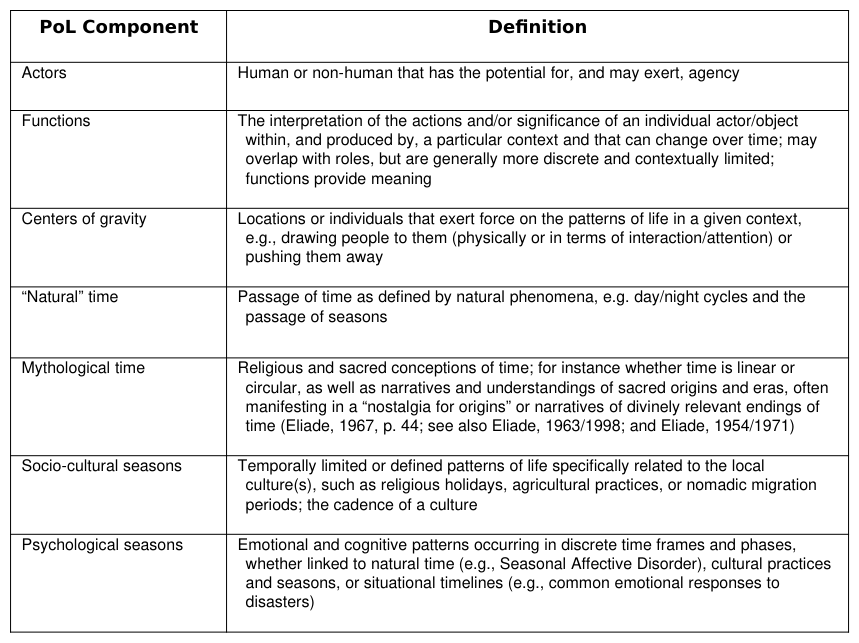
Due to the variety of potential practices, situational contexts, and cultural groups that liaisons or advisors might encounter, we define PoL through an assortment of high level components and contextual lenses that will facilitate sensemaking, rather than a rigidly defined checklist of items. Though this does not exhaustively encompass or describe all elements of interest to observers, and all elements may not be relevant (or equally weighted in relevance) in any given situation, PoL directs observers to examine several key factors: actors present in the situation, the functions served by those actors, the centers of gravity in the environment or situation, and various forms of time: natural time, mythological time, socio-cultural seasons, and psychological seasons (see Table 1 below for more information on these components).
Cross-Cultural Decision Making (2019)
Table 1: Major components of PoL PoL Component Definition
Observed elements of PoL do not have discrete meanings that transfer exactly from situation to situation, but must always be evaluated and interpreted in the local context. Relevant contexts may be cultural or situational, i.e., particular practices may be motivated by cultural values and traditions, or motivation and significance may stem from other requirements and frameworks, such as business contexts or economic factors. Due to the complexity of the human domain, certain component elements of PoL may also function as a framing context; for instance, a given socio-cultural season may bear its own practices and signifiers, but may also alter the way practices or functions that span outside of that time frame should be interpreted while in it. See Figure 1 below for an illustration of these overlapping component and contextual elements.
Cross-Cultural Decision Making (2019)
Figure 1. Components and basic structure of POL
Figure available in the original PDF paper.
The observation and interpretation of PoL is conducted via an iterative, reflexive, and reflective sensemaking process which we outline in the following section.
OUTLINING AN ETHNOGRAPHICALLY-INFORMED SENSEMAKING PROTOCOL (ESP) In order to construct an understanding and interpretation of the Patterns of Life within a given community or organization, individuals must engage in sensemaking. To provide actionable direction on how this sensemaking should occur, we define an Ethnographically-informed Sensemaking Protocol (ESP). As complex systems behavior emerges from, and is dependent on, local information and contexts, this process should be conducted at the local level; in other words, to avoid the erroneous application of generalizations and ensure sensitivity to particular situational and practical impacts, as well as to accommodate the unique combination of ethnoscapes and cultural interactions within an environment, advisors and liaisons must augment broad cultural information and culture- general skills with a robust understanding of local PoL. It is these communities that aggregate up to develop large- scale emergent behaviors. Here again we emphasize the constant tension of complex systems between local and system-wide, between individual actors and larger Patterns of Life. Sensemakers can only operate locally, but they should maintain an awareness of the larger system and the framing contexts it and other systems may impose. Ethnography works within this structure, focusing on a deep understanding of the local environment but with an eye directed toward larger systems. As Schensul et al. (1999) explain, “all ethnography is local…[it] builds local theory--theories that explain events, beliefs, and behavior in the special site an ethnographer is studying” (p. 7); these understandings feed up into, and exist within, “a broader socioeconomic and political context” that is “essential in order to situate local experience and cultural observations” (p. 5).
Liaisons or advisors who need to perform cultural sensemaking on the ground must operate within limited time and space boundaries. Traditional models of ethnography, in which a researcher would live within a community for several years, are not feasible. Therefore, ESP has drawn from Rapid Assessment Processes and quick applied ethnographic methods that present a short-term, intensive, iterative process (see Beebe, 2001; Handwerker, 2001; Cross-Cultural Decision Making (2019)
Murchison, 2010). Operating at the local level and observing local actors (i.e., in a particular village or organization) with recourse to region or nation-wide information as a larger context facilitates this tight focus and quick implementation. We also focus on tools and best practices from rapid, applied ethnography such as embedded participant observation, because they enhances and refines the liaison/advisor’s deep knowledge and therefore facilitate better recommendations and decision making for locally effective and sustainable capacity building.
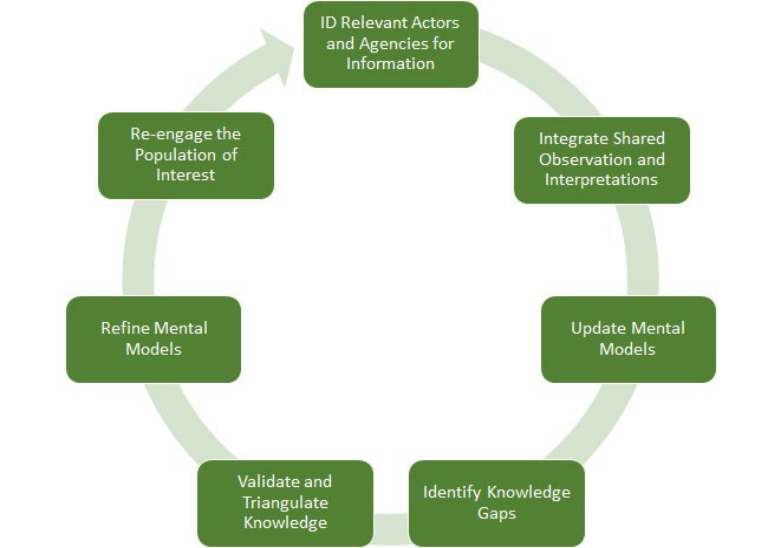
ESP works on two levels: a long-term, high-level process and a per-encounter process. At the top level, individuals conduct an ongoing, iterative cycle of integration, interpretation, and mental model production/refinement that may continue over extended periods of time, for instance over the course of a liaison or advisor’s entire term in the host nation. Sensemakers implement a cognitive cycle (see Figure 2 below) in which they identify relevant actors and/or agencies as sources for information; take their experiences and interpretations from a particular encounter, and share and collectively interpret the knowledge gained with partners and stakeholders as needed; update and refine their mental models based on new input (whether gained directly through the encounter or indirectly through others); identify knowledge gaps to ascertain where particular inquiry or further observation may be needed; and re-engage with the population of interest. Sensemakers should also regularly engage in validating and triangulating their knowledge by various means, for instance gathering additional information using ethnographic interview protocols (open-ended, semi-structured) to check their own observations and interpretations, or to verify data gained from other individuals and/or agencies.
Figure 2. The iterative top-level ESP cycle
We focus here on this overarching iterative process. ESP does feature a secondary level, per-encounter integrated process of observation and interpretation that facilitates establishing local baselines. For reasons of relevance to our case study and length limitations of the current paper, we will provide further detail on this second level in future publications.
CASE STUDY: INEFFECTIVE KEY LEADER ENGAGEMENTS This case study, drawn from the primary author’s work as an embedded social scientist with Regional Command Cross-Cultural Decision Making (2019)
East Afghanistan Provincial Reconstruction Team (PRT) efforts (see Rohde, 2007), illustrates the shortcomings of using the broad application of a fixed concept of culture when identifying stakeholders and conducting Key Leader Engagements. It also demonstrates the negative impact of ignoring the characteristics and contexts of the local community, as well as the need for a holistic reading of Patterns of Life within that local community context. The events of this case study occurred prior to our work on ESP, but involved use of a precursor to the current protocol which incorporates many similar components and rests on the same fundamental theoretical and procedural basis. We have reframed the discussion here to fit with POL and ESP-relevant terminology, but have not altered the events, observations, or interpretations.
As part of the Coalition’s strategic policy of winning Afghan “hearts and minds” (Department of the Army, 2009) the PRT had been negotiating terms with local tribal elders to provide a mobile medical clinic, in the hopes of gaining village support for local development and aid efforts. The village was part of a spike in insurgent activity, and the PRT hoped that providing essential services and winning local support would reduce the violence. PRT personnel received regional cultural training on identifying traditional tribal leaders based on cultural markers (e.g., clothing and age) with whom to negotiate and gain approval for aid and development, which they followed. When villagers directed the PRT personnel to key leaders, because these individuals fit the cultural profile provided, they assumed that these were in fact the appropriate, empowered stakeholders. These tribal elders arranged for the clinic to occur at an unfinished school construction site that they stated was central and easily accessible by foot, and that the PRT should prepare to treat men, women, and children. The primary author was assigned to accompany PRT personnel to the site in order to assess the effectiveness of the aid efforts in garnering local support and goodwill.
Prior to implementation of the clinic, the primary author performed an initial iteration of the ESP process and interviewed U.S. personnel who had been involved in the negotiations, including individuals from Civil Affairs and USAID. As part of the first step, identifying relevant actors and agencies, in addition to the local population such relevant individuals included U.S. personnel who had established a relationship with the villagers and had knowledge of village dynamics. These interviews demonstrated that U.S. personnel had used the fixed cultural models provided by pre-deployment training to identify key leaders with whom to negotiate, and that the village had been assessed merely at a broad level as an Afghan agricultural village. No attention had been directed to the local details of the economy and workforce. The primary author also conducted research through secondary sources about the area where the village was located, including requests for further information on the current socio-political situation in the hopes of pre-identifying centers of gravity that could be further observed during the event. Individuals and organizations, such as the Haqqani network, that had a potential ideological, economic, or political impact on the village were also identified in the hopes of understanding how they might affect the planned medical engagement. All of these component POL elements, whether environmental, political, economic, or security-based, had to be considered not only in isolation, but in how they interacted to develop a complex local system.
This pre-assessment, and the integrated observations and interpretations (high level ESP stage 2) that resulted, helped the primary author to prepare general research questions and key focus areas for detailed POL observation on the ground during the clinic event. Based upon this early synthesized mental model, the primary author identified a short list of guiding questions to help the PRT understand the results of the planned effort. The primary questions were: 1) whether the medical engagement was appropriate for the population; 2) was there a way to truly measure the results on the target population’s sentiments toward the U.S.; 3) if so, how could a successful engagement be sustained, or what other efforts could be done with the local population to sustain goodwill; and 4) if the clinic did not address the needs of the village, then why not?
Upon arriving at the site for the mobile medical clinic it became clear that the negotiations for aid had not gone according to PRT estimations. The crowd waiting at the site consisted entirely of men age 30 and older, who were well-dressed and appeared to be in good health; none of the expected women and children were present. Two cars arrived shortly, and the crowd quickly separated to let them discharge the occupants at the entrance to the school. A young Afghan man, approximately 23-25 years old and wearing a spotless salwar kameez, jumped from the lead vehicle to open the door for a frail elderly gentleman in the second vehicle. Neither of these men had been present in the earlier negotiations; the PRT team had no knowledge of who these men were or their function. The elderly man leaned heavily on the younger man’s arm and the pair slowly made their way to the front of the crowd. He was clearly a major center of gravity as the crowd, without any verbalized direction, approached the elderly man and in turn each embraced him and kissed his hand, then nodded to the younger man as they shuffled aside to let the next Cross-Cultural Decision Making (2019) man offer greetings and respect. The procession of healthy, middle aged men and the ritualistic show of respect to the elderly Afghan troubled the observing PRT medical team. Despite the chief medical officer’s request to one of the tribal elders to commence the clinic, he was instructed to wait until all those present had a chance to offer their respects; repeated requests to begin were rebuffed. With obvious impatience and a concern for security, the PRT medical team waited until all the men present had a chance to greet the elderly Afghan.
Once the last man paid his respects, the younger Afghan escorted the elderly man to the car, shut the door and stood aside as the two vehicles sped away from the site. The PRT medical team without hesitation quickly instructed the crowd to line up to receive services. The young Afghan man then made an astonishing transformation, moving from his earlier function as the elderly man’s quiet companion to the function of a very vocal man in charge, and the clear center of gravity. He firmly directed a cadre of men to organize the crowd and then went about ensuring all was in order. Two hours into the medical clinic it was readily apparent to PRT staff this was not a normal humanitarian project; the majority of men seen by the medical staff had no health complaints and instead asked for Viagra.
It was clear that the two unidentified men were of great importance from behavioral patterns; in addition, the tribal elders previously identified by PRT personnel were initially absent from the clinic, and upon arriving later showed deference to the two men. The position and function of these two men represented a knowledge gap in the previous research. Furthermore, the makeup of the crowd, their behavior, and the nature of the medical requests did not match expectations for a normal clinic operation. The mental model for the village and the aid situation was clearly incorrect, prompting the lead author to begin a second iteration of the ESP cycle, seeking new relevant actors to inform a revised mental model. Sources of information on these two men were needed, but had to be selected carefully to avoid misinformation or causing a conflict.
Observing PoL at the site, individuals needed to be identified that may have had a relationship with, and knowledge of, the two men but were accessible and less likely to provide misinformation or be resistant to speaking with the researcher. At the time of the event, children were perceived as neutral participants and could generally be trusted to provide honest information; moreover, unlike adult men or women, they were frequently easier to speak with because complicated procedures for introductions and security were not necessary. Though no children were present within the group of patients, there were some playing or observing near the site, all of whom were boys. In the area in which the village was located, it was normal to see children of both genders together in public, so the absence of girls was odd. It was discovered that females of all ages had been instructed to stay at home.
The primary author approached one of the children and asked casual questions about the village and his normal life (e.g. does he attend school and whether he is playing with school friends, and whether they are usually at this location during this time of day). Since sustained observation of general PoL within the village was not possible in the given time frame, this information had to be elicited from locals. The child mentioned that the women would normally be out in the fields working, but that his mother had been told to prepare dinner for unfamiliar guests. The primary author also asked about the two men, and the child responded that they were members of an important family. In deference to the children’s security, more detailed questions were not pursued. Other children were asked similar general questions in order to triangulate the initial response and hopefully establish an understanding of normal village PoL. Responses from other children nearby matched those of the initial child. As an extension, to triangulate and validate the emerging information, questions were also asked of some of the accessible adult male attendees in order to develop a more holistic view and compare their knowledge to that of the PRT. In total, over 30 people were interviewed on site. These interviews continued to identify knowledge gaps not only for the researcher but for the overall PRT, and repeatedly triangulate and validate gathered information.
The researcher reported these initial findings to the commanding officer. Agreeing that something was amiss, the PRT commander requested an interview with the young Afghan man, who agreed. The primary author conducted the interview with the aid of an interpreter, and quickly discovered that the young man was the actual power broker in the village rather than the group of tribal elders. He and his uncle had used the tribal elders with whom the PRT negotiated as proxies to set up the clinic. The young man revealed that he was responsible for the construction of the site at which the medical clinic was being held. He and his family held some traditional cultural authority, but he had augmented this with additional economic authority in response to the circumstances in the village. The war and insurgency had resulted in the loss of many of the community’s men, hampering the ability of the small agricultural community to maintain their output, and creating an additional financial and resource burden on the remaining men due to their duty to support the population of widows. Additional stress was placed on traditional agrarian Cross-Cultural Decision Making (2019) production due to instability of the area as a result of the war, as well as Haqqani network activity. The upsurge in violence was a result of the local men taking jobs to place IEDs or otherwise support the Haqqani network’s criminal activities simply in order to supplement their income and provide for their families.
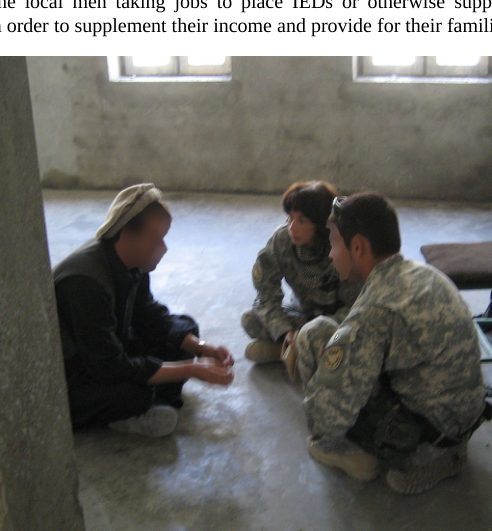
Figure 3. Interviewing the young Afghan man through an interpreter (faces have been blurred to protect the identity of the participants); his manner of sitting (see in contrast to the interpreter), along with other elements of his body language and behavior, initially suggested that he may have had significant exposure to Western culture.
The young Afghan man had studied in America, earned a degree in business, and returned to establish a contracting business in Kabul to win construction contracts from the U.S. The economic instability of the village allowed him to step in and obtain additional power beyond what would culturally be expected due to his ability to provide paying employment, while his uncle served as a figurehead to make the situation more palatable within the cultural context. The young man’s power, however, depended on the ability to earn contracts. Thus, while the PRT had negotiated with the apparent power brokers, this young man had arranged behind the scenes for the clinic to serve not as a local service, but instead as a display of the young man and his clan’s influence with the PRT. The medical clinic was a symbolic demonstration to the village and the traditional tribal hierarchy that his clan could bring money and development to the village.
The PRT’s previous mental model of the village and its context, based on a constrained understanding that emphasized culture without taking into account the impact of practical economic and political factors, treated the violence as ideologically motivated. The PRT did not grasp the dynamic relationship between the village’s traditional culture and present economic and population stressors, which facilitated the Haqqani network influence and shifted authority within the village. Thus we see that a holistic understanding of PoL, which incorporated not just culture but also these situational exigencies, developed at the local level for this particular village was necessary. In this case, the generalized strategy for “winning hearts and minds” was flawed because it did not meet this population’s local needs. A medical clinic, while potentially useful, did not ultimately address the present issue in the village, which was employment for the male population. As these sorts of local, tactical misallocation of efforts occur and accrue, they can result in a large scale strategic failure.
Having identified and filled in the relevant knowledge gaps, and updated the PRT’s organizational mental model, the PRT commander was then able to renegotiate with the actual power broker and establish a job development program with the young man’s contracting company to address immediately employment needs. During the course of the PRT’s term in the area, there was a decrease in violence, which may have been a result of this job program Cross-Cultural Decision Making (2019) stabilizing the economic situation. This decrease was a part of a 60-70% reduction in kinetic operations within the region as a result of the initial integration of social scientists into PRT operations (Role of the Social and Behavioral Sciences, 2008). Following this incident, the PRT was trained by the lead author in this rapid assessment technique. Later reports from this PRT showed that they were better able to conduct negotiations and partner with local populations in developing appropriate aid projects.
CONCLUSIONS
Advisors and liaisons involved in capacity building and stability operations in post-conflict or post-disaster environments face a large number of interconnecting cultural and situational challenges within a complex and evolving human domain. Pre-assignment cross-cultural training, whether culturally or regionally specific or generalized, cannot prepare advisors and liaisons for the full range of situations and people they will need to handle; they must be empowered to quickly but deeply assess the environment, the local status and functioning of the human domain, and identify appropriate stakeholders or influence points. Expanding from an overly rigid and too-broad idea of “culture” to a holistic model of complex Patterns of Life, and performing sensemaking through a methodology like our Ethnographically-informed Sensemaking Protocol can facilitate this flexibility for grasping and operating within complex systems. An understanding of the interrelationship between local factors and overarching contexts will also assist personnel in operating with an orientation toward both tactical and strategic levels. In the future, we hope to expand the current work on PoL and ESP to detail more visual observation-based processes, and work toward the construction of a full program of instruction that could be implemented across operational and subject-matter domains.
ACKNOWLEDGMENTS
This work is supported in part by the Office of Naval Research. The views and conclusions contained in this document are those of the authors and should not be interpreted as representing the official policies, either expressed or implied, of the Department of Defense or Office of Naval Research. The U.S. Government is authorized to reproduce and distribute reprints for Government purposes notwithstanding any copyright notation hereon. This work was supported, in part, by the Office of Naval Research project N00014-11-C-0193, Perceptual Training Systems and Tools (PercepTS).
REFERENCES
Abbe, A., & Halpin, S. M. (2010). The cultural imperative for professional military education and leader development. Appadurai, A. (1990). Disjuncture and difference in the global cultural economy. Public Culture, 2(2), 1–24.
doi:10.1215/08992363-2-2-1 Bhawuk, D., & Brislin, R. (2000). Cross-cultural training: A review. Applied Psychology, 49(1), 162–191. doi:10.1111/1464- 0597.00009 Byram, M., Nichols, A., & Stevens, D. (2001). Developing intercultural competence in practice. Multilingual Matters. Byrne, D. S., & Callaghan, G. (Eds.). (2014). Complexity theory and the social sciences: the state of the art. London: Routledge. Cilliers, P. (1998). Complexity and postmodernism: Understanding complex systems. New York: Routledge. Clifford, J., & Marcus, G. E. (Eds.). (1986). Writing culture: the poetics and politics of ethnography. Berkeley, CA: University of
California Press. Department of the Army. (2009). Tactics in counterinsurgency (Field Manual No. 3-24.2). Washington, DC: U.S. Government Printing Office. Retrieved from http://armypubs.army.mil/doctrine/DR_pubs/dr_a/pdf/fm3_24x2.pdf Earley, P. C., & Ang, S. (2003). Cultural intelligence: individual interactions across cultures. Stanford, Calif.: Stanford
University Press. Eliade, M. (1967). Myths, Dreams, and Mysteries: The Encounter Between Contemporary Faiths and Archaic Realities. (P.
Mairet, Trans.). New York: Harper & Row. Eliade, M. (1971). The myth of the eternal return, or, Cosmos and history. (W. R. Trask, Trans.). Princeton, N.J.: Princeton University Press. (Original work published 1954) Eliade, M. (1998). Myth and Reality. Prospect Heights, IL: Waveland Press. (Original work published 1963) Cross-Cultural Decision Making (2019)
Erez, M., & Earley, P. C. (1993). Culture, self-identity, and work. N.Y.: Oxford University Press. Garfinkel, A. (1987). The Slime Mold Dictyostelium as a Model of Self-Organization in Social Systems. In F. E. Yates, A.
Garfinkel, D. O. Walter, & G. B. Yates (Eds.), Self-Organizing Systems (pp. 181–213). Springer US. Retrieved from http://link.springer.com/chapter/10.1007/978-1-4613-0883-6_11 Gertsen, M. C. (1990). Intercultural competence and expatriates. International Journal of Human Resource Management, 1(3), 341–362. Knipper, M. (2013). Joining ethnography and history in cultural competence training. Culture, Medicine, and Psychiatry, 37(2),
373–384. doi:10.1007/s11013-013-9315-1 Leung, A. K. -y., Lee, S. -l., & Chiu, C. -y. (2013). Meta-knowledge of culture promotes cultural competence. Journal of Cross- Cultural Psychology, 44(6), 992–1006. doi:10.1177/0022022113493137 Littrell, L. N., Salas, E., Hess, K. P., Paley, M., & Riedel, S. (2006). Expatriate Preparation: A Critical Analysis of 25 Years of
Cross-Cultural Training Research. Human Resource Development Review, 5(3), 355–388. doi:10.1177/1534484306290106 McSweeney, B. (2002). Hofstede’s Model of National Cultural Differences and their consequences: A triumph of faith - a failure of analysis. Human Relations, 55(1), 89–118. doi:10.1177/0018726702551004 Mitchell, D. (1995). There’s no such thing as culture: Towards a reconceptualization of the idea of culture in geography.
Transactions of the Institute of British Geographers, 20(1), 102. doi:10.2307/622727 Osland, J. S., & Bird, A. (2000). Beyond sophisticated stereotyping: Cultural sensemaking in context. The Academy of Management Executive, 14(1), 65–77. doi:10.5465/AME.2000.2909840 Puck, J. F., Kittler, M. G., & Wright, C. (2008). Does it really work? Re-assessing the impact of pre-departure cross-cultural
training on expatriate adjustment. International Journal of Human Resource Management, 19(12), 2182–2197. doi:10.1080/09585190802479413 Queensland Health. (2010). Five cross cultural capabilities for non-clinical staff. Division of the Chief Health Officer, Queensland Health. Rasmussen, L. J., Sieck, W. R., Crandall, B. W., Simpkins, B. G., & Smith, J. L. (2011). Data collection and analysis for a cross-
cultural competence model (Final Report). Applied Research Associates, Inc. Retrieved from http://www.defenseculture.org/research/emergeresearchfiles/decisionsupportandmodeling/data_collection_analysis.pdf Role of the Social and Behavioral Sciences in National Security: Hearings before the Subcommittee on Terrorism & Unconventional Threats, of the House Armed Services Committee and the Subcommittee on Research and Education, of the House Science & Technology Committee, 110th Cong. (2008) (testimony of COL Martin P. Schweitzer). Retrieved from https://science.house.gov/hearing/subcommittee-research-and-science-education-hearing-role-social-and-behavioral- sciences Said, E. W. (1978). Orientalism. New York: Pantheon Books. Sands, R. G. (2012). Cultural relativism and the convergence of ethnography and 3C. Military Intelligence Professional Bulletin,
38(1), 13–20. Sieck, W. R., Smith, J. L., & Rasmussen, L. J. (2013). Metacognitive strategies for making sense of cross-cultural encounters.
Journal of Cross-Cultural Psychology, 44(6), 1007–1023. doi:10.1177/0022022113492890 Simpson, G. G., Gerard, R. W., Goodenough, W. H., & Inkeles, A. (1961). Comments on Cultural Evolution. Daedalus, 90(3), 514–533. Weick, K. E. (1995). Sensemaking in organizations. Thousand Oaks: Sage Publications. Zbylut, M. R., Metcalf, K. A., McGowan, B. D., Beemer, M., Vowels, C. L., & Brunner, J. M. (2008). An analysis of cross-
cultural behaviors for military advisors in the middle east. Proceedings of the 26th Army Science Conference, Orlando, FL, December 1-4, 2008
Cross-Cultural Decision Making (2019)
LISTED IN THE AHFE DIGITAL BOOKSTORE CATALOGUE
Explore the complete digital volume
Advances in Cross-Cultural Decision Making
Read this individual research paper free through the original publisher, or explore the full digital proceedings book.
ISBN 978-1-4951-2095-4
Explore this ISBN in the AHFE Bookstore ↗Listed in the July 2026 bookstore catalogue; search by ISBN to confirm current availability · Digital book purchase optional