Yoshitaka Maeda, Satoshi Suzuki, Akinori Komatsubara (2021). Analysing the Differences of Resilience Between Experts and Novices in Order to Increase Medical Safety and Quality. In: Advances in Human Aspects of Healthcare. AHFE Open Access, vol. 13. https://doi.org/10.54941/ahfe100530
In clinical sites, including hemodialysis, medical staff have to deal flexibly with fluctuations in the physical condition of patients or the progress of dialysis treatment in order to increase the safety and quality of medical services. It is often observed that experts can perform such actions, whereas novices cannot. A training program is needed to teach appropriate skills to novices in a short time. Therefore, it is necessary to clarify the components of experts’ behavior in order to develop such a training program. This study analyzed the differences between experts and novices in their performance during hemodialysis medical services. Subsequently, these differences were discussed from the viewpoint of resilience engineering. As a result, it was found that experts can anticipate the medical characteristics of patients and tasks (e.g., variability of each patient’s condition) and characteristics of patient satisfaction (e.g., contents of medical services that patients demand). Experts depend on their memories of previous treatments and apply them to today’s patient (even though the treatment conditions of the last time and today are different); however, this may lead to medical accidents.
Hemodialysis is a medical treatment in which moisture and waste matter, which are accumulated in the patients’ body due to renal failure, are removed by extracorporeal circulation of blood. Patients must receive dialysis treatments for approximately four hours, three times a week, at dialysis hospitals because the waste materials drained from their kidneys accumulates in their body unless renal function is improved. By December 2011, there were more than 310,000 dialysis patients in Japan (Tsubakihara, 2013).
In order to provide safe, high-quality medical services in a dialysis treatment, the medical staff have to perform very well because the physical condition of the patients and the progress of the dialysis treatment (such as the progress of circulating blood) are always changing. In other words, staff are expected to notice and deal with any abnormality of patients undergoing hemodialysis treatment to ensure good medical service (Ohtsubo et al., 2008). In many dialysis hospitals, the specific contents of the tasks that staff perform during treatment are prescribed medically. The order and the timing for performing those tasks, however, are entrusted to staff judgment, because they often fluctuate based on the physical condition of the patient or the progress of the dialysis treatment. It is said that experts can respond appropriately to fluctuations in the patient or treatment but novices cannot. Therefore, it is necessary to teach these skills to novices in a short time. Since experts generally obtain their knowledge through long-term experience, it is necessary to clarify the differences between experts and novices in how they undertake hemodialysis treatment and determine why the experts do it better in order to develop training programs. Therefore, for the sake of novice staff education, this study analyzed the differences between experts and novices in their performance during hemodialysis medical services. Then, the performances of the experts that increased the safety and quality of medical services were discussed from the viewpoint of resilience engineering.
METHODS
Design In the study of experts’ characteristics, the “relative approach” is the process of comparing experts to novices (Chi, 2006). One merit of this approach is that it is easy to use the experts’ characteristics for novice staff education because the skills novices lack are very evident (Takayama et al., 2011). Therefore, this study adopts a “relative approach,” and examines the performance of experts that improves medical services through an analysis of the performance differences between experts and novices.
Participants Three staff members with 1, 5, and 26 years of experience working at a Japanese university hospital participated in this study. In order to classify them into novices, intermediates, or experts, their years of experience with hemodialysis, the frequency of their advice to co-workers, and whether their skills were trusted by patients and doctors were considered.
In the hospital where the study was conducted, approximately 100 patients receive dialysis treatment in 52 beds per day. Staff use safety checklists before and at the middle stages of dialysis treatment. These checklists consist of three kinds of lists, which are used before the treatment, just after the beginning stage of treatment and the middle stage of treatment. In addition to these lists, there is a list for double check at the beginning stage of treatment. Each list consists of approximately ten items, which shows the tasks that staff should perform during treatment. Table 1 gives a sample of a safety checklist used at the hospital. In this way, the content of the tasks that staff should perform are medically prescribed. As for the order and the timing to perform the tasks, they are entrusted to the staffs’ judgment, because they often fluctuate by the physical condition of the patient or the progress of the dialysis treatment.
Table 1: An example of a safety checklist used at the hospital 1. Did you see the patient information on the monitor?
Table available in the original PDF paper.
2. Did you see the instructions/special memo on the monitor?
3. Is the setting of the anticoagulant appropriate?
4. Is the patient’s estimated ideal weight appropriate?
5. Is the setting of removal amount/ultrafiltration rate appropriate?
6. Is the setting of the substitution fluid circuit appropriate?
7. Does the setting of the blood flow rate change?
8. Is the circulating blood volume sufficient?
9. Is the taping of the centesis part safe?
10. Is the setting of the towel forceps/bed side guard appropriate?
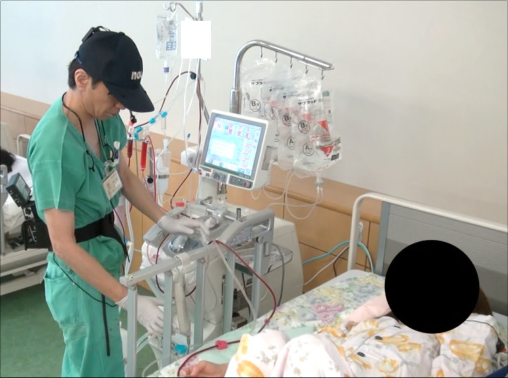
Procedure and Data Analysis In a dialysis treatment, medical staff can notice any abnormality in the physical condition of a patient or in the progress of dialysis treatment by obtaining visual information on various points, including the puncture point on the patient. In other words, visual information is important for staff to perform appropriately in hemodialysis. In order to analyze the differences between experts and novices, it is necessary to measure the contents of each task that each staff member accomplishes with an eye-tracking device. One example is the device used in the study on eye movement differences between experts and novices during laparoscopic surgery (Law et al, 2004). First, the three staff were attached with the EMR-9 eye-tracking system (NAC Image Technology, USA) and then they performed a series of tasks at the beginning stage of dialysis treatment (Fig. 2). These tasks include, for example, the setting of the treatment condition of the dialysis device, the assistance of puncture, a check of the physical condition of the patient, or the progress of the dialysis treatment just after the puncture. In other words, we tracked performance on a series of tasks during a critical stage of dialysis related to medical safety.
Second, with the images photographed by the eye-tracking device, the order in which they were performed by each of the staff was collected, and the data was analyzed based on a model used to describe a work process at a hospital (Shimono et al, 2011). This model is a form for analyzing work processes at the hospital and, thus, it covers characteristics of hospital work processes, such as fluctuations in the physical condition of patients. In this study, for example, the order of performance by each staff member, the resources that staff used in their performance, and the factors that caused the order and the timing to fluctuate in each of the tasks were described (Table 2).
Figure 1. Eye-tracking device worn by expert medical staff during hemodialysis medical service in the hospital.Table 2: The contents described in the analyzing of each staff member’s performance Actions The task performed by medical staff Time line The order of performance by each staff
RESULTS
Tasks both experts and novices can perform to increase the safety and quality of medical services Some tasks are not affected by fluctuations in the physical condition of patients or the progress of dialysis treatment, such as confirming whether the pharmaceutical products (e.g., dialyser) prepared for the patient are correct. There are no differences between experts and novices in their performance and both of them can perform to increase the safety and quality of the medical services. These tasks are easy to perform; for example, staff have only to compare the medicine name that is ordered by the doctor and the medicine name that is by the bedside of the patient. In other words, the techniques for these tasks are considered easy to teach by classroom lecture.
Tasks only experts can perform to increase the safety and quality of medical services In the tasks that were affected by fluctuations in the physical condition of the patients or the progress of dialysis treatment, such as confirming whether the circulating blood volume was sufficient or not, experts executed the task more often (the number of gaze times) than novices. In addition, experts adjusted the timing of task performance in order to notice and deal with any abnormality in the patients undergoing hemodialysis treatment. In these tasks, a method and a concrete criterion to notice the previously mentioned abnormality is affected by fluctuations of the physical condition of the patient or the progress of dialysis treatment. In other words, in order to develop a training program, it is necessary to clarify the reasons why experts can perform such behaviors which are very important for medical safety.
In the tasks that are able to be easily affected by the patients’ request, such as adjusting the height of the bed, the experts were able to comply with patients’ wishes without patients having to state their wishes. In addition, experts planned to accomplish tasks effectively and finish treatment earlier by correctly obtaining the progress and task performance of another staff member who worked with them. In this way, expert staff accomplished patient satisfaction better compared to novice staff. In these tasks, the criterion for patient satisfaction is affected by fluctuations of the patient’s wishes. In other words, it is necessary to identify why experts are able to perform such behaviors and then train novices in it.
Tasks that experts cannot perform to increase the safety and quality of medical services Experts tended to depend on their memory when performing tasks because they overvalue efficiency. For example, this hospital displays the safety checklist (Table 1) on the monitor of the dialysis device for preventing any omission of tasks. Whenever each task is completed, staff must input “check finished” into the device. However, experts completed all checks at once and they input “check finished” into the device in a mass entry afterwards because experts memorized the checklist’s contents. During this investigation, an expert forgot to carry out the task of “confirming the blood pressure of the patient.” The expert attached such great importance to work efficiency that it resulted in an omission of a task relevant to medical safety. It is necessary to teach novices not to perform such undesirable behaviors that could impact medical safety.
DISCUSSION
While this study clarified differences between experts and novices in their performance during hemodialysis medical services, there are also some similarities in the expert-novice contrasts in the cognitive work of emergency physicians. For example, expert emergency physicians can adjust task contents appropriately and also obtain the state of team members’ performance in proper timing while the physical condition of patients or the progress of treatment fluctuates every hour (Schubert et al, 2013). In other words, the differences that were clarified in this study do not result from only technical skills (e.g., a puncture skill), which have typically been a target of the novice staff education regarding hemodialysis (Kamata et al, 2012). The differences that were clarified in this study resulted from the differences between experts and novices in their cognitive skills, which are in the background of technical skills. Therefore, in this study, we discussed differences in cognitive skills between experts and novices, specifically from the viewpoint of resilience engineering.
Resilience engineering is an approach to human factors engineering proposed by a researcher named E. Hollnagel. For example, disturbances that may spoil medical safety (fluctuations in the physical condition of patients and fluctuations in the task content that staff should accomplish, which is caused by fluctuations in the physical condition of patients) always occur in hemodialysis clinical sites. In such clinical sites, staff should expect what kind of disturbances can appear (i.e., ANTICIPATING), monitor for disturbances that were previously expected (i.e., MONITORING), and respond to regular and irregular disturbances appropriately (i.e., RESPONDING). In addition, staff should look back on whether these actions were appropriate and learn in order to help during the next treatment (i.e., LEARNING) (Hollnagel, 2010). Such an approach is called resilience engineering, and the behaviors responding to the disturbance flexibility are called resilience behaviors or resilience skills.
In clinical sites, experts can perform resilience by noticing early signs of problems (Nemeth et al, 2008). Therefore, in this study, the performance of experts that increases safety and quality of medical services was discussed from the viewpoint of resilience engineering. In addition, it is thought that the experts’ desirable behaviors, responding to the disturbance flexibility, which was clarified in this study, is equivalent to RESPONDING in the four resilience skills. Therefore, what kind of ANTICIPATING, MONITORING, and LEARNING experts perform in order to perform desirable RESPONDING, and the shortcomings of experts’ Resilient Behaviors, which were clarified in this study, were discussed. In addition, the opinions of three participants and one expert staff (25 years of experience, working at a Japanese university hospital) were referred to in this discussion.
ANTICIPATING and MONITORING (Supports Experts’ Resilience Behavior) From the previously mentioned results, experts who performed resilience behaviors improved medical safety and increased patient satisfaction. Therefore, what kind of ANTICIPATING and MONITORING behaviors experts performed regarding each of these two purposes is discussed.
First, with regard to resilience behaviors for the purpose of medical safety, experts adjusted the contents and the timing of their task performance to notice easily fluctuations in the physical condition of patients or the progress of dialysis treatment. For this adjustment, it is thought that experts have to anticipate the medical characteristics of each patient. For example, the medical characteristics of each patient are the normal blood pressure level, the normal tendency of the change of venous pressure under treatment, and the physical deconditioning that they may be prone to have. In addition, it is thought that experts have to anticipate the medical characteristics of each task (e.g., whether the treatment conditions of the task are easily fluctuated on the treatment day). It is thought that experts use these anticipated characteristics for determining the criteria to notice previously mentioned abnormalities (e.g., circulating blood volume depletion), and then monitor the area selectively to notice the abnormality. This tendency is observed in experts in other clinical sites, as well. For example, expert emergency physicians anticipate potential problems or needs of the patient and team members before performing a task (Schubert et al, 2013). In other words, it is useful to anticipate the medical characteristics of each patient and each task when performing resilience behaviors to increase medical safety.
Second, as for resilience behaviors for increasing patient satisfaction, the expert was able to comply with the patient’s wishes without the patient stating them. In addition, they planned to accomplish tasks effectively and to finish treatment earlier by obtaining another staffs’ progress of task performance. For these behaviors, it is thought that experts have to anticipate the characteristics that influence the satisfaction of each patient. These include the contents of what each patient normally request, responses to requests that satisfy/dissatisfy each patient, ways to respond that reduce stress or tension in patients, and the characteristics of each patient’s communication (e.g., whether the patient talks to staff actively/ passively). In hemodialysis clinical sites, how staff understand the demands of each patient strongly influence patient satisfaction so it is effective for the improvement of patient satisfaction that the staff understands each patient and considers how to decrease the burden of their hemodialysis treatment (Sherriff-Tadano et al, 2003). In other words, it is thought that anticipating the characteristics that influence the satisfaction of each patient is useful for performing the resilience behavior that increases patient satisfaction.
LEARNING (Supports Experts’ Resilience Behavior) When experts perform a task, they remember “the situation that they experienced in the past that is similar to the current situation,” and compare the current task with the past situations (Randel et al, 1996). Therefore, it is thought that experts in hemodialysis learn the previously noted characteristics from success/failure experiences of MONITORING and RESPONDING in previous treatments (i.e., LEARNING). The next step then is to promote such LEARNING in novice staff education. As for medical novice staff, however, learning may be inhibited because novices rely on help even when the case is not so difficult or complex (Ross et al, 2014). This tendency in novice staff cannot be avoided when considering medical safety, but it is necessary for experts to consider how to avoid inhibiting the LEARNING of novices. For example, when experts help novices, they let novices think about how to respond by oneself.
Shortcomings of Experts’ Resilience Behavior From the previously mentioned results, experts tended to depend on their memory when they performed a task because they overvalued efficiency. In other words, it is thought that experts depended on the memory of MONITORING and RESPONDING in previous treatments. For example, although the patient’s physical condition and current treatment is different from the previous treatment, there is the possibility that the experts set the same treatment condition as the previous treatment in the current treatment, because they based their memory of the situation on what they experienced in the past. Such undesirable bias is one of the shortcomings of experts in the field of medical care in particular (Chi, 2006). For example, expert staff in cardiology perform cardiology-type treatments even if the case is an infectious disease, because they base their memory of past situations on cardiology (Hashem et al, 2003). In other words, to neglect MONITORING of the current treatment and to treat only based on the memory of the previous treatment is equal to NEGATIVE resilience behavior; as a result, it may lead to medical accidents.
Summary Through these four components, from ANTICIPATING to LEARNING, experts can perform resiliently in their effective procedures with their technical skills (e.g., blood circuit connection) and non-technical skills (e.g., appropriate communication) with patients. Novices should be assessed for these four components and skills training programs should be developed to strengthen resilient skills.
On the other hand, during novice staff education, it is necessary to instruct novices not to perform experts’ undesirable resilience behaviors. The rule must be established, “when you perform the task, you shouldn’t depend on only MONITORING/RESPONDING from the previous treatment and you shouldn’t neglect MONITORING of the current treatment.”
CONCLUSIONS
This study analyzed the differences between experts and novices in their performances during hemodialysis medical services. Subsequently, the actions of experts that increased the safety and quality of medical services were discussed from the viewpoint of resilience engineering. As a result, there were three differences noted between experts and novices.
・ First, there are tasks which both experts and novices can perform to increase the safety and quality of medical services. These tasks are easy to perform because they are not affected by fluctuations in the physical condition of patients or the progress of dialysis treatment. In other words, the techniques for these tasks are thought to be able to be taught easily by classroom lecture.
・ Second, there are tasks that only experts can perform to increase the safety and quality of medical services. These tasks are easily affected by fluctuations in the physical condition of patients or the progress of dialysis treatment, but experts appropriately respond to such fluctuations because they anticipate the medical characteristics of each patient and task (e.g., variability of each patient’s condition) and the characteristics of patient satisfaction (e.g., content of medical services that patients demand). It is necessary to clarify the detailed components of the appropriate resilient skills and to develop training programs so that novices, who are lacking in these skills, can be taught in a short amount of time.
・ Lastly, there are tasks that experts cannot perform to increase the safety and quality of medical services. In these tasks, experts are apt to depend on the memories they have of previous treatments. Such behavior may occasionally trigger some kind of human error and experts sometimes skip a necessary task. To increase medical safety and quality, it is necessary to consider the aforementioned experts’ inappropriate behavior.
These results are expected to be useful for developing training programs that can supply novices with appropriate resilient skills in a short time.
REFERENCES
Chi, M. T. (2006). Two approaches to the study of experts’ characteristics. In K. A. Ericsson et al. (Eds.), The Cambridge handbook of expertise and expert performance (pp. 21-30). Cambridge: Cambridge University Press. Hashem, A., Chi, M. T., & Friedman, C. P. (2003). Medical errors as a result of specialization. Journal of biomedical
informatics, 36(1), 61-69. Hollnagel, E. (2010). Prologue: the scope of resilience engineering. In E. Hollnagel et al. (Eds.), Resilience engineering in practice: a guidebook (pp.3-8). London: Ashgate. Kamata, T., Ochiai, M., Fujisawa, N., Kadoya, Y., Tomita, M., & Okamura, M. (2012). Simulation program for ultrasound-
guided central venous access procedural training. Nihon Toseki Igakkai Zasshi, 45(11), 1027-1033. Law, B., Atkins, M. S., Kirkpatrick, A. E., & Lomax, A. J. (2004). Eye gaze patterns differentiate novice and experts in a virtual laparoscopic surgery training environment. In Proceedings of the 2004 symposium on Eye tracking research & applications ACM, 41-48. Nemeth, C., Wears, R., Woods, D., Hollnagel, E., & Cook, R. (2008). Minding the gaps: creating resilience in health care.
Advances in patient safety: new directions and alternative approaches, 3, 1-13. Ohtsubo, M., Togashi, T., & Hagiwara, C. (Eds.). (2008). Tohseki Shugi Anzen Zissen Manyuaru (Safety practice manual of dialysis skill). Osaka: Medicus Shuppan. Randel, J. M., Pugh, H. L., & Reed, S. K. (1996). Differences in expert and novice situation awareness in naturalistic decision
making. International Journal of Human-Computer Studies, 45(5), 579-597. Ross, A. J., Anderson, J. E., Kodate, N., Thompson, K., Cox, A., & Malik, R. (2014). Inpatient diabetes care: complexity, resilience and quality of care. Cognition, Technology & Work, 16(1), 91-102. Schubert, C. C., Denmark, T. K., Crandall, B., Grome, A., & Pappas, J. (2013). Characterizing novice-expert differences in
macrocognition: an exploratory study of cognitive work in the emergency department. Annals of emergency medicine, 61(1), 96-109. Sherriff-Tadano, R., & Ohta, A. (2003). Factors that Influence Psychological Adjustment to Haemodialysis. Journal of Japan Academy of Nursing Science, 23(1), 1-13. Shimono, R., Tsuru, S., & Iizuka, Y. (2011). A model for describing work process at hospitals. Journal of the Japanese Society
for Quality Control, 41(2), 69-80. Takayama, C., & Ohno, T. (2011). Information gathering process of troubleshooters: How the experts get it done. IPSJ SIG technical reports, 142(12), 1-8. Tsubakihara, Y et al. (2013). Overview of regular dialysis treatment in Japan (as of 31 December 2011). Therapeutic Apheresis
and Dialysis, 17(6), 567-611.
LISTED IN THE AHFE DIGITAL BOOKSTORE CATALOGUE
Explore the complete digital volume
Advances in Human Aspects of Healthcare
Read this individual research paper free through the original publisher, or explore the full digital proceedings book.
ISBN 978-1-4951-2093-0
Explore this ISBN in the AHFE Bookstore ↗Listed in the July 2026 bookstore catalogue; search by ISBN to confirm current availability · Digital book purchase optional