Luca Rizzi, Ubaldo Spina, Cinzia Dinardo, Vincenzo Dimiccoli (2021). Medical Device for Patient Immobilization and Repositioning During Proton Therapy Treatment. In: Advances in Human Aspects of Healthcare. AHFE Open Access, vol. 13. https://doi.org/10.54941/ahfe100506
Proton therapy is a type of particle therapy which uses a beam of protons to irradiate diseased tissue, protons accelerated by a cyclotron (or synchrotron) are concentrated on the neoplastic tissue with highest precision.Results of proton therapy are actually considered better than those from conventional radiotherapy, chemotherapy and surgery, concerning the elimination of the neoplasm and thanks to lower incidence of possible side effects. To get the best benefit from this treatment, it is very important to irradiate, the same point, with the same intensity during each treatment session. This objective could be quite complex to be achieved and for that reason the design of such device was carried out through a complex anthropometric and usability analysis.ITEL Telecomunicazioni develop a new Bed Positioning System for proton therapy thanks to which it is possible to obtain, in addition to the immobilization, a perfect repeatability of the position assumed by the patient during treatment. Particular attention has been paid to patient positioning procedures, developed to be as quick as possible by the use of a restraint devices connected directly to the table. Ergonomic study and platform design, developed with CETMA collaboration, allows its use by a wide range of different users.
To get the best benefit from Proton Therapy treatment, it is very important to irradiate, the same point, with the same intensity during each treatment session. For this reason it becomes very important to replicate each time the exact position of the patient. This objective could be quite complex to be achieved in a short time by health professionals. The project idea starts from needs of both consumers, patient and health care professional, with the aim of creating a device that can allow the best exposure of the organ to be treated in the best conditions of comfort for the patient and health staff during the positioning procedure. For that reason the design of such device was carried out through a complex anthropometric and usability analysis.
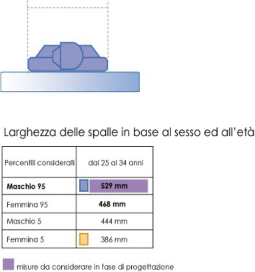
BED DIMENSIONING AND ANTHROPOMETRIC SPECIFICATION Main dimensions of bed platform are based on a deep analysis of scenarios of use considering both the operator and the patient and the way they approach to this device. We paid particular attention to human’s segments dimension, while lying in supine position, considering differences of percentiles, gender and age.
Those data were obtained through user analysis considering type of treatment to be performed and type of user that will interact with the system. Two main types of users were identified: adult males between the ages of 25 and 34 years and adult females aged always between 25 and 34 years old. For those typical user we considered 4 different percentiles able to identify the larger number of dimensions (height, width and depth), in order to ensure greater comfort to the highest possible number of people.
In the following tables we reassume the results of analysis (DIN 33402-2, 2005 and Panero, 1979)
Figure 1. Bed Dimensioning: height, width and depth (DIN 33402 and Panero)
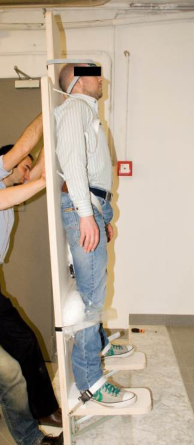
CRITICAL PATIENT POSITIONS DURING TREATMENT Analyzing treatment protocol procedures we identify some critical issues for vertical patient positioning (Figure 2). In this position the patient could eventually lose his initial position causing irradiation of different target from the planned one.
Figure 2. Patient treatment in vertical position
Figure available in the original PDF paper.
Humans while standing tends to change position and balance between legs, for that reason this platform requires a plurality of fixing points to secure the patient relative to the bed, in a fixed position during all treatment session.
User can move both forward and laterally, left and right side, thus is important to fix all body segments form head to each ankle.
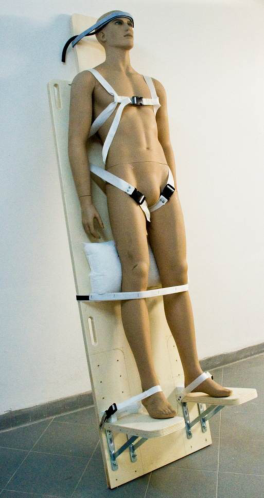
Figure 3. Wook mock-up and harness system
Designed constrain doesn’t hold patient’s weight but avoid user movement and body segments displacement. To avoid the sensation to be suspended in the air we design a footboard support on which patient can easily stand.
The restraint system design was based on a study of commercial harness, this system, due to its flexibility, allow wide range use and fine adjustment. Bundle fixed loops were designed on man and women percentiles. Footboard range of motion was defined considering minimum shoulder height of 5° percentile women and maximum shoulder height of 95° percentile man (1260 mm and 1550 mm).
Patients are positioned on the bed using their shoulder as reference point. Patient’s shoulder should be aligned on the top of the bed and footboard will be positioned in contact with feet using available range of motion of about 290mm. Harness loops are fixed on the board considering segments dimension of 5°, 50° and 95° percentile of both genders.
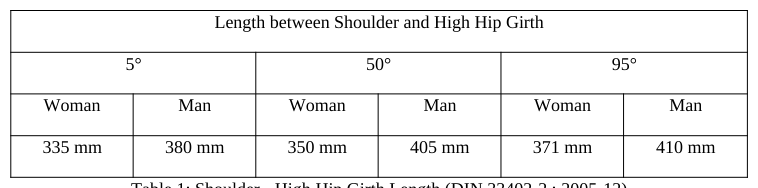
Bundle fixed loops of thoracic area are inserted seeing hip belt position and considering following parameters for man and woman:
Table 1: Shoulder - High Hip Girth Length (DIN 33402-2 : 2005-12)
The distance between the two bundle is about 360 mm according to the 50° percentile woman and are positioned in the middle point between the excursion that covers a distance from the shoulders from 320mm to 400mm.
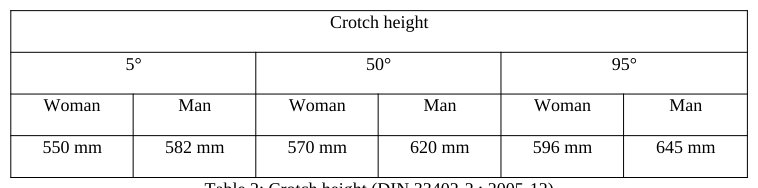
Following values were used for the harness of lumbar area: Crotch height
Table 2: Crotch height (DIN 33402-2 : 2005-12)
The harness is also fixed to the board in two different crotch position. The first point is positioned at 550 mm form shoulder point and the second at 645 mm from shoulder. Those points were chosen to fit different patient height.
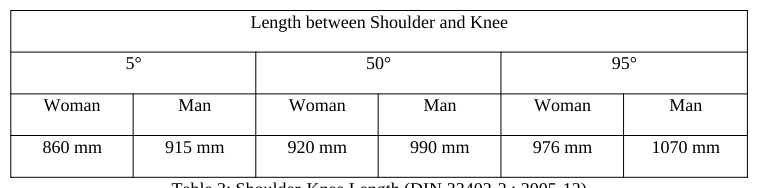
Following values were used to design the fixing of knee and leg: Length between Shoulder and Knee
Table 3: Shoulder-Knee Length (DIN 33402-2 : 2005-12)
This bundle is positioned at the average value of 960 mm of distance from the shoulders. The band can adjusted into two different holes to cover an height of about 120mm.
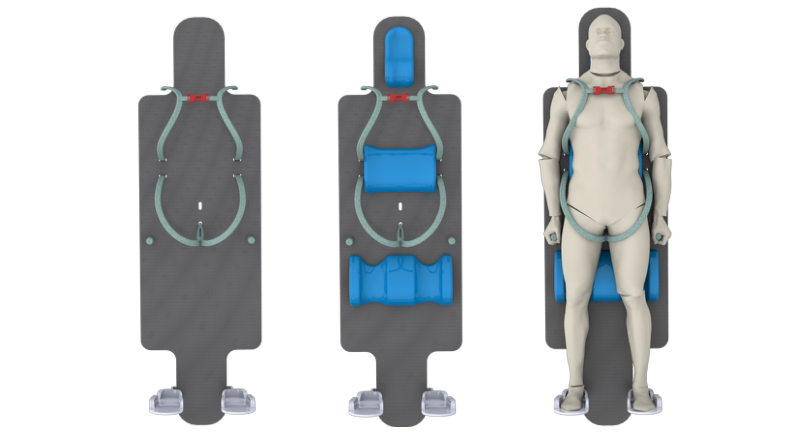
Human spine can be treated as a long-chain mobile, to be sure that this remains motionless during scanning and treatment, we must provide constant contact of the back. For this reason some shims, like pillows, were inserted in spaces naturally created between the curves of the spine and flat board.
PROCEDURE DESIGN FOR PATIENT PREPARATION AND POSITIONING To ensure ease of use and effectiveness of the system we analyzed different ways of positioning and wearing of this system. Users of this device, patients and health workers, will perform different tasks to provide a secure and fast fixing, this procedure has been deeply analyzed to simplify each necessary task.
Each step of the procedure were analyzed and each task were considered for its complexity and for its relation with all others tasks. Execution time of each task was register and also possible human error where highlighted.
This allowed the team to estimate needed time for patient positioning by health care worker and to evaluate simplicity of the entire procedure.
Design process has been developed in several steps including testing phases with the aim to validate system usability, from interaction point of view, by patient, and regarding procedures of use carried by health care professionals. Usability tests were performed on a mock-up of Proton Therapy Bed made of plywood. The evaluations were performed by CETMA and ITEL researchers using a panel of users selected into company personnel.
Patient preparation Patient preparation procedure will be performed trough the following steps:
a) First of all, the patient will change dresses and will wear clothes more suitable for the treatment, in particular thin, comfortable and without metal parts. Tracksuit and a pair of socks are perhaps the most suitable clothing; b) Bed platform is in horizontal position and patient will be asked to lie down on it. Platform will be positioned at operator height, 80 cm from ground, and patient will use a small ladder to facilitate the ascent (for practical reasons the laboratory test was performed with the bed positioned at 10 cm from the ground) ; c) Two operators, from opposite sides of the bed, will proceed with positioning procedure and help patient while wearing the harness.
Positioning Procedure Designed positioning procedure is fully described in the following paragraph, this procedure is the result of the analysis developed on the device.
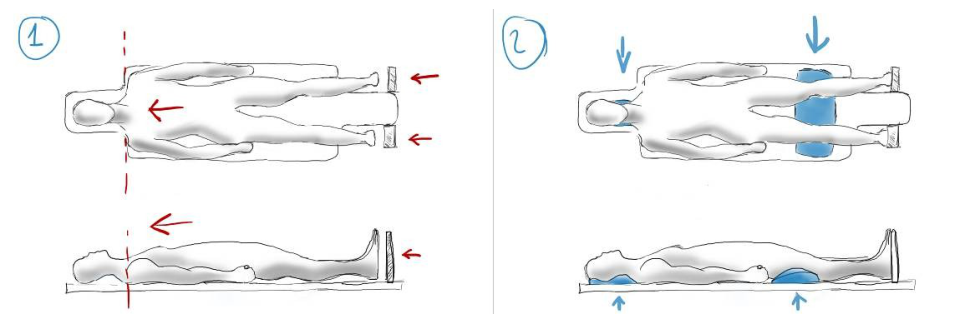
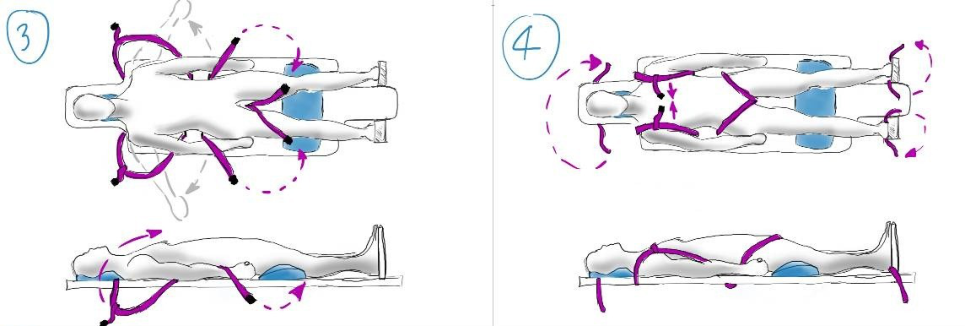
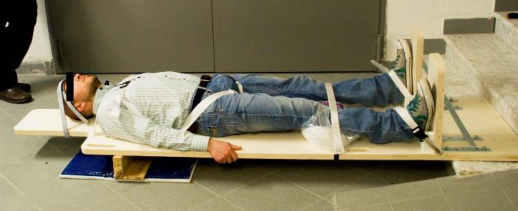
Figure 4. Patient Positioning Two skilled health care professionals will follow the entire procedure a. Patient, lying on the bed, will be moved with shoulders in contact with top reference support; b. Some pillows are placed under the patient's anatomical curves, we can not exclude the use of vacuum cushions. In particular, a pillow is placed under knees;
c. Footboard are then positioned in contact with patient's feet. Patient must be free of shoes and both feet are then separately secured with bands.
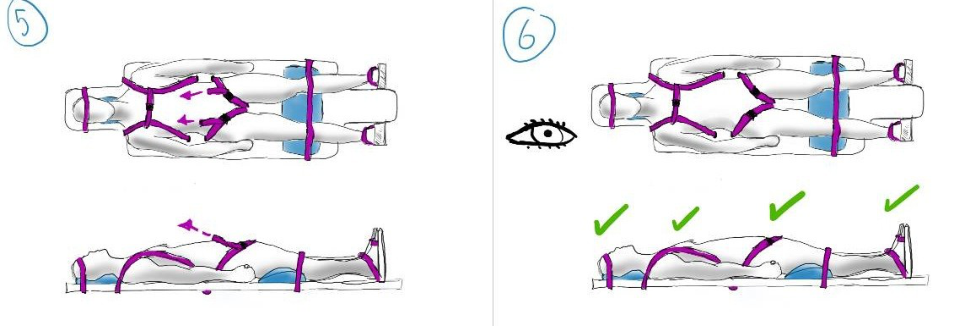
Figure 5. Harness Wearing d. Patient will put his arms into harness shoulders strap, chest clip, which combines shoulders, is then fixed. For female patients it is preferable to position the chest clip as higher as possible to avoid breast
compressions during harness tensioning; e. Bundles terminals, available near patient crotch are taken by operators, each for his side of competence. Crotch terminal, if in high or low position, are selected as function of patient stature. It’s important that the engagement point of this terminals is always behind the patient, thus a suspension of the basin in vertical position is always guaranteed;
f. Terminals available for patient's hips, are fixed with groin terminals and operators will proceed with a preliminary adjustment of bands;
Figure 6. Harness check and tensioning g. Band to lock the knee joint is positioned just below the articulation and locked in tension; h. The entire harness can be tensioned as much as possible, compatibly with sensations reported by the patient; i. When patient immobilization is completed, the platform can be moved. Before proceeding with the handling a second check should be performed inverting operator’s positions.
The following figure shows the rendering of the table with the harness system, the anatomical pillows to fill the concavity and anatomical curves, and the patient fully harnessed.
Figure 7. Rendering of treatment bed with virtual manikin
USABILITY TEST
Only critical treatment’s positions that may cause some patient’s movement were carried out during test execution.
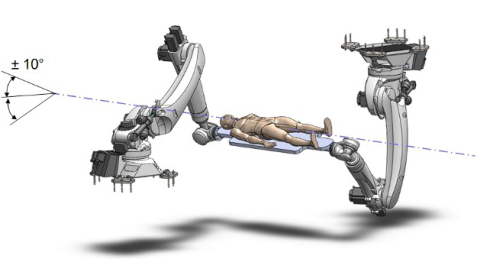
Platform is moved in limit positions of antitrendelemburg (vertical position), and in lateral tilt (inclination on the left of 10° approx.). Users sensation were monitored in both positions while an evaluation team register any macro movements of patient body.
Figure 8. Critical Positions Bed movement is achieved manually with two operators.Figure 9. Patient harnessFigure 10. Vertical and lateral position
During test, the evaluation team has also performed the think-aloud, usability analysis method, which is used to more accurately understand user feelings during test course. The think-aloud requires user to comments out loud what he's doing, sensations arising during the interaction with the object and what are his impressions and experience. A member of evaluation team record each information.
The purpose of think-aloud testing is to fully bring out the mental model that user have while performing set of tasks and use those information to improve designed task in terms of sequence and scope. It was also performed a final evaluation form asking users to evaluate each test performed. Questions concern general device perception, its use, simplicity or difficulty in performing tasks and movements.
CONCLUSIONS
On the whole the system seemed quite comfortable and easy to use.
Platform setup procedure, particularly footboard positioning was quite long because operators has to disassemble and reassemble 8 screws, and took an average of four minutes when performed by two operators. The procedure for fixing the harness results faster and usually in only 2 minutes patient was ready to be moved. The system for the harness wearing was easy enough to use and bands tensioning could be performed efficiently. The insert, pillow like, positioned behind knee joints was very useful to maintain leg position.
ACKNOWLEDGMENTS
Patient immobilization system is a project of ITEL Telecomunicazioni S.r.l., platform design and handling systems are patented.
REFERENCES
DIN 33402-2 (2005-12) “Ergonomics - Human body dimensions - Part 2: Values”, DIN Deutsches Institut für Normung e.V. Panero J., Zelnik M. (1979) “Human Dimension and Interior Space: A Source Book of Design Reference Standards”, Watson- Guptill Pubns Ed. Urlich Karl T., Eppinger Steven D., Filippini R. (2/ed 2007), “Progettazione e sviluppo di prodotto”, McGraw-Hill Editore.
LISTED IN THE AHFE DIGITAL BOOKSTORE CATALOGUE
Explore the complete digital volume
Advances in Human Aspects of Healthcare
Read this individual research paper free through the original publisher, or explore the full digital proceedings book.
ISBN 978-1-4951-2093-0
Explore this ISBN in the AHFE Bookstore ↗Listed in the July 2026 bookstore catalogue; search by ISBN to confirm current availability · Digital book purchase optional