Elly M. Waaijer, Hanneke J.J. Knibbe (2021). A 5-Category Classification System for the Design and Planning of Healthcare Facilities. In: Advances in Human Aspects of Healthcare. AHFE Open Access, vol. 13. https://doi.org/10.54941/ahfe100505
In order to implement programs to prevent back pain in caregivers, assessment of the degree of passivity and mobility of patients is imperative. After all, the load in health care ergonomics is often the patient. The degree of cooperation or resistance determines the load on the back for the caregivers and the necessity of the use of lifting devices like patient lifters or sliding sheets. It also has its impact on the choice of equipment to carry out daily hygienic care. These assessments must be done in both a practical and a reliable way. One of the major problems encountered in health care during the process of implementing ergonomic changes is the lack of space. There is often not enough space to work with larger equipment like patient lifters and shower chairs or other medical devices necessary in a preventive program. This leads to undesirable extra physical load for caregivers. The Mobility Gallery, a validated 5-category classification system, is now used to define in a structured manner the existing and future population of a healthcare facility and supports the planning and space design. Based on the assessment of mobility levels, the equipment needed can be defined. All transfers and care activities are shown in a bird’s eye view image and are translated into functional areas. This tools will encourage architects to build in the future in such a way that one of the corner stones of a safe patient handling program, sufficient space, is guaranteed.
Occupational back pain among caregivers still leads to high costs for health care facilities and personal suffering for caregivers (Hignett 2003, Knibbe 2008). In order to reduce this problem a national approach was undertaken in the Netherlands by means of so-called convenants. In each health care sector agreements supported by signed commitment by all relevant parties led to the development of guidelines for practice and considerable support for the implementation process. As one of the first steps in this process, healthcare organisations in the Netherlands have developed guidelines for each patient handling activity, which stipulate a ban of manually lifting passive patients in excess of 25 kg, strict application of ergonomic devices, and specified work techniques during patient washing and wound care.
In order to implement this, the assessment of the degree of passivity and mobility of patients is a core element of the approach. This must be done in both a practical and a reliable way. For this purpose a 3-category and a 5-category system to assess the degree of patient mobility and passivity was developed. The 3- and 5 category mobility levels were visualised with symbols
The required use of specific ergonomic devices during patient handling activities is based on the assessment of the functional mobility of the patients. At first three mobility categories were distinguished;
Figure 1. Symbols Til (Lift) Thermometer, Arbocatalogus
Figure available in the original PDF paper.
1. Patients who are independent or need a little bit of help due to insecurity
2. Patients who are unable to take care of themselves and need help from caregivers
3. Patients who are completely dependent of the caregivers
For transferring a patient, a stand and raising lifter is compulsory for a patient in the second category and a full weight bearing, or so-called passive lifter is necessary for a patient in the third category. An electric height adjustable bed is required when a patient is being washed or dressed on the bed and an adjustable shower chair is required when a patient is showered in sitting position for a patient both in the second and third category. For repositioning patients within the bed, an electrical adjustable bed and slide sheet or overhead pole is compulsory for a patient in the second as well as the third category. A compression stocking slide should always be used for putting on and taking off compression stockings of a patient, independent of the mobility category of the patient.
In the course of the implementation process the demand for a further specification of the mobility categories was apparent. Therefore a 5-category system was developed based on the ICF-2 and ergonomic requirements. Its content was 100% correlated to the 3-category system that was in use initially. The differences between the two systems (3 and 5 categories) are mainly related to issues of quality of care. For example the need for an ergonomic device can be similar, but the need of activating the patient is specified in the 5-category system, whereas it is not in the 3- category system.
Figure 2. Symbols from The booklet about aids for caregivers (Knibbe 2006)
Figure available in the original PDF paper.
An international validation study in four countries (UK, USA, Germany and The Netherlands) has shown the validity of both classification systems (Knibbe 2012). The 5-category system has advantages in defining ergonomic devices and the need of activating patients.
A similar 5-category system, the Mobility Gallery, is used in the Care Thermometer (Knibbe 2012). This validated self-assessment instrument, categorises the mobility level of all patients, considers caregiver exposure to physical overload and makes appropriate equipment recommendations for the delivery of safe patient care. It also concludes on elements of quality of care.
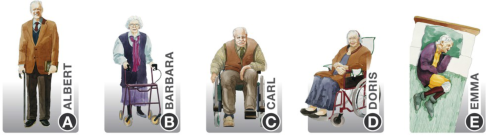
Figure 3. Elderly care images from the Mobility Gallery (Knibbe 2008)
The Mobility Gallery is more than merely a classification system. It offers colourful images of the five levels of mobility for elderly care, acute care and special care. By visualising the characters, the Mobility Gallery becomes an important interdisciplinary communication tool, making it possible to discuss choices in care and rehabilitation in a realistic way. (Knibbe 2008) It also has the advantage of classification and standardisation. A special gallery is made for the bariatric (plus-size) patients, since this group needs extra attention when it comes to care planning and additional space to carry out the care processes.
Figure 4. Images of the bariatric Mobility Gallery (Knibbe 2008)
Figure available in the original PDF paper.
The Mobility Gallery also is used as a tool to determine the appropriate equipment for the care process and the mobilisation of patients. It is particularly important to select a technique and or equipment that continuously stimulates and encourages the patient to use all residual physical function and to stretch their ability whenever possible and desirable. Grids are developed to show the equipment to be used, i.e. for transfers Albert and Barbara can transfer independently, while Carl uses a stand and raising aid. Doris and Emma are transferred with a sling lifter. The same method can be used for the appropriate shower equipment, transport units, ambulation and bathing options.
HEALTH DESIGN PROCESS Ergonomic considerations are critical during the design process to minimise the potential for employee injury. The ergonomist is an important stakeholder who should be included in all phases of the design process, review all construction documents, and participate in the evaluation of the design features in mock-up simulations. Nurse leaders must be diligent in ensuring that ergonomic features are included in the design to provide optimal patient and provider outcomes after the facility is constructed. (Stichler 2011)
In a health design process the Mobility Gallery can be supportive to understand and discuss the future target group of patients for a ward, or an entire healthcare facility. Based on the expected mobility level per ward, the appropriate type and number of equipment can be defined. Algorithms are formulated for the number of equipment needed for the daily care of the patient per ward (Battevi 2006, CEN/ISO TR 12296-2013).
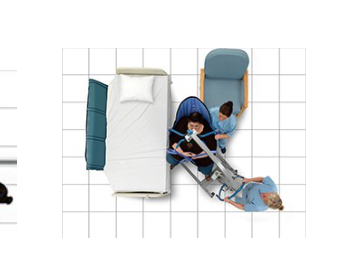
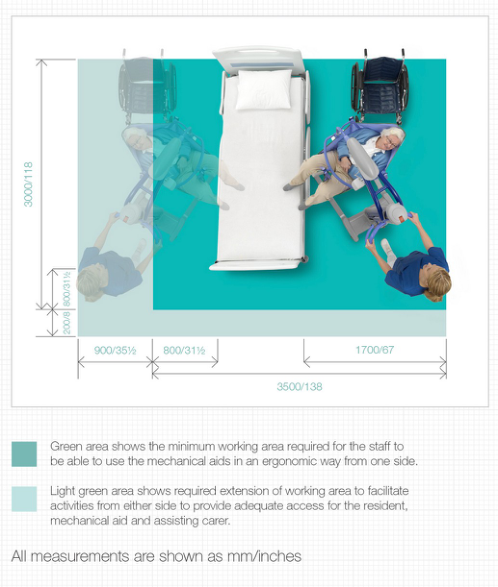
With the known mobility levels and the equipment in place, the storage areas and space requirements for all care activities can be defined and can be used as a first step in the health design process. Based on bird eye’s view images and research about the space requirements per activity round the bed, at the toilet and in the shower and bathing area a database is build with the minimal space required to carry out the mobilisation and care activities in the described areas. (Waaijer 2014). These are developed both for the average size patient as for the plus size patients enabling architects and planners to design an ergonomic health care environment.
Figure 5. Examples of the bird eye’s view images (Waaijer 2014)Figure 5. Example of space requirements (Waaijer 2014)
CONCLUSIONS
The described tools and methods can be supportive for the design of general care environments. Space requirement studies in special areas, such a critical care areas are not yet performed in detail, but need to be. Future research can contribute to define space requirements for these areas and can be beneficial in reducing physical overload for caregivers and improving quality of care.
REFERENCES
Arbocatalogus: http://www.arbocatalogusvvt.nl/public/file/Tilthermometer Battevi, N., Menoni, O., Ricci, M.G., Cairoli, S. (2006), MAPO index for risk assessment of patient manual handling in hospital wards: a validation study. Ergonomics, 49, 7: 671-687 CEN/ISO TR 12296-2013 Ergonomics – Manual Handling of People in the Healthcare sector (ISO/TR 12296:2012 Stichler, J.F., Feiler, J.L (2011), Ergonomics in healthcare Facility Design, Part 1, Health Facility Design, Jona, Vol 41, 2, 49-51 Hignett, S., Crumpton, E., Ruszala, S., Alexander, P., Fray, M., Fletcher, B. (2003). Evidence based patient handling: systematic
review. Nursing Standard, 17 (33), 33-36 Jansen, J., Morgenstern H., Burdorf, A. (2004). Dose-response relations between occupational exposures to physical and psychosocial factors and the risk of low back pain. Occupational Environmental Medicine, 61(12): 972–979. Knibbe J.J., Knibbe N.E. (2006), The booklet about aids for caregivers, LOCOmotion Knibbe J.J., Waaijer E.M. (2008), Mobility Gallery, ArjoHuntleigh Knibbe, J.J., Knibbe, N.E., Geuze, L. (2008), Een hap uit een gegroeide olifant, vierde nationale monitoring fysieke belasting,
SOV&V, Den Haag (in Dutch). Fourth National Monitoring, Unions & Employers organizations, The Hague. Knibbe J.J., Knibbe N.E., Waaijer E.M. (2012), Assessments of patients with a 5-category or a 3-category practical classification system: validity and practicality, Work 41 5655-5656 Knibbe J.J., Knibbe, N.E. (2012), An international validation study of the Care Thermometer, a tool Supporting the quality of ergonomic
policies in health care, Work 41 5639-5641 Stichler, J.F., Feiler, J.L., (2011) Ergonomics in healthcare Facility Design, Part 1, Health Facility Design, Jona, Vol 41, 2, 49-51 Waaijer E.M., Guthknecht T., Muir M. (2014), Guidebook for Architects and Planners, functional design for mobilisation and ergonomics, ArjoHuntleigh.
LISTED IN THE AHFE DIGITAL BOOKSTORE CATALOGUE
Explore the complete digital volume
Advances in Human Aspects of Healthcare
Read this individual research paper free through the original publisher, or explore the full digital proceedings book.
ISBN 978-1-4951-2093-0
Explore this ISBN in the AHFE Bookstore ↗Listed in the July 2026 bookstore catalogue; search by ISBN to confirm current availability · Digital book purchase optional