Michal Pelczarski (2018). Ultralight Exoskeleton Walking System for Heavy Loaded Users. In: Advances in Human Factors and Sustainable Infrastructure. AHFE Open Access, vol. 3. https://doi.org/10.54941/ahfe100116
It is known that because of the vertical position of the human body, there are few serious imperfections in the musculoskeletal structure. These critical defects, combine with elongated life time, results in the mass sicknesses and disorders. Proposed in the article system, can greatly reduce that imperfections, by giving the right dynamic support for the natural musculoskeletal system. Additionally, the ultralight exoskeleton walking system, absorbs the energy during the movement of the strongest groups of muscles, and gives it beck, supporting weaker groups of the muscles. The ultralight exoskeleton walking system, combines of two subsystems: pneumatic (or not) top independent exoskeleton and attached to it walking exoskeleton system. Top one saves the human spine structures. The second one save the human knees. Both of them reduce the muscles fatigue.
The article is about searching for the new supporting systems for the man of the future. Elongation of the man life, ageing societies and wrong life models shows the great needs for such ideas, structures and prototypes. This article will talk about existing products and the prototypes, made mostly by the wetly and highly advanced companies. After that, author’s proposition will be presented. To understand the way of human evolution, and its movement abilities, the cheetah, during the run was analyzed (Ackermann), (Bochenek and Reicher), (Horst), (Paluch, Kuliński and Michalski, 2005), (Poplewski, 1947).
.
Figure 1. Running cheetah photos, allows to search the way of mammal movements. The top and the bottom photo, shows that the legs and arms muscles belonging to that extremely elegant creature, are prepared to heavy work, in a direction, shown by the red (large arrows). Blue (smaller arrows) shows, the moment, when the arms and legs, are getting back to the work position, with no external loading. These movements requires, less stronger groups of muscles. That disproportion means, that these large groups of muscles (responsible for the movement in red arrows direction) may additionally, work for accumulation of the energy. This energy may be used to support work of less stronger groups of
Figure available in the original PDF paper.
muscles (responsible for the movement in blue arrow direction). (The photo was adapted from: http://www.youtube.com/watch?v=yAnRURDEyGY, 2014)
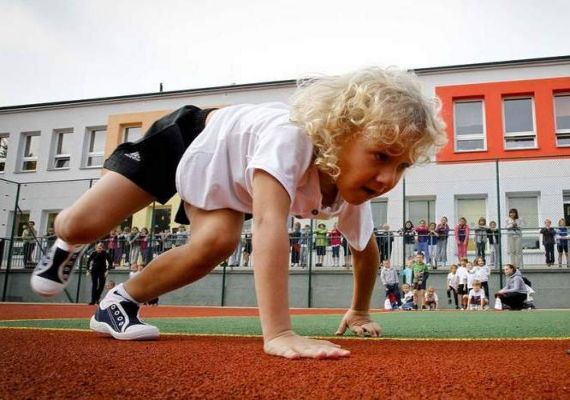
Figure 2. "Running on the knees" child, behaves very similar to the cheetah, although less elegant and with minimum speed, but the type of movement is the same. White arrows show the main action directions. Left hand and right leg are ready to get back in the cycle, moving to the starting position. (The photo was adapted from: http://niezatapialna-armada.blogspot.com/2012/06/177-klata-jak-upirata-czyli-zaginione.html, 2014)
EXISTING PRODUCTS AND PROTOTYPES OF WALKING SYSTEMS All selected below examples, shows the strong need, for the creation of the new walking support systems. Two examples are made by Honda Company, one by the Askawa Company and third by Wacoal Sports Science Corp. Interestingly, all three companies are probably from the Japan. Generally Honda company, has created three types of human supporting systems, but two of them (shown at Figure 4 )seems to be the most attractive, comparing to their price. Quite interesting are the shorts shown at (Figure 5). As the producer of Men's Running Tights & Shorts explains: “These shorts are packed with technologies like the patented kinesiology support webbing. This targets key stress zones including your lower back, lower abdominals, hamstrings and quadriceps. This technology mirrors the results of kinesiology taping techniques applied to muscles by sports medicine professionals. User will get improved biomechanics, throughout his workout from the exoskeleton support system, provided by this technology. Muscles and joints will get the full advantage. The benefits are: - Channeling power for efficient muscle movement, - Enhancing stability and balance, - Maximizing muscular stamina, - Minimizing muscle oscillation,
- Superior shock resistance. For increased circulation and less fatigue, user can rely on the variable compression. User get the optimal efficiency from you movements, keeping your muscles and legs energized over a longer period of time.”
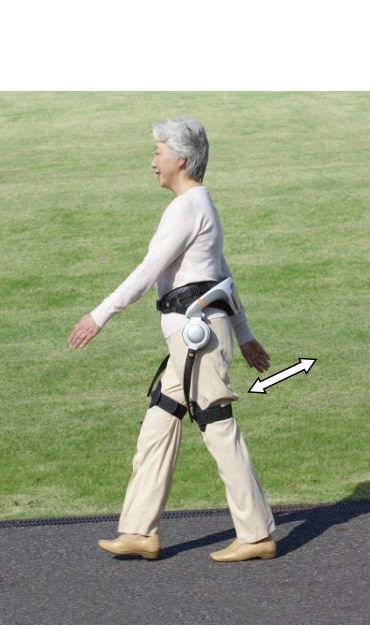
Figure 3. "Walk Assist" system, build by Honda. The system helps to rotate the legs around the hip joint. System is attached to the user body by the "belly" belt and tight straps. The belt must be quite stable to transfer the horizontal reactions. (The photo was adapted from: http://www.gizmag.com/honda-leasing-walking-assist-device-exoskeleton/27681/pictures#19, 2014)Figure 4. "Bodyweight Support" system, second of the Honda's company product, which proves that civilization problem becomes more and more important. Actually the user seats at the system which expands between the top of the boots and the users crotch. Supporting force is shown by the shorter arrow. Forces are transmitted to the ground by metatarsal, as it is shown by the longer arrow. (The photo was adapted from: http://www.gizmag.com/honda-leasing-walking-assist-device-exoskeleton/ 27681/pictures#33, 2014)
Figure available in the original PDF paper.
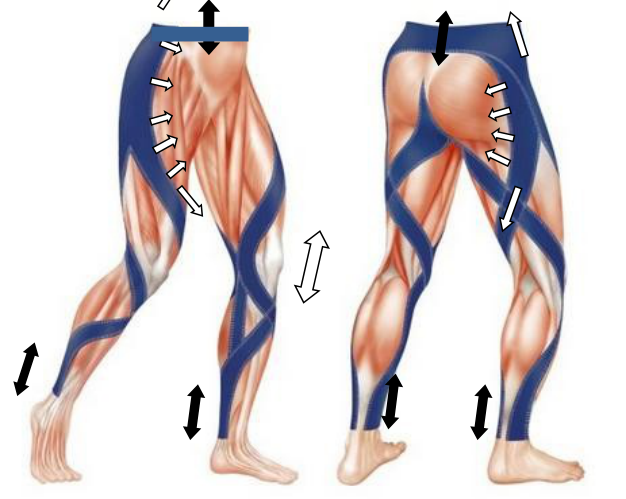
Figure 5. The drawing shows the existing on a market system called CW-X Support Web, made by Men's Running Tights & Shorts. The product looks very attractive, but may have a few disadvantages. Because the ties are not straight, so during the stretching they will change their shape to less curved, that creates orthogonal tensioning, shown by the white arrows. That geometry leads to a high level of deformations, what needs a strong anchor system. As it is shown by the black arrows, there are no anchorage system around the heel or the ankle, so there is a great chance to los the internal forces acting at the system. (The photo was adapted from: http://www.slashsport.com/shop/product/cw-xpro-mens-supportive-performance-running-shorts-black, 2014)
G G
Figure 6. The drawing shows the other existing system, made by Yaskawa corporation, supporting the human walking abilities, called "Ankle assist". As the producer explains: "when the motor located close to the ankle, turns the foot up, the knee bends automatically". So this system provokes the knee bending, by foot rotating, and all works because of the muscle "G". (The photo was adapted from: http://www.youtube.com/watch?v=MVJ7NvCGZOU, 2014)
Figure available in the original PDF paper.
THE AUTHORS PROTOTYPE OF THE NEW WALKING SYSTEM PRESENTATION Below schemes and photos shows the main structural idea of the system (Figure 7). Existing prototype is shown at (Figure 8 and Figure 9). Design of the final system will be changed later during further research. In the near future, static and biomechanical analyses are planned. Real tension forces will be found thanks to four tensnometer’s. When all tie forces, will be known, the biomechanical models will be calculated, to assess the level of the user muscles fatigue wearing the system, and without it.
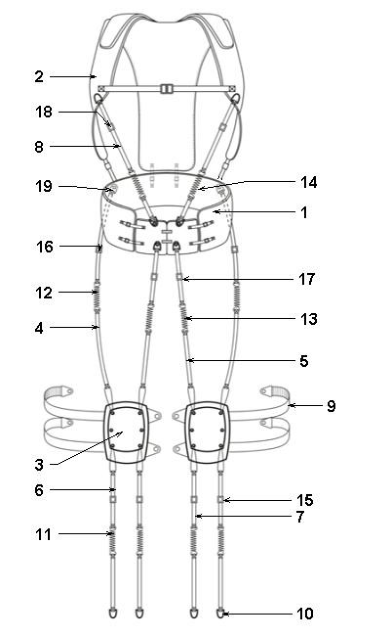
Figure 7. The scheme view of the systems structure. (1)- “belly” belt,(2)- top exoskeleton body,(3)- knee pads,(4) and (5) - top straps, (6) and (7) - bottom straps, (8)- chest straps , (9)- knee pads straps, (10)- anchor point of bottom straps, (11)- bottom straps spring, (12) and (13)- top strap springs, (14)-
chest straps spring, (15)- bottom straps length regulation, (16) and (17)- top straps length regulation, (18)- chest strap regulation, (19)- top strap anchor point. (Author, graphic made by: Pavlo Prokoptsiv)
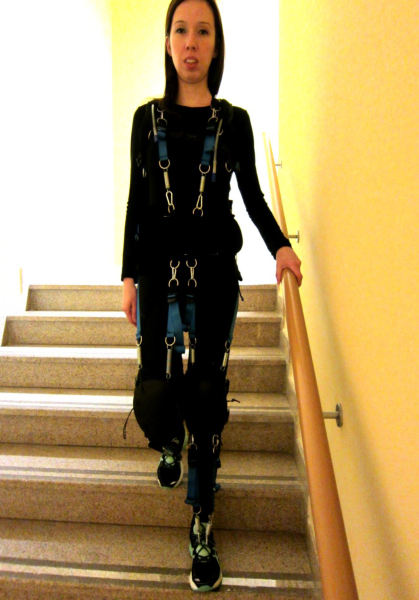
Figure 8. View on the walking system prototype. High springs elongation is visible, at the top straps of the right leg. It is visible that the muscles works is supported by the system. (Tester and demonstrator:
K. Machala)
Figure 9. Photo shows that the system reacts also very well, during left or right sight legs movements.
Because of that, during the mountain running, that system is able to absorb most of the dynamic shocks, acting on a legs and all the body. These abilities can also be used during the work with patients with paralyzed mobility. (Tester and demonstrator: K. Machala)
RESEARCHING THE NEW WALKING SYSTEM During the authors tests, made while climbing up the stairs or walking on a highly inclined slops, it was visible that foot position was very important, for increasing the supporting knee forces. Actually, it is possible to fall beck on, the foot, at the system, during “getting back” movement, shown by the smaller (blue) arrows (Figure 1). Obviously that supporting knee force, will produce reactions at the bearing areas no. 2 and no. 10 (Figure 7). These forces will increase the compression of users body, but it last very short amount of time, and additionally, the top part of the exoskeleton body, has a large contact area, what minimize the pressure, acting on the users body and the shine bone is very well prepared to withstand the high compression. Knee pad, functioning as the top and bottom ties connector, and also as a ties deviator. Additionally the high of the knee pad is a very important factor, because it creates the lever arm for the ties forces, which in medicine is called as insertion angel. Interestingly, the tie “A” length instead of tie “B” length, wasn’t changing during all “straight” legs movements . So finally it is the “B” tie, which produces the elongations, and creates the forces at the system, (during the typical straight movements). The tie “A” works than, as the important transmitter of the forces from the knee pad to the bearing point no. 19 (Figure 7). Because of the springs no. 12, 13, 14 (Figure 7) the system has the possibility to accumulate the energy during the movement, without high deformation constrains. It is extremely important that system has to be very elastic and at the same time able to keep constant force during body deformation and tie elongation. Analyzing the movement sequences, it can be seen that the supporting system pushes the knee joint (from inclined to the straight position) and also attracts the hip forward. Moreover tie “A” becomes very important, during adduction and abduction legs movements, as it is shown at (Figure 9 ). During lifting very heavy loads user should incline his foots from 0 deg. to 45 deg. And that will activate the tie “A” system, increase the stability, and resultant supporting knee force generated by the system.
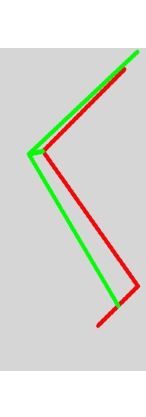
Figure 10. The schemes show how the ties „B” elongate during walking up the stairs. Black ( or red) lines, models the human legs, and the gray (or green) lines models the tie “A” and “B”, which are the part of the walking system. Length of the tie B left = 422 units (measured at the left leg), comparing with the neutral position, when the legs are straight, and the distance B0 = 427 units, gives the change in distance (elongation ε) around -1%. Length of the tie B right = 491 units (measured at the right leg) , comparing with B0=427, gives the change in distance around 15%. (The human model was adapted from: http://www.youtube.com/watch?v=_NooLwSRm8E, 2014)
Figure available in the original PDF paper.
Figure 11. The schemes, show how ties "B", elongate during walking up the stairs. Black (or red) lines, models the human legs, and the gray (or green) lines models the tie “A” and “B”, which are the parts of the walking system. Length of the tie B left = 448 units (measured at the left leg), compared with neutral position length "B0", gives the "ε” around 15%. Length of the tie B middle = 487 units (measured at the left leg), compared with the neutral position, gives the "ε” around 14%. Length of the tie B right =
456 units (measured at the left leg), compared with neutral position, gives the "ε” around 7%. (The
human model was adapted from: http://www.youtube.com/watch?v=_NooLwSRm8E, 2014)
Figure 12. The schemes shows how ties "B" elongates during walking down the stairs. Black (red) lines, models the human legs, and the gray (green) lines models the tie “A” and “B”, which are the part of the walking system. Length of B left = 445 units, compared with neutral position, gives the "ε" around
Figure available in the original PDF paper.
4%. And length of B right = 466 units, so comparing with neutral position, gives the "ε" around 9%. Assuming that B length is 40 cm and taking in to account the elongation "ε" =5%, it means that ΔL = 2 cm. Assuming that "B" length is 40 cm and taking in to account the elongation ε =15%, it means that ΔL = 6 cm. Knowing the spring characteristic, it can be predicted that force “F” (Figure 9) will range
between 2.4 to 6 kG. (tester and demonstrator: K. Machala)
F knee pad
A
Equation reproduced from the original PDF.
F
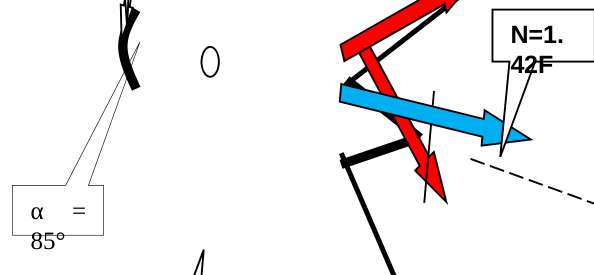
Figure 13. Above scheme, shows the model of the resultant force “N” acting on the knee. Assuming that the knee pad may move up or down along the knee, so the knee pad is modelled as the rotational deviator. In case the max, 15% tendon “B” elongation (Fig. 8. right scheme) when the angle, between tendon “A” and “B” may be around 84°, it can be calculated that the action "N", may be around 8.5 kG. So that is quite impressive that the knee joint, may be pressed from inclined, to the straight position, by such height force.
Figure available in the original PDF paper.
CONCLUSIONS
The proposed above prototype of the ultralight exoskeleton system is being tested now by the author and it is visible, that the new system is very helpfully, during a long time climbing, or running on highly tilted surfaces - especially when the user is carrying heavy loadings. During the mountain running, new system is able to protect the user’s body from the high dynamic shocks. It was also tested, that the system can be used during long marches. Wearing the system, changes slightly the motoric of movements but even the inexperienced user will be able to learn it in less than 20 min. This is, because the system, do not have any motors and electronics equipment, so the user, can feel, exactly how can he improve the support of the system. Instead heavy loaded mountain users, the system can be also used during the rehabilitation processes and for the patients with movement difficulties.
REFERENCES
Ackermann W. P.: „Chiropraktyka ukierunkowana, diagnoza i techniki”, Ackermann Institutet. Bochenek A., Reicher M.: „Anatomia człowieka”, Wydawnictwo Lekarskie PZWL, T.1. Horst W.: „Obciążenia układu ruchu, przyczyny i skutki”, Oficyna Wydawnicza Politechniki wrocławskiej. Paluch R., Kuliński M., Michalski R. (2005): „Obciążenia układu ruchu, przyczyny i skutki”, PAN, Komitet Ergonomii, Wrocław. Poplewski R. (1947):„Anatomia ssaków”, Spółdzielnia Wydawnicza Czytelnik, T2.
LISTED IN THE AHFE DIGITAL BOOKSTORE CATALOGUE
Explore the complete digital volume
Advances in Human Factors and Sustainable Infrastructure
Read this individual research paper free through the original publisher, or explore the full digital proceedings book.
ISBN 978-1-4951-2092-3
Explore this ISBN in the AHFE Bookstore ↗Listed in the July 2026 bookstore catalogue; search by ISBN to confirm current availability · Digital book purchase optional