Bárbara Saraiva, Nuno Belino, Rui Miguel, João Carvalho, Annabel Fernandes (2026). Eco-Dyeing of Wool-Blend Fabrics with a Natural Lac Dye: Comparison of Dyeing Processes and Treatment–Reuse of Dyeing Wastewater. In: Human Systems Engineering and Design (IHSED2026): Future Trends and Applications. AHFE Open Access, vol. 237, pp. 523–533. https://doi.org/10.54941/ahfe1008192
Sustainable textile production requires ecoengineering solutions that integrate natural colorants, process optimization, and circular water management. In this work, wool-blend fabrics (45% wool/55% polyester) were dyed with a lac-based natural dye using exhaustion, pad-dry, and pad-batch processes, aiming to support ecodesign strategies for lower-impact textile products. Dyeing performance was assessed through colorimetric analysis and color fastness tests. Among the tested routes, exhaustion dyeing provided the best overall balance between color development and fastness properties. The wastewater generated during the exhaustion process was subsequently treated by electrochemical oxidation using a boron-doped diamond anode, as an ecoengineering approach for effluent reclamation and reuse. The treatment reduced the organic load and color of the eco-dyeing wastewater, improving its suitability for partial replacement of fresh water in new dyeing cycles. Reuse assays carried out with a 50:50 mixture of treated effluent and fresh water produced fabrics with only a slight color difference compared with those dyed with fresh water, while maintaining comparable color strength and very good washing and rubbing fastness. These results demonstrate the feasibility of combining natural dyeing, advanced electrochemical treatment, and wastewater reuse as an ecodesign-oriented strategy for circular and more sustainable wool-blend textile processing.
The textile industry has a substantial environmental footprint, driven by greenhouse gas emissions, intensive water and energy consumption, and the discharge of pollutants into water, soil, and air. Its predominantly linear production model accelerates resource depletion and poses risks to ecosystems
Received June 12, 2026 Revised June 27, 2026 Accepted July 10, 2026 Available online September 25, 2026
and human health (Ellen MacArthur Foundation, 2017). Within the textile manufacturing chain, pre-treatment, dyeing, and finishing are among the most resource- and energy-intensive stages, requiring large water and energy inputs and generating wastewater rich in dyes and auxiliary chemicals, which may be persistent, highly colored, and harmful to the environment and human health (Dutta et al., 2024).
To reduce the environmental impact of textile wet processing, dyeing technologies have evolved towards water-saving processes and the reduced use of hazardous chemicals. Exhaustion dyeing remains widely used in industry, but it is not fully optimized for natural dyes, since incomplete dye uptake generates contaminated residual baths and the process requires substantial water and energy for heating (Pizzicato et al., 2023). Padding- based technologies have therefore gained attention because they can improve dye utilization and reduce water consumption, particularly for dyes with low fiber affinity. In these processes, dye uptake occurs at lower liquor ratios than in exhaustion dyeing, with fixation achieved by drying, curing, or batch holding (Mongkholrattanasit et al., 2015).
In parallel, natural dyes have regained scientific and industrial interest as sustainable alternatives to synthetic colorants. Obtained from renewable biological or mineral sources, they can reduce chemical dependence and support the demand for non-toxic and eco-friendly textile products, particularly those made from natural fibers (Pizzicato et al., 2023).
Despite their environmental appeal, natural dyes still present technical limitations, including low fiber affinity, poor fastness to washing, light, and perspiration, and difficulties in shade reproducibility (Dey et al., 2025). These issues are especially relevant in wool-blend fabrics, where consistent coloration depends strongly on the dyeing route. Moreover, auxiliary agents used to improve fixation and uniformity may increase the organic load of the effluent and reduce its biodegradability, meaning that wastewater from natural dyeing may still require treatment before discharge or reuse (Saraiva et al., 2025a; Handayani et al., 2018). Thus, effective treatment and reuse strategies are essential to support the industrial viability of natural dyes within eco-design and eco-engineering approaches.
Among textile wastewater treatment technologies, electrochemical oxidation (EO) has gained attention due to its ability to degrade recalcitrant organic compounds without chemical addition or sludge generation, while enabling the reuse of treated dyeing baths in new dyeing processes (Orts et al., 2019; Brillas et al., 2015). Boron-doped diamond (BDD) anodes are particularly suitable for this purpose because of their high chemical, electrochemical, and structural stability, allowing operation at high potentials where most organic pollutants can be oxidized (Saraiva et al., 2025a; Pinto et al., 2022). In this context, this study compares different eco-dyeing processes for wool-blend fabrics using a lac-based natural dye and evaluates EO treatment and reuse of the resulting wastewater as an eco-design and eco-engineering strategy for more sustainable textile production.
MATERIALS AND METHODS
Eco-Dyeing Processes The eco-dyeing experiments were carried out at laboratory scale using a wool-blend fabric (45% wool/55% polyester) supplied by FITECOM, S.A. and characterized elsewhere (Saraiva et al., 2025b). The fabric was dyed with a lac-based natural violet dye extracted from Kerria lacca (Bishal et al., 2023), purchased from Aquitex, S.A. together with the auxiliary products used in the eco-dyeing processes. According to the supplier, the dye is compatible with batch, continuous, exhaustion, and conventional printing processes.
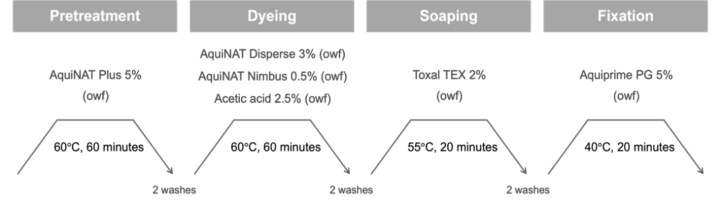
In the exhaustion dyeing experiments, the process was conducted on a weight-of-fiber (owf) basis in sealed stainless-steel minireactors using a Mathis Labomat BFA-12 apparatus. A fabric-to-bath ratio of 1:20 was used, corresponding to 10 g of fabric and 200 mL of bath per minireactor. The sequence included pretreatment, dyeing, soaping, rinsing/washing, and fixation steps, using the auxiliary products and operating conditions shown in Figure 1. At the end of each stage, the corresponding eco-dyeing wastewater (EDW) was collected and combined for subsequent EO treatment.
For the impregnation processes, namely pad-dry and pad-batch, the same product concentrations used in the exhaustion tests were applied. Pretreatment, dyeing, soaping, and fixation were performed using an impregnation machine (foulard). In the pad-dry process, fabrics were dried in a Mathis Labdryer at 80 °C for 5 min after each stage, whereas in the pad- batch process, drying was carried out at room temperature for 24 h.
Figure 1: Schematic diagram of the eco-dyeing curves by exhaustion.
ELECTROCHEMICAL TREATMENT AND REUSE ASSAYS EO was performed in batch mode under stirring at 250 rpm in an undivided cylindrical cell containing 250 mL of EDW. A commercial BDD anode and a stainless-steel cathode, each with an immersed area of 20 cm2, were arranged in parallel with a 0.5 cm interelectrode gap. Power was supplied by a Multimetrix XA 3033 unit (0–30 V, 0–3 A). Experiments were conducted at 50, 100, and 300 A m−2 for 8 h, with samples collected every 2 h. Additional EO runs were then performed under the selected conditions to obtain sufficient treated EDW for reuse assays, targeting a chemical oxygen demand (COD) of 400 mg L−1 (Saraiva et al., 2025a).
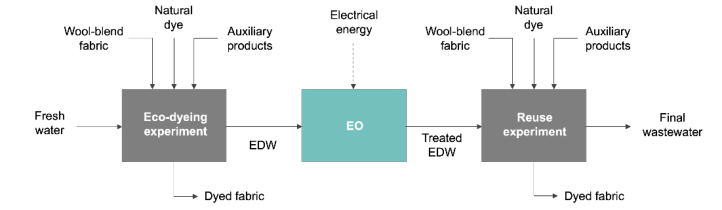
The reuse strategy is summarized in Figure 2.
Figure 2: Schematic representation of wastewater reuse strategy in eco-dyeing process (adapted from Saraiva et al. (2025a)).
Treated EDW was reused in new eco-dyeing processes following the main requirements for textile wastewater reuse established in the AquaFit4Use project (Silva et al., 2018). Reuse trials followed the dyeing procedure shown in Figure 1, replacing fresh water with a 50:50 mixture of treated wastewater and fresh water. This ratio was selected as a practical condition to assess partial water substitution while maintaining dyeing quality and reproducibility (Saraiva et al., 2025a).
ANALYTICAL METHODS EDW was characterized before and after EO treatment in terms of pH, electrical conductivity (EC), turbidity, COD, dissolved organic carbon (DOC), dissolved inorganic carbon (DIC), total dissolved nitrogen (TDN), and ion concentrations. EC, pH, and turbidity were measured using Mettler Toledo SevenEasy S30 and S20 meters and a Lovibond TB350 turbidity meter, respectively. COD was determined by the closed reflux titrimetric method according to Standard Methods (APHA, 2017). DOC, DIC, and TDN were measured using a Shimadzu TOC-VCPH analyzer coupled to a TNM-1 unit after filtration through 0.45 μm membranes. Ion concentrations were measured by ion chromatography utilizing a Shimadzu 20A Prominence system, as described by Fernandes et al. (2016).
Dyeing performance was evaluated through CIELab coordinates (L*, a*, and b*) and K/S values, measured with a Minolta M-3600d spectrophotometer under D65 illumination and a 10° observer angle. K/S values were calculated from diffuse reflectance at λmax = 400 nm, and color difference (ΔE) according to ISO 105-J03:2009 (2009). Color fastness to rubbing, under dry and wet conditions, and to washing were assessed according to ISO 105-X12:2016 (2016) and ISO 105-C06:2010 (2010), respectively, using an AATCC Crockmeter and a Linitest apparatus.
RESULTS
Eco-Dyeing Performance The colorimetric results of fabrics dyed by exhaustion, pad-dry, and pad- batch are shown in Table 1. Pad-dry produced the highest color intensity, as indicated by the highest K/S value, while all samples showed similar lightness
Eco-Dyeing of Wool-Blend Fabrics With a Natural Lac Dye 527 and light gray shades. Exhaustion dyeing resulted in a more reddish tone, whereas impregnation processes produced more bluish shades, especially in the pad-batch process.
Table 1: Colorimetric analysis of the fabrics dyed with different dyeing processes.
K/S 0.66 ± 0.03 0.8 ± 0.2 0.7 ± 0.1 Regarding color fastness, exhaustion dyeing showed the best overall performance (Table 2). All samples presented good to very good rubbing fastness, in agreement with Mongkholrattanasit et al. (2015). Still, impregnation-dyed samples showed lower wash fastness and visible color loss, as also reported for pad-dyeing processes by Wang et al. (2023). Thus, exhaustion was the most suitable route for the wool-blend fabric, consistent with Martins et al. (2015).
Table 2: Color fastness to washing and rubbing of the fabrics dyed with different dyeing processes. Scale: 1 (poor) to 5 (excellent).
Table available in the original PDF paper.
Washing Rubbing Staining Dry Wet
Sample Color Change
CA CO PA PES PAC WO Exhaustion 4−5 5 5 5 5 5 5 5 4−5 Pad-dry 4 5 5 5 5 5 5 3−4 3−4
Pad-batch 3−4 5 5 5 5 5 5 4 3−4
ELECTROCHEMICAL TREATMENT OF ECO-DYEING WASTEWATER
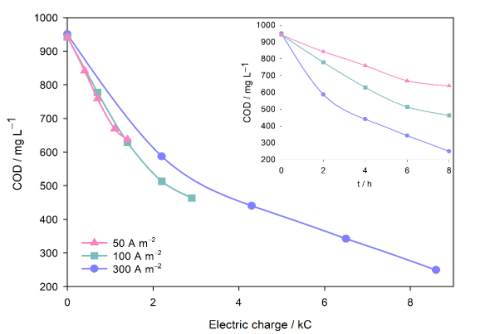
Figure 3 presents the COD decay with applied electric charge and treatment time for the EO treatment performed at current densities of 50, 100, and 300 A m−2. COD decreased for all applied current densities, confirming that EO was effective in promoting pollutant abatement in the eco-dyeing wastewater. Although 300 A m−2 presented the highest COD removal rate, this condition required a substantially higher electric charge, which is less favorable from an operational and energy-consumption standpoint. In contrast, 50 A m−2 resulted in slower degradation kinetics and would be expected to require a longer treatment time to reach the same effluent quality. Since the target of
COD < 400 mg L−1 was reached at 100 A m−2, this current density was selected for the subsequent reuse study, as it represented a practical compromise between treatment time, oxidation efficiency, and electrical demand.
Figure 3: COD decay with applied electric charge and with treatment time (inset) for the EO experiments performed with EDW.
After EO treatment at 100 A m−2, EDW showed a substantial reduction in organic load and turbidity (Table 3), with no visible residual color, confirming the effectiveness of BDD-mediated oxidation for the treatment of this wastewater. An increase in DIC concentration and a decrease in pH were observed. DIC increase can be ascribed to the mineralization of the organic compounds (Souli et al., 2023). The increase in pH is most likely due to the release of H+ from the redox reactions and to the carboxylic acid formation from the organic matter oxidation. Since chloride was present in the original EDW, indirect oxidation mediated by electrogenerated active chlorine species may have contributed to pollutant removal, as suggested by the formation of chlorinated oxyanions (Fernandes et al., 2016). Overall, EO effectively reduced the organic and color-related pollution of the EDW, producing an effluent suitable for subsequent reuse assays.
Table 3: EDW characterization before and after 12 h of EO treatment. ND: Not detected.
Table available in the original PDF paper.
Parameter Raw EDW EDW After EO_12h pH 4.02 ± 0.02 3.1 ± 0.1 EC / mS cm−1 0.45 ± 0.01 0.58 ± 0.02
Reuse Performance in Eco-Dyeing The treated EDW was reused in new eco-dyeing assays as a 50:50 mixture with fresh water. Due to its acidic pH, the amount of acetic acid required during the dyeing stage was reduced fivefold, without compromising the final dyeing performance. As shown in Table 4, fabrics dyed with treated wastewater presented colorimetric properties close to those obtained with fresh water.
Table 4: Colorimetric analysis of the fabrics dyed with fresh water and with treated EDW (50:50 mixture with fresh water).
Table available in the original PDF paper.
Parameter Eco-Dyeing With Fresh Water Eco-Dyeing With Treated EDW L* 69.8 ± 0.3 69.3 ± 0.4 a* 9.8 ± 0.1 10.5 ± 0.2
Although the ΔE value was slightly above the commonly desired threshold, no visible color differences were observed, and the result may still be acceptable depending on the intended end use of the fabric (HNLíder, 2025; Skychem Group, 2025). The slight color deviation may be associated with residual oxidation products in the treated effluent, which can interact with dyeing auxiliaries and influence shade development. Similar effects have been reported for reused textile effluents, whose application may be more suitable for darker shades or processing stages where minor color variations are less perceptible (Chollom, 2014; Buscio et al., 2016).
The color fastness results were very promising, with no relevant differences between fabrics dyed with fresh water and those dyed with treated EDW (Table 5). Washing and rubbing fastness remained high, confirming that partial replacement of fresh water by treated EDW did not impair the functional quality of the dyed fabrics, in agreement with previous findings reported by Saraiva et al. (2025a).
Table 5: Color fastness to washing and rubbing of the fabrics dyed with fresh water and with treated EDW (50:50 mixture with fresh water). Scale: 1 (poor) to 5 (excellent).
Table available in the original PDF paper.
Washing Rubbing Staining Dry Wet
Samples Color Change
CA CO PA PES PAC WO 4−5 5 5 5 5 5 5 5 4−5
Eco-dyeing with fresh water
4−5 5 5 5 5 5 5 4−5 4
Eco-dyeing with treated EDW
CONCLUSION
This study demonstrates the feasibility of integrating natural dyeing, electrochemical wastewater treatment, and partial water reuse as an eco- design and eco-engineering strategy for wool-blend textile processing. Among the dyeing routes tested, exhaustion provided the best overall performance, combining suitable color development with superior washing and rubbing fastness. Although pad-dry offers advantages in terms of operational time, energy demand, and water use, it would require further optimization, including chemical dosage adjustment, to achieve dyeing performance comparable to exhaustion. Pad-batch showed intermediate behavior but may be less suitable for the short production cycles typical of the woollen textile industry.
Electrochemical oxidation with a BDD anode proved effective for the treatment and reclamation of eco-dyeing wastewater generated with a natural lac dye, promoting substantial organic load reduction and discoloration. The operating condition of 100 A m−2 provided a suitable compromise between treatment efficiency and electrical demand for producing treated effluent for reuse assays. However, the formation of oxidation by-products should be carefully considered in future scale-up studies.
Reuse assays confirmed that a 50:50 mixture of treated effluent and fresh water could be applied in new dyeing cycles without compromising the functional quality of the dyed fabrics. The fabrics obtained with reused water showed only slight color deviation and maintained high washing and rubbing fastness. In addition, the acidic character of the treated effluent allowed a fivefold reduction in acetic acid addition during dyeing, highlighting an additional benefit in terms of chemical savings. Overall, the results support the potential of BDD-mediated EO as part of a circular water management strategy for more sustainable natural dye-based textile processes. Future work should focus on pilot-scale validation, detailed by-product characterization, and integration with complementary treatment steps to improve sustainability and industrial scalability.
ACKNOWLEDGMENT
The authors are very grateful for the support granted by the Research Unit of Fiber Materials and Environmental Technologies (FibEnTech-UBI), through the Projects references UID/00195/2025 (https://doi.org/10.54499/ UID/00195/2025), UID/PRR/00195/2025 (https://doi.org/10.54499/UID/ PRR/00195/2025) and UID/PRR2/00195/2025 (https://doi.org/10.54499/ UID/PRR2/00195/2025), funded by FCT - Fundação para a Ciência e a Tecnologia, IP/MECI, and from GIATEX Project, funded by the recovery and resilience program (PRR - Plano de Recuperação e Resiliência) and by the European funds NextGeneration EU (https://recuperarportugal.gov.pt/). Annabel Fernandes acknowledges FCT and the University of Beira Interior for the research contract CEECINST/00016/2021/CP2828/CT0006 under the scope of the CEEC Institutional 2021, funded by FCT (https://doi. org/10.54499/CEECINST/00016/2021/CP2828/CT0006).
FUNDING SOURCES This research was funded by Fundação para a Ciência e Tecnologia (FCT), projects UIDB/00195/2020, UID/PRR/00195/2025, and UID/ PRR2/00195/2025, and research contract CEECINST/00016/2021/ CP2828/CT0006 awarded to Annabel Fernandes under the scope of the CEEC Institutional 2021, and by the GIATEX Project 01/C05-i11/2024. PC644943052-00000050, financed by the Recovery and Resilience Plan.
REFERENCES
APHA, AWWA, WEF. (2017) Standard Methods for the Examination of Water and Wastewater, 23rd ed. American Public Health Association, American Water Works Association, Water Environment Federation, Washington, DC. Bishal, A., Ali, K., Ghosh, S., Parua, P., Bandyopadhyay, B., Mondal, S., Jana, M.,
Datta, A., Das, K. K. and Debnath, B. (2023) Natural dyes: Its origin, categories and application on textile fabrics in brief. European Chemical Bulletin, 12, 9780–9802. https://doi.org/10.48047/ecb/2023.12.8.804 Brillas, E. and Martínez-Huitle, C. A. (2015) Decontamination of wastewaters containing synthetic organic dyes by electrochemical methods: An updated review. Applied Catalysis B: Environmental, 166–167, 603–643. https://doi. org/10.1016/j.apcatb.2014.11.016 Buscio, V., García-Jiménez, M., Vilaseca, M., López-Grimau, V., Crespi, M. and
Gutiérrez-Bouzán, C. (2016) Reuse of Textile Dyeing Effluents Treated with Coupled Nanofiltration and Electrochemical Processes, Materials 9(6), 490. https://doi.org/10.3390/ma9060490 Chollom, M. N. (2014) Treatment and reuse of reactive dye effluent from textile industry using membrane technology [Master’s thesis, Durban University of Technology]. Dey, P., Dey, P., Hoque, M. B., Baria, B., Rahman, M. M., Shovon, S. and Das, D.
(2025) Sustainable and eco-friendly natural dyes: A holistic review on sources, extraction, and application prospects. Textile Research Journal, 95(10–20), 2472–2499.
Dutta, S., Adhikary, S., Bhattacharya, S., Roy, D., Sovona, C., Chakraborty, A., Banerjee, D., Ganguly, A., Nanda, S. and Rajak, P. (2024) Contamination of textile dyes in aquatic environment: Adverse impacts on aquatic ecosystem and human health, and its management using bioremediation. Journal of Environmental Management, 353, e120103. https://doi.org/10.1016/j.jenvman.2024.120103 Ellen MacArthur Foundation. (November 28, 2017). A New Textiles Economy:
Redesigning Fashion’s Future. Ellen MacArthur Foundation Website: https:// www.ellenmacarthurfoundation.org/a-new-textiles-economy. Fernandes, A., Coelho, J., Ciríaco, L., Pacheco, M. J. and Lopes, A. (2016) Electrochemical wastewater treatment: influence of the type of carbon and of nitrogen on the organic load removal. Environmental Science and Pollution Research 23, 24614–24623. https://doi.org/10.1007/s11356-016-6851-6 Handayani, A. I., Kristijanto, I. and Hunga, A. I. R. (2018) Are natural dyes eco-
friendly? A case study on water usage and wastewater characteristics of batik production by natural dyes application. Sustainability of Water Resources Management, 4(4), 1011–1021. https://doi.org/10.1007/s40899-018-0217-9 HNLíder. (October 12, 2025). Consistência de lotes: como combinar cores em grandes pedidos de atacado. LEADING Website: https://www.hnleading.com/pt/ batch-consistency-how-to-match-colors-across-large-wholesale-orders/ ISO. (2009) Textiles—Tests for Colour Fastness—Part J03: Calculation of Colour
Differences. ISO 105-J03:2009. ISO, Geneva, Switzerland. ISO. (2010) Textiles—Tests for Colour Fastness—Part C06: Colour Fastness to Domestic and Commercial Laundering. ISO 105-C06:2010. ISO, Geneva, Switzerland. ISO. (2016) Textiles—Tests for Colour Fastness—Part X12: Colour Fastness to
Rubbing. ISO 105-X12:2016. ISO, Geneva, Switzerland. Martins, T. G., Simone, C., Chiapetta, L., Carvalho, J. and Cassella, R. J. (2015) Comparison of the efficacy of different techniques (exhaustion and padding) for the fixation of permethrin in fabrics, Revista Virtual de Química 7(4), 1119–1129. https://doi.org/10.5935/1984-6835.20150062 Mongkholrattanasit, R., Saiwan, C., Rungrungkitkrai, N., Punrattanasin,
N., Sriharuksa, K., Klaichoi, C. and Nakpathom, M. (2015) Ecological dyeing of silk fabric with lac dye by using padding techniques, The Journal of the Textile Institute 106(10), 1106–1114. https://doi.org/10.1080/00405000.2014.976957 Orts, F., Del Río, A. I., Molina, J. and Cases, F. (2019). Study of the reuse of industrial wastewater after electrochemical treatment of textile effluents without external addition of chloride. International Journal of Electrochemical Science, 14, 1733–1750. https://doi.org/10.20964/2019.02.27 Pinto, C., Fernandes, A., Marques, A., Ciríaco, L., Miguel, R., Lopes, A. and Pacheco,
M. J. (2022) Reuse of wool dyeing wastewater after electrochemical treatment at a BDD anode. Journal of Water Process Engineering, 49, 102972. https://doi. org/10.1016/j.jwpe.2022.102972 Pizzicato, B., Pacifico, S., Cayuela, D., Mijas, G. and Riba-Moliner, M. (2023) Advancements in sustainable natural dyes for textile applications: A review. Molecules, 28, e5954. https://doi.org/10.3390/molecules28165954 Saraiva, B., Belino, N., Miguel, R., López-Grimau, V., Buscio, V., Carvalho, J. and
Fernandes, A. (2025a). Treatment of natural dye wastewaters by electrochemical oxidation: Comparative analysis of anode materials and optimization for reuse. Journal of Environmental Management, 395, 127908. https://doi.org/10.1016/j. jenvman.2025.127908
Eco-Dyeing of Wool-Blend Fabrics With a Natural Lac Dye 533 Saraiva, B., Fernandes, A., Miguel, R., Carvalho, J., Belino, N. and Lopes, A. (2025b)
Electrochemical Treatment of Wastewater from Wool-Blend Fabrics Dyeing with a Natural Lac Dye, in: Cunha, J., Borrega, A. C., Carvalho, H., Providência, B. (Eds.), Advances in Fashion and Design Research III. Springer Nature Switzerland, pp. 619–627. https://doi.org/10.1007/978-3-031-83185-0_56 Silva, L. G. M., Moreira, F. C., Souza, A. A. U., Souza, S. M. A. G. U., Boaventura, R. A. R. and Vilar, V. J. P. (2018) Chemical and Electrochemical Advanced Oxidation Processes as a Polishing Step for Textile Wastewater Treatment: A Study Regarding the Discharge into the Environment and the Reuse in the Textile Industry. Journal of Cleaner Production 198, 430–442. https://doi.org/10.1016/j. jclepro.2018.07.001 Souli, I., Afonso, C., Lopes, A., Pacheco, M. J., Ciríaco, L., Labiadh, L., Ammar, S. and
Fernandes, A. (2023) Treatment of fish canning wastewater by the electrochemical oxidation process. Journal of Water Process Engineering 56, 104423. https://doi. org/10.1016/j.jwpe.2023.104423 Skychem Group. (October 7, 2025). Color Difference Formula and ΔE: CIE Standards and Color Tolerance. Skychem Group Website: https://skychemi.com/ pt/color-difference-formula-delta-e/ Wang, M., Yi, N., Fang, K., Zhao, Z., Xie, R., and Chen, W. (2023) Deep colorful
antibacterial wool fabrics by high-efficiency pad dyeing with insoluble curcumin, Chemical Engineering Journal 452, 139121. https://doi.org/10.1016/j. cej.2022.139121
FIND THE COMPLETE VOLUME IN THE AHFE DIGITAL BOOKSTORE
Explore the complete digital volume
Human Systems Engineering and Design (IHSED2026): Future Trends and Applications
Read this individual research paper free through the original publisher, or explore the full digital proceedings book.