Bekir Arslan, Birgit Milius (2026). A Human Factors Framework for Evaluating Digital Train Commands in Railway Operations. In: Advances in Human Factors of Transportation. AHFE Open Access, vol. 224, pp. 451–457. https://doi.org/10.54941/ahfe1007873
The digitalisation of operational train commands represents a major step in the transformation of railway operations and fundamentally changes safety-critical communication between dispatchers and train drivers. Traditionally, commands are issued through written or verbal procedures based on strictly standardised rules, ensuring clarity and reliability, particularly in disruption scenarios. With the introduction of digital train commands, these procedures are increasingly replaced by interface-based transmission and acknowledgement mechanisms, raising new questions regarding usability, comprehensibility, and human–system interaction.This paper presents a human factors–oriented methodological framework for the systematic evaluation of digital train commands in railway operations. The focus lies on research design and evaluation methods suitable for early deployment and transition phases, rather than on operational performance outcomes. The proposed approach combines simulator-based studies, task and process analyses, semi-structured interviews, questionnaires, mockups, and thinking-aloud techniques to investigate cognitive workload, acceptance, and safety-critical communication under realistic operating conditions. Particular attention is given to transitional environments in which traditional and digital command procedures coexist, potentially increasing cognitive demands and the risk of human error.The framework examines how factors such as stress, time pressure, prior experience, and interaction design influence user behaviour and trust in digital acknowledgement mechanisms. By systematically addressing both technical and human aspects, the approach supports early identification of usability issues and interaction risks before large-scale implementation. The paper contributes a transferable methodological basis for evaluating digital command systems in the railway domain and other safety-critical transportation contexts, highlighting the need to integrate human factors alongside technological innovation to maintain established safety standards.
Safety-critical communication forms the backbone of railway operations and is essential for maintaining a high level of operational safety, particularly in complex and time-critical situations. During disruption management, when
452 Arslan and Milius deviations from standard operating procedures occur, operational commands play a central role in restoring order and ensuring the safe continuation of train movements. Any form of miscommunication in this context entails significant risks. Ambiguities, misunderstandings, or incorrect transmissions may not only cause delays but can also escalate into safety-critical situations or accidents. To minimise these risks, both the wording and the sequence of commands have traditionally been strictly standardised, leaving little room for interpretation (Huth, 2025).
With the ongoing digitalisation of the railway sector, this long-established framework is undergoing a fundamental transformation. Digital train command systems replace verbal dictation and repetition with interface- based transmission and acknowledgement mechanisms. These systems promise faster communication, improved documentation, and increased efficiency, particularly in disruption scenarios. At the same time, they introduce new challenges related to human–machine interaction, cognitive workload, and acceptance among operational staff. The shift from verbal closed-loop communication to digital acknowledgement raises important questions regarding how commands are perceived, processed, and verified by users in safety-critical situations (Maschek, 2022).
A particular challenge arises during transition phases, in which traditional written or verbal command procedures coexist with digital solutions. Such hybrid operational environments require train drivers and dispatchers to switch between different communication modes, potentially increasing cognitive demands and the risk of human error. While regulatory frameworks at national and European level provide the formal basis for command procedures, the practical impact of digitalisation on human performance and safety-critical communication remains insufficiently understood.
This paper addresses this gap by presenting a human factors–oriented methodological framework for evaluating digital train commands in railway operations. Rather than focusing on operational performance outcomes, the study emphasises research design and evaluation methods suitable for early deployment and transition phases. By adopting a systematic human factors perspective, the paper aims to support a user-centred assessment of digital command systems and contribute to the safe and sustainable digitalisation of railway operations.
COMMANDS IN GERMAN RAILWAY OPERATIONS Written Commands as the Established Safety Standard
The system of written operational commands in Germany has long constituted a core element of safe railway operations. Regulated within a strictly standardised framework, written commands ensure reliable and unambiguous communication between dispatchers and train drivers, particularly in disruption scenarios where deviations from regular procedures are required. The system comprises a defined set of command types, each issued using a uniform command form that clearly separates the operational instruction from its underlying reason (Huth, 2025).
A Human Factors Framework for Evaluating Digital Train Commands 453 Command transmission follows a closed-loop communication principle: the dispatcher dictates the command verbatim, the train driver repeats it word by word, and the dispatcher confirms the correct reproduction. Only after completion of this sequence is the command considered valid. This procedure minimises ambiguity, reduces interpretation space, and has proven highly robust under conditions of stress and time pressure. Typical applications include authorising trains to pass signals at danger, imposing temporary speed restrictions, or permitting reverse movements (Huth, 2025).
In preparation for digitalisation, the structure of the written command form has recently been revised. Command reasons have been reorganised and expanded, and individual command elements are now distinguished by unique identifiers. These refinements increase structural clarity and establish a consistent foundation for digital representation while preserving the proven safety logic of the written command system (Huth, 2025).
Transition From Written to Digital Command Digital train commands represent a fundamental change to the established communication process. Instead of verbal dictation and repetition, commands are generated within a digital system and transmitted electronically. Train drivers access the command via a transaction-based authentication mechanism and must actively confirm receipt and understanding. This acknowledgement replaces the traditional verbal closed-loop procedure (Norwig, 2025a).
The digital approach offers clear advantages. Standardised templates enable faster transmission, particularly during large-scale disruptions, while digital documentation improves traceability and reduces media discontinuities. At the same time, the shift introduces new dependencies on technical infrastructure, network availability, and interface usability. Authentication mechanisms, device variability, and newly designed user interfaces may introduce novel interaction risks that were previously mitigated through verbal redundancy (Norwig, 2025a).
A key challenge arises from the phased implementation strategy. Digital commands are initially deployed on selected routes, while traditional written procedures continue to be used elsewhere. This coexistence of communication modes requires operational staff to switch between different interaction concepts, potentially increasing cognitive workload and the risk of error. User acceptance and consistent application therefore become critical factors during the early rollout phase (Norwig, 2025b).
European Context and Hybrid Implementation At the European level, operational command procedures are defined within a harmonised framework for ETCS-supervised operations. However, these specifications cover only a limited subset of operational scenarios and do not fully reflect the complexity of national railway networks operating under mixed signalling conditions. As a result, the German command system follows a hybrid approach that integrates European principles while retaining additional national commands (EU, 2019).
454 Arslan and Milius Comparative examples from other European railways illustrate alternative digitalisation strategies, ranging from mandatory, fully digital command systems to gradual, hybrid deployments. These differences underline that digital command implementation is not solely a technical challenge but also a socio-technical transition that must account for regulatory environments, operational practices, and human factors (EU, 2019).
METHODOLOGICAL FRAMEWORK FOR HUMAN FACTORS EVALUATION Challenges of Introducing Digital Commands
The digital train command system is currently in an early phase of development and deployment and has not yet been extensively tested in everyday railway operations. With the timetable change in December 2025, the system is initially introduced on a voluntary basis. During this transition phase, dispatchers and train drivers independently decide whether to use digital commands, while full responsibility for operational safety remains with the individuals involved. This voluntary framework may limit both acceptance and consistent application, as operational staff may be reluctant to rely on a system that is not yet mandatory (Stanton et al., 2016).
A further challenge arises from the limited scope of deployment. Digital commands are introduced only on selected routes, while traditional written command procedures continue to apply across large parts of the network. As a result, dispatchers and train drivers may be required to alternate between digital and written command procedures within the same operational context. Such hybrid environments increase cognitive workload, reduce user motivation, and may encourage a fallback to established written procedures for the sake of simplicity and continuity (Stanton et al., 2016).
These challenges underline the importance of systematic evaluation during the early deployment phase. Close observation of operational use, together with structured analysis of acceptance, usability, and safety-related implications, is essential to support a safe and consistent integration of digital commands into everyday railway operations (Stanton et al., 2016).
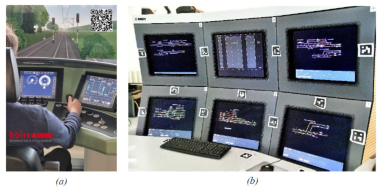
Figure 1: Facilities at the chair of railway operations and infrastructure (a) train driving simulator, (b) electronic interlocking.
A Human Factors Framework for Evaluating Digital Train Commands 455 Simulation-Based Evaluation
At the chair of Railway Operations and Infrastructure at Technische Universität Berlin, a comprehensive operational environment is available that reproduces all interlocking technologies currently used in Germany. This infrastructure has been employed for many years in education, professional training, and research. It is complemented by a train driving simulator, which is likewise used for experimental studies. For the present project, the operational environment and the driving simulator are combined to investigate realistic railway scenarios in a controlled setting. Both the digital train command system deployed by Deutsche Bahn and a self-developed prototype are integrated into the environment and applied alternately during the experiments. Participants assume the role of either dispatcher or train driver and are instructed to verbalise their actions while performing assigned tasks using the thinking-aloud method. Eye movements are recorded using eye-tracking technology, and additional video documentation is collected. Each session is followed by a structured debriefing focusing on experienced challenges, positive and negative aspects, and potential improvements.
Interviews, Questionnaires and Mock-Up Studies In addition to simulator-based investigations, interviews and questionnaire surveys are conducted with dispatchers and train drivers who interact with the digital command system. The aim is to capture assessments of system usage, acceptance, perceived usefulness, and route-specific characteristics. Participants are also invited to create mock-ups in order to visualise their expectations regarding functionality, interface design, and integration into existing work processes. The data collection combines qualitative and quantitative approaches. Questionnaires include Likert-scale items as well as open-ended questions, enabling both statistical analysis and deeper insights into individual user perspectives. Furthermore, the System Usability Scale (SUS) is applied to obtain a standardised measure of usability. Surveys are conducted both after simulator-based test runs and as part of a longitudinal assessment accompanying the operational rollout of the digital command system (Stanton et al., 2016).
Integration and Analysis of Results Following data collection, all results are subjected to a systematic analysis focusing on usability, acceptance, and safety-related aspects of human– system interaction. In addition, changes in system usage over the course of the introduction are examined to determine whether initial hesitation decreases with experience or whether early acceptance declines over time. By comparing experiences with the Deutsche Bahn system, the self-developed prototype, and the mock-ups created during the surveys, robust insights are expected for the development of an optimised digital command process. These findings form the basis for the concluding summary and the outlook on future research activities.
CONCLUSION AND RESEARCH OUTLOOK The digital train command represents a significant milestone in the digitalisation of railway operations, introducing fundamental changes to safety-critical communication processes that have traditionally relied on written and verbal procedures. While digital commands promise improvements in efficiency, standardisation, and documentation, their successful implementation ultimately depends on human factors. Acceptance, usability, and operational reliability remain decisive in ensuring that the high safety standards of railway operations are maintained. This paper presented a human factors–oriented methodological framework for evaluating digital train commands during early deployment and transition phases. By combining simulator-based studies, interviews, questionnaires, usability analyses, and structured error classification, the approach enables a systematic assessment of strengths, limitations, and interaction risks. The integration of both the Deutsche Bahn digital command system and a self-developed prototype into realistic experimental environments provides a robust basis for analysing operational, technical, and human dimensions without relying on fully deployed field data.
As the nationwide introduction of digital commands begins with the timetable change in December 2025, continuous monitoring of acceptance and system use across different routes and operational contexts becomes essential. Particular attention must be paid to fragmented deployment strategies and voluntary usage, which may hinder consistent application and increase cognitive demands in hybrid operational environments. The primary contribution of this paper lies in identifying key human-factors-related challenges associated with the transition from written to digital command procedures and in outlining a structured methodological framework for their systematic evaluation. Future research will focus on examining the effects of digital commands on situational awareness, error resistance, and communication efficiency, as well as on identifying user groups that may require additional support or adapted interface designs. These steps are essential to ensure that digital train commands enhance operational performance without compromising the established safety culture of railway operations.
DISCLAIMER Funded by the European Union. Views and opinion expressed are however those of the author(s) only and do not necessarily reflect those of the European Union or the Europe’s Rail Joint Undertaking. Neither the European Union nor the granting authority can be held responsible for them. The project „PhDs EU-Rail“ is supported by the Europe’s Rail Joint Undertaking and its members.
REFERENCES
Arslan, B. and Milius, B. (2026) From written to digital commands in German railway operations: challenges and opportunities. Promet – Traffic & Transportation, 38(1), pp. 1–6. https://doi.org/10.730/ptt.v38i1.1096 DB InfraGO AG (2025) Digital Command: Digitization Forum. Frankfurt am Main:
DB InfraGO AG, 20 May 2025. Deutsche Bahn (2025) Digital command: Training tool for train dispatchers. Available at: https://digitaler-befehl-schulung.deutschebahn.com/ (Accessed: 30 September 2025). Deutsche Bahn (2025) Digital command: Training tool for train drivers. Available at:
https://digitaler-befehl.deutschebahn.com/ (Accessed: 30 September 2025). European Commission. Commission Implementing Regulation (EU) 2019/773 of 16 May 2019 on the technical specification for interoperability relating to the operation and traffic management subsystem of the rail system within the European Union. Official Journal of the European Union, L 139I, 27 May 2019. Hagemeyer, F. et al. (2021) Automated rail transport: Technical and legal aspects.
Wiesbaden: Springer Vieweg. Huth, J. (2025) Driving regulations. Deutsche Bahn Richtlinie 408. Frankfurt am Main: DB Netz AG. Maschek, U. (2022) Securing rail traffic: Fundamentals and planning of signaling
and safety technology. Wiesbaden: Springer Vieweg. Norwig, B. (2025a) Operational testing – Digital command. Deutsche Bahn Betriebserprobung, Document No. 03-02-01-W-101. Available at: https://www. dbinfrago.com/web/schienennetz/netzzugang-und-regulierung/technischer- netzzugang/digitaler-befehl-pilotbetrieb-12592966 (Accessed: 9 September 2025). Norwig, B. (2025b) Participating track sections: Digital command. DB InfraGO AG. Available at: https://www.dbinfrago.com/resource/ blob/12592984/3f6fa802e2ebfe3101be6def0b42e6aa/Anwendungsbereich- Digitaler-Befehl-Streckennummern-data.pdf (Accessed: 9 September 2025). Norwig, B. et al. (2023) ‘The digital command: Process acceleration and work
simplification in the company’. Deine Bahn, February 2023. Available at: https://www.system-bahn.net/aktuell/der-digitale-befehl-prozessbeschleunigung- und-arbeitserleichterung-im-betrieb/ (Accessed: 9 September 2025). Stanton, N.A., Salmon, P.M., Rafferty, L.A., Walker, G.H., Baber, C. and Jenkins, D.P. (2016) Human factors methods: A practical guide for engineering and design. Boca Raton, FL: CRC Press.
LISTED IN THE AHFE DIGITAL BOOKSTORE CATALOGUE
Explore the complete digital volume
Advances in Human Factors of Transportation
Read this individual research paper free through the original publisher, or explore the full digital proceedings book.
ISBN 979-8-950676-00-0
Explore this ISBN in the AHFE Bookstore ↗Listed in the July 2026 bookstore catalogue; search by ISBN to confirm current availability · Digital book purchase optional