Xiaolei Guo, Ruiqi Zhang, Weitong Sun, Jingrui An (2026). Reframing Immigrant Narratives through AI-Assisted Co-Creation and Immersive Experience: A Case Study of Ideal Home. In: Human Factors in Communication of Design. AHFE Open Access, vol. 216, pp. 216–226. https://doi.org/10.54941/ahfe1007638
This study examines immigrant storytelling as an experiential and participatory form of communication. We created Ideal Home, an AI-assisted immersive narrative experience that combines large language model–supported narrative co-creation with virtual reality. To understand audience experiences, we conducted in-depth interviews with participants and domain experts to examine which design factors shaped interpretation, emotional engagement, and sense-making of immigrant narratives. Our findings highlight four experiential design dimensions: multi-perspectival narratives, non-linear narrative structure, metaphorical spatial aesthetics, and intentionally constrained user agency. We use these findings to discuss how these dimensions can inform the design of narrative experiences that support cross-cultural understanding and meaningful emotional connection.
Immigrant narratives play a critical role in shaping public understanding, emotional attitudes, and social perceptions of migration experiences. Existing research has shown that such narratives can foster empathy, challenge stereotypes, and influence cross-cultural understanding (Sanchez Laws, 2020; Pérez Garcia and Bittner, 2023). However, immigrant experiences are most often conveyed through passive representational forms, such as individualized narrative accounts, media reports, and cultural artifacts. This focus has left immigrant narratives underexplored as designed experiential forms that actively shape how audiences perceive, interpret, and make sense of migration.
Recent advances in technology open new opportunities to rethink immigrant storytelling. Large language models (LLMs) enable a shift from single-author narratives toward human–AI co-creation, supporting narrative multiplicity, recomposition, and decentralized authorship (Clark et al., 2018; Mirowski et al., 2023; Kim et al., 2024). At the same time, virtual reality (VR), through immersion, presence, and spatialized storytelling, allows narratives to be experienced rather than merely read or observed,
Reframing Immigrant Narratives Through AI-Assisted Co-Creation 217 fostering embodied and affective engagement (Shin, 2018; Beadle et al., 2021). Together, these technologies create new possibilities for engaging with complex, culturally situated experiences such as migration through experiential sense-making.
Driven by contemporary social contexts and recent technological advances, this paper presents Ideal Home, an immersive narrative design project that combines AI-assisted narrative co-creation with virtual reality to explore immigrant storytelling as a participatory and experiential communication process. Centered on the theme of in-between belonging, the project examines how cultural dislocation, fragmented identity, and the reconstruction of memory across time and space can be expressed through immersive narrative design.
Adopting a research-through-design approach, we developed Ideal Home through multi-stage narrative collection, LLM-assisted script generation, and VR scene design, followed by a qualitative interview study with participants and domain experts. Through thematic analysis of the interview data, we identify four design dimensions that shaped audiences’ sense-making of immigrant experiences. Based on these findings, we discuss how large language models and immersive media can jointly inform the design of VR storytelling experiences that support cross-cultural understanding and meaningful emotional connection. This work contributes design insights for AI-assisted immersive storytelling and articulates transferable design dimensions for future research and practice.
RELATED WORK
LLM-Facilitated Narrative Generation LLMs are increasingly recognized as powerful tools for co-creative applications as their text-generation capabilities continue to advance (Dathathri et al., 2019; Keskar et al., 2019). In creative writing contexts, LLMs function as augmentative tools that support human authors in narrative generation, language construction, and ideation (Alabdulkarim et al., 2021). Scriptwriting has emerged as a prominent application domain, with prior work demonstrating how LLMs can assist in generating fictional dialogues, character arcs, and narrative structures (Mathewson and Mirowski, 2017; Schmidtová et al., 2022; Mirowski et al., 2023). Beyond supporting individual authorship, recent research suggests that LLMs can act as intermediaries between authors and audiences. Kim et al. (2024) show that AI systems can function as “translators” or “mediators,” dynamically adapting narrative tone and style across contexts and audiences, thereby enabling more flexible and scalable forms of communication and co-creation.
Research on co-creative writing with LLMs has also examined the collaborative process and its limitations. In most workflows, human authors guide models through structured prompts and iterative refinement to achieve coherence and stylistic consistency (Clark et al., 2018). However, despite their generative strength, LLMs remain prone to hallucination, narrative discontinuity, and semantic drift, particularly in complex or personal storytelling scenarios (Yao et al., 2023; Roe et al., 2024; Venkatraman et al.,
2024). These challenges underscore the importance of sustained human involvement to maintain semantic coherence, logical flow, and emotional tone in AI-assisted narratives (Wan et al., 2024). Together, this body of work provides both conceptual grounding and practical guidance for collaborative narrative generation practices.
Immersive Storytelling VR has been widely studied as a medium for fostering cross-cultural understanding and emotional engagement due to its immersive and embodied affordances. Prior research suggests that first-person perspectives, multisensory feedback, and contextualized environments in VR can support embodied empathy and deepen users’ cognitive and emotional engagement with culturally distant others (Shin, 2018; van Loon et al., 2018). In the context of migration and displacement, immersive storytelling has been identified as a particularly promising approach. A systematic review by Sanchez Laws (2020) highlights VR’s potential to support immigrant integration and challenge stereotypes through experiential engagement. Empirical case studies further demonstrate that immersive VR narratives can strengthen viewers’ emotional connection to refugees and increase social awareness and responsibility (Pérez Garcia and Bittner, 2023). The sense of embodiment afforded by first-person perspectives plays a critical role in shaping empathetic and attitudinal responses (Herrera et al., 2018). From a design perspective, Beadle et al. (2021) identify key narrative strategies that influence empathetic experience in VR, including perspective shifts, emotional pacing, and contextual realism. Collectively, this literature establishes VR as a powerful medium for cross-cultural communication and empathy-building, while also offering methodological and design insights that inform the development of immersive migrant storytelling experiences in this project.
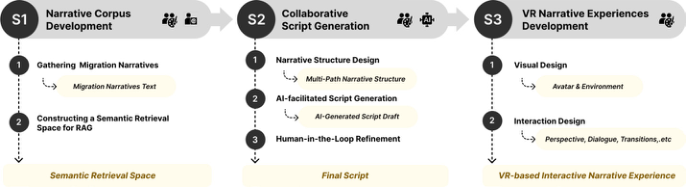
NARRATIVE GENERATION AND DEVELOPMENT This project adopted a three-stage development process through collaboration among immigrant participants, human creators, and LLMs (as shown in Figure 1).
Figure 1: The illustration of the three-stage (S1, S2, and S3) development process of this project.
Reframing Immigrant Narratives Through AI-Assisted Co-Creation 219 Stage 1: Narrative Corpus Development
The first stage of this project focused on constructing a narrative corpus to support LLM-assisted script generation. Seven immigrant participants from diverse cultural backgrounds were recruited, all of whom had lived in the host country for over five years. Narrative data were collected through three rounds of life story interviews (McAdams, 1993) and narrative elicitation techniques grounded in qualitative narrative inquiry (Riessman, 2008). These methods encouraged participants to share migration experiences and personal reflections through free-form narration in their preferred linguistic styles. The collected texts covered themes such as migration motivations, cultural dislocation, adaptation challenges, identity transformation, emotional memory, and evolving notions of home and belonging, and were expressed in diverse forms including reflective essays, short stories, and poetry.
To support semantic coherence and emotional continuity during generation, the narrative texts were pre-processed using SpaCy (Honnibal and Montani, 2017) and embedded into a retrieval-augmented generation (RAG) semantic space (Lewis et al., 2020). This localized knowledge base was integrated into the GPT-4 generation pipeline, enabling real-time retrieval of relevant narrative fragments to inform context-aware script generation.
Stage 2: Collaborative Script Generation The second stage focused on collaborative scriptwriting facilitated by LLMs. To address GPT-4’s limitations in handling extended context and maintaining narrative coherence, we adopted a structure-driven generation strategy. This approach was informed by classical dramaturgical frameworks, including Aristotle’s four-part model of plot, theme, character, and dialogue (Aristotle, trans. 350 B.C.), as well as Freytag’s dramatic structure (Freytag, 1894), and aligns with recent co-writing practices that decompose narratives into modular units for human–LLM collaboration (Lu et al., 2023). Moreover, given the emotional and cultural complexity of immigrant narratives, and prior findings on the challenges LLMs face in generating affectively nuanced stories, we implemented a human-in-the-loop workflow grounded in human–AI co-writing research (Clark et al., 2018; Liu et al., 2022; Li et al., 2023). Specifically, human creators engaged in iterative rounds of review and revision following initial model outputs, refining semantic coherence, emotional authenticity, and cultural appropriateness.
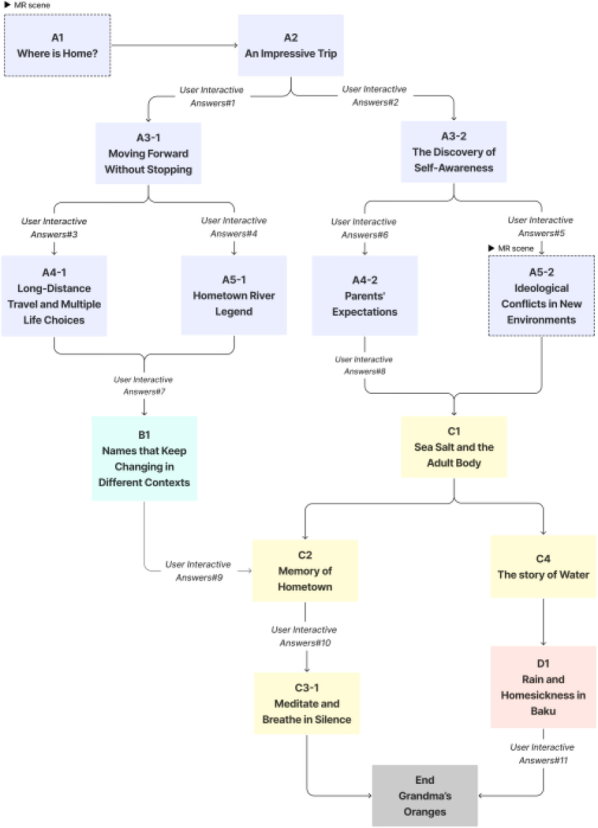
The creative team first analyzed participant narratives and constructed a nonlinear narrative structure composed of four narrative units, each centered on a fictional immigrant character (as shown in Figure 2). Each unit contained multiple themed scene nodes that functioned as semantic prompts for script generation and structural anchors for subsequent immersive experience design. Human creators then collaborated with LLMs to generate dialogue for each predefined scene node. Following established screenwriting practices, creators first authored concise log lines for each scene to specify setting, objectives, conflict, and key events, providing narrative scaffolding for generation (Freytag, 1894). Building on this structure, a set of structured prompting strategies was developed to guide the model’s output according
to the thematic and emotional goals of each scene. These strategies included dialogic prompting, which positioned the audience as a virtual interlocutor to shape tone and addressivity; stylistic conditioning, which introduced poetic, metaphorical, or rhythmical cues to enrich narrative voice; and content blending, which recomposed narrative fragments from multiple immigrant accounts to generate dialogues reflecting shared themes while preserving individual distinctions. This approach aligns with recent practices in modular and collaborative human–AI scriptwriting (Lu et al., 2023). Finally, the generated scripts were iteratively reviewed and refined by the authors across multiple rounds. Revisions focused on semantic coherence, emotional authenticity, and cultural appropriateness, until consensus was reached on the final scripts.
Figure 2: Multi-path narrative structure of Ideal Home. Each color-coded path represents a distinct narrative unit (A–D), composed of multiple scene nodes, each shown as an individual block.
Reframing Immigrant Narratives Through AI-Assisted Co-Creation 221 Stage 3: VR-Based Narrative Experience Development
In the third stage, we designed and implemented a total of 15 immersive VR scenes using the Unity engine, each corresponding to a predefined scene node and its thematic focus. The final experience, Ideal Home, was deployed on the Meta Quest 3 platform as a 10-minute interactive narrative. Guided by a virtual avatar, viewers interact with key narrative events through hand- and gaze-based inputs, while choice-based dialogue selections made via handheld controllers drive narrative progression across scenes.
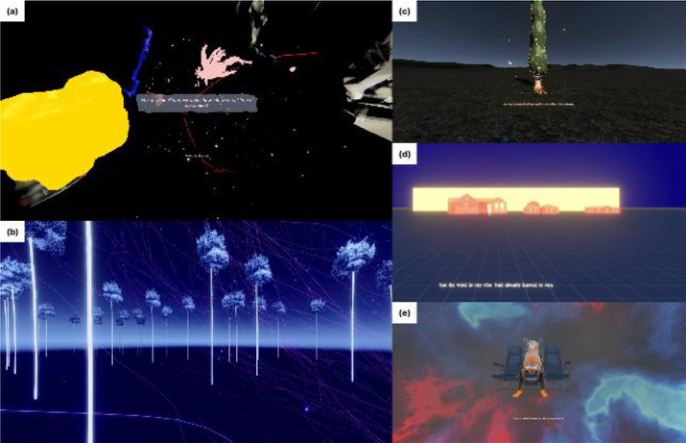
The visual design adopts an abstract and metaphorical aesthetic, composed of a guiding avatar and expressive environments (as shown in Figure 3). The avatar was intentionally designed as a ghost-like, indeterminate figure without identifiable markers of race, gender, or corporeality, encouraging interpretive openness and disrupting cultural stereotyping. Environments were conceived as emotionally charged containers that externalize cultural memory, identity anxiety, and transnational experience. Through deliberate manipulation of color, lighting, particle effects, and symbolic objects, scenes function as metaphorical spaces rather than literal representations, inviting audiences to actively interpret meaning.
Figure 3: Screenshots of the VR scenes in Ideal Home. (a) A5-2: Ideological conflicts in new environments, (b) B1: Keep changing in different contexts, (c) C2: Memory of hometown, (d) D1: Rain and homesickness in Baku, and (e) A2: An impressive trip.
The interaction design was guided by the narrative intent and experiential goals of the project. We intentionally constrained user agency to reinforce themes of limitation and in-between belonging. Accordingly, all scenes are experienced from a seated, fixed-point perspective, allowing only limited exploration through head rotation. This design draws on cinematic virtual reality techniques to guide attention and regulate narrative pacing (Dooley and
McMahan, 2018; Mateer, 2017). In addition, sustained gaze within designated areas triggers gradual visual transitions, including blurring, defocusing, and refocusing effects. These visual shifts are designed to evoke the psychological experience of identity instability often associated with migration. Moreover, we employed visual strategies such as modular decomposition, lens blur, and light–shadow modulation to represent transitions between memory, reality, and illusion.
UNDERSTANDING IDEAL HOME EXPERIENCE To understand how audiences experienced Ideal Home and which design elements shaped their sense-making of immigrant narratives, we conducted an interview study following the completion of the immersive experience. This section reports the interview methods and synthesizes key findings.
Method
We conducted semi-structured interviews with six participants, including three domain experts with backgrounds in immersive media, narrative design, or human–computer interaction, and three general participants who experienced Ideal Home for the first time. All participants completed the VR experience prior to the interview. Interviews were conducted individually and lasted between 30 and 45 minutes. Questions explored how participants perceived and interpreted the narrative, how they emotionally engaged with the characters and scenes, and how specific design elements, such as narrative structure, visual aesthetics, interaction mechanisms, and degrees of agency shaped their experience. Participants were also asked to reflect on moments they found confusing, emotionally resonant, or particularly memorable. All interviews were audio-recorded, transcribed, and analyzed using thematic analysis.
Findings Four themes emerged, corresponding to key design dimensions that shaped audience experience.
First, participants reported that encountering multiple voices and perspectives, rather than following a single protagonist, shifted their engagement away from identification with an individual character toward resonance across shared experiences. Several participants noted that the blended and de-personalized narratives encouraged them to reflect on common emotional patterns, such as uncertainty, longing, and adaptation— rather than focusing on biographical details. This multiplicity supported comparative reflection and a broader understanding of immigrant experiences as collectively shaped rather than individually exceptional.
Second, participants frequently described the non-linear and fragmented narrative structure as helping them make sense of how memory, identity, and belonging are experienced throughout the migration process. Rather than perceiving the discontinuities as confusing, participants interpreted them as meaningful representations of interrupted timelines, unresolved emotions,
Reframing Immigrant Narratives Through AI-Assisted Co-Creation 223 and ongoing identity reconstruction. This structure helped participants understand immigrant experience as an open-ended process rather than a linear journey toward resolution.
Third, participants emphasized that the abstract visual environments enabled them to engage with emotional and cultural experiences that were difficult to articulate verbally. Metaphorical spaces and symbolic objects were described as creating “room for interpretation,” allowing participants to project their own meanings and emotions onto the experience. This abstraction was perceived as effective for conveying feelings of displacement, ideological tension, and homesickness without relying on literal representation.
Finally, while some participants initially expected more freedom of movement or interaction, many later reflected that the constrained agency supported focus and sustained emotional engagement. Fixed viewpoints and limited interaction were seen as directing attention toward narrative content and emotional atmosphere, reducing distraction and reinforcing a sense of limitation and in-betweenness. Participants described this constraint as aligning with the themes of restricted choice and environmental alienation often associated with migration experiences.
DISCUSSION
The aim of this work was to explore how AI-assisted co-creation and immersive media can support immigrant storytelling. The four design dimensions identified in this study illustrate how immigrant narratives can be reimagined as experiential spaces for meaning-making. Multi-perspectival narratives, fragmented structure, metaphorical spatial aesthetics, and constrained user agency collectively shift audience engagement from identification and explanation toward interpretation and reflection. Rather than aiming for narrative closure or representational accuracy, these dimensions support engagement with uncertainty, ambiguity, and partial understanding. This reframing shifts the design goal from representational accuracy toward supporting reflective engagement, aligning with prior critiques of humanitarian and testimonial narratives that risk simplifying complex lived experiences through coherent or consumable stories (Chouliaraki, 2013).
In addition, this work offers implications for AI-assisted narrative design. The collaborative scriptwriting process demonstrates how large language models can support narrative multiplicity without replacing human authorship. By positioning LLMs as a recompositional medium rather than an autonomous storyteller, Ideal Home enabled the blending of voices and emotional patterns while maintaining cultural sensitivity and emotional authenticity (Bender et al., 2021; Weidinger et al., 2022). Our findings underscore the importance of human-in-the-loop workflows and deliberate constraint in AI-assisted storytelling, particularly when working with culturally situated and emotionally sensitive narratives.
Overall, this research suggests that immersive media, when combined with carefully structured human–AI collaboration, can support new forms of experiential immigrant storytelling that prioritize reflection and sense- making over representation or persuasion. The identified design dimensions
offer transferable insights for future work on immersive narrative design in cross-cultural and emotionally complex contexts.
Limitations and Future Work This study is exploratory in nature and has several limitations. The interview sample was relatively small and qualitative, prioritizing depth of experience over generalizability. In addition, the design intentionally emphasized constrained agency and narrative abstraction; while this supported experiential sense-making in Ideal Home, it remains unclear how different levels of interactivity, realism, or narrative transparency might shape audience interpretation and engagement. Future work could systematically explore these trade-offs by varying interaction constraints, degrees of abstraction, or the balance between authored and AI-generated content. Further research could also examine how different configurations of human–AI collaboration influence narrative coherence, emotional authenticity, and cultural sensitivity in immersive storytelling contexts.
CONCLUSION
This paper presented Ideal Home, an interactive immersive experience that combines LLM-supported co-creation with virtual reality to support experiential sense-making of migration. We examined how narrative generation, spatial aesthetics, and immersive interaction design jointly shape audience experience. Through in-depth interviews with participants and domain experts, we identified four key experiential design dimensions— multi-perspectival narratives, non-linear structure, metaphorical spatial aesthetics, and constrained user agency. Based on these findings, this work illustrates the potential of AI-assisted immersive storytelling as a design approach for engaging with complex, culturally situated, and emotionally charged experiences, and offers transferable insights for future research and practice in immersive narrative design.
ACKNOWLEDGMENT
The authors would like to thank all participants who generously shared their personal stories and experiences, making this project possible.
REFERENCES
Alabdulkarim, A., Li, S. and Peng, X. (2021) ‘Automatic story generation: Challenges and attempts’, arXiv preprint, arXiv:2102.12634. Aristotle (c. 350 B.C.) Poetics. Various translations. Beadle, H., Zhang, J. and Nishida, T. (2021) ‘Empathy in virtual reality: A review
of design strategies and future research directions’, in Proceedings of the 2021 CHI Conference on Human Factors in Computing Systems. New York: ACM, pp. 1–12. Bender, E.M., Gebru, T., McMillan-Major, A. and Shmitchell, S. (2021) ‘On the dangers of stochastic parrots: Can language models be too big?’, in Proceedings of the 2021 ACM Conference on Fairness, Accountability, and Transparency (FAccT ’21). New York: ACM, pp. 610–623.
Reframing Immigrant Narratives Through AI-Assisted Co-Creation 225 Chouliaraki, L. (2013) The Ironic Spectator: Solidarity in the Age of Post-
Humanitarianism. Cambridge: Polity Press. Clark, E., Ross, A.S., Tan, C., Ji, Y. and Smith, N.A. (2018) ‘Creative writing with a machine in the loop: Case studies on slogans and stories’, in Proceedings of the 23rd International Conference on Intelligent User Interfaces. New York: ACM, pp. 329–340. Dathathri, S., Madotto, A., Lan, J., Hung, J., Frank, E., Molino, P., Yosinski, J. and
Liu, R. (2019) ‘Plug and play language models: A simple approach to controlled text generation’, arXiv preprint, arXiv:1912.02164. Dooley, J. and McMahan, R.P. (2018) ‘A comparison of viewing techniques for 360-degree video in head-mounted displays’, in Proceedings of the ACM Symposium on Applied Perception. New York: ACM, pp. 1–8. Freytag, G. (1894) Freytag’s Technique of the Drama: An Exposition of Dramatic
Composition and Art. Chicago: Scott, Foresman and Company. Herrera, F., Bailenson, J., Weisz, E., Ogle, E. and Zaki, J. (2018) ‘Building long-term empathy: A large-scale comparison of traditional and virtual reality perspective- taking’, PLOS ONE, 13(10), e0204494. Honnibal, M. and Montani, I. (2017) ‘spaCy: Industrial-strength natural language
processing in Python’. Available at: https://spacy.io (Accessed: 15 January 2026). Kim, T., Han, H., Adar, E., Kay, M. and Chung, J.J.Y. (2024) ‘Authors’ values and attitudes towards AI-bridged scalable personalization of creative language arts’, in Proceedings of the 2024 CHI Conference on Human Factors in Computing Systems. New York: ACM, pp. 1–16. Lewis, P., Perez, E., Piktus, A., Petroni, F., Karpukhin, V., Goyal, N., Küttler, H.,
Lewis, M., Yih, W. and Rocktäschel, T. (2020) ‘Retrieval-augmented generation for knowledge-intensive NLP tasks’, Advances in Neural Information Processing Systems, 33, pp. 9459–9474. Li, M., Yang, Q., Lee, J.S., Zhu, Y., Smith, N.A. and Choi, Y. (2023) ‘CoAuthor: Designing a human–AI collaborative writing dataset for exploring language model capabilities’, in Proceedings of the 2023 CHI Conference on Human Factors in Computing Systems. New York: ACM, pp. 1–14. Liu, Y., Wu, S., Ruan, M., Chen, S. and Xie, X.-Y. (2022) ‘Human–AI collaborative
writing: Effects of AI assistance on writing performance and experience’, Scientific Reports, 12(1), 15105. Mateer, J. (2017) ‘Directing for cinematic virtual reality: How the traditional film director’s craft applies to immersive environments and virtual reality’, Journal of Media Practice, 18(1), pp. 14–25. McAdams, D.P. (1993) The Stories We Live By: Personal Myths and the Making of
the Self. New York: Guilford Press. Mirowski, P., Mathewson, K.W., Pittman, J. and Evans, R. (2023) ‘Co-writing screenplays and theatre scripts with language models: Evaluation by industry professionals’, in Proceedings of the 2023 CHI Conference on Human Factors in Computing Systems. New York: ACM, pp. 1–34. Pérez Garcia, A.I. and Bittner, J.V. (2023) ‘Exploring VR storytelling to foster
empathy toward refugees: A case study’, New Media & Society. Advance online publication. Riessman, C.K. (2008) Narrative Methods for the Human Sciences. Thousand Oaks, CA: Sage. Sanchez Laws, A.L. (2020) ‘Virtual reality as a tool for social inclusion of immigrants:
A systematic literature review’, Virtual Reality, 24(4), pp. 731–753.
Shin, D. (2018) ‘Empathy and embodied experience in virtual environment: To what extent can virtual reality stimulate empathy and embodied experience?’, Computers in Human Behavior, 78, pp. 64–73. Wan, Q., Hu, S., Zhang, Y., Wang, P., Wen, B. and Lu, Z. (2024) ‘“It felt like having
a second mind”: Investigating human–AI co-creativity in prewriting with large language models’, Proceedings of the ACM on Human-Computer Interaction, 8(CSCW1), pp. 1–26. Weidinger, L., Mellor, J., Rauh, M., Griffin, C., Uesato, J., Huang, P.-S., Cheng, M., Glaese, A., McAleese, N., Hendricks, L.A., et al. (2022) ‘Ethical and social risks of harm from language models’, arXiv preprint, arXiv:2112.04359. Yao, J.-Y., Ning, K.-P., Liu, Z.-H., Ning, M.-N., Liu, Y.-Y. and Yuan, L. (2023) ‘LLM
lies: Hallucinations are not bugs, but features as adversarial examples’, arXiv preprint, arXiv:2310.01469.
LISTED IN THE AHFE DIGITAL BOOKSTORE CATALOGUE
Explore the complete digital volume
Human Factors in Communication of Design
Read this individual research paper free through the original publisher, or explore the full digital proceedings book.
ISBN 978-1-964867-92-2
Explore this ISBN in the AHFE Bookstore ↗Listed in the July 2026 bookstore catalogue; search by ISBN to confirm current availability · Digital book purchase optional