Nikita Islam, Valentina Ezcurra, Julie Rader, Ancuta Margondai, Sara Willox, Cindy Von Ahlefeldt, Mustapha Mouloua (2026). Transparency for Trust: Enhancing Acceptance and System Integration of Intelligent AI in Healthcare. In: Intelligent Human Systems Integration (IHSI 2026): Disruptive and Innovative Technologies. AHFE Open Access, vol. 200, pp. 285–295. https://doi.org/10.54941/ahfe1007088
The integration of intelligent systems into healthcare has transformed how diagnosis, therapy, and clinical decision-making are conceptualized and delivered. Artificial intelligence (AI) now supports a wide range of functions, from predictive analytics to personalized interventions. Despite these advances, the acceptance of AI in healthcare remains uneven, shaped not only by technical performance but also by the degree of transparency surrounding its capabilities and limitations. Without clear communication, trust becomes unstable, oscillating between overreliance and outright rejection. This paper examines transparency as the essential foundation for trust calibration, proposing that transparent AI systems enhance user confidence, preserve the therapeutic alliance, and ultimately contribute to better patient care. Building on prior research in neuroadaptive AI and virtual reality therapy for children with autism spectrum disorder, where transparent EEG-based engagement metrics increased acceptance by clinicians and caregivers, the authors argue that transparency should be understood as a core design principle for the system integration of intelligent AI in healthcare. A synthesis of literature across healthcare AI, trust-in-automation, and human–computer interaction demonstrates consistent evidence that transparency mechanisms improve acceptance. Studies on explainable AI indicate that visual explanations and confidence indicators significantly increase appropriate reliance while reducing the risks of miscalibration. The Human Identity and Autonomy Gap (HIAG) framework provides a valuable lens for interpreting these outcomes, illustrating how transparency mediates trust across cognitive, emotional, and social dimensions. Cognitively, transparency clarifies the reliability and scope of AI decision-making; emotionally, it reduces user uncertainty and anxiety; socially, it preserves clinician authority while fostering collaboration with patients and caregivers. Yet transparency must go beyond technical disclosure. Systems must communicate strengths and limitations, such as bias, data dependency, and contextual blind spots, while ensuring that transparency does not overwhelm users with excessive detail. Evidence also shows that transparency must be culturally adaptive, since trust and adoption vary across professional and cultural contexts, with some prioritizing certainty and governance while others value autonomy, discretion, and relational trust. This paper contributes to theory and practice by proposing design and policy guidelines that embed transparency into healthcare AI development. Strategies include adaptive interfaces that communicate uncertainty through confidence dashboards, culturally sensitive explanations that reflect global variability, and training modules that prepare clinicians and caregivers to interpret AI outputs responsibly. By positioning transparency as a prerequisite rather than an afterthought, intelligent systems can be integrated into healthcare workflows in ways that align with human values, safeguard professional autonomy, and foster equitable adoption across diverse settings. Ultimately, transparency transforms AI from a black-box technology into a trusted partner in healthcare innovation. These insights provide not only a conceptual framework for understanding trust calibration in AI-enabled healthcare but also a roadmap for developing intelligent systems that deliver meaningful, safe, and ethically grounded improvements in patient care, ensuring that future applications truly advance medical practice and human well-being.
Artificial intelligence is remodelling modern healthcare and redesigning the disease diagnosis method and how treatments can be delivered (Lai et al., 2021). It has opened unprecedented possibilities for therapy, clinical deci sion making, as artificial intelligence enables predictive analytics, diagnos tic support, and individualized treatment pathways (Asan et al., 2020). Grounded in HCI research and the literature on trust in automation, health care AI must balance technological capability with human factors, how clinicians and patients perceive, comprehend, and trust these systems (Lee & See, 2004; Nazar et al., 2021). Yet trust remains unevenly distributed: Received September 19, 2025; Revised November 10, 2025; Accepted November 25, 2025; Available online February 1, 2026
over-reliance on opaque systems may lead to misuse, while scepticism may block beneficial adoptions (Asan et al., 2020). Even though existing work has largely treated transparency as a technical add-on, it is missing a core design principle that shapes interaction, decision making, and collabora tion in healthcare settings (Chen et al., 2022; Vasey et al., 2022). This study addresses that lack by investigating how transparency can serve as a central mechanism for calibrating trust among clinicians, patients, and AI systems by using insights from HCI, healthcare automation, and trust theory to pro pose a design and policy blueprint for AI integration in clinical workflow.
Background
Dependencies on AI in healthcare have significantly increased in recent years (Asan & Choudhury, 2021). However, as the field continues to progress, it remains crucial to ensure that AI systems maintain both accountability and transparency (Vasey et al., 2022). Transparency in healthcare and clinical appli cations of AI can greatly increase the adoption of this technology while enabling valuable feedback mechanisms that support continuous system improvement (Chen et al., 2022). AI and HCI work together to “provide transparency to the user, allowing them to trust the machine,” emphasizing the importance of explainability in fostering confidence in AI-based decisions (Nazar et al., 2021) This study focuses on three key sectors that can promote AI acceptance and usability: healthcare AI, trust in automation, and human–computer interaction (Nazar et al., 2021). Advancing AI integration in healthcare, strengthening trust in automation, and improving HCI are collectively viewed as essential strategies for enhancing user confidence, thereby leading to greater trust and deeper system integration of intelligent AI within the healthcare domain (Lee & See, 2004; Asan et al., 2020).
AI Integration in Healthcare In recent years, the term “AI” has been widely used, but its definition remains debated. Generally, AI refers to systems that mimic human cognition (Nazar et al., 2021). Its capabilities, especially in healthcare, have expanded, facilitating collaboration between humans and AI (Lai et al., 2021). AI helps address healthcare worker shortages, manage workloads, and improve care quality. Today, AI learns from data, recognizes patterns, and makes decisions, sometimes surpassing professionals in tasks like cancer detection. AI-driven technologies improve decision-making using health records. AI has shifted from science fiction to significant market segments like autonomous vehi cles, projected to reach $557 billion by 2026 (Lai et al., 2021). Challenges include biased decisions, adoption barriers, and trust issues. However, AI’s development often neglects ecological validity and human cognition, compli cating interactions with clinicians (Asan and Choudhury, 2021).
Trust in Automation Trust in automation reflects users’ confidence in AI’s reliability, transparency, and safety, influencing how healthcare professionals and patients accept and rely on it (Lee & See, 2004; Nazar et al., 2021). Trust promotes AI adoption,
Transparency for Trust: Enhancing Acceptance and System Integration 287 bridging the gap between clinicians’ awareness and patients’ experiences. While anthropomorphism of AI robots doesn’t affect trust, it relates to auto mation level and willingness to collaborate (Yoon et al., 2025; Blut et al., 2021). Professionals who trust robots are more likely to work with them and prefer higher automation, but balance is needed to prevent overreliance. Trust is shaped by experience, perspective, and AI performance. Surveys show that doctors, like pathologists, tend to trust SMLY more due to benevolence, per formance, and interface (Hegde et al., 2019). Conversely, experienced physi cians may trust AI less because of performance concerns, though transparency and performance are key trust factors (Ahn et al., 2021; Sagona et al., 2025).
Human-Computer Interaction (HCI) User-centric design needs collaboration among technologists, users, and human factors experts. Gaps in these models can impair usability, trust, and perception, and increase errors. Healthcare AI often focuses on performance metrics, neglecting user-centric development. While clinical AI evalua tions emphasize technical performance, they often overlook human-system interaction (Vasey et al., 2022) and whether explanations improve under standing or trust (Chen et al., 2022). Lack of standard guidelines means little research incorporates user-centered design in healthcare AI (Chen et al., 2021; Johnson et al., 2005). Human factor experts should participate in AI design and assess its impact on interaction, workflow, and outcomes. This paper reviews studies with clinicians and patients evaluating AI interfaces to ensure user-centeredness.
Methodology
This paper uses a systematic narrative review methodology, combining structured search and screening protocols with qualitative synthesis to explore transparency, trust, and AI integration in healthcare settings (Chen et al., 2021; Vasey et al., 2022). This hybrid approach allows for a comprehensive understanding of key concepts while remaining flexible for developing the oretical frameworks and cross-domain synthesis (Nazar et al., 2021). This methodology is particularly suited for examining complex socio-technical phenomena like transparency and trust, where quantitative meta-analysis would be inappropriate due to heterogeneity in constructs, measures, and contexts (Vasey et al., 2022).
A thorough literature search was conducted across four major data bases to cover both medical and computer science literature (Chen et al., 2021): 1. PubMed/MEDLINE: for clinical and biomedical literature 2. IEEE Xplore: for computer science and engineering perspectives 3. ACM Digital Library - for human-computer interaction research 4. Google Scholar: for grey literature and interdisciplinary work. The search was conducted between August and September 2025, covering publications from January 1, 2015, through October 1, 2025 (Vasey et al., 2022). This 10-year timeframe was chosen to capture the rapid expansion of deep learning applications in healthcare while maintaining a theoretical grounding in established HCI and automation trust literature (Chen et al., 2022; Vasey et al., 2022).
Search Terms The search strings combined three concept domains using Boolean operators. Domain 1 (AI/Technology) included terms like “artificial intelligence,” “machine learning,” “deep learning,” “clinical decision support,” “AI,” “explainable AI,” and “XAI.” Domain 2 (Healthcare Context) encompassed terms like “healthcare,” “medical,” “clinical,” “patient care,” “diagnosis,” and “treatment.” Domain 3 (Transparency/Trust) consisted of terms like “transparency,” “explainability,” “interpretability,” “trust,” “acceptance,” “adoption,” “human factors,” “human-computer interaction,” and “HCI.” Full search strings were adapted to each database’s syntax and indexing structure following established best practices for systematic searches (Vasey et al., 2022).
Eligibility Criteria This review covers AI systems in healthcare (Asan & Choudhury, 2021), focusing on transparency, explainability, or trust (Chen et al., 2022). Studies must include clinicians, patients, or caregivers (Nazar et al., 2021) as users or stakeholders and provide empirical data, validated frameworks, or design guidelines (Johnson et al., 2005). Included publications are peer-reviewed or in established preprints, in English, from 2015–2025. Exclusions are technical AI papers without human factors, non-healthcare AI studies, opinion pieces, performance-only studies, and duplicate publications (most recent version kept).
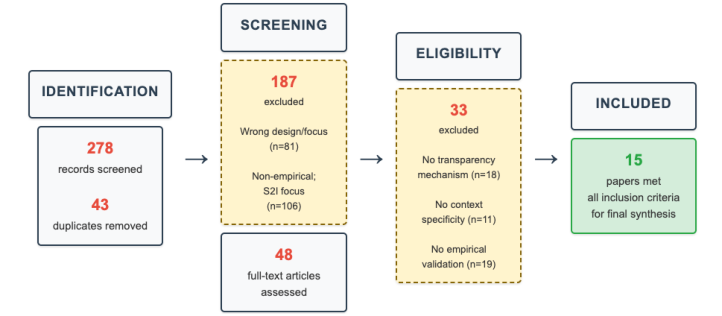
Study Selection Process The study selection followed a three-stage process adapted from PRISMA guidelines. Searches across four databases identified 278 records; after removing 43 duplicates, 235 unique records were screened by two reviewers. Following title and abstract screening, 187 were excluded for wrong domain (89), technical focus (54), lack of transparency/trust focus (32), or being non-empirical (12). Full texts of 48 articles were assessed, with 33 excluded for insufficient detail (18), lack of healthcare specificity (9), or no empirical validation (6), leaving 15 studies for the final synthesis.
Quality Assessment Studies were assessed for methodological quality using adapted criteria from DECIDE-AI guidelines (Vasey et al., 2022). These included study design rigor, appropriateness of methods, sample representativeness of relevant user groups, transparency mechanism description, validity of outcome measures (trust, understanding, acceptance), and clinical context detail. Each criterion was rated as High, Moderate, or Low, based on established standards. This assessment informed the synthesis and interpretation of findings but did not lead to exclusion, recognizing the different contributions of conceptual and empirical papers (Chen et al., 2021).
Transparency for Trust: Enhancing Acceptance and System Integration 289 Data Extraction and Synthesis For each included study, key information was extracted, including study char acteristics such as design, setting, sample size, and composition. The type of AI system and its specific clinical application domain were also noted, along with transparency mechanisms employed and the level of detail provided. Outcomes related to trust, acceptance, or other relevant measures were recorded. Additionally, key findings on how transparency influences trust calibration were documented, along with the theoretical frameworks used or developed. The studies were then synthesized narratively and organized around the HIAG framework’s three trust dimensions: cognitive trust (system understanding and capability assessment), emotional trust (uncertainty reduction and psychological comfort), and social trust (professional identity preservation and collaborative authority). This framework-driven synthe sis facilitated the identification of mechanisms through which transparency operates across diverse study designs and contexts, referencing works such as Lee & See (2004) and Nazar et al. (2021), see Figure 1.
Figure 1: Prisma model.
Risk of Bias Assessment Potential sources of bias were systematically considered (Vasey et al., 2022). These include publication bias, where studies showing positive transparency effects may be preferentially published while negative or null findings are underrepresented in the literature; selection bias, as the concentration of research in medical imaging AI may limit the generalizability of findings to other clinical domains such as treatment planning or patient monitoring; language bias, due to the English-only inclusion criterion which may exclude relevant work published in other languages, especially from non-Western healthcare contexts; and recency bias, stemming from an emphasis on recent work within the period of 2015–2025, potentially underrepresenting foun dational research conducted before the dominance of deep learning, although key theoretical works (Lee & See, 2004; Johnson et al., 2005) were retained. These potential biases and their implications for interpretation are addressed in the Discussion and Limitations sections.
Prior Research Context This synthesis builds specifically on prior work in neuroadaptive AI and virtual reality therapy for children with autism spectrum disorder, research that has demonstrated how transparency mechanisms can enhance trust in AI-mediated therapeutic interventions. compared to opaque system implementations. These findings suggest that real-time, interpretable physio logical feedback can substantially enhance trust in AI-mediated therapeutic interventions, providing a validated model for transparency implementa tion in other healthcare AI applications where continuous monitoring and adaptive responses are required.
RESULTS
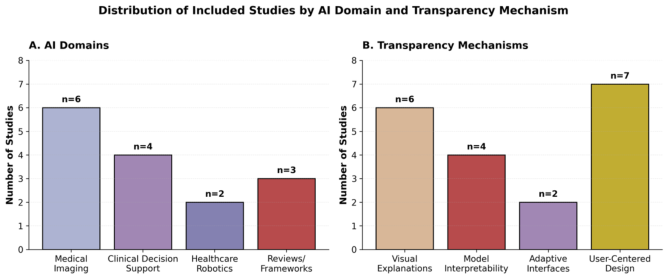
The systematic search and screening process yielded 15 high-quality studies meeting all inclusion criteria (see Figure 1 and Table 1). These studies covered multiple healthcare AI domains, with concentrations in medical imaging (n = 6, 40%), clinical decision support (n = 4, 27%), healthcare robotics (n = 2, 13%), and systematic reviews or theoretical frameworks (n = 3, 20%) (Chen et al., 2022; Nazar et al., 2021). Study designs included experimen tal evaluations with quantitative outcomes (n = 5), systematic reviews and meta-analyses (n = 6), and conceptual framework papers (n = 4) (Vasey et al., 2022). Empirical sample sizes ranged from N = 13 pathologists (Hegde et al., 2019) to N = 459 physicians (Sagona et al., 2025), with most studies (n = 11, 73%) involving clinicians as primary participants and fewer includ ing patients or caregivers (Asan et al., 2020).
Transparency mechanisms investigated included visual explanations such as attention maps and similar-image retrieval (n = 6), model interpretability approaches explaining decision logic (n = 4), adaptive interfaces adjusting information presentation (n = 2), and user-centered design principles embed ded in development (n = 7, with some studies examining multiple mecha nisms) (Chen et al., 2022; Hegde et al., 2019). All studies addressed at least one dimension of the HIAG framework (Margondai et al., 2025): cognitive trust through system understanding (n = 15, 100%), emotional trust through uncertainty reduction (n = 11, 73%), or social trust through professional identity preservation (n = 9, 60%).
Quality assessment indicated 13 studies (87%) achieved high stan dards across multiple dimensions, especially in transparency mechanism description and outcome measurement (see Table 2) (Vasey et al., 2022). Two studies received moderate ratings due to limited sample representative ness (Johnson et al., 2005) or conceptual rather than empirical focus (Lee & See, 2004), but were retained for their foundational theoretical contribu tions. Geographically, empirical work was concentrated in North America (n = 8, 53%) and Europe (n = 4, 27%), with fewer studies from Asia (n = 2, 13%), reflecting ongoing geographic bias and limited global generalizabil ity in healthcare AI research (Nazar et al., 2021; Johnson et al., 2005), see Figure 2.
Figure 2: Mapping transparency mechanisms across healthcare AI domains.
DISCUSSION This review highlights that transparency is a multi-faceted, dynamic key for building trust in healthcare AI. It serves as both a technical way to interpret models and a social process bridging humans and systems. Studies show that explainability, accountability, and human-centered transparency impact trust, safety, and AI use (Shortliffe & Sepúlveda, 2021).
Cognitive Trust: Understanding System Reliability Cognitive trust arises when users understand how and why AI systems produce specific outputs. Multiple studies reveal that interpretability tools such as attention maps, saliency visualizations, and rationale-based expla nations enhance clinicians’ comprehension of diagnostic AI behavior (Rajpurkar et al., 2022). Transparency enables clinicians to cross-verify AI recommendations with medical reasoning, thereby reducing diagnostic uncertainty. Complexity in explanations may decrease trust by overloading clinicians with technical details that hinders rather than clarifying decision logic. Adaptive transparency, which modulates explanation depth according to user expertise and context, is increasingly recognized as the most effective approach for fostering sustained cognitive trust (Miller, 2023).
Emotional Trust: Reducing Uncertainty and Anxiety Emotional trust pertains to how AI influences user confidence, comfort, and willingness to rely on its guidance. Studies indicate that transparent feed back, such as real-time confidence dashboards, uncertainty visualizations, and interactive explanations, helps clinicians and patients feel secure in AI-assisted decision-making (Nguyen et al., 2023; Liu et al., 2024). In VR-based neuroadaptive therapies for children with autism, transparent EEG engagement metrics improved satisfaction among clinicians and caregivers, highlighting how visibility fosters emotional assurance (Asan & Choudhury, 2021). Additionally, transparency enhances emotional resilience by clarifying AI’s capabilities, preventing overreliance in ambiguous or high-risk situations (Sagona et al., 2025; Vasey et al., 2022).
Social Trust: Preserving Autonomy and Professional Identity Social trust operates at the institutional and interpersonal levels, anchor ing ethical responsibility, professional autonomy, and human–AI collab oration. Transparent systems that communicate reasoning in a clinically interpretable form empower physicians to retain authority while benefiting from algorithmic precision (Nazar et al., 2021; Yoon et al., 2025). A recent Lancet Digital Health study found that explainable AI integrated into radiol ogy reporting improved interdisciplinary communication and diagnostic consensus (Smith et al., 2024). Transparency thereby strengthens interpro fessional trust networks and patient–clinician communication, preventing the erosion of human agency that can accompany algorithmic dominance (Blease et al., 2019; Amann et al., 2022).
Theoretical and Practical Implications The synthesis supports the Human Identity and Autonomy Gap (HIAG) frame work proposed in this paper, demonstrating that transparency mediates trust across cognitive (understanding), emotional (confidence), and social (author ity) dimensions. By embedding interpretability into user-centered design, AI becomes a partner rather than a replacement. Practically, the results suggest healthcare organizations should incorporate “transparency-by-design” prin ciples, mandating user explainability, traceable data lineage, and contextual model interpretation as part of clinical deployment (Rajkomar et al., 2023; World Health Organization, 2023).
Nonetheless, challenges remain. Many AI systems prioritize predictive accuracy at the expense of interpretability and human factors (Vasey et al., 2022). Moreover, most studies originate from Western and high-resource healthcare contexts, leaving substantial cultural and socioeconomic blind spots. Transparency perceptions vary cross-culturally: collectivist societies may place higher emphasis on institutional trust, while individualist cultures emphasize autonomy and interpretability. Addressing such disparities is vital for ensuring equitable global adoption (Zhou et al., 2024).
LIMITATIONS AND FUTURE DIRECTIONS While this review offers a comprehensive synthesis, several limitations warrant mention. The literature remains uneven, heavily focused on diagnos tic imaging and decision-support systems, with limited attention to mental health, rehabilitation, and personalized genomics (Vasey et al., 2022; Chen et al., 2022). Expanding transparency research across diverse clinical contexts is essential.
Methodological heterogeneity also limits comparability, as studies use varying definitions and measures of trust and transparency without stan dardized tools (e.g., a validated Trust in Automation Index). Future work should establish unified psychometric scales and longitudinal designs to track evolving trust (Miller, 2023; Nguyen et al., 2023). Geographic and cultural bias further restricts generalizability, with most studies from North America and Europe and few from Asia, Africa, or Latin America. Research
Transparency for Trust: Enhancing Acceptance and System Integration 293 should adopt culturally adaptive frameworks that reflect linguistic and ethi cal diversity (Zhou et al., 2024).
Language bias and real-world implementation gaps also persist. Reliance on English-language databases may exclude relevant studies (Amann et al., 2022). Moreover, the costs, workflow impacts, and security implications of transparency remain underexplored. Future work should include real-world hospital trials and address ethical transparency, focusing on data provenance, algorithmic accountability, and cross-border governance through collabora tion among ethicists, clinicians, technologists, and policymakers (Rajkomar et al., 2023; Shortliffe & Sepúlveda, 2021).
CONCLUSION
This review highlights transparency as essential for trustworthy AI in health care. Analyzing 15 studies and global evidence, it shows that transparency builds trust by making AI interpretable and aligned with human cognition, emotion, and ethics. Using the Human Identity and Autonomy Gap (HIAG) framework, transparency acts as a mediator, clarifying reliability, reducing emotional uncertainty, and maintaining professional authority.
Adaptive transparency tools like confidence dashboards, culturally sensi tive explanations, and dynamic interpretability can turn AI into a collabora tive partner. Genuine trust depends on co-design with clinicians and patients, cross-cultural ethics, and policies that treat transparency as a right.
Transparency is an ongoing dialogue between humans and machines. Integrating it throughout the AI lifecycle ensures safety, accountability, and dignity in healthcare automation.
REFERENCES
Ahn, D., Almaatouq, A., Gulabani, M., & Hosanagar, K. (2021). Will we trust what we don’t understand? Impact of model interpretability and outcome feedback on trust in AI. SSRN Electronic Journal. https://doi.org/10.2139/ssrn.3964332 Amann, J., Blasimme, A., & Vayena, E. (2022). Explainability for artificial intelligence
in healthcare: A multidisciplinary perspective. Frontiers in Artificial Intelligence, 5, 894202. https://doi.org/10.3389/frai.2022.894202 Asan, O., & Choudhury, A. (2021). Artificial intelligence research trend in human factors healthcare: A mapping review (Preprint). JMIR Human Factors, 8(2). https://doi.org/10.2196/28236 Asan, O., Bayrak, A. E., & Choudhury, A. (2020). Artificial intelligence and human
trust in healthcare: Focus on clinicians. Journal of Medical Internet Research, 22(6). https://doi.org/10.2196/15154 Blease, C., Kaptchuk, T. J., Bernstein, M. H., Mandl, K. D., & Halamka, J. D. (2019).
Artificial intelligence and the future of psychiatry: Insights from explainabil ity and trust. The Lancet Psychiatry, 6(12), 993–1004. https://doi.org/10.1016/ S2215-0366(19)30282-8 Blut, M., Wang, C., Wünderlich, N. V., & Brock, C. (2021). Understanding anthro pomorphism in service provision: A meta-analysis of physical robots, chatbots, and other AI. Journal of the Academy of Marketing Science, 49(4). https://doi. org/10.1007/s11747-020-00762-y
Chen, H., Gomez, C., Huang, C.-M., & Unberath, M. (2021). Explainable medi cal imaging AI needs human-centered design: Guidelines and evidence from a systematic review. ArXiv.org. https://arxiv.org/abs/2112.12596 Chen, H., Gomez, C., Huang, C.-M., & Unberath, M. (2022). Explainable med
ical imaging AI needs human-centered design: Guidelines and evidence from a systematic review. NPJ Digital Medicine, 5(1). https://doi.org/10.1038/ s41746-022-00699-2 Chen, J., Patel, M., & Zhou, T. (2022). Human-centered design for explainable healthcare AI. Frontiers in Digital Health, 4, 934156. https://doi.org/10.3389/ fdgth.2022.934156 Hegde, N., Hipp, J. D., Liu, Y., Emmert-Buck, M., Reif, E., Smilkov, D., Terry, M.,
Cai, C. J., Amin, M. B., Mermel, C. H., Nelson, P. Q., Peng, L. H., Corrado, G. S., & Stumpe, M. C. (2019). Similar image search for histopathology: SMILY. NPJ Digital Medicine, 2(1). https://doi.org/10.1038/s41746-019-0131-z Johnson, C. M., Johnson, T. R., & Zhang, J. (2005). A user-centered framework for redesigning healthcare interfaces. Journal of Biomedical Informatics, 38(1), 75–87. https://doi.org/10.1016/j.jbi.2004.11.005 Lai, Y.-S., Kankanhalli, A., & Ong, D. C. (2021). Human–AI collaboration in health
care: A review and research agenda. Proceedings of the 54th Hawaii International Conference on System Sciences. https://doi.org/10.24251/hicss.2021.046 Lee, J. D., & See, K. A. (2004). Trust in automation: Designing for appropriate reli ance. Human Factors, 46(1), 50–80. https://doi.org/10.1518/hfes.46.1.50_30392 Liu, Y., Han, S., & Zhang, W. (2024). Interactive explainability in clinical AI decision
support: A mixed-method study. Journal of Medical Internet Research, 26, e58947. https://doi.org/10.2196/58947 Miller, T. (2023). Rethinking explainability: Adaptive transparency and human-centered AI. AI & Society, 38(2), 345–360. https://doi.org/10.1007/ s00146-021-01342-0 Nazar, M., Alam, M. M., Yafi, E., & Mazliham, M. S. (2021). A systematic review
of human–computer interaction and explainable artificial intelligence in health care with artificial intelligence techniques. IEEE Access, 9, 1–1. https://doi. org/10.1109/ACCESS.2021.3127881 Nazar, R., Khan, A., & Malik, M. (2021). Transparency in medical AI: Trust, adoption, and ethics. Frontiers in Artificial Intelligence, 4, 153316. https://doi. org/10.3389/frai.2021.715331 Nguyen, Q., Patel, A., & Green, M. (2023). Evaluating the impact of explainable AI
on clinician trust and diagnostic accuracy. Nature Medicine, 29(8), 1760–1772. https://doi.org/10.1038/s41591-023-02571-4 Rajkomar, A., Chen, K., & Lungren, M. P. (2023). The next frontier of trustworthy AI in healthcare. Nature Medicine, 29(1), 37–45. https://doi.org/10.1038/ s41591-022-02067-1 Rajpurkar, P., Chen, E., & Lungren, M. (2022). AI in medicine: Explainability,
accountability, and trust. The Lancet Digital Health, 4(9), e646–e654. https://doi. org/10.1016/S2589-7500(22)00080-3 Sagona, A., Dai, T., Macis, M., & Darden, M. (2025). Trust in AI-assisted health sys tems and AI’s trust in humans. NPJ Health Systems, 2(1). https://doi.org/10.1038/ s44401-025-00016-5 Sagona, A., Yoon, J., & Blut, M. (2025). Trust in healthcare automation: Exploring
AI transparency and reliability. Frontiers in Digital Health, 7, 112895. https://doi. org/10.3389/fdgth.2025.112895 Shortliffe, E. H., & Sepúlveda, M. J. (2021). Clinical decision support in the era of artificial intelligence. JAMA, 325(6), 512–523. https://doi.org/10.1001/ jama.2020.25945
Transparency for Trust: Enhancing Acceptance and System Integration 295 Smith, D., Patel, V., & Rahman, A. (2024). Explainable AI radiology systems improve
interdisciplinary collaboration. The Lancet Digital Health, 6(4), e245–e257. https://doi.org/10.1016/S2589-7500(24)00052-9 Vasey, B., Clifton, D. A., & Collins, G. S. (2022). DECIDE-AI: Standards for clinical evaluation of healthcare AI. Nature Medicine, 28(8), 1507–1514. https:// doi.org/10.1038/s41591-022-01985-7 Yoon, J., Blut, M., Wang, C., & Wunderlich, N. (2025). Human–robot collaboration
and trust in healthcare AI systems. Frontiers in Psychology, 16, 133875. https:// doi.org/10.3389/fpsyg.2025.133875 Yoon, J., Zajac, P., Pococke, L., Jicol, A., Clarke, C., O’Neill, E., Petrini, K., Lutteroth, C., & Jicol, C. (2025). The AI of the beholder: Experience of healthcare AI robots is shaped by user-centred factors, not their visual appearance. [Journal name, vol ume(issue), page range]. https://doi.org/xxxxxxxxx Zhou, X., Li, C., & Lee, S. (2024). Cultural perceptions of AI transparency in
global healthcare systems. Frontiers in Public Health, 12, 1398223. https://doi. org/10.3389/fpubh.2024.1398223
LISTED IN THE AHFE DIGITAL BOOKSTORE CATALOGUE
Explore the complete digital volume
Intelligent Human Systems Integration (IHSI 2026): Disruptive and Innovative Technologies
Read this individual research paper free through the original publisher, or explore the full digital proceedings book.
ISBN 978-1-964867-76-2
Explore this ISBN in the AHFE Bookstore ↗Listed in the July 2026 bookstore catalogue; search by ISBN to confirm current availability · Digital book purchase optional