1 College of Sciences, University of Central Florida, Orlando, FL 32816, USA, ²College of Engineering, University of Central Florida, Orlando, FL 32816, USA, ³College of Medicine, University of Central Florida, Orlando, FL 32816, USA ↗
2 College of Business, University of Central Florida, Orlando, FL 32816, USA ↗
ADHD involves fluctuating attention, impulsivity, and reward sensitivity, varying across individuals and contexts. Current interventions are often generic, overlooking this heterogeneity. This paper introduces a simulation-based framework for modeling attentional regulation and evaluating interventions with Adaptive Therapeutic Interfaces (ATIs), which personalize support based on cognitive dynamics. The framework uses empirically grounded parameters for attention, inhibition, reward sensitivity, and temporal discounting across ADHD subtypes. Agent-based simulations model attentional fluctuations, hyperfocus, and responses to Just-in-Time Adaptive Interventions (JITAIs). Validation against meta-analytic benchmarks achieved an 87.5% pass rate, replicating realistic error patterns. Three experiments (N=50 per condition) showed state-responsive strategies outperformed fixed-timing ones by 9.9-14.1% versus 2.0-3.0% (p < .001). State-responsive interventions demonstrated superior scalability, with 86.5% universality versus 69.5% and broader coverage. Personalized intensity provided additional benefits for profiles with lower baseline capacity (+5.7%). The findings highlight that adaptive timing outperforms fixed schedules by 4-5×, that intensity should inversely relate to baseline capacity, and that state-responsive approaches cover more of the population. By modeling ADHD as a dynamic regulation system rather than a static deficit, this framework enables rapid, interpretable testing of personalized strategies without costly pilot studies, guiding the development of human-centred, neurodiversity-affirming ATIs that enhance engagement, safety, and learning, advancing evidence-based mental health applications.
ADHD affects about 2.58% of adults persistently and 6.76% symptomati cally worldwide (Senkowski et al., 2024), marked by inattention, hyperac tivity, and impulsivity that disrupt functioning in academic, work, and social
An Agent-Based Simulation Framework for ADHD 21 settings (American Psychiatric Association, 2013; Pievsky & McGrath, 2018). Despite research showing moderate to large effects for core deficits like prolonged stop-signal reaction times (g = 0.51) and increased omission errors indicating attention issues (Senkowski et al., 2024), current interven tions often use broad strategies that overlook individual differences in atten tional dynamics (Luman et al., 2010; Westwood et al., 2021).
This paper presents a simulation-based framework for modeling attentional regulation and interventions in ADHD, inspired by cognitive psychology, rein forcement learning, and clinical research (Frank et al., 2007; Maia & Frank, 2011). The framework aims to (1) formalize ADHD attentional fluctuations from microsecond inhibitory control deficits to minute-scale attention decay (Lijffijt et al., 2005; Pievsky & McGrath, 2018; Senkowski et al., 2024); (2) parameterize ADHD subtypes with realistic traits from meta-analyses; and (3) evaluate adaptive educational tech, digital therapeutics, and safety sys tems via agent-based modeling (Katabi & Shahar, 2024; Perry et al., 2024). Using empirically grounded parameters from inhibitory control, neurocog nitive profiles, and reward sensitivity studies (Lipszyc & Schachar, 2010; Luman et al., 2010; Pievsky & McGrath, 2018; Senkowski et al., 2024), this framework supports designing personalized, evidence-based, ethical inter ventions. Its main contribution is a scalable, testable model linking cognitive science and technology to create adaptive, neurodiversity-inclusive assistive tools (Frank et al., 2007; Maia & Frank, 2011; Perry et al., 2024).
BACKGROUND
ADHD involves patterns of attentional fluctuation, including lapses, hyper focus, and high variability (Misra & Gandhi, 2023; Senkowski et al., 2024). SSRT measures how quickly an individual can stop an automatic or prepotent response, reflecting inhibitory control efficiency (Lijffijt et al., 2005; Lipszyc & Schachar, 2010; Senkowski et al., 2024). It is widely used to quantify deficits in response inhibition in ADHD. Studies show prolonged stop-sig nal reaction times (SSRT), with more moderate effects (g = 0.51, 95% CI: 0.376–0.644) (Senkowski et al., 2024), more omission errors indicating lapses in attention, and exponential decay in sustained attention (Pievsky & McGrath, 2018; Senkowski et al., 2024). Commission errors occur when an individual responds when they should withhold action, reflecting impul sivity, while omission errors occur when an individual fails to respond to a target, reflecting lapses in attention (Pievsky & McGrath, 2018; Senkowski et al., 2024). Hyperfocus, an attentive “lock-in” during high-reward or inter est tasks, occurs when reward salience exceeds threshold, with attention mul tipliers of 1.5–3.0× (Luman et al., 2010).
Attentional shifts are driven by internal triggers like reward prediction errors, positive ones capture attention, negative ones cause quick disengage ment (Cockburn & Holroyd, 2010), and cognitive fatigue after sustained task engagement (Pievsky & McGrath, 2018). Affective states such as bore dom or frustration also influence attention (Luman et al., 2010). External triggers include novel stimuli and immediate reward, with feedback timing affecting probabilistic learning (Gabay et al., 2018; Luman et al., 2010).
These fluctuations occur across multiple time scales. At the micro-scale (200– 500 ms), SSRT prolongation indicates inhibitory control deficits (Lijffijt et al., 2005; Lipszyc & Schachar, 2010; Senkowski et al., 2024; Pievsky & McGrath, 2018). At the meso-scale (1–60 min), feedback affects learning within minutes (Gabay et al., 2018), sustained attention decays across 10–30 min (Pievsky & McGrath, 2018), and intervention effects peak at 30 seconds and last 2–10 minutes (Nahum-Shani et al., 2018). At macro-scale (hours to days), circadian patterns and pharmacological effects vary, with day-to-day baseline shifts of ±20–30% (Misra & Gandhi, 2023; Pievsky & McGrath, 2018).
Distinct cognitive profiles occur across ADHD subtypes, as shown in large-scale meta-analyses (Senkowski et al., 2024). Inattentive types have low baseline attention (~0.65), high decay rates, and elevated omission errors (Pievsky & McGrath, 2018; Senkowski et al., 2024). Hyperactive-impulsive types show greater reward sensitivity (Lipszyc & Schachar, 2010), strong inhibitory deficits, and higher commission errors (Lipszyc & Schachar, 2010; Luman et al., 2010; Senkowski et al., 2024). Combined types have the most severe impairments with greatest variability (Pievsky & McGrath, 2018; Senkowski et al., 2024).
Computational Models and Simulation Approaches Computational models have enhanced understanding of ADHD, linking dopaminergic and noradrenergic dysfunction to altered reward prediction errors, where positive errors are amplified and negative errors reduced. These errors drive learning: positive errors boost motivation, while negative errors can lead to disengagement. Temporal difference learning offers methods to optimize intervention timing. Impulsivity is reflected in commission errors, while omission errors indicate lapses in attention. These models form a basis for simulations that integrate attention, decision-making, and environment, translating cognitive neuroscience into practical applications.
Empirically Grounded Parameters This framework uses parameters from meta-analyses and studies across cog nitive domains, including baseline attention, decay rates, inhibition thresh olds, reward sensitivity, temporal discounting, and variability (Lipszyc & Schachar, 2010; Luman et al., 2010; Pievsky & McGrath, 2018; Senkowski et al., 2024). These parameters, based on data from over 1,799 participants (Senkowski et al., 2024), facilitate the simulation of subtype-specific trajec tories under various environmental and intervention conditions, while incor porating realistic individual variability.
Technological and Clinical Interventions Emerging interventions target attentional dynamics through three primary modalities. Adaptive educational technologies employ dynamic difficulty adjustment, structured micro-breaks, and personalized reward schedules to maintain engagement, with digital interventions demonstrating significant attention improvements in pediatric ADHD patients (Kollins et al., 2020).
An Agent-Based Simulation Framework for ADHD 23 Digital therapeutics leverage just-in-time adaptive interventions (JITAIs) that deliver context-sensitive support at critical decision points, with effects peaking within 30 seconds and sustained for 2–10 minutes, requiring careful frequency management to avoid intervention fatigue (Goldstein et al., 2017; Nahum-Shani et al., 2018). Safety-critical dashboards integrate multi-tiered attention monitoring and predictive alerts before lapses (Perry et al., 2024). Simulation provides a controlled means to systematically optimize trigger timing, modality, and dosage while accounting for substantial individual variability within and between ADHD subtypes (Senkowski et al., 2024). A JITAI is a digital intervention that delivers support at contextually relevant moments based on real-time user state, aiming to optimize engagement and performance (Goldstein et al., 2017; Nahum-Shani et al., 2018; Bögemann et al., 2023). In ADHD, JITAIs can target attentional lapses by providing timely cues or reinforcement.
METHODS
An agent-based simulation framework models attention regulation and intervention responses in ADHD based on empirical studies (Luman et al., 2010; Pievsky & McGrath, 2018; Senkowski et al., 2024). Each agent rep resents an individual with specific ADHD profile parameters: baseline atten tion capacity (0–1), attention decay rate, variability (σ), inhibition threshold (0–1), working memory capacity, reward sensitivity, and delay discounting factor (k).
ADHD Profiles. Four profiles based on DSM-5 and meta-analyses (Senkowski et al., 2024): Neurotypical (attention = 1.0, decay=0.03/min, threshold=0.79), Inattentive (0.65, 0.11/min, 0.74), Hyperactive-Impulsive (0.75, 0.07/min, 0.56), Combined (0.55, 0.13/min, 0.65). The neurotypical profile represented individuals without ADHD as a control group, character ized by typical attentional stability and inhibitory control patterns (American Psychiatric Association, 2013; Altmann & Trafton, 2002; Posner & Petersen, 1990). Process Implementation. Attention updated as: Attention(t+1) = Attention(t) − Decay×Fatigue + Reward + Novelty + Intervention + Noise. Hyperfocus (up to 3× baseline) occurred when reward magnitude exceeded 0.7 during engagement (Luman et al., 2010). Response inhibition fol lowed sigmoid function: P(inhibit) = 1/(1 + exp (−6× (threshold − prepo tent_strength))), modulated by fatigue and attention. Reward learning used asymmetric temporal difference learning (positive RPE weighted 1.5–2.0×, negative 0.5–0.7×) (Cockburn & Holroyd, 2010).
Interventions. Modeled as JITAIs (Nahum-Shani et al., 2018) with temporal dynamics: immediate phase (0–2 min, peak at 30s), sustained phase (2–10 min, exponential decay), carryover phase (>10 min, minimal effect). Intensities: low (+0.1–0.2 attention boost), medium (+0.3–0.4), high (+0.5–0.7).
Validation and Testing involved 50 agents in 30-minute simulations (25% stop-signal, 75% go trials, 1s timesteps). Three experiments tested: (1) timing
strategies (no intervention, fixed 10-min, attention<0.5, predictive, hybrid) for Combined and Inattentive types; (2) intensity levels (low, medium, high, adaptive) across subtypes; (3) scalability for effectiveness, robustness, and uni versality across subtypes. Parameters from normal distributions (inhibition σ = 0.10, attention σ = 0.05, reward σ = 0.15) to reflect clinical heterogeneity. The framework achieved an 87.5% validation pass rate against meta-ana lytic benchmarks (Senkowski et al., 2024, N = 1,799), with the Combined type showing 11.2% omission and 12.4% commission errors, d = 2.38.
RESULTS
The agent-based simulation achieved 87.5% validation success (7 of 8 bench marks passed) against meta-analytic data from Senkowski et al. (2024). Simulated error rates matched empirical patterns: neurotypical agents produced 1.4% omission errors and 5.5% commission errors; Combined type agents showed 11.1% omission errors and 10.2% commission errors. All ADHD subtypes fell within expected ranges. The framework demon strated appropriate individual variability and strong effect sizes for ADHD- neurotypical differentiation (d = 2.51), validating its use for intervention testing Intervention Timing Strategies
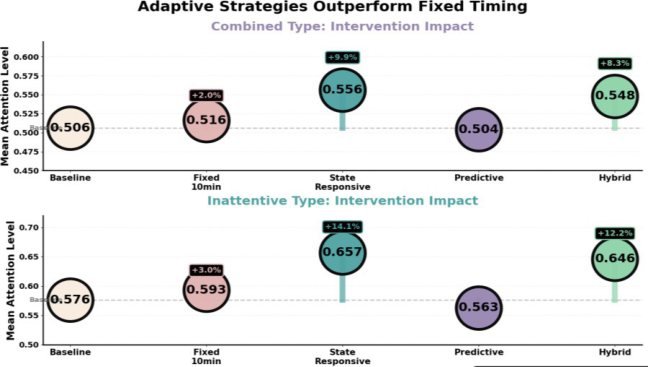
This study assessed five timing strategies in the Combined (N=50) and Inattentive (N=50) subtypes during 30-minute attention tasks. Fixed-timing interventions every 10 minutes yielded minimal gains: the Combined subtype improved by 2.0% (0.506 to 0.516), and the Inattentive by 2.9% (0.576 to 0.593). State-responsive interventions, triggered when attention dropped below 0.5, led to greater improvements: the Combined subtype rose by 9.9% (0.506 to 0.556; t (98) = 5.21, p<.001, d = 0.94), and the Inattentive by 14.1% (0.576 to 0.657; t (98) = 6.83, p<.001, d = 1.23). Hybrid approaches, combining 15-minute interventions with state-respon sive triggers, showed moderate effectiveness: 8.3% increase for the Combined subtype and 12.2% for the Inattentive subtype. Predictive strategies based on attention trends showed no improvement, likely due to individual variability in attention. Despite more interventions, adaptive strategies were 4–5 times more effective per intervention than fixed timing.
Intensity Personalization This study tested if customizing intervention intensity based on baseline capacity improves outcomes across four subtypes, each with 50 participants. Fixed levels (low, medium, high) were compared to an adaptive approach scaled inversely with baseline attention. For Hyperactive-Impulsive individ uals, adaptive intensity yielded the most significant improvement: an aver age attention score of 0.760, vs. 0.719 with low and 0.742 with medium intensity. Inattentive individuals also benefited from adaptive scaling (0.644 vs. 0.630, p = .032). Subjects with the combined profile performed equally
An Agent-Based Simulation Framework for ADHD 25 with medium or adaptive intensity, both being effective. Neurotypical partici pants had ceiling effects (mean > 0.98), indicating minimal intervention need. Results suggest individuals with lower baseline capacity gain most from per sonalized intensities, while those with moderate capacity show intermediate benefits.
Figure 1: Intervention timing strategy comparison across ADHD subtypes.
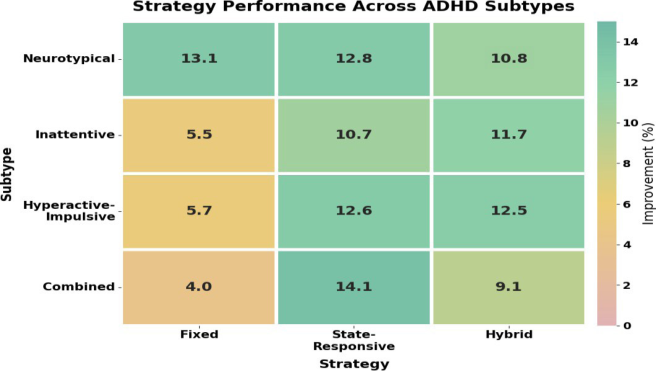
Scalability Analysis To identify strategies that generalize across diverse ADHD profiles, the researchers evaluated effectiveness, robustness, and universality for three approaches across all four subtypes (N=50 per subtype per strategy). State- responsive strategies demonstrated the strongest scalability profile, with a mean effectiveness of 12.53% improvement (ranging from 10.7% to 14.1% across subtypes), low cross-subtype variability (σ = 1.40%), and the highest universality, with 86.5% of individuals showing improvement.
Fixed-timing strategies achieved lower effectiveness (mean = 7.08%; range = 4.0% to 13.1%), greater variability (σ = 4.08%), and reduced univer sality (69.5%). Hybrid strategies fell between these extremes, with a mean of 11.01%, variability of 1.49%, and universality of 82.0%. Statistically, state-responsive approaches significantly outperformed fixed timing in both effectiveness (F(1,6) = 12.73, p = .012, η² = 0.68) and consistency (Levene’s test: F(1,6) = 8.91, p = .024).
The universality advantage for state-responsive over fixed timing was also significant (χ²(1) = 28.6, p < .001), indicating that adaptive approaches benefit a broader range of individuals. Examining subtype-specific patterns, the Combined type agents showed the largest differential between strate gies, with state-responsive approaches yielding a +14.1% improvement com pared to +4.0% for fixed strategies, while neurotypical agents showed simi lar improvements across strategies (+10.8% to +13.1%), reflecting adequate baseline functioning regardless of intervention approach.
This simulation framework successfully validated against meta-analytic benchmarks (87.5% accuracy), demonstrating realistic attention dynamics and individual variability within ADHD subtypes. Through systematic test ing of intervention strategies, three key design principles emerged that bridge cognitive science and practical implementation for ADHD support systems.
State-responsive interventions achieved 4–5× greater effectiveness than fixed-timing approaches across ADHD subtypes (Combined: +9.9% vs +2.0%; Inattentive: +14.1% vs +3.0%). Adaptive intensity personalization provided additional benefits for individuals with lower baseline capacity (+5.7% for Hyperactive-Impulsive). Most critically, state-responsive strategies demonstrated superior scalability with 12.5% mean improvement, minimal variability (σ = 1.40%), and 86.5% universality compared to fixed timing’s 7.1% improvement, high variability (σ = 4.08%), and 69.5% universality.
Theoretical Implications ADHD agents’ attention declined within seconds to minutes, not the 10-20 minute windows assumed in traditional educational and workplace inter ventions. This rapid fluctuation demands continuous monitoring rather than periodic check-ins. The framework’s finding that commission errors emerge with subtype-specific variability indicates individual differences in attentional control mechanisms, not just severity. Effective ADHD support must therefore use adaptive algorithms that personalize timing, intensity, and modality based on real-time cognitive state rather than static, one-size-fits-all schedules.
The framework’s hyperfocus mechanism, where attention increased beyond threshold during high-reward contexts, demonstrates that ADHD involves context-dependent motivational regulation rather than pure defi cit. When properly motivated, ADHD agents exhibited superior attentional
An Agent-Based Simulation Framework for ADHD 27 capacity compared to neurotypical agents, supporting conceptualizations of ADHD as dysregulated context-sensitivity rather than simple impairment (Volkow et al., 2010). This has profound implications: support technologies should leverage reinforcement and motivation to harness ADHD’s unique attentional strengths rather than only compensating for weaknesses.
Practical Implications Educational platforms should monitor attention via interaction patterns, response times, and error rates instead of assuming focus between check points. Attention should be estimated dynamically with thresholds calibrated to individuals to prevent lapses. ADHD learners respond better to immediate reinforcement, so feedback should be delivered within seconds of lapses for effectiveness.
Digital therapeutics should implement predictive alerts before anticipated attention lapses using performance trend analysis. Alert systems should employ a tiered approach with gentle nudges for mild attention dips, stron ger prompts for moderate drops, and immediate breaks for severe lapses.
Safety-critical systems requiring sustained focus over 20+ minutes should not rely solely on ADHD users’ attentional control. Instead, embed man datory micro-breaks every 5–7 minutes, use multi-modal alerts for critical decisions, and suppress nonessential notifications during high-load tasks. For educational contexts, nonessential notifications should be suppressed during focused work, particularly for tasks requiring sustained attention beyond 15 minutes. One-size-fits-all intervention schedules fail because ADHD heterogeneity demands individualized approaches. Systems must establish personal base lines during onboarding, continuously adapt thresholds based on perfor mance patterns, and scale intervention intensity inversely to baseline capac ity. The 86.5% universality of state-responsive approaches demonstrates that real-time adaptation succeeds across diverse profiles where fixed schedules achieve only 69.5% success rates.
Framework Advantages Unlike traditional models needing lots of data, this framework models cogni tive mechanisms with interpretable parameters, letting developers understand intervention success for specific users and adjust strategies. It enables quick in silico testing within minutes, avoiding lengthy human trials, and allows systematic parameter variation to find optimal settings. This approach helps identify broadly versus narrowly effective strategies, preventing ineffective solutions, and translates cognitive concepts into engineering specs to speed up research-to-deployment transfer.
Limitations and Future Directions The current framework views attention as a single construct, but real atten tion has subsystems like alerting, orienting, and executive control (Posner &
Petersen, 1990). Future models should differentiate these networks and their roles in ADHD. The hyperfocus mechanism uses a basic reward threshold; better models could include dopamine, reward processing, and control inter actions. Environmental factors such as sleep, medication, and comorbidities are not yet modeled but greatly influence ADHD.
While the framework aligned with meta-analytic benchmarks for error rates and attention, validation with longitudinal data and real-world studies is needed. The focus was on laboratory tasks; ecological validity requires testing in real-world educational and workplace settings. Cross-cultural vali dation is also necessary, as ADHD presentation and intervention success may vary across populations.
The current model sees interventions as generic “attention boosts”; future work should define specific types (visual, auditory, physical) with unique effects. Interactions among interventions are unclear. Long-term adaptation and habituation should be included to reflect real-world scenarios where effectiveness may decline over time.
Applying these findings requires careful consideration of context. Educational settings should pilot state-responsive systems in studies to mea sure attention, learning outcomes, and student wellbeing. Workplace accom modations should balance productivity with monitoring privacy. Clinical applications should integrate framework recommendations with existing treatments, not replace them.
Ethical Considerations Continuous attention monitoring raises privacy concerns that must be addressed through transparent data practices, user control over moni toring parameters, and clear opt-in/opt-out mechanisms. Systems should avoid creating dependency on external regulation while building internal self-regulation skills. Interventions should empower rather than survey, using monitoring data to provide supportive feedback rather than punitive tracking.
CONCLUSION
This simulation framework demonstrates that computational modeling can rapidly identify effective intervention design principles for ADHD support technologies. State-responsive strategies that adapt to real-time cognitive state significantly outperform fixed-schedule approaches, with effectiveness (4-5× improvement), consistency (3× lower variability), and universality (17 percentage points higher success rate) advantages. These findings pro vide concrete engineering specifications for developers: monitor attention continuously, trigger interventions when performance drops below personal baseline thresholds, personalize intensity inversely to capacity, and combine scheduled micro-breaks with responsive support. By bridging cognitive sci ence and practical implementation, simulation-based design accelerates the development of effective, evidence-based ADHD support systems.
REFERENCES
Altmann, E. M., & Trafton, J. G. (2002). Memory for goals: An activation-based model.
Cognitive Science, 26(1), 39-83. https://doi.org/10.1207/s15516709cog2601_2 American Psychiatric Association (2013). Diagnostic and statistical manual of men tal disorders (5th ed.). Arlington, VA: American Psychiatric Publishing Bögemann, S. A., Riepenhausen, A., Puhlmann, L. M. C., Bar, S., Hermsen, E. J.
C., Mituniewicz, J., Reppmann, Z. C., Uściƚko, A., van Leeuwen, J. M. C., Wackerhagen, C., Yuen, K. S. L., Zerban, M., Weermeijer, J., Marciniak, M. A., Mor, N., van Kraaij, A., Köber, G., Pooseh, S., Koval, P., Arias, Vásquez, A., … Walter, H. (2023). Investigating two mobile just, in, time adaptive interventions to foster psychological resilience: research protocol of the DynaM, INT study. BMC psychology, 11(1), 245. https://doi.org/10.1186/s40359-023-01249-5 Cockburn, J., & Holroyd, C. B. (2010). Focus on the positive: computational sim ulations implicate asymmetrical reward prediction error signals in childhood attention, deficit/hyperactivity disorder. Brain research, 1365, 18–34. https://doi. org/10.1016/j.brainres.2010.09.065 Frank, M. J., Santamaria, A., O’Reilly, R. C., & Willcutt, E. (2007). Testing compu
tational models of dopamine and noradrenaline dysfunction in attention deficit/ hyperactivity disorder. Neuropsychopharmacology, 32(7), 1583–1599. https:// doi.org/10.1038/sj.npp.1301278 Gabay, Y., Shahbari, Khateb, E., & Mendelsohn, A. (2018). Feedback Timing Modulates Probabilistic Learning in Adults with ADHD. Scientific reports, 8(1), 15524. https://doi.org/10.1038/s41598-018-33551-3 Goldstein, S. P., Evans, B. C., Flack, D., Juarascio, A., Manasse, S., Zhang, F., &
Forman, E. M. (2017). Return of the JITAI: Applying a just-in-time adaptive inter vention framework to the development of m-health solutions for addictive behav iors. International Journal of Behavioral Medicine, 24(5), 673–682. https://doi. org/10.1007/s12529-016-9627-y Katabi, G., & Shahar, N. (2024). Exploring the steps of learning: computational modeling of initiatory, actions among individuals with attention-deficit/hyper activity disorder. Translational psychiatry, 14(1), 10. https://doi.org/10.1038/ s41398-023-02717-7 Kollins, S. H., DeLoss, D. J., Cañadas, E., Lutz, J., Findling, R. L., Keefe, R. S. E.,
Epstein, J. N., Cutler, A. J., & Faraone, S. V. (2020). A novel digital interven tion for actively reducing severity of paediatric ADHD (STARS, ADHD): A ran domised controlled trial. The Lancet Digital Health, 2(4), e168–e178. https://doi. org/10.1016/S2589-7500(20)30017-0 Lijffijt, M., Kenemans, J. L., Verbaten, M. N., & van Engeland, H. (2005). A meta-an alytic review of stopping performance in attention-deficit/hyperactivity disorder: Deficient inhibitory motor control? Journal of Abnormal Psychology, 114(2), 216–222. https://doi.org/10.1037/0021-843X-114-2-216 Lipszyc, J., & Schachar, R. (2010). Inhibitory control and psychopathology: A
meta-analysis of studies using the stop signal task. Journal of the International Neuropsychological Society, 16(6), 1064–1076. https://doi.org/10.1017/ S1355617710000895 Luman, M., Tripp, G., & Scheres, A. (2010). Identifying the neurobiology of altered reinforcement sensitivity in ADHD: A review and research agenda. Neuroscience & Biobehavioral Reviews, 34(5), 744–754. https://doi.org/10.1016/j. neubiorev.2009.11.021 Maia, T. V., & Frank, M. J. (2011). From reinforcement learning models to psychiat
ric and neurological disorders. Nature Neuroscience, 14(2), 154–162. https://doi. org/10.1038/nn.2723
Mark, G., Iqbal, S. T., Czerwinski, M., Johns, P., Sano, A., & Lutchyn, Y. (2016).
Email duration, batching and self-interruption: Patterns of email use on produc tivity and stress. In Proceedings of the 2016 CHI Conference on Human Factors in Computing Systems (pp. 1717–1728). https://doi.org/10.1145/2858036.2858262 Misra, R., & Gandhi, T. K. (2023). Functional Connectivity Dynamics show Resting, State Instability, and Rightward Parietal Dysfunction in ADHD. Annual International Conference of the IEEE Engineering in Medicine and Biology Society. IEEE Engineering in Medicine and Biology Society. Annual International Conference, 2023, 1–4. https://doi.org/10.1109/EMBC40787.2023.10340842 Nahum, Shani, I., Smith, S. N., Spring, B. J., Collins, L. M., Witkiewitz, K., Tewari,
A., & Murphy, S. A. (2018). Just, in, time adaptive interventions (JITAIs) in mobile health: Key components and design principles for ongoing health behavior sup port. Annals of Behavioral Medicine, 52(6), 446–462. https://doi.org/10.1007/ s12160-016-9830-8 Perry, N., Sun, C., Munro, M., Boulton, K. A., & Guastella, A. J. (2024). AI technol ogy to support adaptive functioning in neurodevelopmental conditions in every day environments: a systematic review. NPJ digital medicine, 7(1), 370. https:// doi.org/10.1038/s41746-024-01355-7 Pievsky, M. A., & McGrath, R. E. (2018). The neurocognitive profile of attention,
deficit/hyperactivity disorder: A review of meta-analyses. Archives of Clinical Neuropsychology, 33(2), 143–157. https://doi.org/10.1093/arclin/acx055 Posner, M. I., & Petersen, S. E. (1990). The attention system of the human brain.
Annual Review of Neuroscience, 13(1), 25–42. https://doi.org/10.1146/annurev. ne.13.030190.000325 Senkowski, D., Ziegler, T., Singh, M., Heinz, A., He, J., Silk, T., & Lorenz, R. C.
(2024). Assessing inhibitory control deficits in adult ADHD: A systematic review and meta-analysis of the stop-signal task. Neuropsychology Review, 34(2), 548–567. https://doi.org/10.1007/s11065-023-09592-5 Volkow, N. D., Wang, G. J., Kollins, S. H., Wigal, T. L., Newcorn, J. H., Telang, F., ... & Swanson, J. M. (2010). Evaluating dopamine reward pathway in ADHD: clinical implications. JAMA, 302(10), 1084–1091. https://doi.org/10.1001/ jama.2009.1308 Westwood, S. J., Radua, J., & Rubia, K. (2021). Noninvasive brain stimulation in
children and adults with attention-deficit/hyperactivity disorder: a systematic review and meta-analysis. Journal of psychiatry & neuroscience: 46(1), E14–E33. https://doi.org/10.1503/jpn.190179 Zhao, L., Agazzi, H., Du, Y., Meng, H., Maku, R., Li, K., Aspinall, P., Garvan, C.
W., & Fang, S. (2024). A Digital Cognitive, Physical Intervention for Attention, Deficit/Hyperactivity Disorder: Randomized Controlled Trial. Journal of Medical Internet Research, 26, e55569. https://doi.org/10.2196/55569
LISTED IN THE AHFE DIGITAL BOOKSTORE CATALOGUE
Explore the complete digital volume
Intelligent Human Systems Integration (IHSI 2026): Disruptive and Innovative Technologies
Read this individual research paper free through the original publisher, or explore the full digital proceedings book.
ISBN 978-1-964867-76-2
Explore this ISBN in the AHFE Bookstore ↗Listed in the July 2026 bookstore catalogue; search by ISBN to confirm current availability · Digital book purchase optional