Nick Weidensager, Jennifer Brade, Sven Winkler, Franziska Klimant, Philipp Klimant (2026). Distance Estimation in a Telepresence Scenario Using a 360° Monoscopic Camera, an AGV and an HMD. In: Intelligent Human Systems Integration (IHSI 2026): Disruptive and Innovative Technologies. AHFE Open Access, vol. 200, pp. 247–257. https://doi.org/10.54941/ahfe1007084
As telepresence has an increasing number of use cases where veridical perception of distances is crucial, understanding influences on distance perception gets more important. Many researchers focus on stereoscopic virtual environments and most often find that distances get underestimated. But when an operator is remotely controlling a robot, the remote location is often monitored by a monoscopic camera, featuring less cues for distance estimation. Hence, this paper proposes the design and evaluation of a study on distance perception in a monoscopic telepresence environment. Live footage of a 360° camera on an autonomous guided vehicle was shown to the participants via head-mounted-display, while they controlled the movement of the vehicle with a controller. Participants (n = 16) operated the vehicle and completed three different tasks related to distance and spatial perception: (1) In the move-to-target task, distances to a target object were estimated by moving the robot to the target; (2) in the verbal estimation task, they verbally judged different distances; and (3) in the passability judgment task, they assessed whether the vehicle could fit through a gap between two objects. Tasks (1) and (2) were studied with 5 target distance values between 0.7 m and 4 m and task (3) was repeated for 5 gap widths that were up to 15 cm smaller or higher than the AGV width. Each estimation task was tested with and without a visual distance estimation aid (DEA), which consisted of a grid of known size that was displayed in the camera video. Statistical analysis suggests an influence of target distance. For the move-to-target and passability judgement task significant differences were found across all pairwise comparisons, but for verbal estimation only for distances in personal space, i.e. < 2 m. The applied distance estimation assistant did not have a significant impact on the results, improving move-to-target estimations slightly (6.6 %) while somewhat decreasing the accuracy of verbal estimations, i.e. raising overestimation by around 3 %. Besides the small impact, most participants reported feeling safer in correctly estimating distances with the DEA activated, while some reported higher strain on concentration or misjudging the positioning of the grid.Overall, distances were overestimated in the move-to-target task (M = 110.7 %, SD = 17.8 %), while verbal estimates were more balanced, with both over- and underestimations occurring (M = 99.3 %, SD = 22.2 %). In the passability judgment task, participants consistently overestimated the width of gaps, with up to 62.5 % judging them to be wider than they actually were. Underestimation occurred in only about 4 % of trials. This overall overestimation of distances does not fit to typical findings of distance perception in stereoscopic virtual environments and could be influenced by different factors, e.g. bad image quality of the camera or less spatial cues. It could also be attributed to the small camera height of 1 m, since empirical results in the literature unequivocally suggest that lowering the eye-height leads to increasing distance overestimation.
Applications using telepresence have seen a strong surge in the last years, especially in combination with remotely controlled robots that can transmit audiovisual information bilaterally. The term telepresence, first coined by Marvin Minsky (1980), emphasized the quality of sensory feedback to convey the feeling of being physically present in a remote location. That means the Received July 29, 2025; Revised November 10, 2025; Accepted November 25, 2025; Available online February 1, 2026
focus of telepresence is to give users the feeling of being present in a remote location by providing visual, auditive and ideally haptic feedback. Being able to move in a remote environment with the help of robots is also included in telepresence. This technology is also important in situations where people would be exposed to great danger. For example, remote-controlled robots can be used to defuse bombs (Smolarek, 2019), extinguish fires, work in toxic environments (Shen and Shirmohammadi, 2006) or handle radioactive materials (Kim et al., 2006).
It is important for all these applications to perceive the displayed dis tant environment realistically and to estimate distances correctly to avoid collisions. There is a broad body of scientific studies (for reviews see (Creem-Regehr et al., 2022; Feldstein et al., 2020; Kelly, 2022; Renner et al., 2013)) on distance perception in virtual environments (VE), although pri marily computer-generated and stereoscopically displayed environments have been researched. Most user studies report underestimation of dis tances in VE with an average estimation accuracy of 74%, meaning that on average users estimated shown distances to be 74% of their actual value (Kelly, 2022; Renner et al., 2013). But Kelly also found an increase of aver age accuracy in studies with more modern HMDs like Oculus Rift, HTC Vive and Oculus Quest, averaging about 82%. Some user studies investi gated the distance perception in stereoscopic representations of real envi ronments (RE) by giving users video-see-through (VST) HMD or showing prerecorded content. In these studies, estimation accuracy for egocentric distances is reported to vary between 70%–93% depending on the shown eye-height (Corujeira an Oakley 2013) and target distance (Pfeil et al., 2021). Accuracy of distance estimation in a stereoscopic 360° picture of a corridor, viewed in an HMD, was reported to be similar to the performance in a computer rendered version of the corridor with about 80% accuracy (Willemsen and Gooch, 2002).
However, not all use cases of telepresence support the use of stereoscopic cameras either because of missing assembly space or because of higher costs compared to a monoscopic camera, especially if a 360° camera is to be used. Displaying the remote location via 360° camera has the benefit that the tele operator can change the viewing direction without having to move the robot, which could be particularly advantageous in situations with limited mobility. As most mobile teleoperation robots currently implement monocular cam eras, the environment is only displayed monoscopically, i.e. there is only one view that is shown to both eyes of the user. This presumably leads to a loss of depth information compared to virtual environments and with this to a decline in distance estimation accuracy. Since there are only a few scientific studies that deal with the perception of distance in monoscopic images or videos (Masnadi et al., 2021), this needs further investigation.
Therefore, this paper aims to examine the perception of distance in a telepresence scenario, based on a 360° video stream and the influence of an orientation aid. In this paper, research questions are derived on distance estimation in a telepresence scenario and the design and setup of an appro priate user study, as well as the results are presented and discussed in this paper.
Distance Estimation in a Telepresence Scenario 249 Experimental Study
Based on prior work, there are few studies on distance estimates in mono scopically depicted environments. The paper presented here addresses this research gap by planning, conducting and evaluating a distance estimation study. The design of the study targets different factors with an influence on distance perception: the used estimation method and with that egocentric and allocentric distances, a rather short range of distance values (< 4 m) which fits the use case of a remote-controlled robot in an industrial environ ment and the use of a DEA to presumably enhance distance estimation. This design aims to generate an overview of distance perception in telepresence and answer the following research questions (RQ) exploratively: RQ1: Does the target distance have an influence on the distance estimation accuracy?
RQ2: Does the distance estimation assistant have an influence on the dis tance estimation accuracy?
RQ3: Is performance of distance estimation in a telepresence environment (TE) similar to the performance reported for virtual environments?
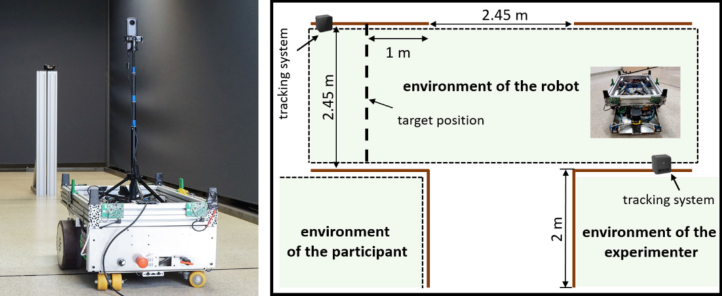
Study Setup and Material The key component of the user study is the AGV, shown in Figure 1 which was initially developed for usage in commissioning processes. The AGV is a small robot, measuring 60 cm × 80 cm × 40 cm (width × length × height) that can move autonomously as well as remotely controlled with a maximum speed of around 5 km/h. The AGV features a safety stop to prevent collisions which is triggered by a LIDAR system if the distance reaches 0.5 m. All data collection, processing and path planning is done by a minicomputer on the AGV, which can be remotely accessed via wireless network. Using this self-developed robot as mobile telepresence system has the advantage of being able to access and control data acquisition as well as altering the system to implement different sensors if needed. Here, the AGV was equipped with the monoscopic 360° camera Ricoh Theta V with the camera video being live streamed to a remote computer, to transform the AGV into a telepresence system. The camera was set to a resolution of 3840 × 1920 pixels and a frame rate of 30 FPS.
Figure 1: Left: AGV with 360° camera setup. Right: Illustration of study environment.
The 360° camera is used to give the user complete freedom of viewing direction without having to turn the AGV. To replicate a realistic situation of a worker having to remotely control an AGV in a factory or warehouse, the camera is installed at a height of 1 m, because that would fit the size of AGV used in industrial settings. The AGV is also equipped with a laptop that is connected to the camera via cable for better handling of the video stream and supporting the camera’s battery lifetime.
Valve’s lighthouse tracking system was used (as depicted in Figure 1) to determine the distance between the robot and the target object by equipping AGV and target with Vive trackers. With this approach, the position of the AGV could be always tracked, allowing for deeper analysis of the users’ steering behavior.
The laboratory, in which the study was conducted, was separated into three spaces via movable opaque walls as shown in Figure 1. As the labora tory was quite small, the total area in which the robot could move measured 6.5 m by 2.2 m. Considering the length of the robot, its safety stop function when approaching an object and the distance between the target and the wall, the effective usable distance is reduced to 4.5 m.
Next to the robot area, there was also a space with table and chair where participants could sit and fill out questionnaires under the guidance of an experimenter at the beginning and end of the study. There, the participant also received the Xbox controller to control the AGV and an Oculus Quest HMD to view the camera stream. Inside the telepresence scenario, partici pants could move the AGV forward or backward by using the directional pads corresponding buttons and progress through the study and confirm estimations by using the trigger buttons.
On the opposite side of the room was the computer setup, which was responsible for communicating with the AGV, collecting data from the track ing system as well as providing feedback on the progress of the study and possible errors to the leading experimenter, who also repositioned the AGV between single runs.
Showing the video stream inside the HMD, as well as controlling the AGV and collecting tracking data were done by software tools built with Unity. Two separate programs ran on the laptop and the desktop PC, that exchanged status information and commands via UDP. The TE was imple mented by mapping the 360° video stream onto the inside of a sphere, thus fully surrounding the user in the HMD.
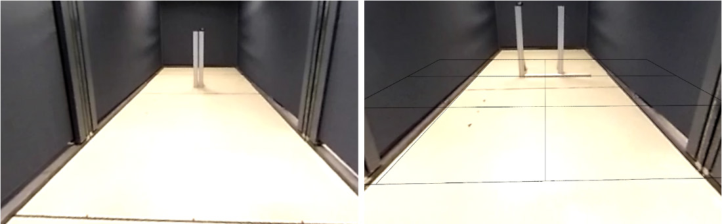
Design The study comprised several tasks which are shown from a participant’s real view in Figure 2. There were two tasks for estimating egocentric distances. First, users had to move the AGV towards the target until an indicated distance to the target is reached, which is referred to as move-to-target task. The sec ond task was to verbally judge the distance to an object (verbal estimation), after it was placed at an unknown distance to the robot, in meters, hence the movement of the AGV was disabled. In a third task, users saw two objects
Distance Estimation in a Telepresence Scenario 251 which they could approach up to one meter. Then, they had to judge if the AGV could fit through the horizontal gap between the two objects. This passability judgement task should give some insight into possible differences in judging allocentric or egocentric distances in this setup. Every participant had to complete all three tasks, but the order was counterbalanced over all participants.
Each of these tasks was performed in multiple sequences, i.e. two repeti tions for each condition with and without DEA to collect more measurement data. In each sequence five different distances were tested: 0.7 m, 1.4 m, 2.1 m, 2.9 m and 3.7 m within the move-to-target and verbal estimation blocks and 0.45 m, 0.51 m, 0.56 m, 0.65 m and 0.74 m gap width within the passability judgement block. The order of the distances was randomized each time to avoid influencing the results by learning effects. This design resulted in a total of 60 measurements, i.e. 5 target distances measured twice for each activated and deactivated DEA with three estimation methods. At the start of each study, it was decided whether the DEA was active in even or odd sequences, which was then used for every block. This pattern was counter balanced over all participants, i.e. half of them started with activated DEA, the other half with DEA deactivated.
Before the trials were conducted in the TE, participants had to first prac tice each of the tasks in a real environment, which was the corridor in front of the laboratory, with the same target objects as shown in the TE. Because the AGV could not be used - as it had to be prepared for the main study in the meantime - two tasks were slightly altered. In the move-to-target task partic ipants had to walk towards the target instead of driving the AGV and for the passability judgement they were given a front part of the AGV chassis to hold in front of themselves when judging passability of the aperture. Additionally, participants should only estimate three distances with the egocentric esti mation methods (0.7 m, 2.1 m and 3.7 m) and two with the passability judgement (0.56 m and 0.74 m). That way it could be tested, if participants understood how to complete the tasks correctly and these estimations in a real environment could be used as reference when analyzing the performance in the TE.
Figure 2: Participants view in the study, for move-to-target task (left) and affordance judgement with activated DEA (right).
Participants For taking part in the study, users needed to be able to hold and use a con troller for interacting with the AGV and to navigate through the user study, be able to wear an HMD to view the video stream and have normal or cor rected-to-normal vision. We recruited a total of 16 participants (8 male and 8 female) of which one could only finish two out of three tasks because of an interruption, with the third being completed later. Most of the recruited par ticipants were members of our university with a mean age of 34.9 (SD = 10.7).
Results
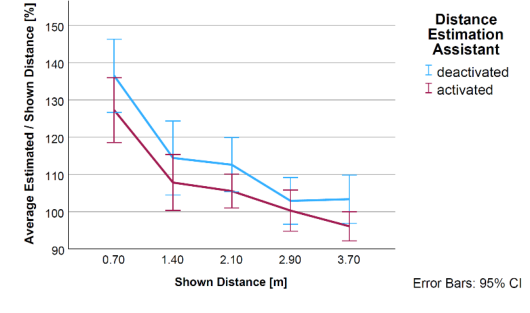
The influences of the target distance and DEA on the move-to-target task are shown in Figure 3. Overall, distances were strongly overestimated with a mean of 110.7% (SD: 17.8%). Trials with activated DEA showed less esti mation error for each target distance with a peak of 9.3% improvement for 0.7 m and 6.6% on average over all target distances.
Figure 3: Estimation accuracy for move-to-target task in TE depending on shown distance.
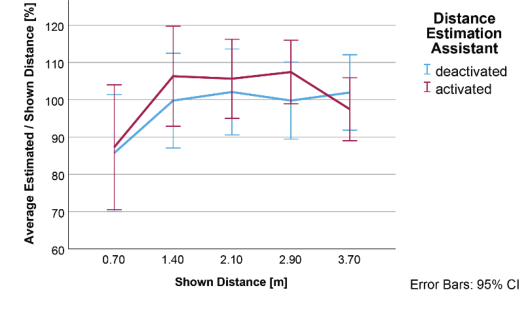
For analysis, a 2 (DEA: activated or deactivated) by 5 (target distance: 0.7 m, 1.4 m, 2.1 m, 2.9 m and 3.7 m) repeated measures ANOVA with a Greenhouse-Geisser adjustment to correct for violation of sphericity was performed. The ANOVA found significant impact of distance, F(1.725, 25.878) = 47.702, p< .001, 𝜂p 2 = 0.761 but no significant impact of nei ther DEA, F(1,15) = 4.063, p=0.062 nor interaction of DEA and distance, F(2.521,37.817) = 0.471, p = 0.672. A Bonferroni-adjusted post-hoc analy sis of distance revealed significantly different estimation ratios for almost all pairwise comparisons (p<0.008) except for the distance pairs of 1.4 m and 2.1 m as well as 2.9 m and 3.7 m. In the verbal estimation task participants underestimated distances of 0.7 m with an average accuracy of 86.5%. All other distance values were evenly over- or underestimated, resulting in mean values ranging from
Distance Estimation in a Telepresence Scenario 253 97.5% to 107.5%. Also different to the move-to-target task is the consis tency of estimation accuracy and that the use of the DEA lead to a subtle increase of estimation ratio instead of reduction. The results are also shown in Figure 4.
As for the move-to-target task, a 2 (DEA) by 5 (target distance) repeated measures ANOVA with Greenhouse-Geisser correction was run. The cor rection was necessary because Mauchly’s test of sphericity showed a sig nificant result for target distance (p<0.001, 𝜀 = 0.44), which means the assumption of sphericity was violated. Again, the ANOVA shows a signif icant impact of target distance, F(1.763, 26.442) = 5.829, p = 0.01, 𝜂p
2 = 0.28 but no significant impact of neither DEA, F(1,15) = 0.793, p = 0.387 nor interaction of DEA and distance, F(2.522, 37.823) = 1.522, p = 0.228. However, a Bonferroni-adjusted post-hoc analysis of distance revealed no significant differences in estimation ratio for any pairing of distance values (p < 0.055).
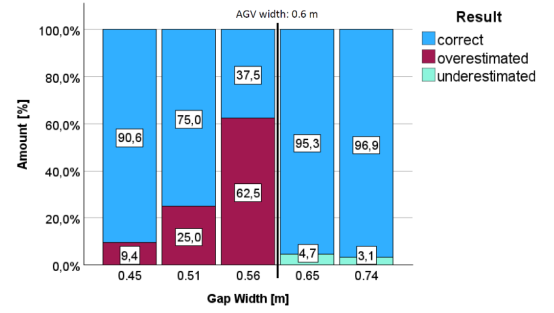
The results of the passability judgement task are depicted in Figure 5 and show a tendency for stronger estimation errors for widths smaller than the AGV width. With an AGV width of 0.6 m, the gap sizes used ranged from being 0.15 m smaller to 0.14 m bigger than the AGV. Although difference of gap to AGV size is similar for gap size pairs 0.45 m and 0.74 m and 0.56 m and 0.65 m respectively, the smaller gap size was more often overestimated than the bigger gap was underestimated. The peak of judgment error is at 0.56 m gap width, where 62.5% of the judgements overestimated the gap size and thought the AGV could fit through. Like the other tasks, the results with and without DEA are very similar. The only notable difference occurs for 0.56 m, where 43.8% of judgements with DEA were correct compared to 31.3% correct judgements without DEA.
Figure 4: Accuracy of verbal estimation task in TE depending on shown distance.Figure 5: Results of the passability judgement task: amount of judgements (including with and without DEA) grouped by gap width.
DISCUSSION
Before conducting the study, three research questions were formulated regard ing the impact of the two variables target distance and distance estimation assistant on distance estimation accuracy. All conditions were tested with three estimation methods: move-to-target) verbal estimation and passability judgement.
The first research question was about the influence of target distance on the accuracy of estimations. For verbal estimations, a significant impact of target distance was found with a repeated measures ANOVA, but not with a pairwise post-hoc comparison. Figure 4 shows that estimation accu racy is close together over all distance values (mean: 99.3%, SD: 22.2%), except for 0.7 m, which was generally more underestimated (mean: 86.5%, SD: 30.4%). A significant impact of target distance could be found for the move-to-target task with significant differences for almost all pairwise com parisons, which can also be seen in Figure 3. Contrary to verbal estimation, distances are strongly overestimated for 0.7 m and for increasing distance, estimation ratios decrease towards a slight underestimation. Verbal estima tion having lower estimation ratios than the move-to-target task is somewhat in line with findings of other studies, which found underestimation for verbal reports in real and virtual environments, whereas blind walking is often close to the actual distance (Creem-Regehr et al., 2022). The presented move-to- target task differs from blind walking though, because participants are not blindfolded while performing the action and an AGV is moved instead of the own body. Thus, additional cues like visual flow and falsely using prior locomotor experience might influence spatial perception. Similarly, there seems to be an impact of target distance, i.e. gap width, on passability judge ments (see Figure 5). Even though the difference between gap width and AGV width was similar, false judgements were much more frequent for gap widths smaller than the AGV width. For the gap widths that are closest to
Distance Estimation in a Telepresence Scenario 255 AGV width, 62.5% of judgements were overestimations, whereas only 4.7% were underestimations. Similar for gap widths 0.45 m and 0.74 m, which equally differ from AGV width, estimations were rather overestimated. So overall the distance at which the target is located seems to have an influence on estimation accuracy, especially for distances in personal space, i.e. < 2 m.
Contrary to expectations, the DEA did not consistently improve perfor mance. In the move-to-target task, overestimations decreased by 6.6% on average, with a maximum improvement of 9.3% for 0.7 m. For passability judgements, modest improvement was observed only for a 0.56 m gap width. Verbal estimations were negatively affected, showing stronger overestima tion when the DEA was active. Participant feedback indicated difficulties interpreting the grid’s spatial alignment and increased cognitive effort, which may explain these effects. Interestingly, most participants (11 out of 16) still reported a perceived benefit, suggesting that the DEA created a false sense of confidence which warrants further study.
The last research question aims at comparing the distance estimation performance in virtual environments and in the proposed telepresence environment. Comparing the findings with other studies that investigated verbal estimation (Creem-Regehr et al., 2022; Feldstein et al., 2020) yields that distances were not as strongly underestimated as previously reported. Following the data reviewed by Kelly (2022), verbal estimations yield an average accuracy of 75.1% with an SD of 19.3%, whereas we measured an accuracy of 99.3% on average with an SD of 22.2%. The move-to-target task mainly lead to overestimations (mean: 110.7%, SD: 17.8%), but is, as already mentioned, hardly comparable to the other often used estimation methods. Results of egocentric distance estimation in this study are over all close to results reported by Masnadi et al. (2021), although they used blind throwing as estimation method. Lastly, passability judgements yield that gap width was strongly overestimated, which is in line with some studies (Moore et al., 2009; Peillard et al., 2019). Our results, at least of verbal esti mations and passability judgements, are therefore comparable with current literature, although the overall setup is quite different. Since a monocular representation offers less depth cues than a stereoscopic VE, stronger esti mation errors could be expected. But literature does not provide empirical evidence that supports this idea (Willemsen and Gooch, 2002). One possible explanation for the stronger overestimation could also be the small camera height of 1 m. Different literature shows that eye height is a strong cue for absolute distance in both the real world (Daum and Hecht, 2009; Gardner and Mon-Williams, 2001; Ooi et al., 2001) and virtual environments (Corujeira an Oakley, 2013). There are competing theoretical explanations for the influence of eye height between the angle of declination (covered in Creem-Regehr et al. (2022)) and texture gradient (Daum and Hecht, 2009). However, the empirical results are unequivocal that lowering eye-height leads to increasing distance overestimation. Therefore, the increased overestima tion by the small camera height could counter the general underestimation caused by viewing the telepresence environment on an HMD, leading to the reported estimation results.
CONCLUSION
In this paper, we present a study investigating distance perception in a mono scopic telepresence scenario by showing a 360° video-stream of a remote location in an HMD. In the study, participants estimated distances between 0.7 m and 3.7 m with two different tasks: move-to-target and verbal estima tion and judged the ability to fit through a gap between two objects for gap widths between 0.45 m and 0.74 m. Additionally, a distance estimation assis tant, i.e. a grid with fixed size, was implemented with the goal of improving the estimation accuracy.
Overall, our findings suggest that users overestimate distances more in the monoscopic video-stream with small camera height compared to a ste reoscopic representation of a virtual environment, although this effect seems to vanish with increasing target distance. For better comparison of distance perception between these environments, a future study should incorporate a remote location as virtual environment as well as telepresence environment.
For higher quality data in future investigations, the study design needs to be improved. Many participants reported in the final interview that tasks were not motivating, repetitive and the overall study length too long, which caused some to rush through the tasks and others to lose focus in later trials. A decrease in mental demand, which was reported by the raw NASA TLX with an average score of 61 (out of 100) over all participants, would benefit data quality. This could be achieved by increasing the quality of the video stream, adding hints for possible actions and decreasing the overall number of trials.
The used DEA did not have the expected positive influence on distance estimation, but most users reported it as being helpful and feeling safer in estimating distances, with 8 participants specifically reporting to use the DEA as main cue or reconstructing the DEA from memory when it was deactivated. Hence, the DEA should be reworked, so users do not misjudge the height in which it is intended, while also simplifying the representation to reduce mental load from comparing the DEA with the shown environment.
ACKNOWLEDGMENT
This work was funded by the Deutsche Forschungsgemeinschaft (DFG, German Research Foundation) – Project-ID 416228727 – CRC 1410. This study was approved by the ethics committee of the faculty of behavioral and social sciences of Chemnitz University of Technology (V-332-15-GJ-Telepresence-13052019).
REFERENCES
Corujeira, J. G. P., Oakley, I. (2013). ‘Stereoscopic egocentric distance perception: the impact of eye height and display devices’, in: Proceedings of the ACM Symposium on Applied Perception, pp. 23–30. doi: 10.1145/2492494.2492509 Creem-Regehr, S. H., Stefanucci, J. K., Bodenheimer, B. (2022). ‘Perceiving distance
in virtual reality: theoretical insights from contemporary technologies’, in: Philo sophical Transactions of the Royal Society B (378). doi: https://doi.org/10.1098/ rstb.2021.0456
Distance Estimation in a Telepresence Scenario 257 Daum, S. O., Hecht, H. (2009). ‘Distance estimation in vista space’, in: Attention,
Perception, & Psychophysics (71), pp. 1127–1137. Feldstein, I. T., Kölsch, F. M., Konrad, R. (2020). ‘Egocentric distance perception: A comparative study investigating differences between real and virtual environ ments’, in: Perception (49), pp. 940–967. doi: 10.1177/0301006620951997 Gardner, P. L., Mon-Williams, M. (2001). ‘Vertical gaze angle: absolute height-in-
scene information for the programming of prehension’, in: Experimental brain research (136). Kelly, J. W. (2022). ‘Distance Perception in Virtual Reality: A Meta-Analysis of the Effect of Head-Mounted Display Characteristics’, in: IEEE Transactions on Visualization and Computer Graphics. doi: 10.1109/TVCG.2022.3196606. Kim, K., Park, J., Lee, H., Song, K. (2006). ‘Teleoperated Cleaning Robots for Use in
a Highly Radioactive Environment of the DFDF’, in: 2006 SICE-ICASE Interna tional Joint Conference, pp. 3094–3099. doi: 10.1109/SICE.2006.314743. Masnadi, S., Pfeil, K., Sera-Josef, J.-V. T., LaViola, J. (2021). ‘Effects of Field of View on Egocentric Distance Perception in Virtual Reality’, in: Proceedings of the 2022 CHI Conference on Human Factors in Computing Systems. doi: 10.1145/3491102.3517548. Minsky, M. (1980). ‘Telepresence’, in: OMNI, pp. 45–51. Moore, K. S., Gomer, J. A., Pagano, C. C., Moore, D. (2009). ‘Perception of Robot
Passability With Direct Line of Sight and Teleoperation’, in: Human Factors: The Journal of Human Factors and Ergonomics Society, pp. 557–570. doi: https://doi. org/10.1177/0018720809341959. Ooi, T. L., Wu, B., He, Z. J. (2001). ‘Distance determined by the angular declination below the horizon’, in: Nature (414), pp. 197–200. Peillard, E., Argelaguet, F., Normand, J.-M., Lécuyer, A., Moreau, G. (2019). ‘Study
ing Exocentric Distance Perception in Optical See-Through Augmented Reality’, in: 2019 IEEE ISMAR, pp. 115–122. doi: 10.1109/ISMAR.2019.00-13. Pfeil, K., Masnadi, S., Belga, J., Sera-Josef, J.-V. T., LaViola, J. (2021). ‘Distance Perception with a Video See-Through Head-Mounted Display’, in: Proceed ings of the 2021 CHI Conference on Human Factors in Computing Systems. doi: 10.1145/3411764.3445223. Renner, R. S., Velichkovsky, B. M., Helmert, J. R. (2013). ‘The perception of egocen
tric distances in virtual environments - A review’, in: ACM Computing Surveys (46). doi: 10.1145/2543581.2543590. Shen, X., Shirmohammadi, S. (2006). ‘Telepresence’, in: Encyclopedia of Multime dia, pp. 848–852. doi: 10.1007/0-387-30038-4_233. Smolarek, M. (2019). ‘Current use of UGVS by the german army’, in: Digital Infan
try Battlefield Solutions, pp. 61–68. Willemsen, P., Gooch, A. A. (2002). ‘Perceived egocentric distances in real, im age-based and traditional virtual environments’, in: IEEE Virtual Reality 2002. doi: 10.1109/VR.2002.996536. Winkler, S., Weidensager, N., Brade, J., Knopp, S., Jahn, G., Klimant, P. (2022). ‘Use of
an automated guided vehicle as a telepresence system with measurement support’, in: 2022 IEEE 9th International Conference on CIVEMSA. doi: 10.1109/CIVEM SA53371.2022.9853678.
LISTED IN THE AHFE DIGITAL BOOKSTORE CATALOGUE
Explore the complete digital volume
Intelligent Human Systems Integration (IHSI 2026): Disruptive and Innovative Technologies
Read this individual research paper free through the original publisher, or explore the full digital proceedings book.
ISBN 978-1-964867-76-2
Explore this ISBN in the AHFE Bookstore ↗Listed in the July 2026 bookstore catalogue; search by ISBN to confirm current availability · Digital book purchase optional