Tomoya Minegishi (2025). Exploring Interpersonal Distance with Virtual Agents on a Naked-Eye Stereoscopic Display. In: Human Factors in Design, Engineering, and Computing. AHFE Open Access, vol. 199, pp. 959–968. https://doi.org/10.54941/ahfe1006908
This study investigates how virtual agents displayed on a naked-eye stereoscopic (3D) screen influence interpersonal distance, as well as discomfort and likeability, during a common corridor passing task. The increasing adoption of "on-screen agents"—virtual body agents displayed on devices such as smartphones and large public screens—offers an alternative way to physical body robots, reducing their high costs and potential physical risks. However, a question remains: can these virtual agents enable users to maintain appropriate interpersonal distances in real-world scenarios? In particular, traditional 2D displays often fall short in conveying the sense of physical presence that humans instinctively need to maintain a comfortable personal space. This deficiency highlights a major challenge in designing natural and effective human-agent interactions.This study directly addresses this gap by focusing on the maintenance of interpersonal distance in dynamic, pre-interaction scenarios within a simulated environment, specifically tailored for immersive technologies. We set out to answer two key research questions:•RQ1: How does interacting with an on-screen agent presented on a stereoscopic display affect the maintenance of interpersonal distance?•RQ2: How do the display conditions (3D vs. 2D) of the on-screen agent affect user comfort and likeability during dynamic interactions?To investigate these questions, we leveraged a Looking Glass naked-eye stereoscopic display, that offers multiple viewpoints without any wearable devices, providing a robust platform for simulating depth perception. We designed a controlled experiment where participants walked past a human-like 3D agent in a simulated corridor. The experiment employed a within-participants design across three different conditions: OFF condition (the display turned off), 2D condition (stereoscopic display function disabled), and 3D condition (stereoscopic display fully enabled). To consider potential order effects, all 15 Japanese participants (aged 21-28 years) experienced all three conditions in different orders. During the task, we precisely measured the shortest distance that participants reached while passing in front of the agent. After completing the task, participants rated their discomfort using the Japanese translation of the RoSAS scale and their liking for the agent using the Godspeed scale. All statistical analyses were conducted using Wilcoxon signed-rank nonparametric tests with Bonferroni-Holm corrections.Findings regarding interpersonal distance in RQ1 showed the following key findings:•There was a significant difference between 3D and 2D conditions (3D condition: Mean = 1046.67 (mm), SE = 62.96; 2D condition: Mean = 755.00 (mm), SE = 74.33; p < .01, Bonferroni-Holm corrected). •There was a significant difference between the OFF and 3D conditions (OFF condition: Mean = 403.67 (mm), SE = 26.07; 3D condition: Mean = 1046.67 (mm), SE = 62.96; p < .001, Bonferroni-Holm corrected), and between the OFF and 2D conditions (OFF condition: Mean = 403.67 (mm), SE = 26.07; 2D condition: Mean = 755.00 (mm), SE = 74.33; p < .01, Bonferroni-Holm corrected)These results strongly suggest that stereoscopic displays enhance the visual presence and realism of virtual agents, thereby working to bring human spatial behavior closer to real-world social norms regarding interpersonal distance. Furthermore, these highlights that the mere presence of the agent influences spatial behavior, regardless of the type of display.On the other hand, RQ2 (ratings of discomfort and likability) showed no significant differences between the 3D and 2D conditions (Discomfort; 3D condition: Mean = 3.36, SE = 0.16; 2D condition: Mean = 3.18, SE = 0.15; p = .27, n.s. , Bonferroni-Holm corrected, Likeability; 3D condition: Mean = 2.51, SE = 0.13; 2D condition: Mean = 2.48, SE = 0.12; p = .88, n.s., Bonferroni-Holm corrected). This result suggests that in a dynamic task such as walking, the display format alone may not be the main driver of emotional responses. It is possible that participants' attention was distributed throughout the environment, or other factors, such as the passive behavior of the agent, had a greater impact on perceived comfort and likability than nuances in display depth.This study shows that virtual agents displayed on a stereoscopic screen have a significant effect on interpersonal distance in dynamic situations, bringing interactions closer to natural human social behavior. This finding is an important step towards achieving more natural and comfortable interactions with on-screen virtual agents, and will contribute greatly to the development of augmented reality (AR), virtual reality (VR) and mixed reality (MR) simulations in particular.This study has limitations: small sample size (15 Japanese participants). Future work needs diverse groups and varied agent behaviors (e.g., dynamic gaze) for more natural interactions.
There are studies displaying 3D models with human-like bodies on computer or smartphone screens, or on large displays installed in public facilities, allowing observers to see the virtual body agents (on-screen agents) and communicate with them comfortably (Hedayati et al., 2020; Komatsu et al., 2009, 2010). On-screen agents have an advantage of being able to virtually express physical movements and facial expressions, reducing the risk of conflict and harm associated with human-like embodied social communication robots. On-screen agents are also easy to set up, requiring only a display and a computer to control the 3D model and output it to displays. Furthermore, compared to developing a communication robot with a physical body, there are fewer control items and parts, making on-screen agents cheaper and quicker to develop.
However, it has been suggested that people may not be able to maintain an appropriate interpersonal distance when interacting with on-screen agents. For humans to communicate comfortably, it is necessary to maintain an appropriate interpersonal distance depending on the relationship with persons. In the case of physically embodied communication robots, it has been shown that people feel uncomfortable, look away, and distance themselves when the interpersonal distance expressed by Hall (Edward, 1996) is not appropriate (Mumm et al., 2011). Interpersonal distance is a potentially important factor influencing interaction quality due to agent presence, but empirical research on it is limited.
To address these limitations, some studies have explored the use of stereoscopic displays, which can provide a sense of depth and presence. For example, previous research has shown that humans maintain appropriate interpersonal distance when engaging in communication tasks with agents on a 3D display (Minegishi et al., 2020). However, this work primarily focused on static, communicative tasks and did not investigate whether these effects hold in dynamic, pre-interaction scenarios, such as walking past an agent in a hallway.
This study directly addresses this research gap. We investigate how a naked-eye stereoscopic display influences interpersonal distance, and feelings of discomfort and likeability during a corridor passing task. By comparing a 3D display condition with a 2D display and an “off” condition, we aim to understand if the enhanced visual presence of stereoscopic displays can bring human spatial behavior closer to real-world social norms. The findings of this research will contribute to the design of more natural and comfortable human-agent interactions, particularly for applications in virtual and mixed reality environments.
RELATED WORK
A common challenge in human-agent interaction is managing appropriate interpersonal distance, which varies depending on the agent’s form and display method. Some studies have investigated how the displayed size of an on-screen agent affects human proxemics. Aramaki et al. (2013) investigated the relationship between the size of an agent displayed in augmented reality (AR) and the distance a person maintains. It was shown that the larger an agent appears, the more people want to distance themselves from the agent. Jones et al. (2020) demonstrated that by projecting an agent operated by a remote participant onto a telepresence robot, it is possible to give the remote participant a sense of presence similar to that of a person actually present at the meeting. However, these studies do not fully clarify how the relationship or visual realism of an on-screen agent influences spontaneous spatial behavior. For example, regarding the interpersonal distance between on-screen agents using human-like 3D models and humans, studies by Hedayati et al. (2020) and Wachsmuth et al. (1997) suggest that on-screen agents’ virtual bodies affect the distance between the agents and humans, and that Hall’s interpersonal distance may not apply to on-screen agents.
In contrast to on-screen agents, physically embodied communication robots present different challenges in managing interpersonal distance. It has
Exploring Interpersonal Distance With Virtual Agents 961
been shown that it is difficult for people to voluntarily distance themselves from communication robots that have human-like bodies. In one study that attempted to manipulate the distance between social robots and humans, Shiomi et al. (2007) investigated whether a museum guide robot could manipulate the distance between itself and children. The robot attempted to manipulate the children’s location by talking to them while they toured the museum. However, the children were interested in the robot itself, and the robot was unable to control the distance. In addition, this study did not consider the interpersonal distance. The research mentioned above also includes studies using social robots with human-like bodies in real space to verify whether the distance between humans and robots can be adjusted. However, it is unclear whether people adjust the interpersonal distance between themselves, and the 3D on-screen agent placed in real space.
A third area of related work concerns the influence of an agent’s behavior, particularly its gaze, on human spatial behavior. There are studies that attempt to adjust the distance between a person and a social robot based on whether the robot looks at the person. Vázquez et al. (2014, 2017) showed that a robot’s gaze and appearance affect its distance from humans. In a scenario where participants brainstormed with a robot, it was shown that participants felt less uncomfortable when the robot was not looking directly at them, significantly reducing the interpersonal distance. Admoni et al. (2013) showed that when a robot stares at people for a long period of time, they perceive the robot as intimidating and unpleasant. Hoffman et al. (2014) showed that participants felt more comfortable when a robot was listening to them and looking at them than when the robot was listening to them and operating a smartphone. It was suggested that when a robot looks at a person, it affects emotions and distance. However, most of these studies have examined participants in a stationary state and have not investigated how an on-screen agent’s visual realism or behavior affects human spatial behavior during a dynamic task like walking.
In summary, while a number of studies have explored human-agent interaction, a research gap remains. Few studies have specifically investigated how display technology, particularly naked-eye stereoscopic displays, affects interpersonal distance and subjective impressions in a dynamic, pre- interaction scenario. Our study aims to fill this gap by focusing on how visual presence influences human spatial behavior in a corridor passing task.
RESEARCH QUESTIONS Previous studies on on-screen agents have largely focused on static communication tasks. We investigate how a stereoscopic display, which provides a sense of visual presence, affects the maintenance of interpersonal distance in a dynamic task, such as walking. We therefore set the following research question:
RQ1 – How does interacting with an on-screen agent on a stereoscopic display affect the maintenance of interpersonal distance?
962 Minegishi
While display technology and agent design influence human-agent interaction, their impact on emotional responses during dynamic, non- communicative tasks is not well understood. We therefore examine how the display conditions (3D vs. 2D) affect a participant’s subjective discomfort and likeability toward the agent, and set the following research question:
RQ2 – How do display conditions (3D / 2D) of the on-screen agent affect comfort and likeability during dynamic interactions?
METHODOLOGY
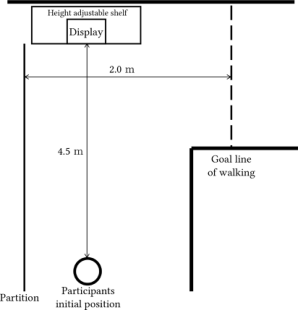
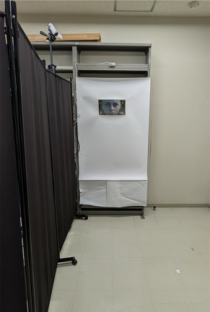
To achieve our goal of analyzing human behavior, we developed an on-screen agent displayed stereoscopically. Additionally, we prepared an environment that simulated a corridor in a public facility. In the experimental environment, it is important that participants can move freely and easily see the on- screen agent. To allow participants to move around freely, we prepared the environment to be larger than the appropriate interpersonal distance range. The experimental environment is shown in Figure 1 and Figure 2.
Figure 1: Diagrams of the experimental environment.
To develop an on-screen agent displayed stereoscopically, we used Looking Glass. This display, developed by Looking Glass Factory, incorporates lenticular lenses in front of a 4K screen. The image is presented so that it appears differently to the observer’s left and right eye. This allows the observer to see in three dimensions with the naked eye. The Looking Glass has a viewing angle of about 50 degrees and 45 viewpoints. The Looking Glass has a 15.6-inch display and an aspect ratio of 16:9. The drawback of stereoscopic displays using lenticular lenses is that the number of pixels decreases as the number of viewpoints increases. However, displays are now coming with higher resolutions, in particular Looking Glass uses 4K (3840x2160 pixel) images to reduce pixel loss. By observing 3D images, observers can determine the distance in the depth direction and the position of objects.
Exploring Interpersonal Distance With Virtual Agents 963
Figure 2: Picture of the experimental environment.
The on-screen agent is controlled by a program we developed using Unity. Unity is a game engine that excels in manipulating 3D models. A human-like 3D model is loaded into Unity and displayed in the Looking Glass. The size of the on-screen agent is designed so that the width of the face within the display area is approximately 160 mm, making it approximately the same size as a human face when displayed. Depending on the display size, it may be possible to display the agent small enough to capture the entire face, but it has been shown that observers tend to move closer to the agent when the agent is displayed small (Aramaki et al., 2013). Additionally, the 3D model we used resembles a human face. This is because it has been shown that observers can estimate an agent’s gaze more accurately when the agent’s face resembles a human face (Delaunay et al., 2010). We also controlled the agent’s blinks within a certain period. Tsubota et al. (1993) measured the number of times people blinked and showed that in an environment with a room temperature of 22.5
C and humidity of 40%, a person in a relaxed state blinked 22±9 times per minute. This on-screen agent is controlled to blink 20 times per minute.
Participants in the experiment were 15 Japanese people (ages 21-28, mean = 23.22, SD = 1.08). The experiment was approved by the ethical committee of the author’s affiliation (Senshu University; Approval number: 24-006). The participants were recruited based on their ability to walk independently. The experiment was conducted with a within-participants experimental design. The experimental conditions included the stereoscopic display enabled (3D condition), the stereoscopic display disabled (2D condition), and the stereoscopic display turned off (OFF condition). The participants were asked to walk through the experimental environment under both conditions: 3D and 2D. Before each experiment, the participants were asked to walk with the OFF condition. The experiment was conducted taking into account order effects.
We were interested in how the on-screen agent presented on a stereoscopic display would affect interpersonal distance and comfort compared to the on- screen agent presented on a regular display. To achieve this, we measured the
964 Minegishi
closest distance reached by the participants as they passed in front of the on- screen agent. The participants were instructed to stand in the initial position and then walk to the goal line (Figure 1). The participants were instructed to walk along the partitions, and we measured the shortest distance to the agent as they walked toward the goal line.
To evaluate participants’ impressions of the on-screen agent, we used the Discomfort factor from Noguchi et al. (2020), a Japanese translation of the RoSAS (Carpinella et al., 2017) scale (Scary, Strange, Awkward, Dangerous, Awful, Aggressive). The participants were asked to rate the discomfort items on a 6-point Likert scale. We also used the Likeability factor from the Godspeed scale, which consists of five questions rated on a five-point Likert scale (Bartneck et al., 2009) (dislike - like, unfriendly - friendly, unkind - kind, unpleasant - pleasant and awful - nice).
RESULTS
All statistical analyses were conducted using the Wilcoxon signed-rank nonparametric test with Holm–Bonferroni method, using R (2.4.0).
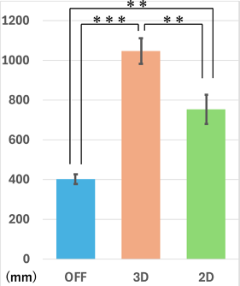
RQ1 is dedicated to evaluating the distance between the on-screen agent and the participants. In each condition, we measured the distance from the agent to the participant when the participant was closest to the agent while walking. Our results showed a significant difference between 3D and 2D conditions (3D condition: Mean = 1046.67, SE = 62.96; 2D condition: Mean = 755.00, SE = 74.33; p <.01). Additionally, there was a significant difference between the OFF and 3D conditions (OFF condition: Mean = 403.67, SE = 26.07; 3D condition: Mean = 1046.67, SE = 62.96; p <.001), and between the OFF and 2D conditions (OFF condition: Mean = 403.67, SE = 26.07; 2D condition: Mean = 755.00, SE = 74.33; p <.01) (see Figure 3).
Figure 3: Analysis of the distance between the virtual agent and participants (The error bar shows Mean +/– SE, *** shows p <.001, and ** shows p <.01).
RQ2 evaluates the discomfort participants feel toward the agent. The discomfort items rated by the participants at the end of each condition were analyzed between conditions. There was no significant difference between the
Exploring Interpersonal Distance With Virtual Agents 965
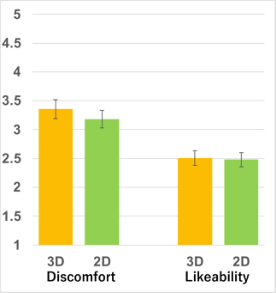
3D and 2D conditions (3D condition: Mean = 3.36, SE = 0.16; 2D condition: Mean = 3.18, SE = 0.15; p = .27, n.s.) (see Figure 4 left side).
RQ2 evaluates the likeability participants feel toward the agent. The likeability items rated by the participants at the end of each condition were analyzed between conditions. There was no significant difference between the 3D and 2D conditions (3D condition: Mean = 2.51, SE = 0.13; 2D condition: Mean = 2.48, SE = 0.12; p = .88, n.s.) (see Figure 4 right side).
Figure 4: Analysis of discomfort (left side) and likeability (right side) (The error bar shows Mean +/– SE).
DISCUSSION
The main result was that there was a significant difference in interpersonal distance between the 3D and 2D conditions.
Specifically, the participants in the 3D condition moved further away from the agent than in the 2D condition. In contrast, significant differences were observed between the OFF and 3D conditions, and between the OFF and 2D conditions, suggesting that the presence of the agents affects interpersonal distance. These results suggest that the presence of an agent via the stereoscopic display can give people a sense of visual presence. While previous work has shown this effect in static communication tasks (Minegishi et al., 2020), our study extends this finding to a dynamic, non-interactive scenario, highlighting that stereoscopic displays can bring human-agent interactions closer to real-world social norms even before direct communication begins.
We evaluated the participants’ discomfort and likeability while walking past the agent displayed on the stereoscopic display. No significant differences were found between the 3D and 2D conditions. The results suggest that differences in display type do not affect comfort while walking. Previous studies have shown that an agent’s gaze displayed on a normal screen can cause discomfort to participants (Admoni et al., 2013), but we showed that 3D or 2D elements had no significant impact on participants’ comfort and likeability.
These results suggest that participants’ discomfort and likeability may be influenced by factors other than differences in 3D or 2D displays. In particular, while walking, participants’ attention may be diverted from visual stimuli, reducing the effectiveness of the 3D display.
966 Minegishi
Future studies should include more diverse conditions and environmental settings to examine the effects of additional factors. The small sample size (N = 15) and the group of Japanese participants may limit the generalizability of our findings. Interpersonal distance is known to vary across cultures and gender (Joosse et al., 2014), necessitating future research with larger and more diverse participant groups. Also, detailed analysis that takes into account the individual characteristics of the participants is also required, including their cultural background and personal preferences.
CONCLUSION
This study investigated the effects of a naked-eye stereoscopic display on interpersonal distance and impressions during a dynamic human-agent interaction. Our findings reveal two key insights. First, participants maintained a significantly greater distance from the virtual agent when it was displayed in 3D compared to 2D, suggesting that enhanced visual realism encourages human behavior that aligns more closely with real-world social norms. Second, the display format did not have a significant impact on participants’ ratings of discomfort or likeability, indicating that emotional responses during dynamic tasks may be influenced by factors beyond visual representation.
These results contribute an important step achieving more natural and comfortable interactions with on-screen agents. The findings are particularly relevant for the development of human-centered interfaces in emerging fields like augmented reality (AR) and mixed reality (MR), where designing for appropriate social space is crucial for user comfort and adoption.
Although this study provides valuable insights, it also has limitations, including the small and culturally limited group of participants. Future research should address these limitations by incorporating larger and more diverse participants to explore cultural and individual differences. Furthermore, future work should investigate the effects of more complex agent behaviors (e.g., dynamic eye gaze and gestures) and multimodal feedback (e.g., audio and haptics) to further enhance the social presence of virtual agents. By advancing our understanding of these factors, we can facilitate natural human-agent communication.
REFERENCES
Admoni, H., Hayes, B., Feil-Seifer, D., Ullman, D., & Scassellati, B. (2013). Are you looking at me? Perception of robot attention is mediated by gaze type and group size. 2013 8th ACM/IEEE International Conference on Human-Robot Interaction (HRI), 389–395. https://doi.org/10.1109/HRI.2013.6483614. Aramaki, R., & Murakami, M. (2013). Investigating appropriate spatial relationship
between user and ar character agent for communication using AR WoZ system. Proceedings of the 15th ACM on International Conference on Multimodal Interaction, 397–404. https://doi.org/10.1145/2522848.2522855. Bartneck, C., Kuli´c, D., Croft, E., & Zoghbi, S. (2009). Measurement Instruments for the Anthropomorphism, Animacy, Likeability, Perceived Intelligence, and Perceived Safety of Robots. International Journal of Social Robotics, 1(1), 71–81. https://doi.org/10.1007/s12369–008-0001–3.
Exploring Interpersonal Distance With Virtual Agents 967
Carpinella, C. M., Wyman, A. B., Perez, M. A., & Stroessner, S. J. (2017). The Robotic Social Attributes Scale (RoSAS). Proceedings of the 2017 ACM/IEEE International Conference on Human-Robot Interaction, Part F1271, 254–262. https://doi.org/ 10.1145/2909824.3020208. Delaunay, F., de Greeff, J., & Belpaeme, T. (2010). A study of a retro-projected
robotic face and its effectiveness for gaze reading by humans. Proceeding of the 5th ACM/IEEE International Conference on Human-Robot Interaction - HRI ’10, 39. https://doi.org/10.1145/1734454.1734471. Edward. T. H. (1996). The Hidden Dimension. vol. 6, no. 1. Doubleday. Hedayati, H., Szafir, D., & Kennedy, J. (2020). Comparing F-formations between humans and on-screen agents. Conference on Human Factors in Computing Systems - Proceedings, 1–9. https://doi.org/10.1145/3334480.3383015. Hoffman, G., Birnbaum, G. E., Vanunu, K., Sass, O., & Reis, H. T. (2014).
Robot responsiveness to human disclosure affects social impression and appeal. Proceedings of the 2014 ACM/IEEE International Conference on Human-Robot Interaction, 1–8. https://doi.org/10.1145/2559636.2559660. Jones, B., Zhang, Y., Wong, P. N. Y., & Rintel, S. (2020). VROOM: Virtual Robot Overlay for Online Meetings. Extended Abstracts of the 2020 CHI Conference on Human Factors in Computing Systems, 1–10. https://doi.org/ 10.1145/3334480.3382820. Joosse, M. P., Poppe, R. W., Lohse, M., & Evers, V. (2014). Cultural differences
in how an engagement-seeking robot should approach a group of people. Proceedings of the 5th ACM International Conference on Collaboration across Boundaries: Culture, Distance & Technology, 121–130. https://doi.org/10.1145/ 2631488.2631499. Komatsu, T., & Kuki, N. (2009). Investigating the contributing factors to make users react toward an on-screen agent as if they are reacting toward a robotic agent. RO-MAN 2009 - The 18th IEEE International Symposium on Robot and Human Interactive Communication, Figure 1, 651–656. https://doi.org/10.1109/ ROMAN.2009.5326350. Komatsu, T., & Seki, Y. (2010). Users’ reactions toward an on-screen agent
appearing on different media. Proceeding of the 5th ACM/IEEE International Conference on Human-Robot Interaction - HRI ’10, 163. https://doi.org/10.1145/ 1734454.1734524. Minegishi, T., & Osawa, H. (2020). Do You Move Unconsciously? Accuracy of Social Distance and Line of Sight Between a Virtual Robot Head and Humans. 2020 29th IEEE International Conference on Robot and Human Interactive Communication (RO-MAN), 503–508. https://doi.org/10.1109/RO- MAN47096.2020.9223506. Mumm, J., & Mutlu, B. (2011). Human-robot proxemics: Physical and psychological
distancing in human-robot interaction. HRI 2011 - Proceedings of the 6th ACM/ IEEE International Conference on Human-Robot Interaction, 331–338. https:// doi.org/10.1145/1957656.1957786. Noguchi, Y., Kamide, H., & Tanaka, F. (2020). Personality Traits for a Social Mediator Robot Encouraging Elderly Self-Disclosure on Loss Experiences. ACM Transactions on Human-Robot Interaction, 9(3), 1–24. https://doi.org/10.1145/ 3377342. Shiomi, M., Kanda, T., Koizumi, S., Ishiguro, H., & Hagita, N. (2007). Group
attention control for communication robots with wizard of OZ approach. HRI 2007 - Proceedings of the 2007 ACM/IEEE Conference on Human- Robot Interaction - Robot as Team Member, 121–128. https://doi.org/10.1145/ 1228716.1228733.
968 Minegishi
Tsubota, K., & Nakamori, K. (1993). Dry Eyes and Video Display Terminals.
New England Journal of Medicine, 328(8), 584–584. https://doi.org/10.1056/ NEJM199302253280817. Vázquez, M., Carter, E. J., McDorman, B., Forlizzi, J., Steinfeld, A., & Hudson, S.
E. (2017). Towards Robot Autonomy in Group Conversations: Understanding the Effects of Body Orientation and Gaze. ACM/IEEE International Conference on Human-Robot Interaction, Part F1271, 42–52. https://doi.org/10.1145/ 2909824.3020207. Vázquez, M., Steinfeld, A., Hudson, S. E., & Forlizzi, J. (2014). Spatial and other social engagement cues in a child-robot interaction. Proceedings of the 2014 ACM/ IEEE International Conference on Human-Robot Interaction, 391–398. https:// doi.org/10.1145/2559636.2559684. Wachsmuth, I., Lenzmann, B., Jörding, T., Jung, B., Latoschik, M., & Fröhlich,
M. (1997). A virtual interface agent and its agency. Proceedings of the First International Conference on Autonomous Agents - AGENTS ’97, 516–517. https://doi.org/10.1145/267658.267801.
LISTED IN THE AHFE DIGITAL BOOKSTORE CATALOGUE
Explore the complete digital volume
Human Factors in Design, Engineering, and Computing
Read this individual research paper free through the original publisher, or explore the full digital proceedings book.
ISBN 978-1-964867-75-5
Explore this ISBN in the AHFE Bookstore ↗Listed in the July 2026 bookstore catalogue; search by ISBN to confirm current availability · Digital book purchase optional