An-Che Chen, Chien-Chih Chen (2018). Investigating the Enhancement of Stereoscopic Displays to Parking Performance. In: Advances in Physical Ergonomics and Human Factors: Part I. AHFE Open Access, vol. 1. https://doi.org/10.54941/10044
To ensure the safety and performance in parking, equipping LCD visual displays of rear view imaging have become popular for modern automobiles. Existing technology often uses plain 2D display for such imaging system but the sense of depth, that is naturally perceived by bare eyes with stereoscopic visions and known to be a crucial piece of information in driving, is absent through such conventional displays. Our study aims to investigate the enhancement in parking performance by providing 3D (or stereoscopic) imaging of the primary rear view display. Research data were collected through the experiments of reverse/backward parking tasks with various types of physical obstacles and camera angles, tested by experienced drivers. Identical set of experiment conditions were instrumented both in 3D and 2D displays for comparison. Performance data, such as clearance to obstacle, task completion time, and parking deviation, as well as the subjective data in evaluating the advantages and disadvantages by providing 3D imaging were both recorded and cross-referenced. Generally speaking, our study does not find much significant advantages in stereoscopic imaging for the driving performance of reverse/backward parking. The subjective measures, however, did suggest the advantages of stereoscopic displays, especially in clearance estimation.
Driver’s visual perception of environment complexity significantly affects cognitive workload and thus vehicle control and reaction time (Hills, 1980; Evans, 2004; Horberry et al., 2006; Etquist et al., 2012). The design of in- vehicle user interfaces has been considered as a crucial aspect in driving performance and safety (Antin, 1993; Weir, 2010). Moreover both the design and research issues in the visual aspects of such interfaces has also been well addressed (e.g., Keinath et al., 2001; Baumann et al., 2004; Chan & Chan, 2010; Lavie et al., 2011).
To ensure the safety and driver performance in parking, equipping LCD visual displays of rear view imaging have become popular in modern automobiles. Conventional settings often employ plain monoscopic (i.e., two- dimensional) display technology for such imaging systems. Theoretically, in comparison with monoscopic visions, stereoscopic (i.e., three-dimensional) visions usually provide more natural and richer content in visual perception (Wickens et al., 2004). The sense of depth, in particular, is one of the primary advantages in stereoscopic vision and has also been known to be crucial in driving performance (Andersen et al., 2011).
Even though the empirical relationship has rarely been addressed in literature, it is reasonable to postulate that by employing stereoscopic display technology to enhance visual perception may have great benefits on driver performance in parking tasks. Our study therefore aims to investigate the potential enhancement in parking performance by providing 3D (or stereoscopic) imaging of the primary rear view display.
METHOD
Research data were collected through the experiments of reverse/backward parking tasks with various types of physical obstacles and camera angles by experienced participants driving their own cars. Figure 1 depicts a sketch of the layout of our experiment setting. Experiment participants were required to drive their own cars to the experiment site and perform the parking tasks as asked. Before the experiments, a 3D camera was installed on the top edge of trunk for the rear view display to participant drivers. The primary task for participants to accomplish under each experimental condition is to back their cars from the starting area to the designated parking space with a rear view display installed near dashboard.
Figure 1. Experiment layout and dimensions
Figure available in the original PDF paper.
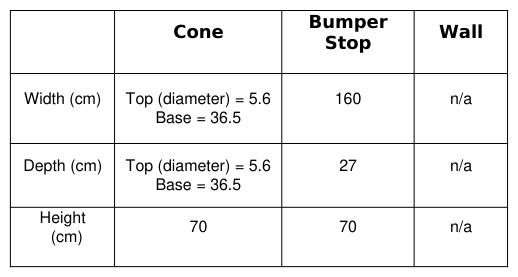
There are three primary independent variables in this experiment design: camera angle, obstacle type, and display mode. Two camera angles (the inclination angles from the vertical) – 27 degree and 45 degree – are selected to represent the optimal viewing with and without the rear bumper respectively. Three types of physical obstacles, i.e., a cone, a bumper stop, and a wall, were used in this study. Table 1 shows the detailed dimensions for these obstacles used in this experiment. Identical set of experiment conditions were instrumented both in 3D and 2D displays for comparison. Participants need to wear 3D glasses at all times during the experiments, even for the conditions of 2D displays, in order to eliminate possible confounding effects due to glasses wearing. A 2x3x2 completely randomized with-subject design with 1 replication forms the basis of this experiment.
Table 1: Dimensions of the obstacles used in the experiment Cone Bumper Stop Wall
Performance data, such as clearance to obstacle, task completion time, and parking deviation, as well as the subjective data in evaluating the advantages and disadvantages by providing 3D imaging were both recorded and cross-referenced.
RESULTS AND DISCUSSION
Twenty subjects (17 male and 3 female) aged between 20 and 39 years were recruited from the University community. All participants were regular drivers with at least two years of licensed driving experience.
Each of the performance measures (i.e., task completion time, rear clearance, and lateral deviation) was analyzed using ANOVA with the within-subject factors of camera angle, obstacle type, and display mode. For task completion time, which was measured from the beginning of starting position departure to the finish of a parking task, no significant results for any main effects (including the 2D vs. 3D display mode) or interactions were concluded.
The main effect of camera angle was significant for rear clearance (p< .0001). Mean clearance decreased with the inclining angle of camera view and the sight of rear bumper. The main effect of obstacle type was also significant for rear clearance (p< .0001). Mean clearance were wider with the wall, comparing to both cone and bumper stop conditions. The interaction effect of camera angle and obstacle type was marginally significant for rear clearance (p=0.063 < 0.1). As shown in Figure 2, the effect of wider clearance with the wall was more obvious with the lower camera angle. Again the effect of display mode, i.e., 2D vs. 3D, was not significant.
Figure 2. The interaction plot for rear clearances under different obstacle types and camera angles
Figure available in the original PDF paper.
For the performance measures on lateral deviation, the main effect of display mode was marginally significant (p= 0.093 < 0.1). In average, less lateral deviation was resulted with the 3D display mode than with the 2D’s. The interaction effect of display mode and obstacle type was also marginally significant (p=0.065 < 0.1). Figure 3 depicts how the two display modes influenced the effects of different obstacle types on lateral deviations. It seems obvious that the effect of obstacle type was significant for lateral deviation with 3D displays but, on the other hand, less sensitive with 2D displays.
Figure 3. The interaction plot for lateral deviations under different obstacle types and display modes
Figure available in the original PDF paper.
In order to have a better understanding on the contribution of this rear view display to such parking tasks, display attending time, which measures the total dwelling time of driver’s visual attention on the display screen while performing the parking task, was also recorded for each experiment conditions. This particular behavioral measure was also analyzed in terms of the three major independent variables, i.e., camera angle, obstacle type, and display mode, using ANOVA. The main effect of camera angle was the only significant result found (p=0.007 < 0.01). The conditions with lower camera angle and sights of rear bumper were associated with, in average, longer display attending time. However, the effect of display mode, i.e., 2D vs. 3D, was not significant.
Subjective measures, such as preferences and comparisons on the two display modes (2D vs. 3D), were collected during the post-experiment interview for each subject driver. Our data showed that about 50% of experiment participants preferred the 3D display setting for better estimation to obstacle shapes/dimensions and therefore the clearances while only 15% preferred 2D, mainly for the reason of being used to it, and another 35% noted indifference. It is obvious that a mild disagreement between the performance measures and the subjective measures on the advantages of 3D displays. Such analysis result seems to coincide with the notion on the discrepancy between perceived usability and actual performance made by Lavie et al. (2011) in their study on aesthetics and usability of in-vehicle navigation displays. For the settings of camera angle/view, the majority (90%) of our participants preferred the lower angle setting (27°) for the reason of the advantage of the view of bumpers as an important cue for clearance estimation.
CONCLUSIONS
Generally speaking, our study does not find much significant advantages in stereoscopic imaging for the driving performance of reverse/backward parking. The only significant advantage of 3D display revealed, but rather marginal, is for lateral deviation. Our analysis on the interaction effect with obstacle type suggests the selective nature of 3D display advantages and, therefore, calls for further research. Despite the less promising results in 3D display advantages from the performance measures, a half of our experiment subjects, however, did prefer the 3D display, especially for better feels in clearance estimation. That is, 3D displays for parking may have positive effects on user experiences, with or without the enhancement on actual performance. Nevertheless, our data did reveal that camera view may play a more crucial role in parking, both objectively and subjectively.
REFERENCES
Andersen, G.J., Ni, R., Bian, Z., Kang, J. (2011) “Limits of spatial attention in three dimensional space and dual task driving performance”. Accident Analysis and Prevention 43. pp. 381-390. Antin, J.F. (1993), “Information aspects of car design: navigation”, in: Automotive Ergonomics, Peacock, Karwowski (Ed.). Baumann, M.,Keinath, A., Krems, J.F., Bengler, K. (2004) “Evaluation of in-vehicle HMI using occlusion techniques:
experimental results and practical implications”, Applied Ergonomics 35. pp. 197-205 Chan, A.H.S., Chan, K.W.L. (2010) “Three-dimensional spatial stimulus-response (S-R) compatibility for visual signals with hand and foot controls”. Applied Ergonomics 41. pp. 840-848. Etquist, J., Rudin-Brown, C.M., Lenné, M.G. (2012) “The effects of on street parking and road environment visual complexity on
travel speed and reaction time”. Accident Analysis and Prevention 45. pp. 759-765. Evans, L. (2004) Traffic Safety. Science Serving Society. Bloomfield Hills, MI. Hills, B.L. (1980) “Vision, Visibility and Perception in Driving”. Perception 9. 195-216. Horberry, T., Andersen, J., Regan, M.A., Triggs, T.J., Brown, J. (2006) “Driver distraction: the effects of concurrent in-vehicle tasks, road environment complexity and age on driving performance”. Accident Analysis and Prevention 38. pp. 185-191. Keinath, A., Baumann, M., Gelau, C., Bengler, K., Krems, J.F. (2001), “Occlusion as a technique for evaluating in-car displays”,
In: Engineering Psychology and Cognitive Ergonomics, Harris (Ed.). pp. 391-397 Lavie, T., Oron-Gilad, T., Meyer, J. (2011) “Aesthetics and usability of in vehicle navigation displays”. International Journal of Human-Computer Studies 69. pp. 80-99. Weir, D.H. (2010) “Application of a driving simulator to the development of in-vehicle human-machine-interfaces”. IATSS
Research 34. pp. 16-21. Wickens, C.D., Gordon-Beker, S., Liu, Y., Lee, J.D. (2004) Introduction to Human Factors Engineering, 2nd ed., Pearson.
LISTED IN THE AHFE DIGITAL BOOKSTORE CATALOGUE
Explore the complete digital volume
Advances in Physical Ergonomics and Human Factors: Part I
Read this individual research paper free through the original publisher, or explore the full digital proceedings book.
ISBN 978-1-4951-2104-3
Explore this ISBN in the AHFE Bookstore ↗Listed in the July 2026 bookstore catalogue; search by ISBN to confirm current availability · Digital book purchase optional