Amna Javed, Youji Kohda (2025). Creating Shared Value in Platform Economies: The Social and Ethical Role of Ride-Hailing Platforms. In: Human Factors in Design, Engineering, and Computing. AHFE Open Access, vol. 199, pp. 279–289. https://doi.org/10.54941/ahfe1006840
The rapid evolution of platform businesses in the digital economy has transformed traditional industries, leading to significant shifts in how value is created and distributed. This research explores the development of a new Creating Shared Value (CSV) theory tailored to the unique characteristics of platform businesses, with a focus on the ride‑hailing sector. While ride-hailing platforms have achieved substantial economic growth, their societal impact remains controversial, with concerns over labor practices, regulatory challenges, and environmental implications. This paper argues that a revised CSV theory is essential to guide platform businesses in balancing economic objectives with social responsibilities by integrating the dynamics of multi‑sided platforms, network effects, stakeholder engagement and changing people’s behaviour to improve social norms. A case study of the ride‑hailing service Careem is selected to observe the actual process and actions taken. The proposed theory emphasises the importance of co‑creating value with all stakeholders, including drivers, passengers, regulators and communities, to achieve sustainable business growth and societal benefits. Data from interviews, direct observation and publicly available company information were analysed through an explanation‑building technique. The findings contribute to theory and practice by offering a CSV framework adapted to platform business contexts and providing managerial and policy insights into how platform firms can promote positive social behaviour.
Platform businesses are becoming a dominant force in the digital economy. The rise of platform-based economies has revolutionized how people interact, exchange value and organise everyday life. Organisations mediating multi- sided interactions; such as ride-hailing, accommodation sharing and digital marketplaces; are reshaping value creation, value capture and stakeholder engagement. While these platforms have been extensively studied for their economic performance, scalability and network effects, their social and ethical dimensions remain underexplored (Javed, Javaid and Kohda, 2024; Shah, 2023).
In this context, traditional models of corporate social responsibility (CSR) are increasingly challenged by the need for business models that embed social value creation at their core (Porter and Kramer, 2011; Royo-Vela and Cuevas Lizama, 2022). The concept of Creating Shared Value (CSV) offers one such approach: integrating business success with societal improvement (Porter and Kramer, 2011; Camarena-Martínez, Ochoa-Silva and Wendlandt-Amezaga, 2016). CSV differs from Corporate Social Responsibility (CSR) in that value for society is embedded within a firm’s business model rather than being an external add-on (Porter and Kramer, 2011).
In recent years, the concept of Creating Shared Value (CSV) has gained significant attention in both academic and business circles as a strategic approach that integrates business success with societal improvement (Porter and Kramer, 2006; 2011). In the context of platform businesses, particularly those in the gig economy, the potential for CSV to influence social behaviour and promote positive social norms is profound. The latest CSV trend explains that business models do not just talk about supply chain with economic and social perspectives but also focus on network effect (Interactions of stakeholders) (Menghwar and Daood, 2021; Rong et al., 2021).
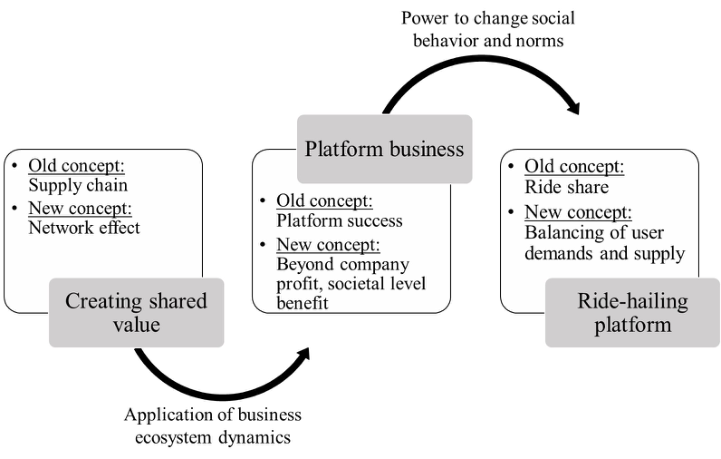
However, the rapid rise of service platforms has also sparked debates around their social impact, particularly concerning labour rights, environmental sustainability, and equitable access to services (Parker, Alstyne and Choudary, 2016; Hagiu and Wright, 2015). The integration of CSV into platform business models has the potential to influence social behaviour on a broad scale (see Figure 1).
Figure 1: Research motivation (combining csv and platform business).
Creating Shared Value in Platform Economies: The Social and Ethical Role 281
Moreover, ride-hailing platforms are uniquely positioned to create shared value by addressing social issues while maintaining profitability. These platforms have the potential to enhance social inclusion by providing accessible transportation options to underserved communities. Platforms can shape social norms around work, where the use of data analytics and behavioural changes can further enhance the effectiveness of service initiatives, encouraging users and service providers to adopt behaviours that align with broader social goals.
Problem Statement Despite the growing interest in CSV and its application in platform businesses, there is a lack of empirical research exploring how these companies can effectively create shared value (CSV) while promoting positive social behaviour. The existing literature predominantly focuses on the economic aspects of platform businesses, often neglecting the broader social implications and the potential for these platforms to drive societal change.
Additionally, while studies have examined the impact of ride-hailing platforms on urban mobility and labour markets, there is limited understanding of how these platforms can strategically integrate CSV to influence social norms and behaviour. This gap presents a critical opportunity for research that explores the mechanisms through which ride-hailing platforms can create shared value and promote social behaviour, particularly in diverse and dynamic markets. This research considers a question: How do ride-hailing platforms integrate CSV to promote positive social behaviour and improve social norms, rather than simply pursuing economic growth? To answer this, we conduct a case study of Careem; a ride-hailing platform operating in Pakistan by exploring how its operations have attempted to influence behaviour at micro (individual), meso (community/organisation) and macro (institutional) levels.
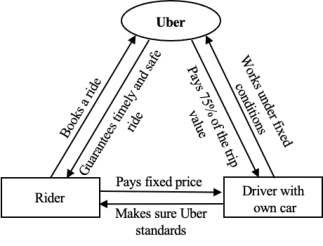
Case Explanation The conventional ride-hailing service-Uber follows a standardized global approach to its operations, offering a consistent experience across different markets (see Figure 2). The platform maintains a strong brand identity and service quality.
Figure 2: Service mechanism of uber.
282 Javed and Kohda
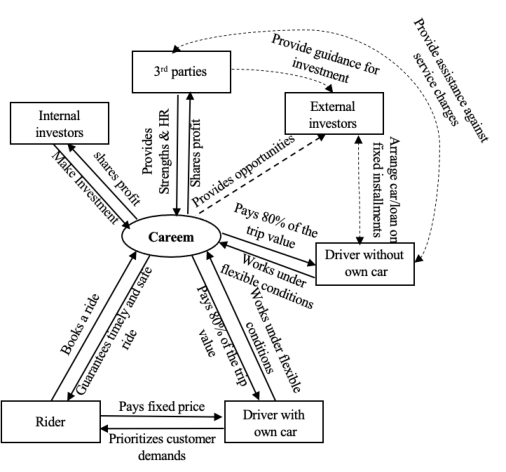
Initially, Careem a ride-hailing service adopted a business model of Uber but in a short period, Careem realized the fact that no service can be implemented in a developing country in its original form because of limited resources and economic/social issues. The service must be re-shaped (Javaid, Javed and Kohda, 2019b).
In Pakistan, Careem has not only transformed urban mobility but also reshaped employment patterns, gender inclusion and digital payment adoption (Javaid and Kohda, 2024; Javid et al., 2022). Careem has shown great progress by increasing the scope of a business model as per local needs. Also, Careem has involved many customers and drivers directly in its service model to facilitate community (see Figure 3). By exploring Careem’s operational mechanisms through the lens of CSV, this study investigates how digital platforms can act as agents of social change rather than mere service providers (Javaid, Javed and Kohda, 2019a).
Figure 3: Service mechanism of careem.
Key Research Questions
1. How does Careem change user‘s behaviour to improve social norms at micro, meso and macro levels? 2. How do cultural differences influence the effectiveness of business strategies for changing social norms? 3. How does Careem use technological innovations to promote positive social behaviours?
The remainder of the paper is structured as follows. Section 2 reviews the relevant literature on CSV, platform business models and social behaviour. Section 3 outlines the methodology. Section 4 presents findings and discussion
Creating Shared Value in Platform Economies: The Social and Ethical Role 283
organised by levels of behaviour. Section 5 articulates the theoretical contribution and proposed CSV for platform framework. Section 6 concludes with implications, limitations and directions for future research.
LITERATURE REVIEW
The literature review covers three areas: CSV, platform business models, and the relationship between platform operations and social norms. The CSV concept (Porter and Kramer, 2011) emphasises joint business and societal value creation, while critiques highlight conceptual ambiguity (Menghwar and Daood, 2021). Platform businesses devise multi-sided interactions (Rochet and Tirole, 2006) and have the power to influence behaviour (Jovanovic et al., 2021). Integrating CSV into such systems requires addressing labour, regulatory, and sustainability challenges (O’Connor and Wright,2015).
Creating Shared Value in Platform Economies Creating Shared Value emphasizes the alignment of business and societal goals. While traditional firms achieve CSV through supply-chain sustainability or community engagement, platform businesses operate through networked interactions that amplify their societal impact (Pera, Occhiocupo and Clarke, 2019). The multi-sided nature of platforms allows them to influence both consumer and producer behaviours simultaneously.
However, prior research on CSV in digital platforms remains fragmented. Most studies focus on efficiency gains, market access and innovation (Khanagha et al., 2022), while limited work examines behavioural and normative shifts. As platform governance mechanisms; such as ratings, feedback systems and reputation algorithms; shape user conduct, there is a growing need to understand their broader sociocultural implications (Salas-Molina, Aguilar and Bistaffa, 2020).
Ride-Hailing Platforms and Social Norms Ride-hailing services have redefined urban transportation, employment and mobility. Scholars have explored their effects on labour markets, urban congestion and service efficiency. Yet few have analysed their influence on social norms, the informal rules governing societal behaviour.
Platforms like Careem embed social values through everyday interactions. Features such as gender-specific ride options (“women drivers” or “women- only rides”), digital payments and driver training programmes contribute to building trust, safety and respect in societies where such norms are still evolving (Amber et al., 2023; Javid et al., 2022). Thus, ride-hailing platforms can serve as laboratories for observing how technological design influences collective behaviour.
CSV, Platform Business and Social Norms Bridging the two streams of CSV and platform business, we observe three tensions. Firstly, traditional CSV frameworks focus on supply chains, employees and products, whereas platform businesses emphasise network
284 Javed and Kohda
interactions, data flows and multi-sided value capture (Meyer, 2018). Secondly, platform businesses often face controversies: precarious labour (drivers), regulatory gaps (city transportation), environmental concerns (increased rides and emissions) which challenge purely positive societal narratives (O’Connor and Wright, 2015). Thirdly, social behaviour change is under-explored: how can platforms deliberately shape social norms (e.g., reduced car ownership, digital inclusion, respectful driver-rider interactions)?
In sum, there is a clear research gap: How can platform businesses operationalise CSV in a way that influences user and stakeholder behaviour, thereby promoting social norms while remaining economically viable? In this sense, Careem’s ecosystem acts as a behavioural catalyst that integrates profit motives with social transformation.
RESEARCH METHODOLOGY This research adopts a qualitative case study approach to explore how Careem integrates CSV principles to promote social norms. A case study is appropriate for understanding complex, context-dependent phenomena (Yin, 2018). The study is conducted in Pakistan, where Careem’s market penetration and social relevance are significant (Shah and Kubota, 2022). The first target was to develop a case study protocol. Then the research employed triangulation across multiple data sources to enhance validity (see Table 1):
Primary Data: Semi-structured interviews with Careem drivers, users and management.
Secondary Data: Company reports, marketing materials and social media communications; government transport policies and digital economy frameworks.
Archival Data: Previous academic studies on Careem and ride-hailing in Pakistan For analysis explanation building technique was adopted.
Table 1: Detailed research approach for data sources in Pakistan.
Table available in the original PDF paper.
Data Collection Methods Target Research
Triangulation Approach Management side (managers, investors, stakeholders)
Direct observation To observe business operations Semi-structured interviews
Changing user behaviour, customization strategies, social norms and societal benefits
User side (drivers and riders)
Semi-structured interviews
User satisfaction and well-being and community involvement Support research accuracy
Archival materials Internet sources, media, press releases, internal documents and blogs
Creating Shared Value in Platform Economies: The Social and Ethical Role 285
FINDINGS AND DISCUSSION Business Ecosystem Dynamics
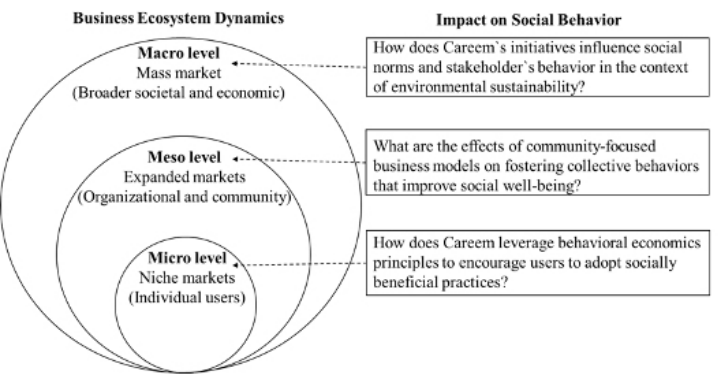
User behaviour on Careem can be examined across micro, meso, and macro levels, each providing unique insights into how individuals and groups interact with the platform.
Micro Level: Transforming Individual Behaviour At the micro level, Careem has influenced user behaviour through design- driven nudges and operational practices. Careem has altered individual behaviours by making ride-hailing more accessible, leading to reduced car ownership. It has also influenced daily commuting habits. For example, the rating system encourages accountability, thereby promoting courteous and respectful behaviour among riders and drivers alike. Additionally, cashless payment options and digital receipts have increased trust and transparency in financial transactions, especially in societies transitioning from cash-based economies.
Careem’s introduction of driver training programmes and safety features (such as ride-tracking and emergency assistance) has enhanced passengers’ sense of security. These practices create shared value by aligning business incentives, customer satisfaction and retention with broader social outcomes like trust and safety (see Figure 4).
Figure 4: Business ecosystem dynamics and its impact on social behaviour.
Meso Level: Shaping Urban and Community Norms At the meso level, Careem’s operations extend beyond individual experiences to community and market ecosystems. Careem has impacted urban mobility by influencing transportation policies, thereby altering employment patterns and local business dynamics. The platform has generated employment for thousands of drivers, including marginalised groups such as women and
286 Javed and Kohda
students. This inclusion has reshaped perceptions about informal labour and digital entrepreneurship.
Moreover, Careem collaborates with local businesses and municipal authorities, influencing urban mobility strategies. By integrating real-time data on traffic and demand, the company supports smarter city planning. Such partnerships demonstrate how CSV can manifest through ecosystem coordination, where shared data and goals yield mutual benefits for businesses and society (see Figure 4).
Macro Level: Institutional and Policy Transformation At the macro level, Careem has contributed to the digitalization of economies, influencing national transportation infrastructure, and shaping regulatory frameworks. It has also played a role in redefining labour markets and encouraging the growth of the sharing economy across the region. Through digital payment systems and driver registration processes, it supports financial inclusion and regulatory compliance. The platform’s operations have influenced national discussions on transport policy, data privacy and gig worker protection. By collaborating with regulators and local governments, the company contributes to transportation policy design, shaping norms around mobility, safety and employment.
Moreover, the platform’s efforts toward environmental sustainability; such as promoting hybrid/electric vehicle use and pooling rides; address societal challenges of congestion and emissions, aligning with broader sustainable development goals. These macro effects reflect the “shared value ecosystem” concept where business, society and institutions co-evolve.
Careem’s initiatives align with the broader Sustainable Development Goals (SDGs), particularly in promoting decent work, gender equality, and innovation. The company’s ecosystem-driven model demonstrates how CSV principles can extend beyond corporate boundaries to shape institutional frameworks and cultural expectations (see Figure 4).
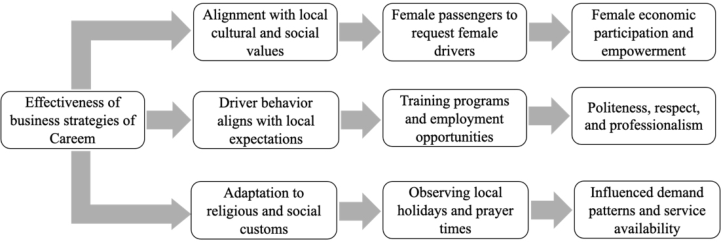
Cross-Cultural Social Norms Cultural differences play a crucial role in determining the effectiveness of business strategies aimed at changing social norms, as demonstrated by Careem’s localized approach across diverse markets. Unlike global competitors that apply uniform strategies, Careem tailors its operations to align with local cultural and social values. For instance, in conservative societies such as Pakistan, Careem introduced the option for female passengers to request female drivers, addressing cultural sensitivities around gender interaction and safety. This not only enhanced women’s mobility but also contributed to shifting social norms toward female economic participation and empowerment (see Figure 5).
Additionally, Careem ensures that driver behaviour aligns with local expectations of politeness, respect, and professionalism, which are highly valued in diverse cultures. Careem also adapts to religious and social customs, such as observing local holidays and prayer times, which can influence demand patterns and service availability. By understanding and respecting
Creating Shared Value in Platform Economies: The Social and Ethical Role 287
these cross-cultural norms, Careem successfully creates a service that is both inclusive and sensitive to the diverse needs of different cultural groups.
Figure 5: Business strategies for changing social norms.
Digital Transformation, Sustainable Growth and Societal Benefits Careem leverages technological innovations as powerful tools to promote positive social behaviours and enhance community well-being across its operating regions. Through its digital platform, Careem utilizes data analytics and AI-driven algorithms to match drivers and riders efficiently, encouraging trust, safety, and reliability in everyday interactions. Features such as in- app safety alerts, real-time tracking, and cashless payment systems foster transparency and accountability, reducing risks and promoting responsible behaviour among users.
Moreover, Careem’s technology-enabled initiatives; such as driver performance monitoring, eco-friendly ride options, and gamified reward systems motivate drivers to maintain high service standards and adopt sustainable practices like fuel efficiency and electric vehicle use. The platform also supports social inclusion by integrating accessibility features and providing earning opportunities for individuals from diverse backgrounds. By embedding these innovations into its service ecosystem, Careem not only optimizes operational efficiency but also shapes user habits and behaviours aligned with broader social and ethical goals.
Careem’s focus on sustainable growth and societal benefits is evident in its commitment to create economic opportunities, reducing environmental impact across the regions. By providing flexible earning opportunities for drivers, Careem contributes to financial inclusion and economic empowerment in communities.
CONCLUSION
The case of Careem illustrates how platform businesses can go beyond transactional efficiency to act as agents of social transformation. By embedding CSV principles into its operations, Careem fosters not only economic benefits but also positive social behaviours and institutional evolution. Through digitalisation, inclusion and ethical engagement, the
288 Javed and Kohda
platform demonstrates how shared value creation can operate simultaneously at micro, meso, and macro levels.
This study highlights that the future of platform business lies not merely in network expansion but in normative innovation — the ability to reshape how societies interact, trust and cooperate in digital spaces. As global economies continue to platformise, the lessons from Careem can inform a new paradigm of responsible and inclusive digital capitalism.
Research Significance and Originality In the past, platform businesses worked for the success of the platform itself, however, in the current economy, people understand the strategies, advantages and disadvantages of platform businesses. Therefore this is the time to introduce a latest trend of platform business with the great focus on how platform business can change people behaviour by changing the social norms? However, CSV is very old concept and there is no further development so this is the time to find new trends. So this research mainly focuses on “over the success of platform business how CSV stands and can be renewed?”
Research Limitations This research is based on a single case study of Careem in Pakistan. While rich in context, the findings may not generalise to all platform types or geographical contexts. Interview data are subject to respondent bias, and direct observation is limited in scope.
ACKNOWLEDGMENT
This research is funded by JAIST Research Grant (FUNDAMENTAL RESEARCH) 2025.
REFERENCES
Amber, H., Beyene Chichaibelu, B. and Hussain, A. (2023) Impact of public transport and ride-hailing services on female labour force participation in Lahore, Pakistan: A mixed-method approach. International Growth Centre working paper PAK- 22040, May. Hagiu, A., and Wright, J. (2015). “Multi-sided platforms.” International Journal of
Industrial Organization, 43, 162–174. doi: 10.1016/j.ijindorg.2015.03.003. Javaid, A., Javed, A., and Kohda, Y., (2019a), Exploring the Role of Learning Organization to Improve Sharing Economy in Developing Countries: A Case Study of Ride-Hailing Service in Pakistan, International Journal of Knowledge and Systems Science (IJKSS), IGI Global, Vol. 10 (4), pp. 35–60. doi: 10.4018/ IJKSS.2019100103. Javaid, A., Javed, A., and Kohda, Y., (2019b), Exploring the Role of Boundary
Spanning towards Service Ecosystem Expansion: A Case of Careem in Pakistan, Sustainability (MDPI), Vol. 11(15), pp. 1–27. doi: 10.3390/su11153996. Javed, A., Javaid, A. and Kohda, Y. (2024) ‘Navigating the road to value: Knowledge as a strategic driver in ride-hailing service’, in 14th Annual International Conference on Industrial Engineering and Operations Management, Dubai, Feb 12–14, pp. 978–8-3507–1734-1.
Creating Shared Value in Platform Economies: The Social and Ethical Role 289
Javid, M. A., Kubota, H. and Others (2022) ‘Travellers’ perceptions about ridehailing services in Lahore’, Transport Policy, 121. doi: 10.1016/j.tranpol.2022.11. Khanagha, S., Machado, C. T. and Torkkeli, L. (2022) ‘Platform business models and
shared value creation: A systematic review’, Technological Forecasting and Social Change, 175, 121391. Menghwar, P. S. and Daood, A. (2021) ‘Creating shared value: A systematic review’, International Journal of Management Reviews, 23(4). doi: 10.1111/ijmr.12252. Meyer, H. (2018) Creating Shared Value (CSV): Operationalising CSV beyond the
firm. University of Cambridge. O’Connor, G. C. and Wright, R. (2015) ‘Managing innovation in the modern corporation’, Journal of Business Strategy, 36(3), 20–30. doi: 10.1108/JBS- 10–2014-0125. Parker, G. G., Van Alstyne, M. W., and Choudary, S. P. (2016). “Platform Revolution:
How Networked Markets Are Transforming the Economy—And How to Make Them Work for You.” W. W. Norton and Company. Pera, R., Occhiocupo, N. and Clarke, J. (2019) ‘Motives and outcomes of value co-creation in the digital era’, Journal of Business Research, 99, 545–556. doi: 10.1016/j.jbusres.2018.01.033. Porter, M. E. and Kramer, M. R. (2011) ‘Creating shared value: How to reinvent
capitalism and unleash a wave of innovation and growth’, Harvard Business Review, 89(1/2), 62–77. doi: 10.1016/j.hre.2011.09.005. Rochet, J-C. and Tirole, J. (2006) ‘Two-sided markets: A progress report’, RAND Journal of Economics, 37(3), 645–667. doi: 10.1111/ j.1756–2171.2006.tb00036.x. Rong, K., Li, B., Peng, W., Zhou, D. and Shi, X. (2021) ‘Sharing economy platforms: Creating shared value at a business ecosystem level’, Technological Forecasting and Social Change, 169, 120804. doi: 10.1016/j.techfore.2021.120804. Salas-Molina, F., Rodríguez Aguilar, J. A. and Bistaffa, F. (2020) ‘Shared value
economics: An axiomatic approach’, arXiv preprint, arXiv:2006.00581. Shah, S. A. and Kubota, H. (2022) ‘Analysing travellers’ attitude towards ride-hailing services in Lahore’, Transportation Research Part A: Policy and Practice, 155, 161–173. Shah, S. S. (2023) ‘Dynamics of social influence on consumption choices’, Heliyon,
9(6), p. e17146. doi: 10.1016/j.heliyon.2023.e17146. Yin, R. K. (2018) Case Study Research and Applications: Design and Methods. 6th Edition. Thousand Oaks, CA: Sage Publications.
LISTED IN THE AHFE DIGITAL BOOKSTORE CATALOGUE
Explore the complete digital volume
Human Factors in Design, Engineering, and Computing
Read this individual research paper free through the original publisher, or explore the full digital proceedings book.
ISBN 978-1-964867-75-5
Explore this ISBN in the AHFE Bookstore ↗Listed in the July 2026 bookstore catalogue; search by ISBN to confirm current availability · Digital book purchase optional