Natsumi Takahashi, Takashi Hashimoto, Amna Javed, Youji Kohda (2024). Visualising Transformation Strategies for Navigating Organisational Change Dynamics: A Case Study of Resource Management in a Japanese Corporation. In: The Human Side of Service Engineering. AHFE Open Access, vol. 143, pp. 271–278. https://doi.org/10.54941/ahfe1005107
1 Hitachi, Ltd., 18-13, Sotokanda 1-choume, Chiyoda-ku, Tokyo, 101-8608, Japan; Japan Advanced Institute of Science and Technology, 1–1 Asahidai, Nomi, Ishikawa 923-1292, Japan ↗
2 Japan Advanced Institute of Science and Technology, 1–1 Asahidai, Nomi, Ishikawa, 923-1292, Japan ↗
Diversity management is an important topic in today’s business world perspective of human resource management; however, it is difficult to align diversity management with the bottom line because it requires investments, contributions, and resources that do not return to the bottom line in the short term. In addition, the lack of a clear method for evaluating effectiveness makes it difficult to make preliminary estimates and decisions regarding strategy implementation. Currently, diversity, quality, and inclusion (DEI) research is being conducted worldwide, and a few drastic solutions have been proposed. This study focuses on the implementation of DEI promotion strategies in companies and explores methods to explain the impact of such strategies in the field. This study provides a way to explain the value of strategies such as DEI, for which quantitative evaluation methods have not yet been established to activate organizational transformation projects in the workplace. It also provides tools to support middle managers who implement strategies in their organisations.
Diversity, equity, and inclusion (DEI) have emerged as crucial facets of organisational effectiveness and societal harmony. Scholars have extensively delved into the multifaceted nature of DEI, seeking to cultivate inclusive environments across diverse settings (Oswick and Noon, 2014). Human rights and social values such as diversity management and stakeholder well- being (Diener, 1984) are becoming increasingly important; however, there are barriers to such transformation projects in the workplace. Because DEI are conceptual goals, it is difficult to quantify the results and make them profitable in the short term, which means that budgets cannot be approved and projects cannot be initiated. Thus, this study examines the relation- ship between corporate philosophy and strategic goals and the institutions that mediate or support the transformation of frontline workers involved
in the practical implementation of these goals. By illustrating and analysing the relationship among value, corporate capacity, and society/market in a micro-meso-macro-loop model, we visualise the impact of strategies on exchange value among stakeholders in the field. Using this model to visu- alise the dynamics through which value and benefits can be exchanged, we explore methods for qualitatively describing value and effectiveness to project sponsors, even for those that cannot be translated into concrete numbers.
This study conducts a novel search for a method to explain the effects of policies that are not approved for implementation because of the diffi- culty in quantifying their goals; furthermore, it focuses on the function of institutions in mediating the relationship between value and profit. From an academic and practical perspective, this study provides a new evaluation methodology for DEI research. Practically, the new evaluation methodology will help ordinary businesspeople understand complex real-world issues and the methodology can be applied to their planning. Further, this methodology can help executives make better decisions regarding experimental strategy approval and assist middle managers to be more accountable for budgets and other aspects of their implementation plans.
Literature Review for DEI in the Workplace The importance of DEI in enhancing organisational efficacy in the work- place has recently gained recognition (Garg and Sangwan, 2021). Extensive scholarly exploration has been undertaken to understand the nuanced dimen- sions of DEI to foster environments of inclusivity across various contexts (Oswick and Noon, 2014). Regarding the impact of the diversity of cul- tural perspectives on work-group processes and outcomes, Ely and Thomas (2001) suggest that individuals with different perspectives actively participate in group discussions, which may lead to more creative and effective solutions. Regarding the management of multicultural organisations, diversity must be used as a resource to maintain an organisation’s competitiveness. Organisa- tions must develop strategies to gather different perspectives from employees with different cultural backgrounds and turn them into competitive advan- tages (Cox and Blake, 1991). Cultural diversity can encourage organisations to adopt innovative and flexible approaches, which can help ensure competi- tive advantage (Shore et al., 2009). Furthermore, groups comprising members with different backgrounds and perspectives can enhance team problem- solving and creativity (Joen et al., 1999), and teams with diverse perspectives and skills are more likely to be innovative and achieve better results than non-diverse teams (Jackson and Ruderman, 1995). Moreover, such diverse teams tend to have higher levels of innovation and productivity, and diversity within an organisation promotes creativity and efficiency. As these previous studies indicate, diversity and inclusion are important elements in organi- sations and, when managed properly, can create a competitive advantage. This is because when individuals from different cultural backgrounds and perspectives collaborate, organisations can find more flexible and creative solutions. However, there are few reports on the negative aspects of DEI and how its effectiveness can be quantified in the short term. The concept of DEI is
Visualising Transformation Strategies for Navigating Organisational Change Dynamics 273
also receiving increasing attention in consumer behaviour research and brand management, with Arsel et al. (2022) providing insight into the impact of DEI on consumer behaviour and market trends and suggesting directions for future research. Ferraro et al. (2023) suggest how DEI can be used to enhance the value and image of a company’s brand and how a company’s positive embrace of diversity can contribute to its business success. DEI is an impor- tant component of consumer behaviour research and brand management; therefore, a better understanding of the impact of DEI on organisational and brand success is important for future research and practice.
Problem Statement With growing interest in the importance of social value creation (Tsai & Ghoshal, 1998), an important issue to be resolved for commercialisation is the consideration of a value-to-profit conversion model. However, there have been few proposals for such models to help entrepreneurs (Dong & Su, 2010). In addition, in transformations involving many stakeholders, the diversity of values can lead to trade-offs of interest (Sabini & Alderman, 2021). Therefore, it is important to carefully explain the process to stakehold- ers and build consensus while proceeding. A value-to-profit conversion model that applies to co-creation and consensus building can help entrepreneurs implement organisational transformation projects, such as promoting DEI in workplaces (April, 2021).
Purpose of this Study The purpose of this study is to propose a method for creating and analysing a value-to-benefit conversion model that will help entrepreneurs build con- sensus on transformation promotion projects, such as DEI promotion. To achieve this objective, the following research questions are posed:
RQ: Which models are useful in explaining value dynamics for difficult- to-quantify objectives?
RESEARCH METHOD The proposed model is explained using a hypothetical model and case anal- ysis. Based on a hypothetical base model using the micro-meso-macro loop model (Dopfer et al., 2004; Hashimoto and Nishibe, 2017), representative DEI-related cases were fitted to test their persuasive potential. The validity of the model was tested through interviews with managers of Company A, a global corporation headquartered in Japan.
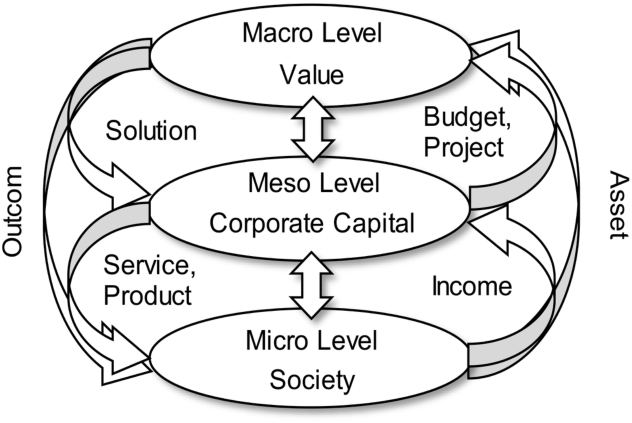
Hypothetical Model The micro-meso-macro loops (Hashimoto and Nishibe, 2017) are used as a multilevel perspective to explain the value and profit transformation analysis model (Figure 1). The top macro-level represents the value that the organisa- tion wants to realise. Examples of value include DEI and subjective well-being (Diener, 1984).
Figure 1: Micro–meso–macro loops for value and profit transformation analysis.
The meso level represents the organisation’s asset buffer. An organisa- tion with a large buffer can reduce its turnover rate, allowing it to create a medium- to long-term payback plan. However, an organisation with a small buffer is not sustainable unless it can increase its turnover rate and create a model that allows it to raise funds quickly because the value operation will not last. However, even if the size of the buffer is small, if a path can be profitable quickly, it will be possible to operate with sufficient value.
The lower micro level represents the area of activity that generates profit. This is where the solutions and innovations created through the realisation of value become concrete services and products that contribute to society and earn profits. The profits made here become cash recovered in the asset area at the meso level. Recovery includes not only market sales but also fundrais- ing from investors through value presentation. In this way, funds raised from society become operating funds for the organisation, value is realised, and compensation is recovered from society through a business strategy that con- verts value into profit, creating a virtuous cycle of sustainable operations. The value and profit conversion analysis model depicts this cycle and ana- lyzes the balance between budget size and turnover rate in the dynamics of value conversion. Ideally, all values should be realised; however, if invest- ment or operating funds are required, the operation must be balanced with the return of funds, considering the organisation and sustainable develop- ment of value realisation. Otherwise, the investment required to realise the value will be too large and the project will become difficult to manage or the organisation will collapse.
Another use of the value and profit realisation analysis model is to explain conceptual value. Particularly, in the case of a business, when starting a project to realise value, it is necessary to explain the profit that can be generated and the payback plan to obtain budget approval from investors
Visualising Transformation Strategies for Navigating Organisational Change Dynamics 275
and senior management. In the case of conceptual values such as diversity and well-being, it is difficult to calculate the actual amount or explain the expected payback in clear numerical terms. Thus, it is impossible to obtain a sufficient budget for this value. Practitioners cannot overcome the barrier to translating value into profits. Even if the value cannot be explained in con- crete numbers, a diagram showing the dynamics, such as in this model, can provide some explanation and allow stakeholders to discuss the profit con- version method (arrows from the meso to the micro level in Figure 1). The model can also be used to clarify misconceptions about scales. In this model, the size of the buffer is considered according to the size of the organisation; therefore, the analysis can be tailored to the circumstances of each organi- sation. A plan that is feasible for a large company may not be feasible for a small- or medium-sized company. Even if the value seems excellent, it must be analysed according to the situation and sustainability of each organisation.
Value Conversion Model for DEI Project
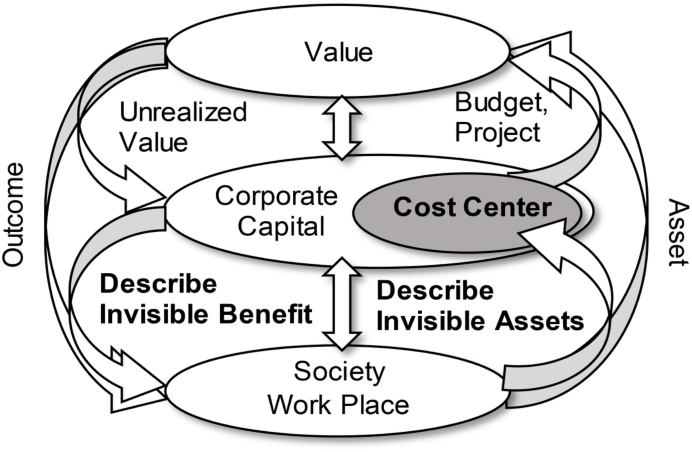
Figure 2 illustrates a model for value realisation projects in which numerical targets and quantitative evaluations are difficult to estimate. For example, because the return on investment for DEI is difficult to achieve in the short term and requires medium- to long-term planning, funds are brokered with cost centres as buffers. If the return on investment is unsuccessful, the cost centre will become too large for the organisation to support, and the project will fail.
Figure 2: Micro–meso–macro loops for difficult-to-quantify value.
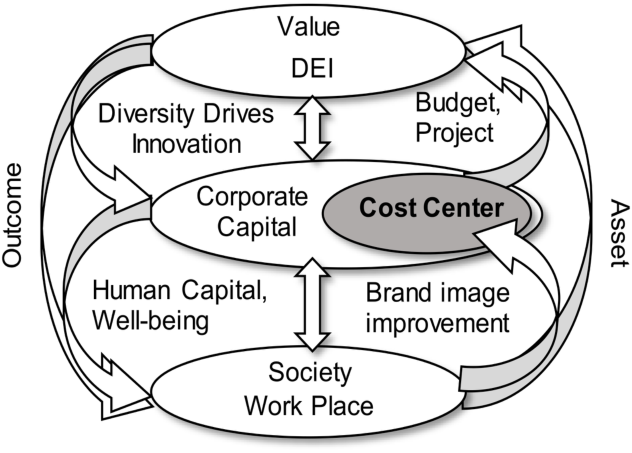
Figure 3 shows a model that simulates the elements of a DEI promo- tion project in the workplace (April, 2021). The creation of better solutions
through the collision of diverse knowledge is said to be a value of diversity; however, it is difficult for middle managers in the field to create budget plans with clear numerical targets of such value, and it is also difficult for front- line members to understand this. However, using this model, it is possible to explain how value is converted into benefits in the dynamics of organisa- tional culture change. From the study of Company A, we know that the true value of a workplace is undermined if, it simply follows numerical targets. For example, increasing the number of female employees to meet the numer- ical goals of gender diversity in the workplace is problematic for women. As part of their social responsibility, companies are expected to consider the well-being of all stakeholders (Howe et al., 2014), not just profits.
Figure 3: Micro–meso–macro loops for promoting DEI in the workplace project.
DISCUSSION
The question of whether such a model would be useful for practitioners was discussed in an interview with the management representatives of Company A that is a global company headquartered in Japan. First, when implementing a project in a company, the impact of the project must be explained to stake- holders and approved in numerical terms. Regarding value-first goals, the interviewees said that it is very difficult to come up with concrete numerical targets, such as what kinds of numbers would be used to measure progress toward the goal and when they would be recouped by the organisation as ben- efits. However, ongoing development goals such as diversity management in human resource development (Köllen, 2021) make it difficult to benefit from these results in the short term. In addition, large companies can defer the payback of results as medium- to long-term goals because they have ample
Visualising Transformation Strategies for Navigating Organisational Change Dynamics 277
resources. However, small- and medium-sized companies need to accelerate the payback of results because they have few spare resources. In addition, some social values are goals in a qualitative context, such as DEI and human rights; however, it has proven to be difficult to evaluate them as numerical targets. For example, in the case of Company A, there was some resistance to measures that simply counted the number of female employees as a gender equality KPI.
Regardless of the significance of the value, it cannot be initiated without stakeholder buy-in at the planning stage. In addition, even in value realisa- tion, where there are serious tradeoffs and risks, if the difficulties cannot be explained, execution may proceed without regard to the concerns of the peo- ple responsible for the execution. The person responsible for implementing the project must be advised that if the value achieved in the objectives does not produce good results for real stakeholders, they should stop the project. However, if the value cannot be calculated clearly, it is impossible to create persuasive materials. In such cases, if we can show a model in which it is difficult to convert value into profit with a concept, we can use it as mate- rial for persuasion. This benefit expression model can be used as explanatory material to start the activity and negotiate the iteration in an agile manner. In organisational transformation projects, it is necessary to have a written plan that allows the project to move forward first, while knowledge co-creation with stakeholders on the profitable part of the value is conducted. There- fore, the interviews concluded that this model would be an effective method because it can explain the value and profit realisation aspects that were not visible in the traditional model.
CONCLUSION
When executing a social value intervention in a company, such as sustainable development, it may be difficult to calculate clear numerical targets or make immediate profits. However, if this is why an organisational transformation project cannot be implemented, social value development will not proceed. In this study, we report a method to bring a project to fruition by first modelling values that are difficult to express numerically, and then building consensus with stakeholders regarding the complexities and trade-offs. In future, by analysing more cases, we will closely examine and prepare methods to help practitioners smoothly explain values and exchange them for benefits.
REFERENCES
April, K. (2021). “The new diversity, equity and inclusion (DEI) realities and challenges”, in: HR: The new agenda, Norman, Paul (Ed.). pp. 119–132. Arsel, Z., Crockett, D., Scott, M. L. (2022). Diversity, equity, and inclusion (DEI) in
the Journal of Consumer Research: A curation and research agenda, Journal of Consumer Research Volume 48, No. 5. pp 920–933. Cox, T. H., Blake, S. (1991). Managing cultural diversity: Implications for organizational competitiveness, Academy of Management Perspectives Volume 5, No. 3. pp. 45–56.
p. 542. Dong, H. P., Su, J. T. (2010). The relationship between working capital management and profitability: A Vietnam case, International Research Journal of Finance and Economics Volume 49, No. 1. pp. 59–67. Dopfer, K., Foster, J., Potts, J. (2004). Micro-meso-macro, Journal of Evolutionary
Economics Volume 14. pp. 263–279. Ely, R. J., Thomas, D. A. (2001). Cultural diversity at work: The effects of diversity perspectives on work group processes and outcomes, Administrative Science Quarterly Volume 46, No. 2. pp. 229–273. Ferraro, C., Hemsley, A., Sands, S. (2023). Embracing diversity, equity, and inclusion
(DEI): Considerations and opportunities for brand managers, Business Horizons Volume 66, No. 4. pp. 463–479. Garg, S., Sangwan, S. (2021). Literature review on diversity and inclusion at workplace, 2010–2017, Vision Volume 25, No. 1. pp. 12–22. Hashimoto, T., Nishibe, M. (2017). Theoretical model of institutional ecosystems
and its economic implications, Evolutionary and Institutional Economics Review Volume 14. pp. 1–27. Howe, C., Suich, H., Vira, B., & Mace, G. M. (2014). Creating win-wins from trade-offs? Ecosystem services for human well-being: a meta-analysis of ecosystem service trade-offs and synergies in the real world, Global Environmental Change Volume 28. pp. 263–275. Jackson, S. E., Ruderman, M. N. (1995). Diversity in work teams: Research
paradigms for a changing workplace (pp. xv–271). American Psychological Association. Jehn, K. A., Northcraft, G. B., Neale, M. A. (1999). Why differences make a difference: A field study of diversity, conflict and performance in workgroups, Administrative Science Quarterly Volume 44, No. 4. pp. 741–763. Köllen, T. (2021). Diversity management: A critical review and agenda for the future,
Journal of Management Inquiry Volume 30, No. 3. pp. 259–272. Oswick, C., Noon, M. (2014). Discourses of diversity, equality and inclusion: trenchant formulations or transient fashions?, British Journal of Management Volume 25, No. 1. pp. 23–39. Sabini, L., Alderman, N. (2021). The paradoxical profession: Project manage-
ment and the contradictory nature of sustainable project objectives, Project Management Journal Volume 52, No. 4. pp. 379–393. Shore, L. M., Chung-Herrera, B. G., Dean, M. A., Ehrhart, K. H., Jung, D. I., Randel, A. E., Singh, G. (2009). Diversity in organizations: Where are we now and where are we going?, Human Resource Management Review Volume 19, No. 2. pp. 117–133. Tsai, W., Ghoshal, S. (1998). Social capital and value creation: The role of intrafirm
networks, Academy of Management Journal Volume 41, No. 4. pp. 464–476.
LISTED IN THE AHFE DIGITAL BOOKSTORE CATALOGUE
Explore the complete digital volume
The Human Side of Service Engineering
Read this individual research paper free through the original publisher, or explore the full digital proceedings book.
ISBN 978-1-964867-19-9
Explore this ISBN in the AHFE Bookstore ↗Listed in the July 2026 bookstore catalogue; search by ISBN to confirm current availability · Digital book purchase optional