Emma Czupi, Elisabeth Shi (2025). Supporting Users' Understanding of Driving Automation Systems: The Effect of Meaningful System Names and Responsibility-Focused Textual Reminders. In: Human Factors in Design, Engineering, and Computing. AHFE Open Access, vol. 199, pp. 2099–2109. https://doi.org/10.54941/ahfe1007022
Implicit demands on drivers are growing with today’s available variety of sustained driving automation systems: Drivers must understand each system’s function, limitations and their own corresponding role. Compared to the strong emphasis on the technical requirements of driving automation (e.g., outlined in international provisions concerning the approval of vehicles equipped with driving automation systems), the process by which users learn about and adapt to their emerging roles have not been explored to the same extent. This study examines how Human-Machine-Interface (HMI) design can enhance drivers’ role understanding as part of mode awareness across different SAE levels of driving automation, and was conducted in preparation for a larger on-road study. Thirty-seven lay participants were assigned to one of two sets of HMIs for different sustained driving automation systems: An informative HMI, including meaningful system names and responsibility-focused textual reminders, versus a non-informative HMI. Participants then answered questions regarding their responsibilities and permitted behaviors when using the different systems. Overall, results show that participants in the informative HMI group gave significantly more correct answers about their user role and behavioral possibilities than participants in the non-informative HMI group. The informative HMI also supported participants in correctly ordering systems by automation level. The findings of this study are used in an upcoming on-road study to examine a novel assessment method for mode awareness. Future research could further examine users’ role-related information needs and the most effective ways to convey this information via the HMI.
Traditionally, drivers are responsible for executing the entire designated driving task. Today’s vehicles offer a growing range of sustained driving automation systems, capable of partially or fully taking over the driving task. However, as long as the human driver is not entirely freed from the driving task, this development does not necessarily reduce the demands
on the person. Rather, drivers have to be aware of each system’s specific functions, capabilities and limitations, how to operate it as well as their own corresponding role and responsibilities. Growing diversity of available driving automation systems and manufacturer-specific or automation level- specific differences impose additional demands. At the same time, the communication of user-centered information has received limited attention. Users thus have to master this implicit demand based on limited information and fragmented cues, resulting in the risk of safety-critical misunderstandings and misuse. The current pretest examines how specific aspects of Human- Machine-Interface (HMI) design can help to support users’ understanding of their roles and responsibilities related to the driving automation systems.
SAE International’s Standard J3016 (2021) provides an established and widely used taxonomy to define six different levels of sustained driving automation. The definitions are formulated in technical terms and mainly focused on the systems themselves while putting less focus on the users’ different and partly novel roles. Indeed, findings suggest that laypeople can mainly distinguish the extreme levels of the SAE taxonomy (Seppelt et al., 2019) and tend to mentally group driving automation systems into fewer, broader categories (Homans et al., 2020).
Understanding the distinction between different automation levels and the corresponding human roles is essential, as safe system use depends on the appropriate interaction between human and vehicle. Empirical findings demonstrate that deviations from expected driver behaviors can result in dangerous situations (Boos et al., 2020). Researchers have thus called for comprehensible, human-centered taxonomies (Kim et al., 2024). One example is the user-centered communication concept applied by the German Federal Highway and Transport Research Institute (BASt) (2020), which aims to provide intuitive, system-independent knowledge on user roles and responsibilities. It differentiates between three driving modes and corresponding user roles. The assisted driving mode encompasses SAE Levels 1 and 2 on the technical side and is associated with the driver role on the human side. The driver is always responsible for performing the driving task, i.e. he or she is supported by driving automation systems of Level 1 or 2, but has to constantly monitor the environment and correct the system if needed. The automated driving mode corresponds to SAE Level 3 on the technical side and entails the user role on the human side. When the automated mode is active, the system takes over the driving task and does not require human supervision. The (fallback-ready) user can perform non- driving-related activities while he or she remains receptive to requests to intervene by the system upon which he or she needs to take over the driving task again. In the autonomous driving mode, which encompasses SAE Levels 4 and 5 on the technical side, the human assumes the role of a passenger. He or she does not have any driving-related tasks and is allowed to freely engage in non-driving-related activities, including sleeping.
While BASt’s user-centered communication concept provides general information on user roles, drivers also need to understand how to behave and interact with a particular system when actually sitting in the vehicle. According to Sarter and Woods (1995), the concept of mode awareness refers
Supporting Users’ Understanding of Driving Automation Systems 2101
to “the ability of a supervisor to track and to anticipate the behavior of automated systems” (p. 7). This includes being aware of the current mode and understanding both system and driver tasks (Boos et al., 2020). As user manuals do not facilitate intuitive access to relevant information, users currently often learn to operate driving automation systems by trial and error (Lubkowski et al., 2021). Despite noticeable room for improvement in building user knowledge, users are still expected to adapt seamlessly to any newly emerging roles. Supporting users in maintaining mode awareness becomes increasingly important as vehicles may offer multiple driving automation systems that can be used within a single trip, potentially increasing the risk of mode confusion (Sarter & Woods, 1995). As such, the HMI’s potential to help drivers understand what is expected from them when using different systems gains importance (Carsten & Martens, 2019). Several research reviews provide recommendations on HMI design (e.g., Carsten & Martens, 2019; Naujoks et al., 2019; Tinga et al., 2023). Nonetheless, Carsten and Martens (2019) conclude that many of their reviewed HMI designs fall short of these recommendations.
Research findings support the benefit of providing information of driving automation reliability (e.g., van den Beukel et al., 2016; Yang et al., 2018) which is inherently related to the driver’s role. Tinga et al. (2022) compared two HMIs in terms of how effectively they support drivers’ supervision and self-regulation during automated driving. Results showed that the HMI which communicated the reliability (capability) of the respective automation system supported understandability and usability best. However, the HMI depicting required/allowed driver tasks was associated with a clearer understanding of permitted activities. Role- and responsibility-focused information encompasses both the capability of the driving automation system as well as the expected or permitted driver behavior, potentially supporting more holistic driver comprehension. Previous research has also demonstrated that even the naming of different systems influence how they are perceived and what capabilities are attributed to them (Abraham et al., 2017; Teoh, 2020). In practice, manufacturers choose system names based on marketing strategies. This leaves users with a plethora of system names that may contain no or even misleading cues about the system’s capability – and in turn also their own role. From the user perspective, this hinders adequate conclusions on a systems capabilities and automation level. Naujoks et al. (2019) and the Transport Research Laboratory (Stevens et al., 2002) recommend that HMIs should communicate system functionality rather than technical terms like SAE levels, avoid abbreviations and foreign words and instead “speak the language of the users” (Naujoks et al., 2019, p. 127).
We thus hypothesize that an informative HMI including meaningful system names and textual reminders of the driver’s current role and responsibilities will result in higher role-related understanding and safer driving behavior than a non-informative HMI with system names that are not meaningful and without textual reminders. The current study serves as a manipulation check and pretest of two HMI-sets, examining whether they are indeed perceived as informative versus non-informative by lay users, particularly
2102 Czupi and Shi
concerning users’ understanding of their role and responsibilities related to the driving automation systems. We hypothesize that meaningful and functionally descriptive names will improve role comprehension compared to conventional, marketing-oriented names.
METHOD
Two sets of HMIs were developed for seven sustained driving automation systems and manual driving, consisting of instrument cluster displays and corresponding sounds (cf. Figure 1–4). The HMI sets share the same system-specific icons and colors. The informative HMI set contains meaningful system names, providing cues to their respective capabilities (e.g., “Automated Mode”). In contrast, the names in the non-informative HMI set are based on existing system names and do not provide such cues (e.g., “Ultimate Pilot”). Table 1 compares the system names in the two HMI sets. Furthermore, the informative HMI includes short textual reminders of users’ role and responsibilities, presented after the activation of each system (e.g., “You may disengage, remain available for takeover”, cf. Fig. 4 and Tab. 1). Additionally, in the informative HMI, the Level 3 system’s request to intervene and the Level 2 system’s hands-on warning are accompanied by a textual message (“Please drive yourself!”/“Hands on the steering wheel!”). For tele-operated modes (named “Tele Assistance”/“Guardian Drive”, and “Tele Driving”/“Remote Drive”), there are no textual reminders because they would be embedded in a Level 4 driving section.
Figure 1-4: Exemplary displays of the informative HMI for system availability, preparation, active system and the responsibility-focused reminder (translated from German).
Sample In total, 37 BASt employees who do not work in the automotive engineering division, and who hold a valid driver’s license, participated the study (Mage = 36.19, SDage = 12.63, 18 female, 18 male, 1 other). Their annual mileage was between 2,000 and 25,000 kilometers, and less than 22% indicated to frequently use driver assistance systems (i.e. cruise control, adaptive cruise control, lane keeping assist, corrective lane keeping assist)
Supporting Users’ Understanding of Driving Automation Systems 2103
or a combination of those (ratings of 4 or 5 on a scale from 1 = never to 5 = frequently). There were no significant differences between the two HMI groups (ninformative = 19; nnon-informative = 18) concerning the demographic variables.
Table 1: Overview of the seven sustained driving automation systems and their respective icon, name in the non-informative HMI (N-HMI), the informative HMI (I-HMI), the responsibility-focused reminder and the corresponding SAE automation level.
Table available in the original PDF paper.
System Icon
Premium Cruise
Pilot Cruise
Ultimate Pilot
AI Drive Guardian Drive
Remote Drive
N-HMI name
Intelli- gent Cruise
Tele Driving
Assisted Mode
I-HMI name
Tele Assis- tance
Autono- mous Mode
Auto- mated Mode
Assisted Mode hands- off
Adap- tive Cruise Control
- -
Reminder Please
Please supervise and correct
Please super- vise and correct
steer and stay ready to break
You may fully disengage from traffic
You may disengage, remain available for takeover
SAE level
during Level 4 section
1 2 2 3 4 during Level 4 section
Note: Informative HMI (I-HMI) system names and responsibility-focused reminders are originally presented in German language, and only translated into English for this article’s readers. The non-informative HMI (N-HMI) system names are in “foreign language” from our participants’ point of view. However, in Germany, English names are commonly used in marketing.
Procedure The computer-based study was conducted in March 2023. First, participants provided demographic information and read the BASt user-centered communication (BASt, 2020). Following a one factorial between-subjects design, participants were assigned to either the informative or the non- informative HMI group. They watched short videos of the respective HMIs depicting the process of availability to active system for the seven different sustained driving automation systems as well as a takeover-request and hands-on warning. After each video they answered three single-choice questions on their corresponding user role, the allocation of the driving task and their behavioral possibilities. They also answered a multiple- choice question on which of six activities (e.g., take a nap, watch a
2104 Czupi and Shi
movie) they are allowed to perform when using the respective system and rated the perceived certainty of the automation level on a 5-point Likert-scale. Finally, participants ranked the systems by increasing driving automation level and indicated their overall certainty of their responses on a 5-point Likert-scale. In addition, participants were asked to pretest a questionnaire on remote operation and specify topics of personal interest related to automated driving. However, these are outside the scope of this article.
RESULTS
The two HMI sets do not significantly differ regarding realism (Mi = 3.05, Mn = 3.11, t(35) = −0.18, p = .859, d = −0.06) or desirability (Mi = 2.63, Mn = 2.33, t(35) = 1.04, p = .304, d = 0.35). More than half of the participants in the informative HMI indicate orienting on the textual reminders when answering the questions.
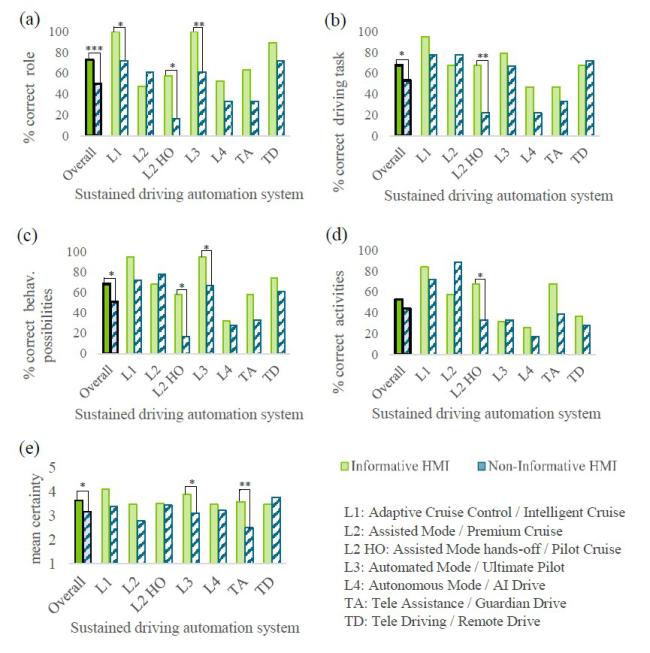
Aggregated across all driving automation systems, participants who received the informative HMI give significantly more correct answers about their user role (Mi = 0.73, Mn = 0.50, t(35) = 3.99, p <.001, d = 1.32), the allocation of the driving task (Mi = 0.68, Mn = 0.53, t(35) = 2.50, p = .017, d = 0.82), their behavioral possibilities (Mi = 0.68, Mn = 0.51, t(35) = 2.70, p = .011, d = 0.89) and indicate higher perceived certainty of the automation level (Mi = 3.65, Mn = 3.17, t(35) = 2.42, p = .021, d = 0.80). The HMI groups do not differ in the percentage of correct responses regarding the permissibility of non-driving-related activities (Mi = 0.53, Mn = 0.44, t(35) = 1.35, p = .186, d = 0.45). These results remain consistent when calculating non-parametrical Mann–Whitney U tests.
Figure 5 shows the distribution of correct answers for each driving automation system and mean perceived certainty of automation level by HMI group. The informative HMI group consistently shows equal or higher shares of correct answers than the non-informative HMI. The advantage of the informative HMI seems to be particularly pronounced for the Level 2 hands-off system. For the Level 4 system, user comprehension is relatively low in both groups. In the informative HMI group, six of 19 participants put all system names in the correct order, while in the non- informative HMI group no participant was able to do so. Fisher’s exact test indicated a statistically significant difference between the groups, p = .020, ϕ = −0.43. The advantage of the informative HMI was also visible in the ordering of the system icons, which 15 participants completed correctly whereas only 8 in the non-informative group (χ2(1) = 4.68, p = .031, ϕ = −0.36). The take-over request and the hands-on warning were correctly understood by every participant in the informative HMI group. In the non- informative HMI group, one person misunderstood the take-over request and two misunderstood the hands-on warning. There was also no significant difference between the participants’ response certainty in the two groups (Mi = 3.14, Mn = 3.04, t(35) = 0.38, p = .707, d = 0.13).
Supporting Users’ Understanding of Driving Automation Systems 2105
Figure 5: Comparison of the correct answers for (a) user role, (b) allocation of driving task, (c) behavioral possibilities, (d) non-driving-related activities and (e) mean certainty of automation level between the two HMI groups (informative n = 19, non-informative n = 18), ***p <.001, **p <.01,*p <.05.
DISCUSSION
The current study serves as a manipulation check and examines if the two sets of HMIs are indeed informative versus non-informative for non-experts, specifically in terms of understanding of their own role and responsibilities when interacting with different sustained driving automation systems. The informative HMI included meaningful system names and responsibility- focused textual reminders, whereas system names in the non-informative HMI provided no cues on system capability and included no textual reminders. The results are in line with the notion that the informative HMI enhances participants’ understanding of their roles and responsibilities when different driving automation systems are active. Aggregated across all systems, the informative HMI group shows more correct answers to the user role, allocation of the driving task and behavioral possibilities, and reports a higher perceived certainty of the systems’ driving automation level. The advantages of the informative HMI on user understanding are particularly pronounced for the Level 2 hands-off system. The reason for
2106 Czupi and Shi
this finding could be that it is counterintuitive for laypeople to take their hands off the steering wheel and still be responsible for driving. As drivers do not need to keep their hands on the steering wheel, they might assume that the system performs the entire driving task reliably. However, the advantage of the informative HMI does not show for every single driving automation system. Potentially, some of the role-focused textual reminder were not formulated clearly enough to be easily understood by participants. Furthermore, participants in the informative HMI group were significantly better at correctly sorting the system names by automation level than participants in the non-informative group. In fact, no participant in the non- informative HMI group was able to correctly sort the systems by automation level. Interestingly, there is still an advantage of the informative HMI even when ordering the system icons which are identical in both HMI sets.
An explanation could be that the better understanding of their own user role and responsibilities helped the participants to better understand the meaning of the icons. Similar to Tinga et al. (2022) our findings suggest that HMI design can support users’ understanding of their role in interactions with driving automation systems. Findings by Tinga et al. (2022) indicate that communicating driving automation reliability via emoticons improves usability and understandability compared to activity-based role depiction. Tinga et al. (2022) conclude that the HMI should nudge drivers what (not) to do when a certain system is active, without communicating it too directly (Tinga et al., 2023). The responsibility-focused reminders used in the current study, however, represent a more abstract form of guidance that encompass both the system’s capabilities and the required driver behaviour. This more holistic approach may support deeper role comprehension, particularly across different levels of automation, compared to an activity-based role depiction.
Future Research Future research could examine further leverage points to promote role- compliant behavior. For example, the timing of the role-based reminder could be varied or could be presented adaptively when detecting role-inadequate behavior. Previous findings also suggest that verbal reminders could be preferred over written ones (Naujoks et al., 2016) and the perception of textual reminders could be directly compared with graphical depictions (cf. Tinga et al., 2022). Additionally, as research on HMIs communicating driving automation systems’ reliability indicates a benefit of providing continuous information (van den Beukel et al., 2016; Yang et al., 2018), role-focused reminders could be compared with continuously presented role-focused information. In addition, future research could examine whether the need for role-focused information varies with experience, especially as findings regarding whether driver information needs differ based on the amount of experience are inconsistent (Diels & Thompson, 2018; Feierle et al., 2020) and at the same time research shows intraindividual differences in the preference for HMI design (e.g., Tinga et al., 2022).
Supporting Users’ Understanding of Driving Automation Systems 2107
CONCLUSION
Overall, our findings suggest that meaningful system names and textual reminders in combination can support users’ role understanding, highlighting the importance of HMI design in fostering safe interaction with different driving automation systems. In a next on-road driving study, the HMI sets pretested here are applied to examine the assessment of mode awareness when different sustained driving automation systems are used.
ACKNOWLEDGMENT
We would like to thank our students Hannah Ligtenberg for her support in preparing and conducting the study, Anna Schwarzwälder for her support in data analysis and Felice Ludwig for her support in the creation of figures and tables. This work is a result of the joint research project STADT:up. The project is supported by the German Federal Ministry of Economic Affairs and Energy (BMWE), based on a decision of the German Bundestag. The authors are solely responsible for the content of this publication.
Credit Author Statement Emma Czupi: writing – original draft preparation; writing – review & editing; methodology; investigation; formal analysis; validation; data curation.
Abraham, H., Seppelt, B., Mehler, B., & Reimer, B. (2017). What’s in a name: Vehicle technology branding & consumer expectations for automation. In Proceedings of the 9th International Conference on Automotive User Interfaces and Interactive Vehicular Applications (pp. 226–234). Association for Computing Machinery. ht tps://doi.org/10.1145/3122986.3123018. Boos, A., Feldhütter, A., Schwiebacher, J., & Bengler, K. (2020). Mode errors and
intentional violations in visual monitoring of Level 2 driving automation. In 2020 IEEE 23rd International Conference on Intelligent Transportation Systems (ITSC) (pp. 1–7). IEEE. https://doi.org/10.1109/ITSC45102.2020.9294690. Carsten, O., & Martens, M. H. (2019). How can humans understand their automated cars? HMI principles, problems and solutions. Cognition, Technology & Work, 21(1), 3–20. https://doi.org/10.1007/s10111–018-0484-0. Diels, C., & Thompson, S. (2018). Information expectations in highly and fully
automated vehicles. In N.A. Stanton (Ed.), Advances in Human Aspects of Transportation (pp. 742–748). Springer Cham. https://doi.org/10.1007/978–3- 319–60441-1_71. Feierle, A., Danner, S., Steininger, S., & Bengler, K. (2020). Information needs and visual attention during urban, highly automated driving—an investigation of potential influencing factors. Information, 11(2), 62. https://doi.org/10.3390/in fo11020062. German Federal Highway and Transport Research Institute (BASt) (2020).
Nutzerkommunikation: Was heißt eigentlich autonomes Fahren? [User communication: What does autonomous driving actually mean?].
2108 Czupi and Shi
Homans, H., Radlmayr, J., & Bengler, K. (2020). Levels of driving automation from a user’s perspective: How are the levels represented in the user’s mental model? In T. Ahram, R. Taiar, S. Colson, & A. Choplin (Eds.), Human Interaction and Emerging Technologies (pp. 21–27). Springer Cham. https://doi.org/10.1007/978–3-030–25629-6_4. Kim, S., Novakazi, F., Shi, E., Harms, I., & Oviedo-Trespalacios, O. (2024).
A Taxonomic Odyssey: Reflections on the Evolution, Criticisms, and Future Directions of Driving Automation Taxonomies. https://doi.org/10.2139/ssrn .4938778. Lubkowski, S. D., Lewis, B. A., Gawron, V. J., Gaydos, T. L., Campbell, K. C., Kirkpatrick, S. A., Reagan, I. J., & Cicchino, J. B. (2021). Driver trust in and training for advanced driver assistance systems in real-world driving. Transportation Research Part F: Traffic Psychology and Behaviour, 81, 540–556. https://doi.org/10.1016/j.trf.2021.07.003. Naujoks, F., Forster, Y., Wiedemann, K., & Neukum, A. (2016). Speech improves human-automation cooperation in automated driving. In Mensch und Computer 2016 - Workshopband. Gesellschaft für Informatik e. V. https://doi.org/10.18420/muc2016-ws08–0007. Naujoks, F., Wiedemann, K., Schömig, N., Hergeth, S., & Keinath, A. (2019).
Towards guidelines and verification methods for automated vehicle HMIs. Transportation Research Part F: Traffic Psychology and Behaviour, 60, 121–136. https://doi.org/10.1016/j.trf.2018.10.012. SAE International (2021). Taxonomy and Definitions for Terms Related to Driving Automation Systems for On-Road Motor Vehicles. Sarter, N. B., & Woods, D. D. (1995). How in the world did we ever get into that
mode? Mode error and awareness in supervisory control. Human Factors: The Journal of the Human Factors and Ergonomics Society, 37(1), 5–19. https://doi. org/10.1518/001872095779049516. Seppelt, B., Reimer, B., Russo, L., Mehler, B., Fisher, J., & Friedman, D. (2019).
Consumer Confusion with Levels of Vehicle Automation. In Driving Assessment Conference 2019 (pp. 391–397). https://doi.org/10.17077/drivingassessment. 1723. Stevens, A., Quimby, A., Board, A., Kersloot, T., & Burns, P. (2002). Design Guidelines for Safety of In-Vehicle Information Systems (TRL Report PA3721/ 01). Transport Research Laboratory. Teoh, E. R. (2020). What’s in a name? Drivers’ perceptions of the use of five SAE
Level 2 driving automation systems. Journal of Safety Research, 72, 145–151. https://doi.org/10.1016/j.jsr.2019.11.005. Tinga, A. M., Cleij, D., Jansen, R. J., van der Kint, S., & van Nes, N. (2022).
Human machine interface design for continuous support of mode awareness during automated driving: An online simulation. Transportation Research Part F: Traffic Psychology and Behaviour, 87, 102–119. https://doi.org/10.1016/j.trf. 2022.03.020. Tinga, A. M., van Zeumeren, I. M., Christoph, M., van Grondelle, E., Cleij, D., Aldea, A., & van Nes, N. (2023). Development and evaluation of a human machine interface to support mode awareness in different automated driving modes. Transportation Research Part F: Traffic Psychology and Behaviour, 92, 238–254. https://doi.org/10.1016/j.trf.2022.10.023.
Supporting Users’ Understanding of Driving Automation Systems 2109
van den Beukel, A. P., van der Voort, M. C., & Eger, A. O. (2016). Supporting the changing driver’s task: Exploration of interface designs for supervision and intervention in automated driving. Transportation Research Part F: Traffic Psychology and Behaviour, 43, 279–301. https://doi.org/10.1016/j.trf.2016.09. 009. Yang, Y., Karakaya, B., Dominioni, G. C., Kawabe, K., & Bengler, K. (2018).
An HMI concept to improve driver’s visual behavior and situation awareness in automated vehicle. In 2018 21st International Conference on Intelligent Transportation Systems (ITSC) (pp. 650–655). IEEE. https://doi.org/10.1109/IT SC.2018.8569986.
LISTED IN THE AHFE DIGITAL BOOKSTORE CATALOGUE
Explore the complete digital volume
Human Factors in Design, Engineering, and Computing
Read this individual research paper free through the original publisher, or explore the full digital proceedings book.
ISBN 978-1-964867-75-5
Explore this ISBN in the AHFE Bookstore ↗Listed in the July 2026 bookstore catalogue; search by ISBN to confirm current availability · Digital book purchase optional