Katsutoshi Michihata, Shohei Nakamura, Kazuhito Wakamoto, Tetsusei Kurashiki (2025). The Influence of Future Temporal Distance on Decision-Making in Futurability Education. In: Human Factors in Design, Engineering, and Computing. AHFE Open Access, vol. 199, pp. 1454–1464. https://doi.org/10.54941/ahfe1006957
This study examined how introducing perspectives from different future time points influenced high school students’ awareness of social issues and their prioritization of policy measures. "Future Design" has been proposed in recent years to address long-term social issues such as environmental problems. A person exhibits “futurability” when his or her experiences an increase in happiness as a result of deciding and acting to forego current gains in order to enrich future generations, and “futurability” is an important in achieving a sustainable society. Future Design involves practical applications such as municipal policymaking, aimed at achieving a sustainable society. Kurashiki, one of the authors, proposes “futurability education” to foster futurability. One of the effective methods to activate futurability is the use of "Imaginary Future Generations" (IFGs), which represent stakeholders acting on behalf of future generations. In previous studies on futurability education, a generation has been defined as 20 years, and IFGs have typically been set approximately 40 years ahead. However, little research has examined how the setting of future time point for IFGs affects thinking and decision-making, despite its importance in both futurability education and Future Design. This study researches this gap by comparing IFGs set at three different time points: 20 years (2043), 40 years (2063), and 60 years (2083) into the future. The social experiment involved 78 high school students who participated in a group workshop during a university open campus event in August 2023. Students worked in groups of four and were presented with policy cards based on Ikeda City’s 6th Comprehensive Plan in Osaka Prefecture, Japan. By analyzing which policy cards were selected, the study explored how decision-making changed across timeframes. The results showed that revitalizing rural areas and promoting labor policy were more likely to be prioritized when the imagined future was more distant. In contrast, the policy like disaster preparedness were favored for the nearer future. These preferences seem to reflect anticipated societal issues in Japan, such as urban overpopulation and the replacement of labor through AI technologies. On the other hand, the relatively low selection of disaster-related policies for the distant future suggests that students assumed major events, like the predicted Nankai Trough mega-quake, Japan, would have already occurred by then. Across all future generations, high selection rates were observed for policies promoting international exchange, countermeasures against declining birthrates and child-rearing support. This indicates a strong awareness of globalization and Japan’s pressing demographic issues. Meanwhile, infrastructure-related policies such as those involving waterworks or road networks, were selected less often, likely due to the perception that Japan’s infrastructure is already well-developed. This study revealed that changing the time period set for IFGs leads to differences in policy preferences and decision-making tendencies. The findings suggest that, in future-oriented education, setting an appropriate future time point according to the topic and educational objectives can enhance the overall educational effectiveness.
In Japan, intergenerational social issues such as the deterioration of infrastructure have become increasingly evident, resulting in a growing burden on future generations. These societal issues are attributed to human tendencies such as myopia (Sapolsky, 2012) and optimism (Sharot, 2011), as well as to social systems that prioritize short-term benefits. To address these issues, Saijo (2020) proposed an academic framework called “Future Design”, which aims to overcome such tendencies and build sustainable social systems. A wide range of studies on future design has been conducted, including research by Nakagawa and Saijo (2021) on methods for acquiring a future perspective, and by Hara et al. (2021) on the impact of introducing future generations into decision-making processes. Applying the concept of future design to educational settings has given rise to research on “Futurability Education.” Futurability is an important concept in future design. Saijo (2020) defines futurability as “a human disposition by which even if one’s present benefits are reduced, the decision, action, and even the very act of thinking that enriches future generations makes people happier.”
The Influence of Future Temporal Distance on Decision-Making in Futurability Education 1455
Kurashiki (2022) defines futurability education as “an educational approach that cultivates decision-making through the recognition and development of futurability inherent in every person, enhanced by cognitive training and trade-off exercises.” Based on this concept, workshops have been conducted with high school, university, and graduate students to help them reflect on the relationship between themselves and society. Yamauchi et al. (2013) defined workshops as creative experiential learning, positioning them as activities in which participants gain learning through the generation of new ideas. In recent years, educational practice has been shifting from teacher-centered learning, where instructors unilaterally deliver knowledge, to student-centered learning, in which students actively engage in discussions and apply their knowledge (Hori and Kato, 2008). As a result, workshops that encourage student initiative are being actively introduced as an effective educational approach.
One effective method for implementing futurability education is brainstorming. Brainstorming is defined as “a group activity aimed at solving specific problems by generating a large number of ideas” (Miller et al., 2001). Because it enables the rapid collection of numerous ideas through free association, brainstorming has been widely used in meetings and educational settings. Previous studies have explored various approaches to enhance idea generation, such as promoting creativity in brainstorming sessions (Al-Samarraie and Hurmuzan, 2018), examining its effectiveness across different purposes and fields (Ritter and Mostert, 2018), supporting discussions through gamification elements (Furukawa and Yuizono, 2018), and visualizing opinions to facilitate new idea creation (Onoda et al., 2018). In futurability education, it is essential for learners to make decisions after imagining a diversity of possible futures. Discussions should therefore include not only ideal future scenarios but also potential futures that may be worse than the present. Accordingly, incorporating brainstorming activities focused on future societies is expected to enable the design of learning environments that foster a broader range of social visions. In addition, in the fields of Education for Sustainable Development (ESD) and environmental education, emphasis has been placed on encouraging students to participate in community development based on the current state and issues of their local regions (Kodama et al., 2023; Shibakawa, 2024). Unlike conventional ESD and environmental education, the present study implemented futurability education that integrates a future-oriented perspective into municipal policy planning.
Previous studies on futurability education have emphasized the importance of acquiring a future-oriented perspective. However, the extent to which decision-making changes depending on the number of years set for future generations has not been clearly identified. Therefore, this study examined differences in the number and content of ideas generated through brainstorming for each future time setting, as well as the influence of these settings on decision-making using the “Policy Cards” described in the next section. It was hypothesized that the farther the future setting, the fewer ideas would be generated and the less specific those ideas would become.
Furthermore, it was assumed that both the characteristic words emerging from brainstorming and the decisions made in the policy card exercise would vary according to the temporal distance set for each group.
METHOD
This study evaluated how varying the number of years set for future generations influences participants’ decision-making and thinking. The participants were 78 high school students who attended an open campus event held in August 2023. The event invited high school students to a university in Osaka, Japan, and implemented a futurability education workshop as part of a university–high school collaborative program. Table 1 presents the overall flow of the workshop. Participants were divided into groups of four, and the workshop was conducted in these small groups.
Table 1: Flow of the workshop.
Table available in the original PDF paper.
Activity First Half 1 Ice-breaking activity 2 Overview of the municipality 3 Ice-breaking game 4 Explanation of the policy card game 5 Policy card game (individual work) 6 Policy card game (group work)
Second Half 7 Explanation of future design 8 Group discussion on future society 9 Policy card game from the perspective of the imagined future generation (individual work) 10 Policy card game from the perspective of the imagined future generation (group work)
Workshop Design To allow participants to experience shifts in thinking, policy selection was conducted from both the perspective of current generations and a perspective of imaginary future generations (IFGs). The perspective of current generations refers to discussing issues as one’s current age in today’s society. In contrast, the perspective of IFGs refers to discussing issues while envisioning oneself at the same age but living in a future society. To represent the standpoint of future generations, participants themselves adopted the role of a person from a future generation and considered its interests; we refer to this role as the IFGs. To examine the effect of temporal distance, we treated 20 years as one generation and created three comparison groups: X (2043; one generation ahead), Y (2063; two generations ahead), and Z (2083; three generations ahead). The policy card game described earlier was then administered under these assigned years. Participants were allocated to four-person groups. When a group fell short of four members, a graduate student from the open-campus staff joined to complete the group, yielding 20 groups in total. For analysis, only high-school student groups were
The Influence of Future Temporal Distance on Decision-Making in Futurability Education 1457
retained; groups that included a graduate student were excluded, resulting in 7 X-groups, 6 Y-groups, and 6 Z-groups. Each group received a handout specifying its assigned year and was instructed to conduct the IFGs work accordingly. One facilitator was assigned to each group to ensure the smooth progress of the workshop.
Brainstorming In this study, a brainstorming session was conducted prior to the discussion from the perspective of IFGs in order to broaden participants’ views of future societies. The theme of the brainstorming was “Images of Future Society,” and participants in each group discussed ideas related to the future society corresponding to their assigned temporal setting. For the brainstorming activity, each group was provided with a large sheet of paper and sticky notes, and participants were instructed to propose as many ideas about future societies as possible. Based on the results of these brainstorming sessions, the number of ideas generated and the characteristic words were compared across the different temporal distance groups. Facilitators were instructed to intervene only when discussions stalled, providing prompts related to everyday aspects such as lifestyle or transportation to help stimulate the conversation.
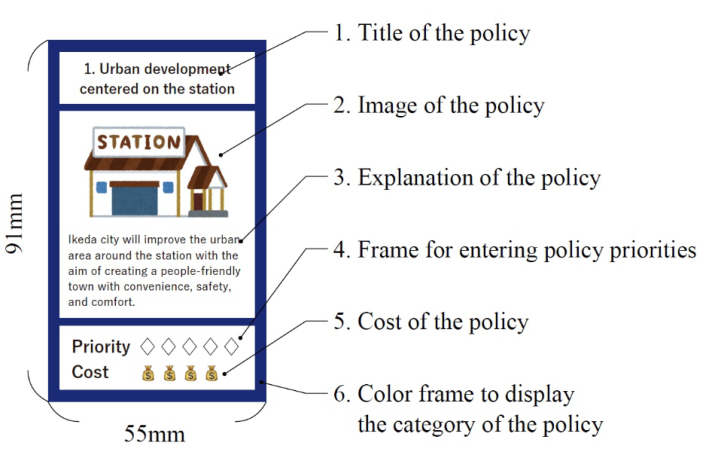
Figure 1: Policy card used in the workshop (Nakamura et al., 2024).
Policy Making Card Game Participants were divided into groups of four to conduct the group activities. In the group work, participants used “Policy Cards”developed by Nakamura et al. (2024). These cards consisted of 30 different policies created with reference to the comprehensive plan of a municipality in the Kansai region.
Each policy card displayed the title of a policy and its associated cost, rated on a 10-point scale ranging from 0.5 to 5.0. Participants were instructed to select policies from among the 30 options so that the total cost would not exceed 28 points (See Figure 1). In this study, the number of years representing future generations varied by group. Similar to the brainstorming activity, participants selected the policies they considered necessary for their assigned future setting. The purpose of this activity was to examine how decision-making changed across different temporal distances.
RESULT & DISCUSSIONS Number and Specificity of Ideas by Temporal Distance
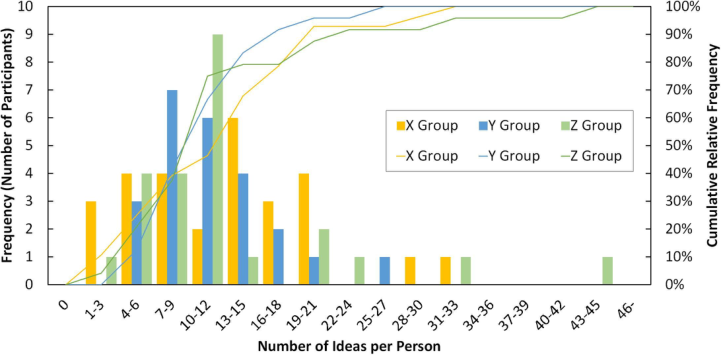
Table 2 shows the average, maximum, minimum, and standard deviation of the number of ideas generated per person during brainstorming for each comparison group, and Figure 2 presents their frequency distributions. Contrary to the hypothesis, the groups representing the nearest future (X group) and the farthest future (Z group) exhibited higher average numbers of ideas generated per person. To examine the significance of group effects and intergroup differences, a one-way analysis of variance (ANOVA) and Bonferroni post-hoc multiple comparison tests were conducted. However, no statistically significant differences were observed. As shown in Figure 2, the frequency distribution of the number of ideas generated per person revealed that the X group displayed a relatively wide distribution, peaking in the 13–15 ideas per person range. In contrast, the Y group was concentrated around the 7–9 range, and the Z group peaked in the 10–12 range. Although the Z group tended to be distributed in the lower range, its higher mean value appears to have been influenced by the presence of a few participants in the 43–45 ideas per person category.
Figure 2: Distribution of the number of ideas generated per person by group.
The Influence of Future Temporal Distance on Decision-Making in Futurability Education 1459
Table 2: Number of ideas by temporal distance.
Table available in the original PDF paper.
Temporal Distance Mean Maximum Minimum SD X group (2043) 12.96 33 2 7.56 Y group (2063) 11.385 25 5 4.72 Z group (2083) 12.71 45 2 9.41
To compare the level of detail in the ideas, the number of nouns, verbs, adjectives, and adverbs per idea was analysed. The results showed that, across all groups, the frequency of parts of speech tended to follow the same order— nouns > verbs > adjectives > adverbs—and that each idea typically consisted of about three to four words (See Table 3). The predominance of nouns in all groups was likely due to many ideas being expressed as single-word concepts such as “autonomous driving” or “declining birthrate and aging population”. Although it was hypothesized that the grammatical complexity of ideas, indicated by linguistic diversity, would decrease as the future setting became more distant, no consistent patterns were observed. As a reason for these results, even the nearest future setting (20 years ahead) appears to have imposed a substantial cognitive load on participants, resulting in no notable differences across conditions set at 20 years, 40 years, and 60 years. Overall, the results did not reveal a clear trend indicating that the length of the future setting affected either the quantity or specificity of ideas. It is possible that prior knowledge or assumptions about each future time period had a stronger influence on idea generation than the future time setting itself. Further studies are needed to verify whether similar tendencies appear under controlled conditions and to confirm the reproducibility of these findings.
Table 3: Frequency of word types by temporal distance.
Table available in the original PDF paper.
Temporal Distance Nouns Verbs Adjectives Adverbs Total X group (2043) 2.42 0.74 0.11 0.18 3.45 Y group (2063) 3.04 1.06 0.14 0.06 4.31 Z group (2083) 2.25 0.96 0.17 0.07 3.44
Characteristic Words by Temporal Distance
Table 4 presents the characteristic words frequently used during brainstorming for each temporal distance setting. Across all groups, words such as “increase” and “decrease” appeared frequently. This trend suggests that participants tended to think by comparing the imagined future with the present, leading them to use such terms when discussing technological advancements or social issues. In addition, words related to technology, such as AI and robots, were common across all groups, indicating a consistently high awareness of technological development among participants.
In the near-future group, characteristic words included terms related to school life, such as school, test, and textbook. Because the participants were high school students, it is likely that they generated ideas reflecting changes in familiar aspects of their daily lives. Furthermore, social issues currently faced by Japan, such as the declining birthrate and aging population and
consumption tax, appeared frequently in the X and Y groups. This suggests that participants imagined both improved and deteriorated future scenarios in relation to these issues. The word “disaster” also appeared in the Y group, likely influenced by the prediction that a major Nankai Trough earthquake has an 80% probability of occurring within the next 30 years in Japan. In the distant-future groups, words related to advanced technologies and their societal implications appeared more frequently. The Y group generated ideas such as autonomous driving and flying cars, while the Z group frequently used words associated with space, including Earth, Moon, and Mars. These results suggest that in envisioning the future, participants tended to generate more concrete and issue-oriented ideas for the near future, whereas ideas for the distant future were more focused on technological innovation. Hara et al. (2025) analyzed the differences in brainstorming results between the present generation and the imagined future generation, revealing that the present generation tended to use words related to current social issues and phenomena, whereas the imagined future generation used words that were more detached from the present context. A similar tendency was also observed in the present study. Overall, the findings imply that technological development is a key factor shaping how individuals imagine and construct visions of the future, exerting a strong influence on idea generation.
Table 4: Top 20 characteristic words extracted from brainstorming by temporal distance.
Table available in the original PDF paper.
Rank X Group (2043) Y Group (2063) Z Group (2083) 1 Increase Space People 2 Decrease Go out Increase 3 Robot People Japan 4 People Increase Average 5 Space Japan AI 6 Go Sky Decrease 7 Japan Decrease Lifespan 8 AI Use Population 9 Technology Rise World 10 Sky New Earth 11 Aging Robot Space 12 Work Mobility Moon 13 School Animals Go out 14 Population Yen Hot 15 World Sea level Travel 16 Test Automation VR 17 Textbook Car Robot 18 Consumption tax Earth Mobility 19 Abolition Fly Mars 20 Average Disaster School
Selection Rate of Policy Cards by Temporal Distance
Table 5 presents the selection rates of each policy card by group. The policies “Promotion of international and regional exchange” and “Response
The Influence of Future Temporal Distance on Decision-Making in Futurability Education 1461
to declining birthrate and child care support” showed high selection rates across all groups. The emphasis on international exchange may reflect the influence of globalization resulting from technological development, as well as the increasing number of foreign residents in Japan. Similarly, the frequent selection of regional exchange policies may be related to participants’ awareness of issues such as regional revitalization and population aging currently emphasized in Japan. The high selection rate of measures addressing declining birthrates and childcare support indicates that participants perceive the declining birthrate and aging population problem as a persistent challenge that will continue to affect Japan in the future. In contrast, policies related to medical care and infrastructure were selected less frequently in all groups. This may be because Japan already has relatively well-developed healthcare and infrastructure systems compared with other countries, leading participants to perceive these as areas requiring less immediate attention.
Table 5: Selection rates of policy cards by temporal distance.
Table available in the original PDF paper.
No. Cost Policy Selection Rate X Group Y Group Z Group
0.0% 16.7% 0.0%
1 4 Urban development centered on the station
14.3% 33.3% 50.0%
2 1.5 Revitalization of Hosokawa area
14.3% 66.7% 0.0%
3 2 Utilization of Osaka Airport
14.3% 33.3% 33.3%
4 3 Promotion of agriculture and horticulture
42.9% 16.7% 16.7%
5 2 Revitalization of commerce
28.6% 50.0% 83.3%
6 2.5 Promotion of industry 42.9% 0.0% 16.7% 7 2.5 Promotion of worker measures
14.3% 33.3% 0.0%
8 2 Promotion of tourism 28.6% 16.7% 16.7% 9 0.5 Promotion of decentralization
14.3% 33.3% 33.3%
10 3 Revitalization of local communities
14.3% 33.3% 16.7%
11 2 Promotion of public interest activities
42.9% 66.7% 33.3%
12 4.5 Enhancement of school education
28.6% 33.3% 16.7%
13 1.5 Promotion of regional education that connects schools, homes and communities
28.6% 16.7% 0.0%
14 4 Promotion of lifelong learning
85.7% 50.0% 66.7%
15 3.5 Creation of civic culture 28.6% 16.7% 33.3% 16 1.5 Promotion of international and regional exchange Continued
Table 5: Continued No. Cost Policy Selection Rate
Table available in the original PDF paper.
X Group Y Group Z Group
0.0% 50.0% 16.7%
17 4 Enhancement of welfare and long-term care for the elderly
0.0% 0.0% 16.7%
18 5 Enhancement of welfare for persons with disabilities
71.4% 66.7% 66.7%
19 4.5 Response to declining birthrate and child care support
28.6% 16.7% 33.3%
20 4.5 Enhancement of life independence support
14.3% 16.7% 16.7%
21 5 Enrichment of housing 28.6% 0.0% 16.7% 22 4 Enhancement of health and hygiene
42.9% 16.7% 33.3%
23 4 Enhancement of regional medical system centered on municipal hospitals
14.3% 16.7% 16.7%
24 3.5 Enhancement of firefighting / emergency medical system
Regarding differences among groups, the results showed that as the temporal distance increased, policies such as “Revitalization of Hosokawa area,” “Urban development for biodiversity,” and “Promotion of worker measures” were more frequently selected. Environmental degradation caused by urban development, such as deforestation, has long been a topic in Education for Sustainable Development (ESD) and environmental education. The increased selection of environmental and resource-related policies suggests a growing concern not only for environmental protection but also for the effective use of natural resources. In particular, the municipality used as the case study for this workshop includes diverse areas such as industrial zones, residential districts, and nature-rich environments. This regional diversity likely contributed to the participants’ heightened awareness of local resource utilization. The increased selection rate for labor-related policies may reflect concerns about the automation of work due to the
The Influence of Future Temporal Distance on Decision-Making in Futurability Education 1463
rapid advancement of AI and technology. The brainstorming results also frequently included ideas related to technology, suggesting participants’ anxiety about potential job loss. This may explain why labor policies were considered more important as the future setting extended further. Conversely, the selection rate for “Urban development for disaster-resistance” tended to decrease in more distant future settings. This could be influenced by prior knowledge, particularly the information released by Japan’s Ministry of Land, Infrastructure, Transport and Tourism, which estimates an 80% probability of a major Nankai Trough earthquake occurring within the next 30 years. Although this study examined how varying the temporal distance of IFGs affects decision-making, the number of analysed cases was limited, indicating the need for further investigation in future research.
CONCLUSION
This study investigated how differences in temporal distance—the number of years set for IFGs—affect idea generation and decision-making in a futurability education workshop conducted with high school students. Participants engaged in brainstorming sessions to envision future societies and performed a policy card selection task representing municipal decision- making. This study suggests that varying the temporal distance of imagined futures influences not only the thematic focus of ideas but also the orientation of decision-making—from addressing immediate social issues to envisioning long-term technological and environmental transformations. The findings highlight the potential of futurability education to cultivate future-oriented and context-sensitive thinking among learners. Future research should expand the sample size, incorporate additional contextual factors such as prior knowledge or media exposure, and explore longitudinal approaches to examine how repeated engagement with future perspectives fosters the development of futurability as a cognitive and moral competence.
REFERENCES
Al-Samarraie, H. and Hurmuzan, S. (2018). A review of brainstorming techniques in higher education. Thinking Skills and Creativity, 27, 78–91. Furukawa, H. and Yuizono, T. (2018). Continuous Ideation with Gamification
Elements in Distributed Brainstorming. Journal of Japan Creativity Society, 21, 1–21. (in Japanese). Hara, K., Ikenaga, T., Arai, T. and Fuchigami, Y. (2025). Policy design and decision criteria for sustainable water supply from the perspective of “imaginary future generations” – A deliberation experiment with policymakers in a municipality, Japan. Futures, 171, 103618. Hara, K., Kitakaji, Y., Sugino, H., Yoshioka, R., Takeda, H., Hizen, Y. and Saijo,
T. (2021). Effects of experiencing the role of imaginary future generations in decision-making: A case study of participatory deliberation in a Japanese town. Sustainability Science, 16, 1001–1016. Hori, M. and Kato, A. (2008). Workshop design: Creating dialogic spaces for collaborative knowledge. Nikkei Publishing Inc, 18–19. (in Japanese).
Kodama, T., Masuda, N., Tabiraki, K., Asaoka, Y. and Abe O. (2023). On the Possibility of Collaborative ESD Activities between Schools and Local Communities with Emphasis on “Local Sustainability”. Japanese Journal of Environmental Education, 32(3), 6–16. (in Japanese). Kurashiki, T. (2022). Futurability Education Based on Future Design. Journal of
Japanese Society for Engineering Education, 70(2), 94–99. (in Japanese). MILLER, B., VEHAR, J. and FIRESTIEN, R. (2001). Creativity unbound: An introduction to creative process, Innovation Resources, Inc. Nakagawa, Y. and Saijo, T. (2021). A visual narrative for taking future generations’
perspectives. Sustainability Science, 16, 983–1000. Nakamura, S., Ogata, T., Wakamoto, K. and Kurashiki, T. (2024). Future Design- Based Policy Making Card Game for High School Education. EcoDesign for Sustainable Products. EcoDesign for Sustainable Products, Services and Social Systems I, 59–70. Onoda, R., Kawakita, T. and Akita, K. (2018). The Effects of Using Movable Opinion
Tags on Argumentation: Focusing on Participants’ Shyness. Japan Journal of Educational Technology, 41(4), 403–413. (in Japanese). Ritter, S. and Mostert, N. (2018). How to facilitate a brainstorming session: The effect of idea generation techniques and of group brainstorm after individual brainstorm, Creative Industries Journal, 11(3), 263–277. Saijo, T. (2020). Future design: bequeathing sustainable natural environments and
sustainable societies to future generations. Sustainability, 12(16), 6467. Sapolsky, M. (2012). Super humanity. Scientific American, 307(3), 40. Sharot, T. (2011). The optimism bias. Current Biology, 21(23), 941–945. Shibakawa, H. (2024). A Whole-School Approach to Building Communities of Practice of ESD: A Case Study of Two Japanese High Schools. Whole School Approaches to Sustainability, Sustainable Development Goals Series, 313–324. Yamauchi, Y., Mori, R., and Anzai, Y. (2013). Workshop design theory: Designing
collaborative learning and creativity. Keio University Press, 22. (in Japanese).
LISTED IN THE AHFE DIGITAL BOOKSTORE CATALOGUE
Explore the complete digital volume
Human Factors in Design, Engineering, and Computing
Read this individual research paper free through the original publisher, or explore the full digital proceedings book.
ISBN 978-1-964867-75-5
Explore this ISBN in the AHFE Bookstore ↗Listed in the July 2026 bookstore catalogue; search by ISBN to confirm current availability · Digital book purchase optional