Taisei Naganawa, Kazuhito Wakamoto, Tetsusei Kurashiki (2025). Design and Evaluation of Message Thinking based on Futurability Education. In: Human Factors in Design, Engineering, and Computing. AHFE Open Access, vol. 199, pp. 1339–1346. https://doi.org/10.54941/ahfe1006945
Human decision-making is often shaped by “temporal myopia” and “present bias,” which lead individuals to undervalue the significance of their future selves and others, resulting in a tendency toward short-term choices. In today’s world, where life expectancy is increasing and career paths are becoming more diverse, it is increasingly important to counteract these tendencies by cultivating decision-making abilities based on long-term and multidimensional perspectives. To address this issue, Saijo proposed the concept of “Future Design,” which aims to build a society that incorporates the interests of future generations. At the core of this framework is the concept of “Futurability,” which refers to the idea that even when present benefits are sacrificed, decisions and actions that contribute to the well-being of future generations can enhance human happiness. Expanding on this concept, Kurashiki introduced “Futurability Education,” an educational intervention framework designed to activate individuals’ inherent potential for Futurability. The framework consists of three phases: (1) recognition of Futurability, (2) cognitive training, and (3) exploration of trade-offs, all aimed at strengthening decision-making capacity. In this study, we developed and tested a practical method of Futurability Education called “Message Thinking.” In this approach, participants take on various temporal and generational roles and write messages to their future selves from each role. The exercises were designed to promote perspective shifts and foster long-term decision-making skills, and their educational effects were empirically evaluated. The study focused on two roles: the “present parent” and the “future parent.” We examined psychological changes before and after the exercise, with particular attention to how participants acquired a future-oriented perspective. The intervention was conducted with 95 graduate students from the Graduate School of Engineering at The University of Osaka. Participants engaged in the Message Thinking exercise and completed pre- and post-surveys. The surveys included the Career Resilience Scale, the Career Decision Self-Efficacy Scale, and items assessing awareness and willingness related to prosocial helping behaviors. Results showed significant improvement in four subscales of the Career Resilience Scale: “ability to cope with problems and change,” “social skills,” “optimism about the future,” and “willingness to help others.” Improvements were also observed in two subscales of the Career Decision Self-Efficacy Scale: “goal selection” and “degree of independence in decision making.” Furthermore, four out of eight items related to prosocial awareness and willingness demonstrated significant gains, especially those addressing support for future others. All of these improvements were confirmed using the Wilcoxon signed-rank test. These findings suggest that Message Thinking enabled participants to reflect on their behavior and decision-making from perspectives that are rarely accessed in daily life, such as those of present and future parents. This experience appears to have supported psychological shifts in career-related thinking and increased their awareness and willingness to support others. In particular, the observed enhancement of future orientation and prosocial attitudes toward future others indicates that Message Thinking holds promise as an effective educational intervention for activating Futurability.
Futurability Education Human decision-making is influenced by cognitive biases such as temporal myopia and present bias, which lead individuals to undervalue the future selves and others, favoring short-term gains over long-term benefits. Such tendencies can significantly affect the quality of decisions made in both personal and societal contexts, particularly in modern times characterized by longevity and increasingly diverse career paths. Therefore, cultivating decision-making skills based on long-term and multidimensional perspectives has become a crucial challenge in career development and education.
In response to this issue, Saijo (2020) introduced the concept of Future Design, which aims to integrate the interests of future generations into present-day social decision-making (Hara et al., 2023a; Hara et al., 2023b). At the theoretical core of this concept lies Futurability—a human disposition in which even if present gains are reduced, actions and thoughts that contribute to the well-being of future generations enhance one’s own happiness. Building upon this idea, Kurashiki (2022) proposed Futurability
Education as an educational framework that applies these principles to learning and decision-making contexts. This framework seeks to develop long-term decision-making skills through three stages: (1) recognition of futurability, (2) cognitive training, and (3) examination of trade-offs.
The Concept and Structure of Message Thinking Message Thinking is an educational intervention developed as a practical approach within Futurability Education. It aims to foster long-term and multidimensional decision-making skills by encouraging participants to engage in role-playing across different temporal axes (present/future) and positional perspectives (e.g., parent, self, descendant), composing messages addressed to their future selves.
In conventional career education, the primary objectives have been to promote self-understanding and clarify future plans. Message Thinking, however, is distinctive in that it expands reflection beyond the individual future self to include relationships with others and society. In this study, participants role-played two socially responsible positions—“present parents” and “future parents”—to facilitate not merely the prediction of future events but also a transformation of values and perspectives grounded in a sense of responsibility.
Furthermore, the process of composing a message addressed to oneself functions as an introspective act of linguistic self-expression, promoting the articulation of one’s inner thoughts and values. This process not only contributes to deepening self-understanding—a central aim of career education—but also helps foster motivation for future-oriented behavior. In particular, composing messages with a clearly envisioned future self as the recipient is expected to enhance Future Self-Continuity and strengthen future orientation.
Empirical studies by Chishima and Wilson (2021) have demonstrated that exchanging letters with one’s future self enhances Future Self-Continuity, positively influencing career planning and preferences for delayed academic rewards. Similarly, previous studies such as Hershfield et al. (2011) have reported that higher levels of Future Self-Continuity promote long-term decision-making. From this perspective, Message Thinking can be positioned as an educational intervention that facilitates the expansion of temporal perspective.
Moreover, such perspective-taking and linguistic reflection through self- dialogue are expected to activate a variety of psychological resources, including optimism about the future and willingness to help others as subfactors of the Career Resilience Scale (Kodama, 2020), as well as goal selection and degree of independence in decision making as subfactors of the Career Decision Self-Efficacy Scale (Hanai, 2018).
In summary, Message Thinking emphasizes temporal and perspectival expansion and introspection through self-dialogue. By incorporating perspectives such as social responsibility toward future others and intergenerational ethics—dimensions often overlooked in traditional career
Design and Evaluation of Message Thinking Based on Futurability Education 1341
education—it serves as a novel educational framework for fostering reflective and future-oriented decision-making.
Research Objective The purpose of this study is to examine the psychological effects of Message Thinking, an educational intervention developed as a practical approach within Futurability Education. Specifically, participants engaged in an introspective exercise in which they role-played two positions—“present parents” and “future parents”—and composed messages addressed to their future selves from each perspective. By measuring changes in psychological indicators before and after the intervention, this study evaluated the educational effectiveness of Message Thinking.
Three key psychological indicators were examined. The first was Career Resilience, which reflects adaptability and flexibility in career development. The second was Career Decision Self-Efficacy, encompassing confidence and autonomy in career-related choices, measured through the subscales of Goal Selection and Decision-Making Agency. The third was Helping Orientation, representing both the awareness of and motivation toward supportive or prosocial behaviors.
By analyzing pre- and post-intervention changes in these indicators, this study aimed to explore the potential of Message Thinking to foster decision- making skills grounded in long-term and multidimensional perspectives.
METHODOLOGY
Participants A total of 95 graduate students enrolled in the Graduate School of Engineering in The University of Osaka, Japan participated in this study. The intervention and subsequent surveys were administered simultaneously under identical conditions and environments for all participants.
Educational Intervention The Message Thinking intervention in this study was designed to encourage participants to reflect on their own decision-making and behavior by role- playing different temporal and social perspectives. The workshop consisted of three sessions corresponding to future timeframes: one year, ten years, and twenty-five years in the future, corresponding to the year 2050. At each stage, participants first imagined their desired future self and then wrote a message addressed to that future self from a specific standpoint.
In the first session, participants thought about what kind of person they hoped to become one year in the future—how they would like to grow, what kind of daily life they would lead, and what values they would uphold. After forming this image, they adopted the standpoint of a present parent and wrote a message to their future self one year ahead.
In the second session, participants imagined themselves ten years in the future, describing the kind of life they wished to live and the values they
would like to maintain. They again adopted the standpoint of a present parent and wrote a message to their future self ten years ahead.
In the final session, participants first imagined their ideal self in the year 2050, reflecting on what kind of person they would like to be. Then, adopting the standpoint of a future parent living in that year, they wrote messages directed backward in time to their future selves one year and ten years ahead. This final session was intentionally designed as a backcasting exercise that encouraged participants to reason backward from a desirable long-term future to reconsider their current attitudes, decisions, and actions.
Through this process, participants experienced both forward reflection, in which they imagined the future from the present, and reverse reflection, in which they looked back to the present from the perspective of a distant future. The intervention as a whole was intended to provide a reflective learning experience that fostered temporal awareness and a deeper and multidimensional understanding of the self.
Measurement Instruments To evaluate the effects of the intervention, three types of psychological measures were used.
The Career Resilience Scale (Kodama, 2017) is an 18-item instrument comprising five factors that assess psychological adaptability and flexibility in career development. The five factors include ability to cope with problems and changes, social skills, interest in novelty and diversity, optimism about the future, and willingness to help others.
The Career Decision Self-Efficacy Scale (Hanai, 2018) was used to measure participants’ confidence and self-efficacy in making career-related decisions. Two subscales were adopted in this study: goal selection and degree of independence in decision making.
Additionally, an original Helping Orientation Scale consisting of eight items was developed to measure both awareness of and motivation toward helping behaviors. This scale assessed not only prosocial awareness toward others in the present but also supportive awareness and behavioral intention directed toward others in the future.
All items across these scales were rated using a six-point Likert scale.
Data Analysis All scales were administered as self-report questionnaires immediately before and after the Message Thinking intervention. To examine changes in the scores of each psychological indicator, the Wilcoxon signed-rank test— appropriate for paired nonparametric data—was employed. The significance level was set at 5%, and results with p <.05 were considered statistically significant.
RESULTS AND DISCUSSION
This section reports the results of the Wilcoxon signed-rank tests that examined pre- and post-intervention differences across the three psychological measures: the Career Resilience Scale, the Career Decision
Design and Evaluation of Message Thinking Based on Futurability Education 1343
Self-Efficacy Scale, and the Helping Orientation items. The significance level was set at 5% (p <.05) for all tests.
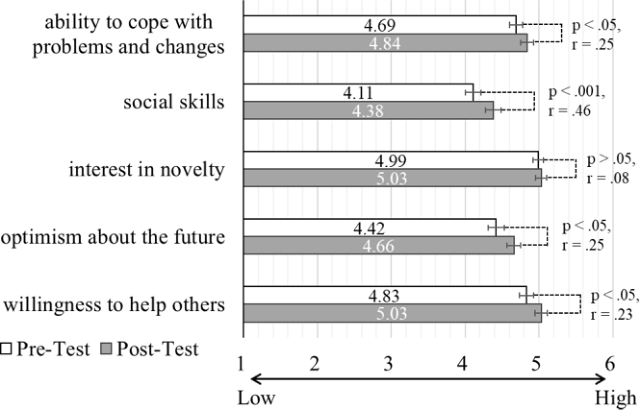
Changes in Career Resilience As shown in Figure 1, four factors of the Career Resilience Scale—ability to cope with problems and changes, social skills, optimism about the future, and willingness to help others—showed significant increases in scores from pre- to post-intervention.
Figure 1: Mean scores (±SE) of the career resilience scale (n = 95).
The significant improvement across these four factors indicates that Message Thinking may enhance participants’ psychological flexibility and interpersonal adaptability in their career development. In particular, the improvements in optimism about the future and willingness to help others are noteworthy from the perspective of expanding temporal and social awareness—dimensions that have been underexplored in conventional career support. Reflecting on oneself from the standpoint of one’s future self or others may serve as an opportunity to reconstruct current behaviors and values.
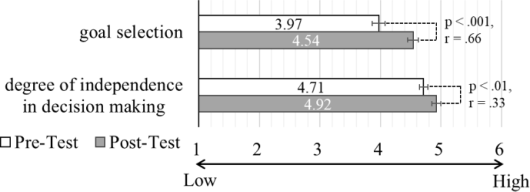
Changes in Career Decision Self-efficacy As illustrated in Figure 2, both subscales of the Career Decision Self-Efficacy Scale—goal selection and degree of independence in decision making— showed significant increases following the intervention.
The significant improvement in both subscales suggests that Message Thinking effectively fosters confidence and autonomy in decision-making related to future careers. Traditionally, the enhancement of self-efficacy has been attributed to past mastery experiences or the presence of role models. However, the present findings highlight that an approach mediated through reflective message writing to one’s future self can also serve as a valuable mechanism for strengthening self-efficacy—a finding that merits particular attention.
Figure 2: Mean scores (±SE) of the career decision self-efficacy scale (n = 95).
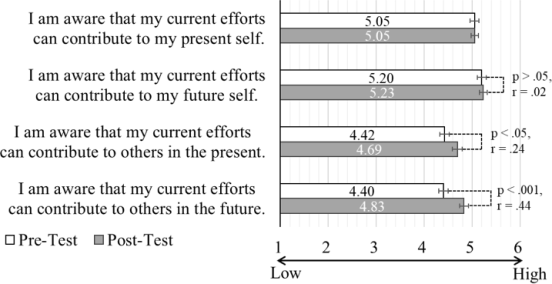
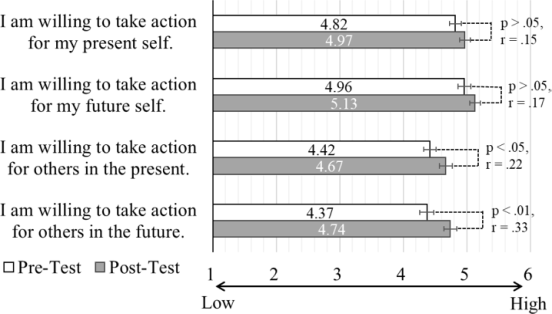
Changes in Helping Orientation Of the eight items assessing helping orientation, four demonstrated significant increases after the intervention (see Figures 3 and 4). Notably, items reflecting awareness that “current efforts can contribute to others in the present or future”and willingness “to take action for others in the present or future” showed clear improvements.
Figure 3: Mean scores (±SE) of helping orientation—awareness (n = 95).Figure 4: Mean scores (±SE) of helping orientation—behavioral intention (n = 95).
Design and Evaluation of Message Thinking Based on Futurability Education 1345
These results suggest that Message Thinking promotes not only self- reflection but also the expansion of one’s consideration toward future others. In particular, the enhancement of helping orientation toward future others directly aligns with the theoretical concept of Futurability, demonstrating that the intervention effectively operationalizes its core educational objective.
Summary Taken together, the results indicate that Message Thinking has multifaceted educational effects—it enhances not only long-term decision-making ability but also personal autonomy in career development and prosocial motivation toward future others. This framework thus contributes to the formation of a sustainable foundation for decision making that emphasizes coexistence with future generations.
However, several limitations should be acknowledged. The participants were limited to graduate students in engineering, which constrains the generalizability of the findings to other populations (e.g., undergraduates, working adults, or high school students). In addition, this study focused only on short-term effects; therefore, longitudinal studies are required to examine the persistence and transferability of these effects over time.
Despite these limitations, the present findings provide empirical evidence that Message Thinking is an effective educational intervention that activates Futurability and fosters future-oriented, socially responsible decision- making. Future research should aim to extend its application to diverse contexts and explore its broader pedagogical potential and limitations.
CONCLUSION
This study examined the psychological effects of Message Thinking, an educational intervention developed as a practical approach within Futurability Education, on factors related to career development. The intervention was conducted with 95 graduate students from the Graduate School of Engineering at The University of Osaka, and changes in Career Resilience, Career Decision Self-Efficacy, and Helping Orientation (awareness and behavioral intention) were assessed before and after the program. The results revealed significant improvements across multiple indicators.
In particular, the enhancement of optimism about the future and willingness to help others within the Career Resilience Scale, improvements in goal selection and degree of independence in decision making within the Career Decision Self-Efficacy Scale, and increased awareness and behavioral intention to support future others indicate that Message Thinking functions as an effective educational intervention that facilitates shifts in temporal and intergenerational perspectives. These findings suggest that Message Thinking not only promotes introspection about one’s own future but also fosters decision-making attitudes that take into account relationships with future others. This supports its role as an educational method for activating Futurability—encouraging future-oriented, socially responsible decision-making.
Future research should aim to diversify participant populations, examine the long-term sustainability of the observed effects, and explore the applicability of Message Thinking in various educational contexts. Addressing these challenges will contribute to further strengthening both the theoretical and practical foundations of this approach.
Overall, this study demonstrates that Message Thinking, as a practical methodology grounded in Futurability Education, provides a framework for fostering decision-making competencies that emphasize coexistence with future generations, thereby contributing to new developments in educational practice and career development support.
ACKNOWLEDGMENT
This work was supported by the OU-SDGs Program, Office of the Center for the Promotion of Excellence in Higher Education, The University of Osaka, under the 2025 OU-SDGs Program for Overseas Research Presentation Support.
REFERENCES
Chishima, Y., & Wilson, A. E. (2021). Temporal distancing during the COVID-19 pandemic: Letter writing with future selves promotes optimism and motivation. Applied Psychology: Health and Well-Being, 13(4), 921–937. Hanai, Y., & Shimizu, K. (2018). The structure and model of the Career Decision
Self-Efficacy Scale: Examination of factorial invariance between university and technical college students. Journal of Career Education Research, 34, 29–38. Hara, K., Naya, M., Kitakaji, Y., Kuroda, M., & Nomaguchi, Y. (2023a).
Changes in perception and the effects of personal attributes in decision-making as imaginary future generations: Evidence from participatory environmental planning. Sustainability Science, 18, 2453–2467. Hara, K., Nomaguchi, Y., Fukutomi, S., Kuroda, M., Fujita, K., Kawai, Y., Fujita, M., & Kobashi, T. (2023b). Policy design by “imaginary future generations” with systems thinking: A practice by Kyoto City towards decarbonization in 2050. Futures, 154, 103272. Hershfield, H. E., Garton, M. T., Ballard, K., Samanez-Larkin, G. R., & Knutson,
B. (2009). Future self-continuity: How conceptions of the future self transform intertemporal choice. Annals of the New York Academy of Sciences, 1167(1), 110–115. Kodama, M. (2017). Development of a Career Resilience Scale for university students. Journal of Career Education Research, 33, 15–24. Kurashiki, T. (2022). Futurability education based on Future Design. Journal of the
Japan Society for Engineering Education, 70(2), 94–99. Saijo, T. (2020). Future Design: Bequeathing sustainable natural environments and sustainable societies to future generations. Sustainability, 12(16), 6467.
LISTED IN THE AHFE DIGITAL BOOKSTORE CATALOGUE
Explore the complete digital volume
Human Factors in Design, Engineering, and Computing
Read this individual research paper free through the original publisher, or explore the full digital proceedings book.
ISBN 978-1-964867-75-5
Explore this ISBN in the AHFE Bookstore ↗Listed in the July 2026 bookstore catalogue; search by ISBN to confirm current availability · Digital book purchase optional