Lindsey McIntire, Patrick O'maille, Eric Liebler, R. Andy McKinley (2025). Non-invasive transcutaneous vagal nerve stimulation enhances mood, task performance, and learning in a high-stress military training environment. In: Human Factors in Design, Engineering, and Computing. AHFE Open Access, vol. 199, pp. 1357–1364. https://doi.org/10.54941/ahfe1006947
Non-invasive transcutaneous vagal nerve stimulation (tVNS) has been shown to accelerate learning and performance in Air Force (USAF) personnel while simultaneously increasing attention, arousal, and mood in well-controlled laboratory tasks. The purpose of this study was to evaluate the effect of tVNS on operational performance, cognitive function, and mood in Air Force trainees undergoing the third week of their Military Qualification Training (MQT) course, the most difficult and fast-paced portion of their curriculum. Methods: USAF trainees were randomly assigned to receive active tVNS or a sham device. On days 1 through 4, trainees completed a 15-item mood questionnaire (pre-task) followed by tVNS or sham, MQT tasks, another round of tVNS or sham, and a final mood questionnaire (post-task). They completed a third mood questionnaire at the end of each day (EOD). Stimulation consisted of 2 minutes of tVNS or sham on one side of the neck followed by a 2-minute break and then 2 more minutes of tVNS or sham on the other side of the neck. Mood was measured using a 7-point numeric rating scale. A mixed-model ANOVA, with “group” as a between-subjects factor and “day” as a within-subjects factor, was used to assess mood changes from pre-task Day 1 ratings to all post-task ratings for each day and pre-task Day 1 ratings to all EOD ratings, as well as changes in task performance. Results: A total of 70 trainees completed the study (39 active, 31 sham). Trainees who received tVNS reported reduced distress (Distressed/Delighted, p<0.001), increased ability (Able/Unable, p=0.020), increased energy (Fatigued/Energized, p=0.002), and an improvement in overall mood (p=0.026) from pre-task Day 1 to all post-task ratings, compared to the sham group. Increased energy (p=0.034) and reduced distress (p=0.042) were maintained at EOD for those receiving tVNS compared with sham. There was a trend toward increased focus (Focused/Distracted, p=0.064) from pre-task Day 1 to all post-task ratings for tVNS vs sham. For performance of MQT tasks, trainees receiving tVNS demonstrated a significant increase in the ability to produce full motion video (FMV)-derived intelligence products in support of mission tasking compared to sham (p=0.020). A significant effect of tVNS compared with sham was observed on Day 1 for the “perform FMV callouts using the appropriate format” and “conduct a target walk-on target verification” tasks. tVNS produced additional performance benefits that did not reach statistical significance. Conclusions: This is the first demonstration of tVNS in a high-stress, high-performance real-world operational training environment. Trainees receiving tVNS saw improvements in several measures of operational readiness, were significantly more energetic, less stressed, and felt better able to perform the required tasks. These operational and mood related improvements in FMV-related tasks suggest that tVNS could be deployed to enhance warfighter training and operational readiness.
The demand for Intelligence, Surveillance, and Reconnaissance (ISR) analysts to support ongoing operations has grown exponentially over the past decade due, in part, to analyst attrition caused by operational burnout (Bryant- Lees et al., 2021, Decker, 2025, Langley, 2012). The US Air Force (USAF)
trains personnel to fly remotely piloted aircraft and serve as image analysts as part of their mission. Because of the high pace and high-risk nature of their mission set, neuromodulation techniques that may accelerate training, sustain attention, reduce fatigue, and improve mood are being explored (Science and Technology Organization, 2024).
Vagal nerve stimulation (VNS) has been shown to increase neuronal plasticity in humans via noradrenergic or cholinergic neurotransmission (Hays, 2016). Non-invasive transcutaneous vagal nerve stimulation (tVNS) passes an electrical current pulsed at 25Hz through the skin/nerve via two electrodes placed over the neck. tVNS has been shown to facilitate learning and memory (Boon et al., 2006, Clark et al., 1999, Sanders et al., 2019, Sun et al., 2017); enhance multiple elements of cognition, such as arousal, attention, multi-tasking, decision-making, and memory (Martin et al., 2004, McIntire et al., 2019, Sjogren et al., 2002, Sun et al., 2017); improve the ability to learn a new language (Llanos et al., 2020, Phillips et al., 2021); boost mood after prolonged periods of activity (Ferstl et al., 2022); and improve fatigue and sleepiness (McIntire et al., 2021).
In well-controlled, research-oriented assessments, tVNS has been shown to enhance learning and performance in USAF personnel, while also increasing attention, arousal, and mood (McIntire et al., 2019, McIntire et al., 2021, Miyatsu et al., 2023). The purpose of this study was to evaluate the effect of tVNS on operational performance, cognitive function, and mood in USAF trainees in a real-world setting. The assessment took place during the third week of their Military Qualification Training (MQT) course, which is considered the most difficult and fast-paced portion of the curriculum.
METHODS
Equipment For tVNS, a handheld device developed and manufactured by electroCore®, Inc. (Rockaway, NJ, USA) was used within the manufacturer’s specifications. This device passes a noninvasive electrical current pulsed at 25 Hz through the skin to the nerve via two electrodes placed over the neck. The sham device was visually identical to the active device and produced similar clicking sounds and tactile vibrations, but it delivered no electrical current. Both devices were supplied by the same manufacturer. Stimulation consisted of 2 minutes of active tVNS or sham on one side of the neck followed by a 2-minute break and then 2 more minutes of active tVNS or sham on the other side of the neck.
Subjects Eligible subjects were healthy active-duty military volunteers between 18 and 42 years of age in training to become Special Operations Forces full motion video (FMV) analysts, career FMV analysts, or 19th Air Lift Wing Personnel. USAF trainees were randomly assigned to receive tVNS or sham.
Non-Invasive tVNS Enhances Mood, Task Performance, and Learning 1359
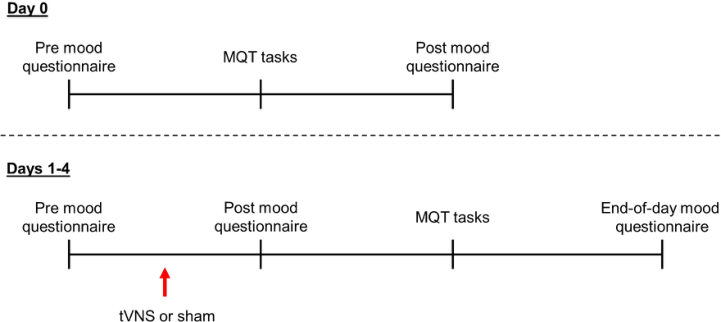
Procedures On Day 0 of their third week of training, trainees completed a 15-item mood questionnaire, followed by MQT tasks, and a second mood questionnaire to establish a baseline. On Days 1-4, trainees completed the mood questionnaire (pre) followed by tVNS or sham, a second mood questionnaire (post), and then their MQT tasks (Figure 1). They completed a third mood questionnaire at the end of each day (EOD). Mood was measured using a 7-point numeric rating scale. Participants also received instructor ratings for each FMV task related to mission understanding or performance, group (tVNS or sham), and day.
Figure 1: Study design. MQT, military qualification training; tVNS, transcutaneous vagal nerve stimulation.
Statistical Analyses A mixed-model ANOVA, with “group” as a between-subjects factor and “day” as a within-subjects factor, was used to assess mood changes from pre Day 1 ratings to all post ratings for each day and pre Day 1 ratings to all EOD ratings, as well as changes in task performance. P values for each day were calculated from two-tailed two-sample t-tests.
RESULTS
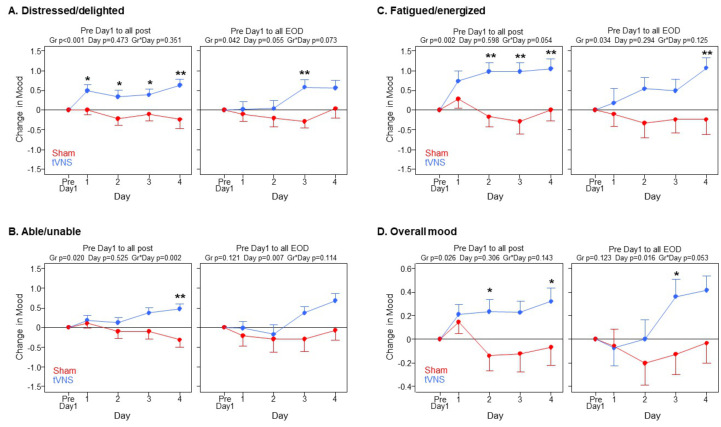
A total of 70 trainees completed the study (39 tVNS, 31 sham). Trainees who received tVNS reported significantly reduced distress (distressed/delighted, p<0.001), increased ability (able/unable, p = 0.020), increased energy (fatigued/energized, p = 0.002), and an improvement in overall mood (p = 0.026) from pre Day 1 to all post ratings, compared to the sham group (Figure 2). Increased energy (p = 0.034) and reduced distress (p = 0.042) were maintained at EOD for those receiving tVNS compared with sham.
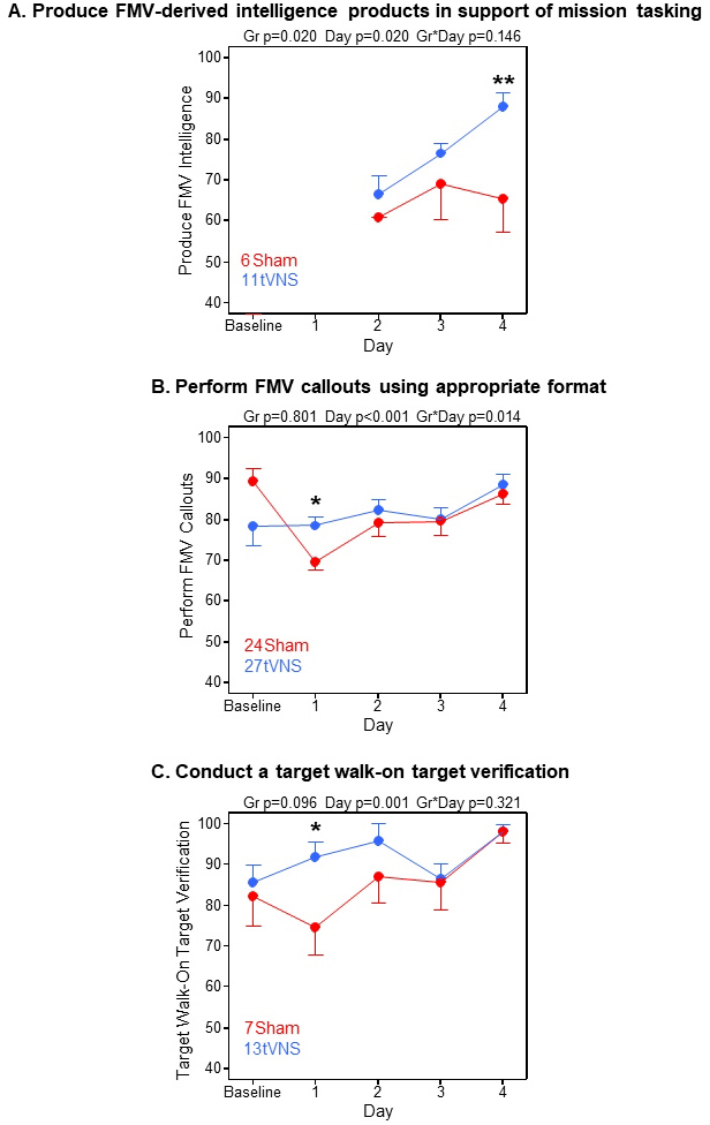
For the instructor-graded MQT course requirements, trainees receiving tVNS demonstrated a significant increase in the ability to produce FMV-derived intelligence products in support of mission tasking compared
with sham (main effect of group, p = 0.020; Figure 3A). A significant effect of tVNS compared with sham was observed on Day 1 for the “perform FMV callouts using the appropriate format” (Day 1, p ≤0.05) and “conduct a target walk-on target verification” (Day 1, p ≤0.05) tasks. tVNS yielded additional performance gains that, while not statistically significant, were considered operationally relevant (eg, perform the required proceedings during a shift-change/mission handoff and produce mission summary intelligence products).
Figure 2: Mood ratings. Data are least-squares mean ± SE. *p ≤0.05; **p ≤0.01. EOD, end of day; Gr, group; tVNS, transcutaneous vagal nerve stimulation.
DISCUSSION
Military training, as well as combat operations, are conducted under high levels of cognitive and physical stress, including energy deficits, sleep deprivation, dehydration, and thermal strain that can contribute to impaired cognitive function (van der Groen et al., 2025). Because of these challenges, the military is actively exploring cognitive neuroenhancement techniques and technologies. Neuromodulation approaches such as transcranial electrical stimulation and transcranial magnetic stimulation have shown varying degrees of promise, but cannot be readily deployed in training and combat operations (Science and Technology Organization, 2024). In contrast, tVNS offers a safe, portable, and field-deployable method to modulate peripheral nervous system activity by activating key brain regions involved in regulating attention, arousal, wakefulness, and memory. This is the first demonstration of tVNS in a high-stress, high-performance, real-world operational training environment.
Non-Invasive tVNS Enhances Mood, Task Performance, and Learning 1361
Figure 3: MQT task performance Data are least-squares mean ±. SE. *p ≤0.05; **p ≤0.01. Abbreviations: FMV, full motion video; Gr, group; MQT, Military Qualification Training; tVNS, transcutaneous vagal nerve stimulation.
Previous research, in multiple settings, has provided encouraging evidence for the cognitive and behavioral benefits of tVNS. In controlled laboratory and operational studies, tVNS has been shown to enhance cognitive performance, learning, and alertness. McIntire et al. demonstrated that nVNS improved cognitive performance in active-duty military personnel during sustained wakefulness as measured by the Psychomotor Vigilance Task and Multi-Attribute Task Battery, while also reducing fatigue and increasing energy compared to sham stimulation (McIntire et al., 2021). Miyatsu et al. reported that tVNS accelerated second language vocabulary recall and was associated with reduced fatigue and increased focus in linguists under training at the Defense Language Institute (Miyatsu et al., 2024). In addition, tVNS has been shown to reduced reaction times, suggesting improved cognitive processing speed (Lerman et al., 2022), and to increase attention, resulting in better performance on visuospatial reasoning and recognition tasks (Klaming et al., 2022).
A recent Delphi study identified attention, arousal, processing speed, cognitive control, and working memory as critical for sustained performance under stress (Albertella et al., 2022). Our current findings that tVNS reduces distress, enhances perceived ability and energy, and improves overall mood complement our previous findings showing improved data retention, reaction time, and arousal (McIntire et al., 2019).
Trainees who received a single session of tVNS demonstrated improvements across several measures of operational readiness, were significantly more energetic, less stressed, and felt better able to perform the required tasks. These operational and mood-related improvements in FMV-related tasks extend previous findings demonstrating that tVNS can be deployed to enhance warfighter training and increase operational readiness.
Subsequent to the positive findings of this and related research, the tVNS technology was adapted specifically for military applications, resulting in the development of the current TAC-STIM™unit, which was designed based on certain specific military operational standards to allow for training and operational use by active-duty military personnel in high-stress, harsh, and/or secure environments. Future efforts should focus on extending these results to other training environments as well as examining the effects of tVNS on stress and cognitive performance in ISR operators and other relevant operational settings.
ACKNOWLEDGMENT
Medical writing and editorial support were provided by Jennifer Ayala, PhD, CMPP, from Citrus Health Group, Inc. (Chicago, Illinois) and were funded by Nisola Consulting Inc. (Liberty, Maine).
REFERENCES
Albertella, L., Kirkham, R., Adler, A. B., et al (2022). Building a transdisciplinary expert consensus on the cognitive drivers of performance under pressure: An international multi-panel Delphi study. Front Psychol. Volume 13, pp. 1017675.
Non-Invasive tVNS Enhances Mood, Task Performance, and Learning 1363
Boon, P., Moors, I., De Herdt, V., Vonck, K. (2006). Vagus nerve stimulation and cognition. Seizure. Volume 15 No. 4, pp. 259–263. Bryant-Lees, K. B., Martinez, R. N., Frise, A., et al (2021). Predictors and protective
factors for suicide ideation across remotely piloted aircraft career fields. Mil Psychol. Volume 33 No. 4, pp. 228–239. Clark, K. B., Naritoku, D. K., Smith, D. C., Browning, R. A., Jensen, R. A.
(1999). Enhanced recognition memory following vagus nerve stimulation in human subjects. Nat Neurosci. Volume 2 No. 1, pp. 94–98. Decker, A. (2025). Pilot shortage: new report calls for more Air Force fighters and larger reserve. Defense One. https://www.defenseone.com/threats/2025/01/pilot- shortage-new-report-calls-more-air-force-fighters-and-larger-reserve/402493/. Ferstl, M., Teckentrup, V., Lin, W. M., et al (2022). Non-invasive vagus nerve
stimulation boosts mood recovery after effort exertion. Psychol Med. Volume 52 No. 14, pp. 3029–3039. Hays, S. A. (2016). Enhancing rehabilitative therapies with vagus nerve stimulation.
Neurotherapeutics. Volume 13 No. 2, pp. 382–394. Klaming, R., Simmons, A. N., Spadoni, A. D., Lerman, I. (2022). Effects of noninvasive cervical vagal nerve stimulation on cognitive performance but not brain activation in healthy adults. Neuromodulation. Volume 25, No. 3, pp. 424–432. Langley, J. (2012). Occupational burnout and retention of Air Force Distributed
Common Ground System (DCGS) intelligence personnel [doctoral thesis]. Rand Graduate School. https://www.rand.org/pubs/rgs_dissertations/RGSD306.html. Lerman, I., Klaming, R., Spadoni, A., Baker, D. G., Simmons, A. N. (2022). Noninvasive cervical vagus nerve stimulation effects on reaction time and valence image anticipation response. Brain Stimul. Volume 15 No. 4, pp. 946–956. Llanos, F., McHaney, J. R., Schuerman, W. L., Yi, H. G., Leonard, M. K.,
Chandrasekaran, B. (2020). Non-invasive peripheral nerve stimulation selectively enhances speech category learning in adults. NPJ Sci Learn. Volume 5, pp. 12. Martin, C. O., Denburg, N. L., Tranel, D., Granner, M. A., Bechara, A. (2004). The effects of vagus nerve stimulation on decision-making. Cortex. Volume 40, No. 4–5, pp. 605–612. McIntire, L. K., McKinley, R. A., Goodyear, C., McIntire, J. P., Brown, R. D.
(2021). Cervical transcutaneous vagal nerve stimulation (ctVNS) improves human cognitive performance under sleep deprivation stress. Commun Biol. Volume 4, No. 1, pp. 634. McIntire, L. K., McKinley, R. A., Goodyear, C. (Year). Peripheral nerve stimulation to augment human analyst performance. Presented at: IEEE Research and Applications of Photonics in Defense Conference (RAPID); Miramar Beach, FL. Miyatsu, T., Oviedo, V., Reynaga, J., et al (2024). Transcutaneous cervical
vagus nerve stimulation enhances second-language vocabulary acquisition while simultaneously mitigating fatigue and promoting focus. Sci Rep. Volume 14, No. 1, pp. 17177. Miyatsu, T., Oviedo, V., Reynaga, J., et al (Year). Transcutaneous cervical vagus nerve stimulation enhances second-language vocabulary acquisition while simultaneously mitigating fatigue and promoting focus. Presented at: Annual Meeting of the American Academy of Neurology; April 23; Boston, MA. Phillips, I., Calloway, R. C., Karuzis, V. P., Pandza, N. B., O’Rourke, P., Kuchinsky,
S. E. (2021). Transcutaneous auricular vagus nerve stimulation strengthens semantic representations of foreign language tone words during initial stages of learning. J Cogn Neurosci. Volume 34, No. 1, pp. 127–152.
Sanders, T. H., Weiss, J., Hogewood, L., et al (2019). Cognition-enhancing vagus nerve stimulation alters the epigenetic landscape. J Neurosci. Volume 39, No. 18, pp. 3454–3469. Science and Technology Organization (2024). Neuroenhancement in military personnel: conceptual and methodological promises and challenges. North Atlantic Treaty Organization. Sjogren, M. J., Hellstrom, P. T., Jonsson, M. A., Runnerstam, M., Silander, H. C.,
Ben-Menachem, E. (2002). Cognition-enhancing effect of vagus nerve stimulation in patients with Alzheimer’s disease: a pilot study. J Clin Psychiatry. Volume 63, No. 11, pp. 972–980. Sun, L., Perakyla, J., Holm, K., et al (2017). Vagus nerve stimulation improves working memory performance. J Clin Exp Neuropsychol. Volume 39, No. 10, pp. 954–964. van der Groen, O., Rafique, S. A., Willmot, N., Murphy, M. G., Tisnovsky, E.,
Brunye, T. T. (2025). Transcutaneous and transcranial electrical stimulation for enhancing military performance: an update and systematic review. Front Hum Neurosci. Volume 19, pp. 1501209.
LISTED IN THE AHFE DIGITAL BOOKSTORE CATALOGUE
Explore the complete digital volume
Human Factors in Design, Engineering, and Computing
Read this individual research paper free through the original publisher, or explore the full digital proceedings book.
ISBN 978-1-964867-75-5
Explore this ISBN in the AHFE Bookstore ↗Listed in the July 2026 bookstore catalogue; search by ISBN to confirm current availability · Digital book purchase optional