Mario Ivan Zignego (2021). Human Factors in the Design of Naval Vessels. In: Advances in Human Aspects of Transportation: Part I. AHFE Open Access, vol. 15. https://doi.org/10.54941/ahfe100618
Ergonomic studies play a particularly important role in the design of naval vessels. Key specializations, including physical, perceptual and organizational ergonomics, apply to navy ship spaces. The contributions of various disciplines to the definition of naval vessels are analyzed and tested in an ergonomic perspective to continuously seek solutions that enable increased efficiency while maintaining safety and comfort. Ergonomics is a science in a continuing evolution. It analyzes social changes and the new expectations that are generated, to meet them at both civilian and military level.
Ergonomics is one system of knowledge, transversal and strongly anthropocentric, that affects all aspects of human engineering and pursues the making of products, environments and services that meet user needs, while improving safety, health, comfort and performance.
The peculiarity of an ergonomic approach is in the ability to draw on a variety of culturally distant disciplines to create methods, evaluation and design systems that ensure a compatibility of user needs, abilities and expectations with environmental and product functionalities.
Ergonomic specializations exist to analyze and solve a variety of aspects. Physical ergonomics focuses on the compatibility of human anatomy in its biomechanical, physiological and anthropometric features, and the static and dynamic parameters of various working activities, including assumed posture, efforts made, utilized equipment, experiential workspace.
Perceptual-cognitive ergonomics has a focus on studies for interface development. A relatively young discipline, it shifts its focus from ‘people who perform tasks’ to ‘people who control machines’. This dimension is oriented to the perception and processing of information, to attention, memory, language and to the activation of motoric human answers in the interaction of people and systems.
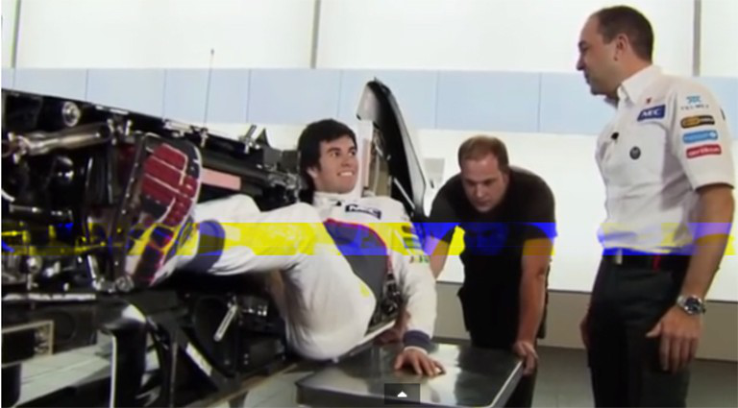
Also a human factor subdiscipline, organizational ergonomics has a key focus on the interaction of individuals and organizations, in regard to the optimization of social and technical systems, of organized structures and strategies underlying human activities. (Fig.1)
Figure 1. Sauber Chief Designer Matt Morris (right) talking to driver Perez as he sits in the cockpit of the car (Picture: YouTube) An interdisciplinary approach
Ergonomics is a multidisciplinary science that uses transversal techniques, building on the foundations of applied sciences, biomedical, social and economic sciences. One common feature is that all ergonomic theories and methods comply with the principle that human well-being is central to the interest of research and design, irrespective that their final goals may be other than this. In the military sector, this translates into an improved military efficiency if military personnel work and live in ergonomically correct environments. This necessitates a definition, based on a usability concept.
Usability of artifacts has no univocal definition. It describes a relation of people and systems. Usability epitomizes how easily people use systems, acquire and retain information, make mistakes, obtain gratification from them. Usability is naturally user centered, with a focus on various performable actions. System design necessitates a fundamental knowledge of people who will utilize them and their operational environment; products that are highly usable individually may not be compatible with more complex contexts, such as on board military vehicles engaged in operational missions. (Fig.2)
Figure 2. 1970 Bertone Lancia Stratos Zero (Picture: www.benedictredgrove.com)
Figure available in the original PDF paper.
Historical background Ergonomic studies and theories developed in the 1920s, and gained further momentum in WW2, when the complexity of war machines required massive efforts of operators to understand and utilize them. This implied stress and poor performance of users, to the extent that it prompted studies of facilities and equipment of a greater adaptability to the capabilities, physiological and psychological limitations of users and the study of these limitations. Human psychology and physiology are the fundamental parameters to which systems, machines, environments and work methods and organization must be matched to.
Opposite to this concept, adaptive ergonomics requires that users only be adjusted to machines, in a relation that is fundamental to ergonomics, to enable a growing global efficiency.
In the 1950s, in the aftermath of WW2, ergonomic studies progressed further in the military sector, particularly in aeronautics and aerospace, with an impact on the steel industry and on large scale sectors in general. Parallel physiological studies developed on the principal industrial noxiousness factors in the performance of heavy labor tasks, on issues of occupational safety and health. Ergonomics shifts its focus from individual performances in a given workplace to the relation of people and their contexts, particularly in terms of environment, facilities and equipment and organization of work.
In the 1970s ergonomic studies centered on workstations and workers’ health and safety issues in the service industry. A decade later, the relation of individuals and computers, and the subsequent interface of individuals and personal computer technology became central to the focus of ergonomics.
Current ergonomic studies deal with macroergonomics issues involving the interaction of individuals and organizations. Based on its inherent multidisciplinary character, ergonomics significantly contributes to active and conscious design processes of new technologies and physical and social environments, governing transformation and understanding the complexity of interactions that affect human satisfaction and well-being. There is growing belief that ergonomic design has a role in preventing risks and hazards, based on adequate revision methods.
ERGONOMICS IN THE MILITARY SECTOR In the military field, ergonomics is studied and applied primarily to obtain the best individual-machine-environment ratio and increase military performance, usability of systems, analysis of recurring errors, comfort and safety while maintaining performance levels.
Ergonomics for the military sector utilizes both physical and cognitive aspects of research.
Physical ergonomics aims at an optimization of physical parameters such as an object’s weight, easy handling, strength requirements, movements to perform in respect of objects and tools.
Cognitive ergonomics studies and seeks solutions for the psychological aspects of the relation of people and machines.
The rules of physical ergonomics for the military do not vary substantially in respect of other civilian industries, and are virtually replicated in sports where competition drives experimental solutions to the extreme limit of hazard. This is not permissible in the military because safety and the protection of operators, equipment and mission are fundamental in a military action. Notwithstanding, both sports and the military draw on studies to optimize products and the interface of man and machine, largely utilizing simulators to recreate virtual reality situations applicable to both.
Physical ergonomics requirements include the following: [Equation or mathematical symbol available in the original paper PDF] work in a natural posture;
[Equation or mathematical symbol available in the original paper PDF] reduce the necessity of an excessive strength; [Equation or mathematical symbol available in the original paper PDF] keep everything in easy to reach positions;
[Equation or mathematical symbol available in the original paper PDF] work at right elevations; [Equation or mathematical symbol available in the original paper PDF] reduce excessive, redundant movements;
[Equation or mathematical symbol available in the original paper PDF] minimize fatigue and static loads; [Equation or mathematical symbol available in the original paper PDF] minimize pressure points ;
[Equation or mathematical symbol available in the original paper PDF] provide sufficient work space; [Equation or mathematical symbol available in the original paper PDF] ensure movement and exercise possibilities;
[Equation or mathematical symbol available in the original paper PDF] maintain a comfortable environment.
The basic philosophy of cognitive ergonomics is to make the interaction of people and machines a ‘friendly’ one, enabling operational efficiency while eliminating errors and long training phases. Categorized in terms of perception, decisions and skills, errors are central to the focus of cognitive ergonomics because errors pose risks to human life. There are so called ‘human’ errors that are often the result of an imperfect design of interfaces that communicate information that is unclear, and may be subject to interpretation. This necessitates the pursuit of standardized basic controls, with a view to generating international armed forces that may operate conjunctly. To standardize enables natural ways in the utilization of military systems, the same as searching the letters on a computer keyboard or operating a vehicle’s directional indicators.
Resources and guidelines As we earlier discussed, ergonomics for naval systems dates back to a long time ago. There is ample documentation on this matter, national and international legislation and specific industry regulations that describe the principal rules to follow in the design of naval systems.
This documentation provides a compendium of information deriving from empirical data, experimental trials, human behavior models, user experience and research and expert opinions. This guidance helps designers in the delivery of individualized systems that meet client needs and the expectations of users and maintainers.
American Bureau of Shipping ABS ‘GUIDANCE NOTES ON THE APPLICATION OF ERGONOMICS TO MARINE SYSTEMS’ provide detailed information on numerous aspects of ergonomics.
ABS Guidance Notes primarily deal with interfacing people and systems, their impact on facilities, equipment and systems, and with occupational safety and health issues. Schemes and design and verification tables are also provided. Notes on security systems and safety technology and workplace accessibility are also provided. ABS Guidance Notes are a fundamental instrument to approach marine architecture and naval design issues in accordance with fundamental ergonomics principles.
Italy’s Navy Marina Militare Italiana has developed rules on human factors and marine systems as part of a publication on the habitability of naval units ‘SMM 100/UEU - ABITABILITA' DELLE UNITA' NAVALI DELLA MARINA MILITARE”.
This norm is articulated in subsections in reference to basic ergonomic concepts: [Equation or mathematical symbol available in the original paper PDF] adaptive ergonomics
[Equation or mathematical symbol available in the original paper PDF] correction ergonomics [Equation or mathematical symbol available in the original paper PDF] system ergonomics
This norm provides guidance to initially adapt people to machines, according to a principle that machines come first.
Psychotechnical strategies follow, to identify operators who are particularly skilled to perform tasks utilizing specific machines. Machines are subsequently adapted to people who become resources, precious and determinant in the economy of systems.
In a third phase, interaction systems are studied to create one system only, conceived, designed, engineered and managed based on the application of preventive versus non corrective criteria. Ergonomics studies with Italy’s Navy show a constant evolution and a new focus based on the ever changing operational needs on board naval vessels. Military missions today integrate surveillance, monitoring, and, increasingly, humanitarian aspects, for which flexible equipment is required, managed by interchangeable staff, where the integration of people and machines is maximized.
Naval vessel operations Italy’s Navy participates with its personnel and equipment to military operations, and to air and sea exercises both nationally and worldwide. These include civilian and military cooperation (COCIM) that contributes to contrast marine pollution, to enhance maritime archaeology research and to the activities of Italy’s Civil Protection Agency. Italy’s Navy also actively participates in initiatives based on international cooperation to improve maritime security, such as the V-RMTC system, designed, engineered and promoted to optimize control of merchant ship traffic. (Source: Italy’s Navy, Ministero della Difesa – Marina Militare)
This document highlights how military activities are currently non predominant in respect of Italy’s overall naval efforts. There clearly emerges the dual connotation that naval vessels must support and be equipped for. Of a particular relevance for naval vessels operating in the Mediterranean is Italy’s Navy Mare Nostrum program, to monitor migration flows in this area. Italy’s army, aviation and coast guard also participate in this mission, employing naval ships, landing platform dock vessels, dinghies, aircraft and helicopters.
To solve aspects in respect of system ergonomics is of fundamental importance in these cases. To coordinate different military corps and equipment entails integration efforts, information exchange, knowledge sharing and team work. Additional to these aspects, there are physical ergonomics issues because naval vessels under these programs must accommodate military crews and civilian personnel, medical staff and paramedical aides that provide assistance to rescued passengers. This relation of people and machines is significantly more complex, because rescued passengers need to adjust to onboard spaces, recognize locations and signaling systems and operate in unfamiliar, often hostile environments. Perceptual-cognitive ergonomics supports design and engineering aspects that are not specifically related to the operation of military vessels, and mediate the interface and communication that enable the understanding and utilization by all onboard staff.
For the most strictly military aspects, Italy’s Navy is part of multinational Combined Maritime Forces. CMF incorporates vessels of 29 nations who provide naval vessels and air patrol in the Middle East waters of the Red Sea, the Persian Gulf and the Indian Ocean, to contribute to improve maritime security in the region, based on a volunteer military partnership. This is a case for system ergonomics, also associated to an ergonomic design and engineering, that is strategic for the success of missions based on broad geographical scope and international coalition.
To work and live aboard naval vessels Seamen are different than land based people. These few words epitomize a history of men and places, of men and ships, where the concept of adaptive ergonomics ruled historically as the only possible solution to criticalities on board. Everything on board naval ships is designed, studied and built based on an efficiency principle that minimizes space, materials and energy. Crews must submit to these rules that are made up of many little things that are different than in the civilian world.
Multifunctional space concepts do not stem from contemporary tradeshow designs. Onboard spaces were always multifunctional. Spaces were multifunctional on board nineteenth century clippers and frigates, where crews lived near guns. Food and torpedoes are stowed together on board submarines, where space is both multifunctional and shared, as in the ‘hot bunking’, or sharing of a berth practice. Except for certain specialized vessels, including submarines and other special naval units, the effects of globalization and standardized lifestyles are also reflected in the naval world. The design of modern naval vessels has been deeply revised lately, toward habitability models that are closer to civilian lifestyle. Earlier berthing areas and shared facilities are replaced with private cabins and separate facilities. Important changes have been made to the interiors and the logistics of life onboard. Smaller, Human Aspects of Transportation I (2021) gender integrated crews that include women in the service have influenced choices toward new operational necessities, also associated with an increased automation. New modular interiors shape the volumes and general architecture of naval vessels. This general revision of life onboard military vessels also affects living areas including wardrooms, mess rooms, galleys, stowage areas, corridors and stairs.
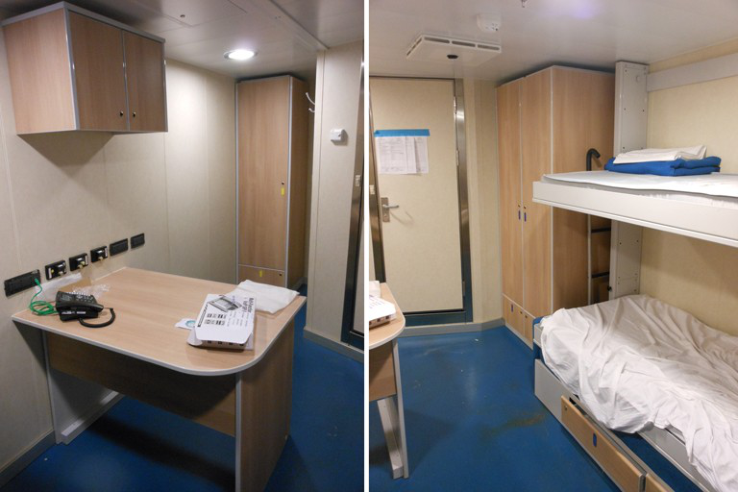
This new mode of conceiving of naval vessel spaces is based on ergonomics applied to the naval world. Specifically, studies on physical, perceptual and system ergonomics transversally contribute to design new operational units. The old concept of an adaptability of people to machines tends to be dismissed, at the same time that an analysis of workloads and of tasks to perform takes new strength, to relate crews to efficiency standards as established. (Fig.3)
Figure 3. 1970 Italian military ship cabin
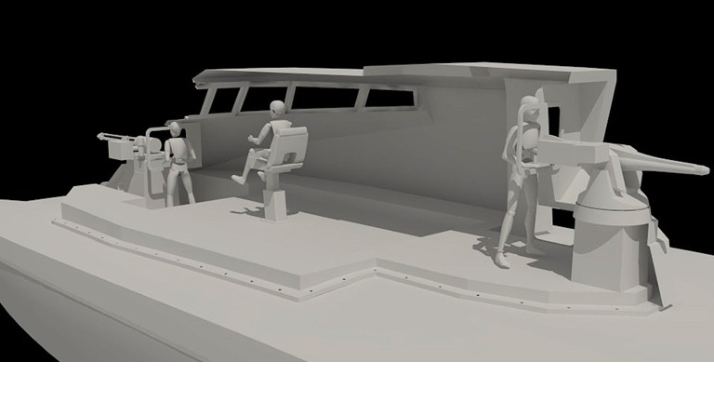
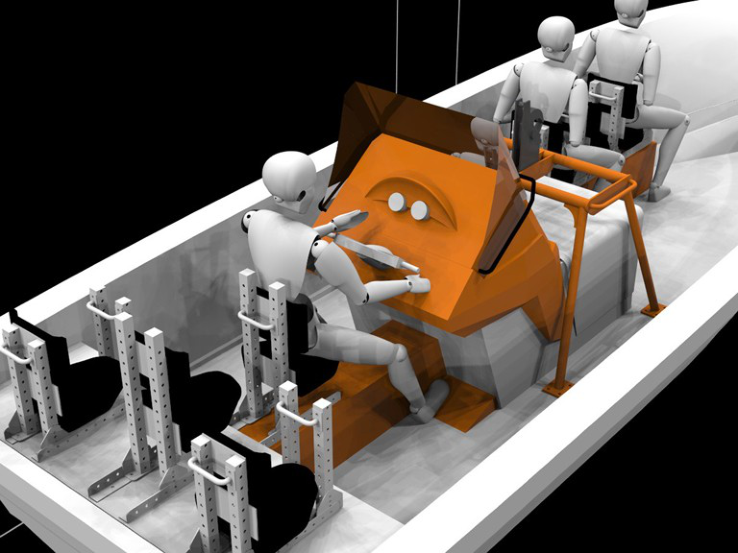
Criticalities of high speed naval craft Naval vessels include specialized units, where adaptive ergonomics prevails as an aspect of physical ergonomics. Specialist naval craft includes submarines, amphibious assault craft, dinghies, high performance units. This naval fleet is utilized by specialist staff, trained to conform with the requirements of living on board naval craft and adapt to its operational environment. Notwithstanding, substantial efforts are currently being made in this sector toward an ergonomic design. It is clear how the operational nature of these units must prevail on accessorial elements, and an attitude to operate in hostile environments is one core aspect to tackle in this respect. It is essential that coast guard vessels move and follow their targets in all sea conditions, use weapons or provide assistance, operating in a variety of situations, at the same time that crew safety is ensured. (Fig.4)
The design and engineering of operational naval vessels draws on a number of specializations and sciences, including primarily Human Factor Engineering (HFE) that, parallel to Project Management, treats ergonomics transversally to a variety of disciplines. The task to perform ergonomically is particularly onerous in this respect.
One action consists in an analysis of strains on operators and their possible solutions. To contrast outer forces generates fatigue, and fatigue causes a worsening of the concentration needed to perform tasks, reducing operational efficiency. Negative forces and factors that are core to the ergonomics of design of high performance naval craft include the following: [Equation or mathematical symbol available in the original paper PDF] wave based gravitational accelerations
[Equation or mathematical symbol available in the original paper PDF] bank angle based centrifugal acceleration [Equation or mathematical symbol available in the original paper PDF] collisions and impact shocks
Equations and mathematical formulas are available in the original paper PDF.
[Equation or mathematical symbol available in the original paper PDF] visibility No matter how trained, and training is also a further task where perceptual and cognitive ergonomics also play a role, crews need equipment and systems to support and help human work. We are hence in the area of the relation of people and machines. As earlier discussed, user interfaces assume a key role both in respect of maneuvering and operating high performance craft. Response time to external strains significantly shortens to enable fastness as a result of natural, instinctive behaviors.
Because individualization is unviable for military craft, there is a need of accurate ergonomic studies that lead to solutions that are as generic as possible to enable use by most operators, at the same time that efficiency is maintained. (Fig.5)
Figure 4. Ergonomic Study for High Speed Naval CraftFigure 5. Ergonomic Study for Rescue boat (ing. Falletta C.)
ERGONOMICS AND DESIGN TECHNOLOGY Ergonomics is interdisciplinary: as such, it employs tools and methods that draw on various sciences, assuming and interpreting their data. As earlier discussed, the principal scope of ergonomics is the real world. Notwithstanding, there exist tools to verify and support this matter that recreate the concrete conditions to perform test and trials.
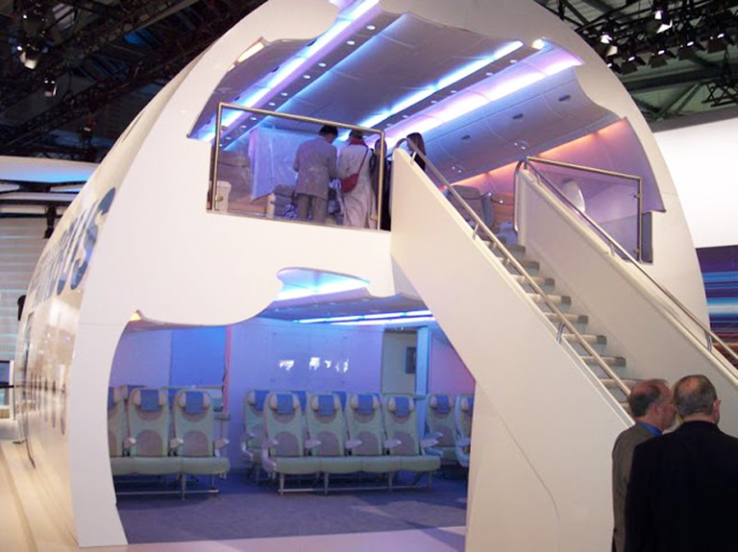
Mock up and simulators Unlike industrial design, naval construction always suffered the impossibility to realize prototypes, finished and functioning. Because of the size of a ship and the few units that are normally built, we may analogize construction to craftsmanship, in that a craftsman’s number one creation is launched a functioning exemplar for all intents and purposes. In a testing phase, this determines manifold interventions to modify and correct design, construction or assembly errors. To limit these criticalities, mock up models are used, providing at least part of the functionality of construction to enable testing of a design and correction of errors in a pre-construction phase. Mock up models are utilized to simulate a vessel’s navigating bridge, its interior décor and exterior finishes, part of its facilities and equipment. (Fig.6)
Figure 6. Mock-up – airbus 380 - http://airbus-a380-pictures.blogspot.it
Additional to providing scale or full sized design replicas, mock ups are used to test the ergonomics, dimensions, usability and to acquire users’ feedback in respect of environmental well-being levels. Simulators are designed and built to serve other purposes. They faithfully replicate part only of the components of spaces or machines and are utilized to test specific mechanical and human functionalities. Simulators are utilized to train aircraft pilots, to learn to direct the course of a ship, to handle a container, to shoot a gun. User interfaces of consoles or shooting positions are tested on a simulator.
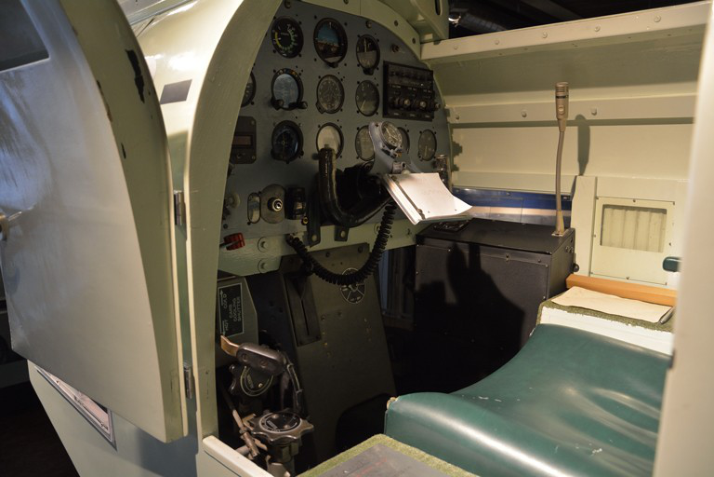
Simulators are essential components of ergonomic tests: operator positions can be simulated to recreate an exterior context, generating movement, noise, et cetera. Unlike mock ups, simulators enable a dynamic interaction of people and machines, and are also employed for personnel training. The integration of mock ups, simulators and computer graphics determines what we call ‘a virtual reality’. Borders with the tangible world grow thinner, parties merge in a ‘game’ so real that, if used to serve ergonomic purposes, it can help anticipate situations where real world experimentation may prove dangerous and irreversible. (Fig.7)
Figure 7. Flight Simulator - Berlin's German Museum of Technology
REFERENCES
A.A. V.V. (2014), “The application of ergonomics to marine system”, in: American Bureau of Shipping, Houston (Ed). A.A. V.V., “High speed craft human factors engineering – Design guide”, Website: www.highspeedcraft.org Costa, M. (2003), “Psicologia Militare”, Franco Angeli, Milano. Gamaleri, A. (2013), “Navi Militari – Alloggi del personale – Nuove Tendenze”, in: “Marinai d’Italia” a.LVII, n. 1 Gen/Feb. Hougtae, K., Park, J.H., Hojin, H., Chang-Min L. (2007), “Evaluation of Navy Shipboard Habitability for a Warship Design Human Model”, in: Duffy V.G. Digital Human Modeling, Springer-Verlac Berlin Heidelberg. Marcolin F., Introduzione all’ergonomia, Internet WEB Site: www.ergocert.org Polizzotto L., L’ergonomia applicata al sedile nautico Dubhe di Red, www.redsrl.eu. Sabbatini A., Cutilli P., Cos’e l’ergonomia – cenni storici e sviluppi attuali, www.lazio.cgil.it . Stato Maggiore della Marina, (2003), “Abitabilità delle Unità Navali della Marina Militare – Norme per i locali di vita, la
logistica, i servizi e la sussistenza”, U.A.G.R.E. 2° Ufficio - Tipografia, Giugno. Stone B., Ergonomics & Human Factors, www.ergonomics.org.uk Stone R.J., Human Factors Guidance for Designers of Interactive 3D and Games-Based Training Systems, http://www.hfidtc.com Wisner, A., Theureau, J., “Metodi e criteri di organizzazione ergonomica del lavoro industriale”, Doc. N° 1658/75 i ACE www.percro.org www.STR.EU.COM http://www.marina.difesa.it/ATTIVITA/Pagine/Attivita.aspx
LISTED IN THE AHFE DIGITAL BOOKSTORE CATALOGUE
Explore the complete digital volume
Advances in Human Aspects of Transportation: Part I
Read this individual research paper free through the original publisher, or explore the full digital proceedings book.
ISBN 978-1-4951-2097-8
Explore this ISBN in the AHFE Bookstore ↗Listed in the July 2026 bookstore catalogue; search by ISBN to confirm current availability · Digital book purchase optional