Ehm Kannegieser, Sergius Dyck, Andreas Lambert, Stefan Wolff, Andy Philipp (2025). Taking Perspective: Broadening Acceptance of a Serious Game Framework. In: Human Systems Engineering and Design (IHSED2025): Future Trends and Applications. AHFE Open Access, vol. 198, pp. 379–386. https://doi.org/10.54941/ahfe1006791
Educators often face challenges or avoid incorporating digital learning content into theirclasses due to the limited availability of content that meets specific course requirements.In previous research, a vision was presented for developing and deploying serious gamesthat leverage Digital Game-Based Learning (DGBL) and domain-agnostic frameworks toenhance educational experiences across diverse fields of knowledge. Evaluating thisconcept, a central insight was that the fundamental game loop should remain intact acrossdifferent knowledge domains - rather than requiring educators to rebuild a game for eachsubject, a core game loop was maintained, where progression depended on missioncompletion, enabling easy alteration of visual setting, storytelling components, orgamification features for extra motivational impact. Studies confirmed that a domain-agnostic serious game framework, combined with robust interoperability standards, couldsignificantly improve accessibility for educators seeking to delve into DGBL environmentswithout in depth game development knowledge. The presented body of work intends toshow how modular designs, centralized maintenance, and flexible mission structuressupport a wide range of instructional goals, ultimately fostering deeper learnerengagement and more sustainable knowledge acquisition. However, a key limitation is thecurrent 4X-style (explore, expand, exploit, exterminate) game loop, which fails to engageevery learner profile equally. Consequently, in its next iteration the concept is broadenedto additional game play styles, presenting an approach for integrating a role-playingmechanic with shifting perspectives. By examining a serious game developed for theGerman Weather Service (DWD), it is demonstrated how perspective-taking within a role-playing context can enrich the narrative, deepen learner immersion, and ultimatelyimprove understanding of the diverse roles embedded in complex processes.
Serious games represent a pivotal element of technology-enhanced learning, with the global market continuing to grow (Sonawane, 2017). When learners are intrinsically motivated, their learning outcomes generally improve (Krapp et al., 1993); consequently, instructional systems should foster this motivation. Serious games harness the natural intrinsic appeal of game-play by embedding educational objectives directly into the game environment. Approaches such as DGBL (Prensky, 2007) and Immersive Didactics (Bopp, 2006) accomplish this by constructing learning settings that resemble entertainment games, thereby drawing players into a state of heightened intrinsic motivation. By weaving educational content into a structured game environment, learners are gradually immersed in absorbing tasks that facilitate deeper processing of the subject matter (Garris et al., 2002). High intrinsic motivation, defined as an internal drive to engage in an activity for its own sake and enjoyment, has been associated with markedly improved learning outcomes in simulation-based environments and Serious Games (Deci et al., 1985; Girard et al., 2013). Under conditions of elevated intrinsic motivation entry into a flow state has been observed, whereby an optimal balance between perceived challenge and personal skill elicits deep concentration and an immersive learning experience (Csikszentmihalyi, 1991). During Flow temporal awareness is diminished and complete attention is allocated to the task, a combination that has been shown to heighten engagement and sustain persistence throughout the learning activity (Sweetser et al., 2005).
RELATED WORK
Lost Earth 2307 is a 4X genre strategy game based on DGBL and Immersive Didactics. The game focuses on the interpretation of optical, infrared, and radar imagery. It has been operationally deployed by the German Armed Forces at the training center for military image analysts (Roller, 2013). Iterative evaluations were carried out during development, and attention was directed to learning outcomes, game functionality, and user experience (Atorf et al., 2019a). Additional on-site evaluations of immersion and usability were performed, and limited learnability was identified as a concern. A pedagogical agent was therefore integrated to enhance learnability. Nevertheless, a subsequent study of this implementation revealed that overall usability in Lost Earth 2307 still required improvement (Atorf et al., 2019b). Usability deficiencies are understood to disrupt immersion, thereby reducing acceptance and learning effectiveness (Cheng et al., 2015).
In subsequent works a need of a more streamlined game design was identified (Atorf et al., 2020) as a methodological and technical framework was developed with the primary objective of extending a serious game by a feature that enables learning content from third-party systems to be integrated at minimal authoring cost (Atorf et al., 2021). Based on established standards, Learning Tools Interoperability (LTI) and the Experience API (xAPI) are proposed to interconnect the participating
Taking Perspective: Broadening Acceptance of a Serious Game Framework 381
systems: Interoperability is ensured through LTI, whereby existing e-learning tools such as courses, quizzes, or simulations are embedded directly within the serious game via single sign-on so that redundant implementation is avoided. All learning objects are retained in their source platforms. They are merely accessed by the game. Comprehensive learning analytics are provided through xAPI. In-game interactions are serialized as Actor Verb Object statements and are stored in a Learning Record Store. Through the Learning Record Store detailed longitudinal analyses of learner progress are made possible.
In this way, the game loop is preserved as the central game-play focus while new or updated instructional materials can be integrated and evaluated at any time. Development overhead is markedly reduced and domain- agnostic applicability of the concept is ensured. Existing content authored in familiar learning-management-system editors can be repurposed. Centralized maintenance without local client installations is facilitated and scalable data-driven assessments across diverse application domains are supported.
Although the proposed concept was initially situated within the cybersecurity domain, the underlying framework has been generalized to ensure applicability across any domain (Atorf et al., 2023).
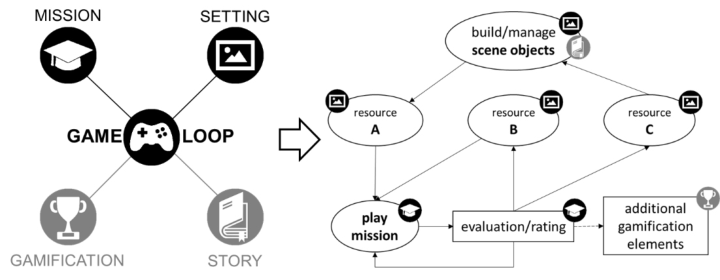
Figure 1: Left: concept modules; right: basic construction and management simulation game loop.
The Game Loop is defined as the central module, containing the general game-play rules, mechanics and is represented by a Construction and Management Simulation with Resource Conversion (Rollings & Adams, 2003). Progress within the game and development of the game world are made dependent on the acquisition of specific resources, which are provided after mission completion. Before a mission can be started the necessary resources must be converted, see Figure 1 right. These core mechanics are kept generic and consistent in every instance that targets a specific knowledge domain. All remaining modules are configured individually to meet specific requirements.
The Setting module is required and is used to specify the game world and the visual appearance of the instance. Templates and configuration files
are applied so that graphical assets, character names, object descriptions and other game elements can be defined by authors. This modular design permits rapid changes of settings (e.g. science fiction to a realistic environment).
The Story module is optional. When considered useful a coherent narrative across all missions inside the chosen setting can be written. Flavor texts, character dialogues and further textual elements are inserted to add context and motivation for the completion of mission tasks. The inclusion of storytelling within a serious game is believed to enable deeper immersion (Naul & Liu, 2019).
The Gamification module is optional, providing additional rewards and achievement goals that go beyond the basic Game Loop can be introduced to raise player motivation, see Gamification option in Figure 1 right.
The Mission module is regarded as highly significant because tasks from the knowledge domain that are essential for the learning objectives are contained within it. A modular and independent mission loop is implemented to ensure modularity and adaptability. It allows individual missions to be created or adapted without any change to the central Game Loop or to the other modules. Teachers are therefore able to concentrate solely on adding or adjusting missions without dealing with the overarching story, gamification elements, graphical assets or general game mechanics.
A concrete proof of concept was presented in (Kannegieser et al., 2022). It was demonstrated that domain specific content, exemplified by cybersecurity, can be seamlessly incorporated into a browser based serious game framework without any modification of the core mechanics.
IMPROVING ACCEPTANCE Focusgroup-centered design plays a crucial role in learning environments that effectively meet learners’ needs. By involving users directly via structured feedback sessions, authors can adapt content, mechanics, and difficulty levels precisely to the audience, resulting in increased engagement and motivation, higher knowledge acquisition and thus improved educational impact (Barab et al., 2005; Kato et al., 2008; Vasalou et al., 2017).
These benefits are also reflected in the principles of multimedia learning and instructional design. In (Mayer et al., 2014) it is highlighted that learners benefit most from content that is concise and directly relevant to their needs (Coherence Principle, Modality Principle). Studies cited by Mayer show that well-designed, personalized multimedia presentations significantly improve retention and understanding.
In his synthesis of over 800 meta-analyses (Hattie, 2012), also confirms that tailored, learner-adapted strategies have a strong positive impact on learning outcomes.
These examples and research findings underscore that focusgroup- centered approaches help create learning environments that improve key factors like motivation, engagement, and sustainable learning outcomes.
Taking Perspective: Broadening Acceptance of a Serious Game Framework 383
Integrating an alternative game loop based on role-play game (RPG) mechanics into the framework therefore only seemed logical, addressing a broader spectrum of cognitive, affective, and social learning processes, as the existing 4X game loop, while effective for teaching strategic planning, systems thinking, and resource management, may not cater equally to all learning styles or instructional goals.
Research in DGLB shows that variety in game-play mechanics increases motivation and engagement, as learners are able to select or switch between modes that best fit their preferences and learning objectives (Gee, 2003; Hamari et al., 2016). The RPG loop, with its emphasis on narrative immersion, real-world decision-making, and social interaction, appeals strongly to learners who are motivated by context, story, and role enactment. This complements the abstract, systems-oriented nature of 4X games, which some users may find too detached or impersonal. Allowing learners to experience both types of game-play within the same framework supports differentiated instruction and accommodates diverse learner profiles, a key principle in modern pedagogical theory (Tomlinson, 2014), further improving immersion and learning effectiveness by providing meaningful choices, authentic contexts and immediate feedback (Deterding et al., 2011; Cheng et al., 2015).
CONCEPT EXTENSION RPG naturally provide the aforementioned elements, especially while dealing with scenarios where players make high-stakes decisions and witness the consequences. By integrating such a game loop, the framework directly addresses previous concerns about usability and immersion, identified in evaluations of the 4X system. A fitting instance is the serious game HQ501 which is part of the HoWa-PRO2 training framework, researching next-generation flood-early-warning systems for local extreme-rain events and is deployed in workshops for civil-protection and water authorities. Commissioned by the Saxon State Office for Environment, Agriculture and Geology (LfULG) and implemented in TWINE3, an open source game engine for interactive, nonlinear stories, by a specialist game-design team, it trains disaster-management personnel to handle flood scenarios and the inherent uncertainties in rainfall and river-level forecasts utilizing gamification, experimental learning and didactic questioning. Running in a browser HQ50 allows this decision-making to be practiced virtually on any modern device. It has been successfully applied in training courses by the German Meteorological Service (DWD) and by other public institutions.
In the game, players are presented with an emerging flood threat, requiring municipalities and emergency services to take rapid, high-stakes decisions under difficult conditions. The player’s experience is defined by their adoption of a professional persona such as a municipal official, mayor, or fire-brigade commander, each mechanic modeled via role-specific decision
trees. The simulation compresses a two-day crisis into a short, focused session (10–15 minutes of real time), placing them in situations where they must make decisions under pressure and uncertainty. Throughout the game, a dynamic stream of information reflects the evolving flood threat, challenging the player to constantly assess the situation, interpret incomplete or ambiguous data, and prioritize actions. Communication and coordination with virtual stakeholders is a core element, mirroring the real-world complexity of disaster response. A personalized report at the end of the game highlights successful actions and suggests improvements.
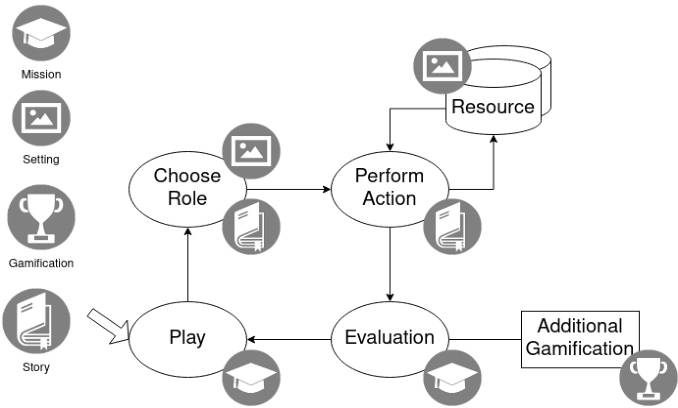
The integration of this RPG loop (see Figure 2) into the modular framework means that, alongside the existing construction and management simulation, instructors and learners can access an experience that emphasizes situational awareness, teamwork, and adaptive decision-making. The game’s branching structure ensures that each choice directly impacts the scenario’s progression, providing immediate feedback on the consequences of actions. At the conclusion of each session, the player receives a personalized report highlighting effective responses and areas for improvement, reinforcing reflective learning and skill development.
Figure 2: Extension of the framework by an RPG game loop based on HQ50.
Technically, the framework must be able to seamlessly switch between or offer both game loops. The underlying modules for setting, story, missions, and gamification need to accommodate the narrative-driven, role-based structure of HQ50. For example, the setting module would represent real- world environments affected by floods, while the story module would support the dynamic scenario narrative and stakeholder interactions. The mission module would be adapted to model discrete crisis-management tasks, such as issuing warnings, deploying resources, or communicating with the public.
Taking Perspective: Broadening Acceptance of a Serious Game Framework 385
From a pedagogical perspective, this extension allows the framework to train not only procedural or technical skills but also soft skills such as leadership, communication, and crisis management under uncertainty.
CONCLUSION & FUTURE WORK The presented work extends a domain agnostic serious game framework by adding a role-playing game loop alongside the established 4X construction management loop. The extension was implemented within the existing modular architecture that separates Game Loop, Setting, Story, Gamification, and Mission modules, thereby allowing educators to continue injecting domain specific content through the LTI interoperability standard while the core mechanics remain unchanged. The perspective shifting disaster response scenario of HQ50 was used to illustrate how narrative immersion and authentic decision making can be used to address previous concerns of effectively meeting learners’ needs by focusgroup-centered design.
Future work will consist of systematic assessment of the newly integrated role-playing game loop, such as quantifying its usability with the System Usability Scale (SUS). In parallel, qualitative data are expected to be gathered through semi structured interviews (e.g. NASA Task Load Index (NASA- TLX)) and think aloud protocols so that latent design flaws can be brought to light with quantitative scores. To explore whether the role-playing paradigm offers pedagogical advantages beyond the established 4X mechanic, a controlled AB experiment is envisioned. Learning gains, engagement metrics, time on task, and perceived workload could then be compared through mixed effects modeling, while xAPI statements might provide fine grained behavioral traces for secondary analysis. Moving forward, future research activities will seek out additional promising game mechanics for potential integration, aiming to further expand the framework’s pedagogical reach.
REFERENCES
Atorf, D. et al. (2019a). Balancing realism and engagement for a serious game in the domain of remote sensing. In: Games and Learning Alliance: Proceedings of the 7th International Conference 2018, pp. 146–156. Springer Nature CH. Atorf, D. et al. (2019b). Study on enhancing learnability of a serious game by
implementing a pedagogical agent. In: Games and Learning Alliance: Proceedings of the 8th International Conference 2019, pp. 158–168. Springer Nature CH. Atorf, D. et al. (2020). Towards A concept for streamlining game design of an existing serious game and preliminary evaluation. In Proceedings of the IADIS International Conference WWW/Internet, pp. 155 – 160. Atorf, D. et al. (2021). Integrating System-independent Learning Content with the
Benefits of Digital Game Based Learning. AHFE International Conference. AHFE Open Access. Vol. 21. 2021. Atorf, D. et al. (2023). Early concept for a generic and domain-agnostic serious game framework. In: Proceedings of Cognition and Exploratory Learning in the Digital Age (CELDA 2023). pp. 439. Barab, S. et al. (2005). Transformational play: Using games to position person,
content, and context. Educational Researcher, 39(7), 525–536.
Bopp, M. (2006). Immersive Didaktik und Framingprozesse in Computerspielen. Ein handlungstheoretischer Ansatz. Cheng, M.-T.; et al. (2015). Game immersion experience: Its hierarchical structure
and impact on game-based science learning. Journal of Computer Assisted Learning, 31 (3), 232–253. Csikszentmihalyi, M. (1991). Flow: The Psychology of Optimal Experience. Harper & Row. Deci, E. L.; Ryan, R. M. (1985). Intrinsic Motivation and Self-Determination in
Human Behavior. Plenum. Deterding, S. et al. (2011). From game design elements to gamefulness: Defining gamification. Proceedings of the 15th international academic MindTrek conference: Envisioning future media environments. 2011. Garris, R. et al. (2002). Games, Motivation, and Learning: A Research and Practice Model. Simulation & Gaming, 33 (4), 441–467. Gee, J. (2003). What Video Games Have to Teach Us About Learning and Literacy.
Computers in Entertainment. 1. 20. 10.1145/950566.950595. Girard, C. et al. (2013). Serious games as new educational tools: How effective are they? A meta-analysis of recent studies. Journal of Computer Assisted Learning, 29(3), 207–219. Hamari, Juho et al. (2016). Challenging games help students learn: An empirical
study on engagement, flow and immersion in game-based learning. Computers in human behavior 54: 170–179. Hattie, J. (2012). Visible learning for teachers: Maximizing impact on learning.
Routledge. Kannegieser, E. et al. (2022). A proof of concept: Cybersecurity Learning Content in LTI based, educational Systems. Proceedings of the International Conference on Applied Computing and WWW/Internet. Kato, P. M. et al. (2008). A video game improves behavioral outcomes in adolescents
and young adults with cancer: A randomized trial. Pediatrics, 122(2), e305–e317. Krapp, A. et al. (1993). Metaanalyse des Zusammenhangs von Interesse und schulischer Leistung. Zeitschrift für Entwicklungspsychologie und pädagogische Psychologie, 10(2), 120–148. Mayer, R. E. (Ed.). (2014). The Cambridge handbook of multimedia learning (2nd
ed.). Cambridge University Press. Naul, E. and Liu, M. (2019). Why Story Matters: A Review of Narrative in Serious Games. In Journal of Educational Computing Research. Vol. 58, No. 3, pp. 687–707. Prensky, M. (2007). Digital game-based learning: Practical ideas for the applications
of digital game-based learning. St-Paul: Paragon House. Roller, W. (2013). Simulation-based image analysis with serious games, in: Military Scientific Research Annual Report 2013, pp. 20–21. Rollings, A. and Adams, E. (2003). Andrew Rollings and Ernest Adams on Game
Design. New Riders Publishing. Indianapolis, USA, pp. 417–441. Sonawane, K. (2017). Serious Games Market by User Type (Enterprises and Consumers), Allied Market Research. Sweetser, P. et al. (2005). GameFlow: A model for evaluating player enjoyment in
games. Computers in Entertainment, 3(3), 3–3. Tomlinson, C. A. (2014), The differentiated classroom: Responding to the needs of all learners. Ascd. Vasalou, A. et al. (2017). Avatars in social media: Balancing accuracy, playfulness and
embodied messages. International Journal of Human-Computer Studies, 71(7–8), 704–718.
LISTED IN THE AHFE DIGITAL BOOKSTORE CATALOGUE
Explore the complete digital volume
Human Systems Engineering and Design (IHSED2025): Future Trends and Applications
Read this individual research paper free through the original publisher, or explore the full digital proceedings book.
ISBN 978-1-964867-74-8
Explore this ISBN in the AHFE Bookstore ↗Listed in the July 2026 bookstore catalogue; search by ISBN to confirm current availability · Digital book purchase optional