Manasi Deshpande, Chen Ling, Elena Cheng (2025). Influence of Controlled Breaks on Mental Fatigue: Physical Activity Break vs. Social Networking Break. In: Social and Occupational Ergonomics. AHFE Open Access, vol. 190, pp. 28–35. https://doi.org/10.54941/ahfe1006593
Influence of Controlled Breaks on Mental Fatigue 29
expeditious and orderly flow of air traffic, requiring high cognitive demands of sustained vigilance and concentration. Mental fatigue can be defined as a cognitive and biological state of mind caused by a demanding continuous activity over a period requiring mental resources (Boksem & Tops, 2009). It is also closely associated with tiredness or lassitude. Mental fatigue induced by the cognitive tasks could adversely impact the controller’s cognitive functioning and performance and may threaten aviation safety. Therefore, it is important to understand how mental fatigue develops with air traffic control tasks and how to best manage and mitigate mental fatigue.
CTEAM Air Traffic Control Simulation Software The CTEAM software is an air traffic control simulation software developed by the Federal Aviation Administration (FAA; Baliey et al., 1999). The software shows the airports, the aircraft represented by the data block, and the restricted airspace. The aircraft turns yellow once the participant activates it by clicking. After the participant assigns the required heading, altitude, or speed to the aircraft, it turns green and moves accordingly. The participant could select from eight heading directions, three-speed levels, and four altitude options. The simulation acknowledged the control commands audibly and visually (e.g., “Roger, speed fast”). The participants were instructed to direct aircraft to their specified destinations (airports and exits) as safely and efficiently as possible. The goal for the participant was to minimize the activation time, en-route time, number of crashes, and proximity errors while navigating the aircraft to their respective destinations. The activation time is the time that elapsed between the aircraft’s appearance on the screen and when the participant activated it; the proximity error happens when two aircraft come in proximity such that there can be an increased likelihood of the two aircraft colliding with each other, or an aircraft comes in proximity to a boundary, an airport, or a restricted airspace.
Self-Rated Mental Fatigue Questionnaire Chalder (1993) designed a fatigue questionnaire for clinical assessment, and Chua et al. (2005) developed a survey to measure fatigue in military settings. Relevant constructs like compensatory behavior, self-confidence, irritability, sleepiness, and pressure from these questionnaires are combined in our study so that participants could self-rate their subjective feelings of mental fatigue. The mental fatigue questionnaire included questions on positive constructs, including calm, confidence, excitement, energy, fitness and motivation, and alertness; and negative constructs, including need for coffee, concentration difficulty, irritability, stress, need for sleep, need for a short stroll, anxiety, and lack of confidence.
Controlled Breaks In a study by Neri et al. (2002), the researchers investigated whether controlled breaks help pilots recover from fatigue. They examined the
influence of scheduled controlled breaks on the performance of pilots on long-haul flights to maintain their alertness. The results revealed that the brief hourly breaks helped the pilots to recuperate from fatigue and sleepiness and maintain vigilance. They also found that postural change, social interaction, or an opportunity to eat positively affected performance concerning alertness and reduced sleepiness. Another study by Henning et al. (1997) reported that breaks involving physical exercise for 3 minutes at frequent intervals enhanced workers’ productivity in continuous computer- mediated work. Thus, controlled breaks can help alleviate some mental fatigue the task induces. Based on these findings, two types of controlled breaks were designed in our study. We used social networking as a means of social interaction for one of the break activities, and brisk walking on a treadmill while listening to music as another break activity. The objective of this study was to explore whether the presence of a break helps improve the simulated air traffic control task performance and the subjective feelings of mental fatigue. We were also interested in studying the difference in the effects of the physically active break and the social networking break.
METHODOLOGY
Participants Fifteen participants took part in this study. They were 18–30 (M = 23.93, S.D. = 2.17) years old, college students from a Midwest university campus. The participants were compensated for their time.
CTEAM Air Traffic Control Simulation Design The CTEAM scenarios were designed with the same level of complexity and the same number of aircraft generated for both sessions. All the scenario sessions were 75 minutes (4500 seconds). The scenarios had two airports as destinations. In each scenario, two aircraft were generated precisely every 60 seconds at the same coordinates in the airspace. The two aircraft and the two airports were placed in the airspace so that the participant would need to resolve conflicts between the two aircraft. The participants were asked to direct these aircraft to their respective destinations as fast as possible with the help of a strategy.
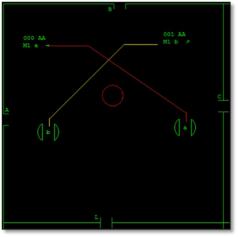
The strategy is a sequence of control actions that help the participants avoid possible conflicts between the two aircraft. The strategy was designed so that aircraft landing on the runway followed a pre-determined path. As illustrated in Figure 1, the red and yellow lines depict the strategy for directing aircraft to avoid a collision. In each task session, the participants were instructed to learn and practice the task strategy at the beginning for around 30 minutes. They used the given strategy to direct the stream of air traffic to follow a prescribed path.
Influence of Controlled Breaks on Mental Fatigue 31
Figure 1: One of the strategies for the CTEAM air traffic control simulation task.
Procedure A quasi-experimental design is used for this study because no control group is implemented. Participants were given the training to perform the CTEAM Air Traffic Control Simulation scenarios for 30 minutes one day before the experiment session, which took place on two separate days. On both days of the experiments, the participants performed two 75-minute CTEAM sessions separated by a 20-minute break activity in between. A 30-minute strategy training session was conducted before every session so the participants could learn the strategy used for each session. Different strategies were used for each session to minimize the learning effect. Between sessions 1 and 2, each participant took a social networking or physical activity break for 20 minutes. The participants were subjected to one type of break on one day and the other on another day. The order of the break was counterbalanced. Participants performed social networking activities using Facebook or Twitter during the social network break. For the physical activity break, participants took a brisk walk on the treadmill at a controlled speed of 3.5 mph while listening to music.
At the beginning and end of both sessions, the participants completed a Fatigue questionnaire to self-rate feelings of mental fatigue. At the end of both sessions, participants completed the NASA-TLX survey for mental workload, which measures six sub-dimensions: mental demand, temporal demand, physical demand, effort, frustration, and own performance. The total experiment duration was around 4.5 hours on each day.
Statistical Analysis A repeated-measure ANOVA was run on the mental fatigue ratings, with the time of the survey’s administration and the type of break activity as within- subject factors. The SAS software and the open-source statistical analysis software JASP were used for the statistical analysis.
RESULTS
CTEAM Air Traffic Control Simulation Task performance The performance parameters of the air traffic simulation were compared before and after the break to understand the influence of a break on
performance. Based on the statistical analysis, there was no significant difference in the performance parameters of the CTEAM simulation before and after the break. The number of crashes was 5.06 (std: 4.05) before the break and 4.36 (std: 3.94) after. The number of proximity errors was 6.06 (std: 10.61) before the break and 2.23 (std: 10.05) after, and the activation time was 7.48 seconds (std: 3.88) before and 7.96 seconds (std: 9.02) after the break.
The CTEAM performance data was further divided into 10-minute chunks for the number of crashes and proximity errors to observe the trend of change in performance over time and to gauge the possible effect of mental fatigue and any mitigating effect of break activity more closely. From the trend analysis of the CTEAM performance parameters, we observed increased crashes and proximity errors toward the end of session one for some participants. This may be due to some mental fatigue being induced over time toward the end of the scenario. Next, ANOVA analysis was done for the CTEAM performance data for the last 10 minutes of session one and the first 10 minutes of session two, i.e., the last 10 minutes before the break and the first 10 minutes after the break. It was observed that there was no significant difference between the performances in these two time periods.
Mental Workload NASA-TLX’s mental workload was measured at the end of both task sessions one and two. The mental workload for task session one was 51.1 (std: 15.51), and for task session two, it was 53.8 (std: 21.64). No significant difference was found between the mental workload ratings.
Mental Fatigue Questionnaire Ratings The fatigue questionnaire used a Likert scale ranging from 1 to 7 (Strongly Disagree to Strongly Agree). For the positive constructs, a higher average rating indicated lower subjective fatigue; hence, an increase in this average at the beginning of session two indicates reduced fatigue. For the negative constructs, a higher rating means higher subjective fatigue, and a marked decrease at the beginning of session two indicates reduced subjective fatigue.
A typical pattern of decreasing-increasing-decreasing trend by most sub- measurements for positive constructs of subjective mental fatigue is exhibited. Mental fatigue gradually built up during task session one but was alleviated by the break. It starts to build up again during task session two. For example, the average rating for alertness was 5.93 at the beginning of session one. This rating was reduced to 5 at the end of session one and increased again to 5.47 at the end of the break, which is also the beginning of session two. This may be a cue for reduced fatigue brought about by the break. Then, at the end of session two, the alertness rating decreased again to 4.63.
The typical negative construct’s pattern is the opposite, showing an increasing-decreasing-increasing trend. For example, the average rating for the need for a cup of coffee was 3.43 at the beginning of session one. This average increases to 4.6 at the end of session one and reduces to 4.07 at the end of the break. Thus, this compensatory behavior of needing coffee is
Influence of Controlled Breaks on Mental Fatigue 33
reduced after the break, which is a cue for reduced fatigue. The average rating increased further to 4.63 at the end of session two, which showed that the mental fatigue level rose again towards the end of the experiment.
The “Ryan-Einot-Gabriel-Welch based on Range” (REGWQ) multiple comparison tests were used to determine if there was a significant difference between the mean ratings at four times of fatigue questionnaire administration. There was a considerable difference between the mean fatigue ratings at the beginning of session one and the end of session two for all sub-measurements of mental fatigue except for anxiety.
The next analysis compared the mental fatigue ratings before and after the breaks. A repeated measure ANOVA analysis showed that the type of break does not significantly affect the mental fatigue ratings. Therefore, the data for both types of breaks were pooled to compare the mental fatigue ratings before and after the break activity. Paired t-test results showed that mental fatigue ratings significantly differed for sub-dimensions of positive constructs of calmness, confidence, excitement, energy, and physical fitness, as well as negative constructs of concentration difficulty and stress. The data shows that many sub-dimensions of subjective mental fatigue were lower after the break than before. The alleviating effect of the break on mental fatigue was evident immediately after the break.
The analysis of mental fatigue ratings from the questionnaire shows that the presence of a break significantly influenced the subjective feeling of fatigue. However, the types of breaks are not significantly different in their influence on the subjective ratings of mental fatigue.
DISCUSSION
Effect of Break The results showed that a 20-minute break activity, no matter the type, was helpful. Although no change in task performance was observed before and after the break in this experiment, both types of breaks improved many dimensions of subjective mental fatigue. The presence of a break, which involves either physical exercise while listening to music or an opportunity for social interaction, had a significant influence on relieving subjective fatigue. This effect started immediately after the 20-minute break at the beginning of session two. This result agrees with Neri et al. (2002) that controlled breaks may improve vigilance.
Thus, the study shows that physical exercise and social breaks may help mitigate sub-dimensions of mental fatigue. Although the type of break does not significantly impact performance, the presence of a break is essential in mitigating subjective mental fatigue. The participants’ comments after the tasks indicated that a social networking break could tap into the participant’s emotions, as it was regarded as enjoyable by 80% of the participants. The physically active break involved exercising on a treadmill while listening to music. Since this activity was performed alone, it did not involve any social interaction. Based on their narratives, the participants preferred the social networking break since they felt disconnected from the rest of the world while performing the tasks, as they were not allowed to engage in
any social communication. This led to an increased urgency to interact with friends on social media or for some change in the environment, as reported by the participants. The participants preferred the social networking break to the physically active break as it offered more options for entertainment, like chatting with friends and family, reading updates from friends, viewing photographs and videos posted by friends, or even playing some of their favorite games.
Development of Mental Fatigue The results show that the subjective ratings of mental fatigue differed significantly at the beginning of task session one and the end of task session two.
Mental fatigue does not always manifest itself in performance. Still, the changes in subjective ratings on mental fatigue collected four times provided evidence about how mental fatigue developed as a result of a tedious task and how a short break helped to relieve the feeling of mental fatigue to some degree. Although we did not observe significant differences in task performance for our simulation tasks, the subjective ratings suggested that participants were working harder toward the end of the sessions to maintain the same level of performance.
The air traffic control simulation task was designed so that participants were required to repeatedly perform the same sequence of control actions. Task monotony may also cause mental fatigue. It needs to be noted that the simulated air traffic control task is different from the actual controller’s task in that the difficulty level set in this study is low, while the actual air traffic control task is much more demanding.
The process of mental fatigue development in this study could also serve as a reference for office workers’ desk jobs. The long hours spent sitting in front of a computer handling computer-based tasks can lead to mental fatigue. The alleviation effect of mental fatigue by a break found in our study can apply to office work. Office workers may benefit from break activities after every 105 minutes of consecutive work in front of the computer. Our finding agrees with Henning et al. (1997), who found that 3-minute physical breaks every hour benefit computer-based workers’ productivity and well-being. Our study also found that the mental fatigue rating at the beginning and end of the 4.5-hour work was significantly different, which suggests that the long work hours have induced mental fatigue despite the break in between. A recent study conducted by Brazaitis and Satas (2023) also found that taking 10-minute physical breaks every 50 minutes for 7 hours after standard office- type sedentary work did not prevent mental fatigue in their participants based on EEG data analysis. Brazaitis et al. (2023) used strictly physical exercise as a form of break, while ours applied both exercise and social network interaction as break activities. All these past studies should be taken into account when finding potential ways of implementing breaks into the work design. Further research should be conducted to find a better method of alleviating office fatigue that proves effective in the subject’s feelings and workspace productivity.
Influence of Controlled Breaks on Mental Fatigue 35
CONCLUSION
In conclusion, our study found that taking a 20-minute break, whether physical exercise or social networking, effectively mitigated some sub- dimensions of mental fatigue induced by cognitive tasks of simulated air traffic control. The participants maintained a similar level of task performance even when they were fatigued toward the end of the second task session. Further studies should be conducted to understand practical mitigation methods for mental fatigue.
ACKNOWLEDGMENT
The authors would like to thank Dr. Larry Bailey from the FAA Civil Aerospace Medical Institute (CAMI) for providing the CTEAM air traffic control simulation software for this study.
REFERENCES
Bailey, L., Broach, D., Thompson, R., & Enos, R. (1999). Controller teamwork evaluation and assessment methodology (CTEAM): A scenario calibration study. (DOT/FAA/AM-99/24). Washington, DC: Department of Transportation/Federal Aviation Administration. Boksem MA, Tops M. (2008). Mental fatigue: Costs and benefits. Brain Research
Reviews, 59, 125–139, 2008. Brazaitis, M., Satas, A., (2023). Regular short-duration breaks do not prevent mental fatigue and decline in cognitive efficiency in healthy young men during an office-like simulated mental working day: An EEG study. International Journal of Psychophysiology. 188, 33–46. https://doi.org/10.1016/j.ijpsycho.2023.03.007 Chalder T., Berelowitz G., Pawlikowska T., Watts L., Wessely S., Wright D.,
Wallace E. P. (1992). Development of a fatigue scale, Journal of Psychosomatic Research, 37, No.2, 147–153. Chua D., Cheng C. Y., Ser D., Lim H. B., (2005) “Development of a subjective fatigue measurement questionnaire for RSAF aircrew,” 47th International Military Testing Association Conference, November 8–10, Singapore. Henning, R. A., Jacques, P., Kissel, G. V., Sullivan, A. B., Alteras-Webb, S. M.,
(1997). Frequent short rest breaks from computer work: Effects on productivity and well-being at two field sites. Ergonomics 40, 78–91. https://doi.org/10.1080/ 001401397188396 Neri D. F., Oyung R. L., Colleti L. M., Mallis M. M., Tam P. Y., Dinges D. F., (2002).
Controlled breaks as a fatigue countermeasure on the flight deck. Aviation, Space and Environmental Medicine, 73, 7, 654–664.
LISTED IN THE AHFE DIGITAL BOOKSTORE CATALOGUE
Explore the complete digital volume
Social and Occupational Ergonomics
Read this individual research paper free through the original publisher, or explore the full digital proceedings book.
ISBN 978-1-964867-66-3
Explore this ISBN in the AHFE Bookstore ↗Listed in the July 2026 bookstore catalogue; search by ISBN to confirm current availability · Digital book purchase optional