Kevin Kapadia, Alyssa Franczak, Nutchanon Yongsatianchot, Stacy Marsella, Richard John (2025). Run, Hide, or Freeze: Social and Emotional Influence on Behavior in an Immersive School Shooting Simulation. In: Safety Management and Human Factors. AHFE Open Access, vol. 189, pp. 54–64. https://doi.org/10.54941/ahfe1006570
As school shootings rise in frequency across the United States, understanding how individuals respond during such crises is critical for developing effective safety protocols. This study used an immersive, computer-based simulation to investigate how social influence and emotion level from non-player characters (NPCs) affect behavior during an active shooter event. A total of 285 participants were randomly assigned to one of six experimental conditions varying NPC behavior (run, hide, or mixed) and emotional intensity (high vs. low). Participants were more likely to run when surrounded by NPCs who ran and more likely to hide when NPCs hid, showing that social influence significantly shaped behavior. Emotional evocative imagery and sounds, however, did not significantly affect decision-making. Increases in negative affect after the simulation and male gender were also associated with a greater likelihood of running. These findings suggest that visible social behavior, rather than emotion, drives emergency responses and highlights the value of social modeling in safety training.
School shootings in the United States have increased dramatically in recent years. The K–12 School Shooting Database (2024) recorded 348 incidents in 2023, the highest number since records began in 1966. Before 2020, no year exceeded 125 incidents, but from 2021 to 2023, the annual average rose to 257. In that same span, an average of 237 people were killed or injured on K–12 campuses each year. These trends highlight the urgency of developing effective strategies to reduce harm during such events. In light of this growing threat, the Federal Bureau of Investigation (FBI) recommends the “Run, Hide, Fight” protocol as a general guideline for individuals confronted with an active shooter (FBI, 2022). This strategy encourages fleeing the scene if possible, seeking concealment if escape is not viable, and resorting to physical defense only as a last option. However, research has shown that human behavior under acute stress often deviates from trained responses. Factors
Run, Hide, or Freeze: Social and Emotional Influence on Behavior 55
such as panic, social cues, and the surrounding environment can strongly influence decision-making, often overriding conscious adherence to protocols (Worthington et al., 2021; Drury et al., 2009; Zhu et al., 2020). These findings suggest that successful emergency response training must account for the psychological and social dynamics that emerge during high-stress situations.
Researchers have increasingly turned to simulation studies to better understand behavioral responses in such contexts. These methods offer safe and controlled environments where participants can respond to realistic threat scenarios (Kapadia et al., 2024). For instance, Bott (2021) used reinforcement learning models to assess mitigation strategies during active shooter events. Awada et al. (2021) incorporated physiological and emotional indicators into VR-based shooter simulations, demonstrating the influence of stress on decision-making. Additional studies have examined virtual environments (Zhu et al., 2019), security countermeasures (Zhu et al., 2022), and student evacuation behavior (Bahmani et al., 2023), all contributing to a growing literature on behavior during emergencies. Work by Zhu et al. (2023) further advanced this field by employing machine learning to simulate crowd behavior, while Arteaga et al. (2023) showed the critical role of leadership in improving safety outcomes during evacuations. The current study builds on this body of research by using an immersive, computer-based simulation to explore how social influence and others’ emotionally evocative imagery and sounds affect individuals’ decision-making during an active school shooting scenario. Prior work has shown that general populations can reasonably approximate behavior during crises for specific demographic groups, such as office workers (Zhu et al., 2019). In this study, we aim to answer the following research questions. 1) How do proximal social influence, NPC emotion level, and the interaction between the two impact whether participants run away or hide? 2) How do participants’ positive and negative affect change in response to the simulation? 3) Which demographic factors are associated with participants’ likelihood of choosing to run or hide during the simulation?
METHODS
Participant Information We recruited 285 participants through Prolific.com, a validated platform for sourcing high-quality online samples in behavioral research (Douglas et al., 2023). We randomly assigned participants to one of six conditions representing all combinations of the behavior of 37 NPCs (all running from shooter, all hiding, or 19 running and 18 hiding [mixed]) and emotion level of the NPCs (high or low). The high emotion condition included blood splatter, NPCs screamed/groaned after being shot, and panicked crowd noises after the shooting began, all of which were absent in the low emotion condition. Social influence and emotion level conditions are named based on the behavior/emotion displayed by the NPCs in each scenario. The sample
size for the Hide-High (NPCs hide and express high emotions) was 45, Hide- Low was 47, Mixed-High was 51, Mixed-Low was 46, Run-High was 52, and Run-Low was 44.
The mean (SD) age of participants was 35.15 (10.89) years. The self- identified gender of the sample was 55.79% male, 40.70% female, and 3.51% other. The self-identified race/ethnicity of the sample was 58.25% White (Non-Hispanic), 14.39% Asian or Pacific Islander, 12.98% Black or African American, 8.42% Hispanic or Latino/a, 3.86% mixed, 1.05% Native American or Alaskan Native, and 1.05% other. Nearly one-third (31.23%) of participants indicated they had received active shooter training. Just under five percent (4.21%) reported having experienced an active shooter scenario in real life. Of those who reported receiving active shooter training, 40.45% indicated they used the training during the simulation, while 30.34% said they did not remember it, and 29.21% said they did not follow it. Around one-third (34.74%) of our sample also reported receiving firearm training, and nearly half (47.02%) reported shooting a firearm in the past. Less than two percent (1.75%) of participants had a military or law enforcement background. Finally, 55.79% of participants currently or previously regularly played first-person shooter video games.
Study Procedure The current simulation draws directly from a previous study by the authors (Kapadia et al., 2025), incorporating new experimental conditions. Participants first provided informed consent and then completed the Positive and Negative Affect Schedule (PANAS), a widely used instrument for assessing emotional states (Watson et al., 1988). The PANAS consists of ten positive (ex. alert) and ten negative (ex. scared or distressed) affect terms, each rated on a scale from 1 (very slightly or not at all) to 5 (extremely). Prior to the simulation, we instructed participants to report how they had felt over the past week; following the simulation, they rated their affective state in the immediate moment. Subsequently, participants completed two brief training modules to familiarize themselves with the simulation environment. They then proceeded through the simulation (described below), after which they completed the same PANAS items and responded to questions regarding their experience with the simulation, activities related to active shooter scenarios, and demographic information.
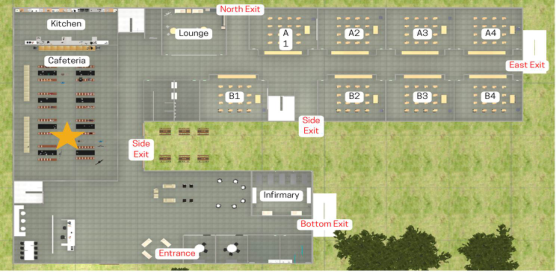
Simulation Procedure Data for this study were collected using a 3D simulation developed in the Unity game engine (Version 2023.2.20), designed to replicate a realistic school environment and foster an immersive experience. Figure 1 displays a map of the school used in the simulation. All participants completed two mandatory training modules before the active shooter simulation. The first module focused on familiarizing participants with basic navigation using keyboard and mouse controls. Upon successful completion, participants proceeded to the second module, which required them to traverse seven designated locations within the virtual school to gain spatial familiarity.
Run, Hide, or Freeze: Social and Emotional Influence on Behavior 57
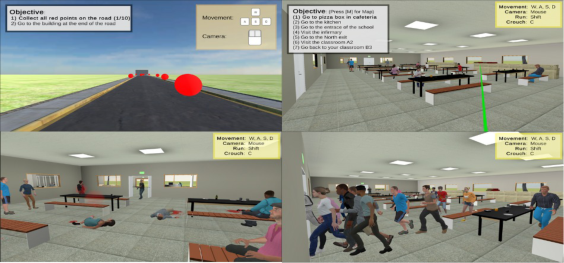
Only participants who completed both training sessions within 15 minutes were permitted to proceed to the active shooter simulation. The school shooting simulation began with participants in the cafeteria (indicated by the star in Figure 1). Three seconds into the simulation, gunshots were audibly triggered, prompting the NPCs to respond by running or hiding, depending on the assigned condition. The simulation lasted up to 70 seconds, allowing sufficient time for participants who chose to evacuate to do so. Participants were free to navigate the environment, but physical constraints, such as boundaries and the presence of other NPCs, restricted movement. Notably, the shooter did not target participants, preventing premature simulation termination and preserving data completeness. Figure 2 presents a selection of screenshots from the simulation. The top-left photo shows the movement training phase. The top-right depicts the cafeteria during the tutorial to help participants become familiar with the school. The bottom-left displays the shooter entering the cafeteria at the start of a high emotion simulation. The bottom-right shows students running away from the shooter.
Figure 1: Map of school used in simulation. Rooms are labeled in black and exits in red. Students begin the simulation in the cafeteria indicated by the star.Figure 2: Selected screenshots from unity simulation. The top-left image shows the movement training phase, while the top-right depicts the cafeteria during the tutorial. The bottom-left captures the shooter entering during a high-emotion simulation, and the bottom-right shows students running away.
RESULTS
Summary of Questions Regarding Simulation Experience The answers to the additional questions regarding simulation experience are summarized in Table 1. Most participants (64.21%) reported they ran towards an exit after hearing gunshots. A majority of participants (64.91%) also reported that they would behave similarly during an actual active shooter event. Approximately half (49.82%) of students claimed the action they chose was not influenced by the other students (NPCs) in the scenario. Of those who said the other students influenced their actions, the most common action was to run because other students were running (78.78% of participants influenced). A total of 11 participants (8.33% of participants influenced) chose the opposite action of what students around them were doing. Finally, most participants (69.12%) found the simulation at least moderately realistic.
Table 1: Summary of questions regarding simulation experience.
Table available in the original PDF paper.
Question Answer Choices Count % Which of the following best Ran towards an exit 183 64.21 Ran to somewhere else in the
42 14.74
school in order to hide
describes what you did when you first heard the gunshots?
Initially hid in my starting location
41 14.39
and then ran towards an exit Hid where I started the entire time 12 4.21 Stood in the same location but did
7 2.46
not try to hide If this scenario occurred in My actions would be mostly similar 185 64.91 My actions would be exactly the
50 17.54
same
real life do you think your actions would be similar?
My actions would be mostly
35 12.28
different My actions would be completely
15 5.26
If this scenario occurred in different real life do you think your actions would be similar?
Was the action you chose
It was not influenced at all by other
142 49.82
students in the scenario
influenced by the other students in the scenario?
It was slightly influenced by other
80 28.07
students in the scenario It was heavily influenced by other
45 15.79
students in the scenario I am unsure if my actions were
18 6.32
influenced by other students in the scenario
Which of the following best
I was not influenced by the actions
153 53.68
of others I ran because other students were
104 36.49
describes how the other students influenced your actions?
running
Continued
Run, Hide, or Freeze: Social and Emotional Influence on Behavior 59
Table 1: Continued Question Answer Choices Count %
Table available in the original PDF paper.
I hid because other students were
17 5.96
hiding I hid because other students were
8 2.81
running I ran because other students were
3 1.05
hiding How realistic did you find
the simulation?
Extremely realistic 26 9.12 Very realistic 69 24.21 Moderately realistic 102 35.79 Slightly realistic 81 28.42 Not at all realistic 7 2.46
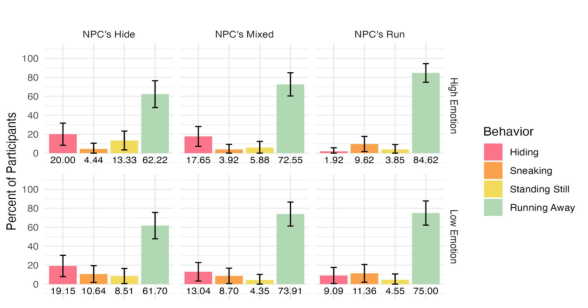
Observed Participant Behavior During Simulation Using participant coordinate data, we categorized behaviors in the simulation as follows: (1) hiding was identified when participants crouched without moving, (2) sneaking was defined as crouching while moving, (3) standing still occurred when participants neither crouched nor moved, and (4) running away was characterized by moving without crouching. Figure 3 presents participants’ most common behaviors based on social influence and NPCs’ emotion level. In all combinations of social influence and emotion level, the most common behavior was to run away.
Figure 3: Percent of participants’ most common behavior by social influence condition and emotion level.
We used binary logistic regression (BLR) to predict the likelihood that participants spent most of their time running away (vs. hiding, sneaking, or standing still). Predictors included the manipulated levels of social influence and emotion level, participants’ perceived realism of the simulation, changes in positive and negative PANAS scores before and after the simulation, whether participants had received active shooter training, and participants’ gender and age. Social influence was contrast coded using two orthogonal
contrasts. The first contrast compared the mixed NPC behavior condition to the average of the run and hide conditions. The second contrast compared the run condition to the hide condition. BLR results are presented in Table 2, showing that participants were 1.96 times more likely to run away when others were running than when others were hiding. Additionally, participants were 1.64 (OR = 0.61) times more likely to run away for each one-point increase in the change in negative PANAS score (Post-Pre). Finally, males were 3.16 times more likely to run away than females. No interactions between social influence condition and emotion level were significant. A likelihood ratio test comparing the full model to a null model including only the intercept revealed that the inclusion of social influence, emotion level, their interaction, and covariates significantly improved model fit, χ2(11) = 42.48, p <.001.
Table 2: Summary of a BLR predicting if participants spent majority of simulation running away.
Table available in the original PDF paper.
Predictor Odds Ratio 95% CI p-Value Intercept 4.28 0.97 – 19.20 0.056 NPCs Mixed (vs Hide and Run) 1.16 0.65 – 2.05 0.603 NPCs Run (vs Hide) 1.96 1.17 – 3.40 0.012 High Emotion Level (vs Low) 1.45 0.82 – 2.63 0.207 Perceived Realism 0.85 0.62 – 1.16 0.296 Difference in Positive PANAS (post-pre) 1.20 0.85 – 1.69 0.302 Difference in Negative PANAS (post-pre) 0.61 0.43 – 0.85 0.004 Received Active Shooter Training 0.71 0.37 – 1.37 0.308 Male 3.16 1.78 – 5.74 <0.001 Age 1.00 0.98 – 1.03 0.873 NPC’s Hid x Low Emotion Level 0.79 0.35 – 1.77 0.571 NPC Behavior Mixed x Low Emotion
0.77 0.38 – 1.57 0.476
Level
Observations 282 R2 Tjur 14.8%
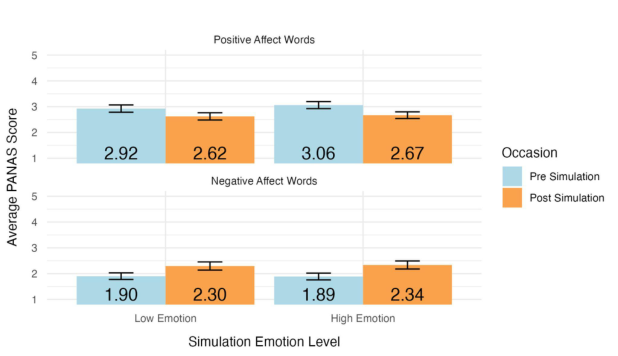
Affective Responses to the Simulation The average positive and negative affect score of participants before and after the simulation by whether participants were in the high or low emotion condition is presented in Figure 4. For the positive items, a 2 (Occasion) by 2 (Emotion Level) way ANOVA found a significant main effect for occasion F(1,560) = 24.84, p <.001, η2 = 0.04, no significant main effect for emotion level F(1,560) = 1.69, p =.194, η2 = 0.00, and no significant interaction between occasion and emotion level F(1,560) = 0.40, p =.525, η2 = 0.00. For the negative items, a 2 (Occasion) by 2 (Emotion Level) way ANOVA found a significant main effect for occasion F(1,560) = 32.95, p <.001, η2 = 0.01, no significant main effect for emotion level F(1,560) = 0.03, p =.855, η2 = 0.00, and no significant interaction between occasion and emotion level F(1,560) = 0.13, p =.717, η2 = 0.00.
Run, Hide, or Freeze: Social and Emotional Influence on Behavior 61
Figure 4: Average positive and negative affect score before and after simulation by emotion level. error bars represent 95% confidence intervals.
DISCUSSION
Social Influence The present study examined how social influence and emotion level from non-player characters (NPCs) in a school shooting simulation influenced participants’ behavioral responses. The primary finding was that participants’ behavior was influenced to some extent by that of the NPCs. When NPCs ran away, participants were significantly more likely to run; conversely, when NPCs hid, participants were more likely to hide. This aligns with prior research highlighting the role of social modeling and crowd dynamics in emergency responses (Drury et al., 2009). Interestingly, while participants believed others did not influence them, the behavioral data suggests otherwise, highlighting a disconnect between perceived and actual social influence.
Emotional Intensity and Affective Responses Contrary to expectations, the emotional intensity of NPCs (high vs. low) had no significant effect on participant behavior. This result suggests that participants may prioritize visible action cues (e.g., running or hiding) over affective expressions when stressed. This insight contributes to growing evidence that concrete behavioral signals are more influential than emotional tone during crisis decision-making (Awada et al., 2021). Affective data from PANAS scores further support the emotional salience of the task. Across all conditions, negative affect increased after the simulation, confirming the emotionally evocative nature of the scenario. Notably, those who experienced greater increases in negative affect were also more likely to run, suggesting that elevated arousal may facilitate escape-oriented behavior.
Gender Differences Gender emerged as a significant predictor of response behavior. Male participants were more likely to run than female participants. This result is consistent with previous research suggesting men and women may differ in their perceived threat sensitivity or action tendencies during emergencies (Kinateder et al., 2014). Further research is needed to investigate whether these differences are driven by socialization, risk perception, or physiological arousal.
Implications for Policy and Training These findings have practical implications for school emergency training. Given the strong influence of modeled NPC behavior, protocols should incorporate social modeling. Drills could feature clear behavioral cues from authority figures or trained leaders to guide responses (Arteaga et al., 2023). Our results also suggest many individuals may not realize they follow social cues under stress. Promoting awareness of this through debriefs or educational campaigns may foster more deliberate, adaptive decision-making in real emergencies.
Limitations and Future Directions Although the simulation offered an immersive setting, it simplified real- life crises as participants were not directly targeted, potentially lowering perceived threat. The adult, online sample also limits generalizability to school-aged populations. Future research should explore whether findings replicate in younger samples or live drills, and how authority figures like teachers or security personnel influence social modeling during active shooter events.
CONCLUSION
This study underscores the powerful role of social influence in shaping decision-making during active shooter simulations. Participants often followed the crowd, even when unaware of doing so, and emotion intensity had little impact on behavior. These insights support the importance of behavioral modeling in emergency preparedness programs. By understanding and leveraging these psychological mechanisms, schools and policymakers can develop training interventions that improve evacuation outcomes and save lives.
ACKNOWLEDGMENT
The authors thank the U.S. Department of Homeland Security for their support. This work was funded under Grant number 17STQAC00001-08- 03. The views expressed are those of the authors and do not necessarily reflect the official policy or position of the Department of Homeland Security.
Run, Hide, or Freeze: Social and Emotional Influence on Behavior 63
REFERENCES
Arteaga, C., Park, J., Morris, B. T. & Sharma, S., 2023. Effect of trained evacuation leaders on victims’ safety during an active shooter incident. Safety Science, 158, p. 105967. Available at: https://doi.org/10.1016/j.ssci.2022.105967. Awada, M., Zhu, R., Becerik-Gerber, B., Lucas, G. & Southers, E., 2021.
An integrated emotional and physiological assessment for VR-based active shooter incident experiments. Advanced Engineering Informatics, 47, p. 101227. Available at: https://doi.org/10.1016/j.aei.2020.101227. Bahmani, H., Ao, Y., Yang, D. & Wang, D., 2023. Students’ evacuation behavior during an emergency at schools: A systematic literature review. International Journal of Disaster Risk Reduction, 87, p. 103584. Available at: https://doi.org/ 10.1016/j.ijdrr.2023.103584. Bott, R. E., 2021. Using Reinforcement Learning for Active Shooter Mitigation.
Doctoral dissertation. Purdue University. Douglas, B. D., Ewell, P. J. & Brauer, M., 2023. Data quality in online human-subjects research: Comparisons between MTurk, Prolific, CloudResearch, Qualtrics, and SONA. PLOS ONE, 18(3), p. e0279720. Available at: https://doi.org/10.1371/ journal.pone.0279720. Drury, J. et al., 2009. Cooperation versus competition in a mass emergency
evacuation: A new laboratory simulation and a new theoretical model. Behavior Research Methods, 41(3), pp. 957–970. Available at: https://doi.org/10.3758/ BRM.41.3.957. FBI, 2022. Active Shooter Safety Resources. Federal Bureau of Investigation.
Available at: https://www.fbi.gov/how-we-can-help-you/active-shooter-safety- resources. Kapadia, K., Yongsatianchot, N., Marsella, S., & John, R. (2024, December).
Integrating actual human behavior into an agent-based school shooting simulation. In 2024 Winter Simulation Conference (WSC) (pp. 2094–2105). IEEE. https://doi.org/10.1109/WSC59978.2024.10384608 Kapadia, K., Yongsatianchot, N., Byrd, K., Marsella, S., & John, R. (2025, April 8). The impact of social influence and threat uncertainty on behavior in a school shooting simulation (Version 1). PsyArXiv. https://doi.org/10.31234/osf.io/ av25r_v1 Kinateder, M. T., Kuligowski, E. D., Reneke, P. A. & Peacock, R. D., 2014. A review
of risk perception in building fire evacuation. National Institute of Standards and Technology, pp. 1–42. Riedman, D., 2024. Incidents per Year 1970–2024. K-12 School Shooting Database.
Available at: https://k12ssdb.org [Accessed 10 Jan. 2024]. Watson, D., Clark, L. A. & Tellegen, A., 1988. Development and validation of brief measures of positive and negative affect: The PANAS scales. Journal of Personality and Social Psychology, 54(6), pp. 1063–1070. Available at: https:// doi.org/10.1037/0022-3514.54.6.1063. Worthington, V., Hayes, M. & Reeves, M., 2021. Active Shooter Protocols:
Perceptions, Preparedness, and Anxiety. Psi Chi Journal of Psychological Research, 26(2), pp. 91–101. Available at: https://doi.org/10.24839/2325- 7342. JN26.2.91. Zhu, R., Becerik-Gerber, B., Lin, J. & Li, N., 2023. Behavioral, data-driven, agentbased evacuation simulation for building safety design using machine learning and discrete choice models. Advanced Engineering Informatics, 55, p. 101827. Available at: https://doi.org/10.1016/j.aei.2022.101827.
Zhu, R. et al., 2019. Information Requirements for Virtual Environments to Study Human-Building Interactions during Active Shooter Incidents. In: Proceedings of the International Conference on Computing in Civil Engineering, pp. 188–195. Available at: https://doi.org/10.1061/9780784482445.024 Zhu, R., Lucas, G. M., Becerik-Gerber, B. & Southers, E. G., 2020. Building
preparedness in response to active shooter incidents: Results of focus group interviews. International Journal of Disaster Risk Reduction, 48, p.101617. Available at: https://doi.org/10.1016/j.ijdrr.2020.101617 Zhu, R. et al., 2022. The impact of security countermeasures on human behavior during active shooter incidents. Scientific Reports, 12(1), p.929. Available at: https://doi.org/10.1038/s41598-022-04922-8
LISTED IN THE AHFE DIGITAL BOOKSTORE CATALOGUE
Explore the complete digital volume
Safety Management and Human Factors
Read this individual research paper free through the original publisher, or explore the full digital proceedings book.
ISBN 978-1-964867-65-6
Explore this ISBN in the AHFE Bookstore ↗Listed in the July 2026 bookstore catalogue; search by ISBN to confirm current availability · Digital book purchase optional