Mashrura Musharraf, Cong Liu, Jennifer Smith (2025). Understanding Crew Estimations for Icebreaker Assistance in Ice-Covered Waters. In: Advances in Human Factors of Transportation. AHFE Open Access, vol. 186, pp. 581–590. https://doi.org/10.54941/ahfe1006548
In ice-covered waters merchant vessels often require assistance from icebreakers to avoid navigational hazards such as besetment and hull damage. Given that icebreakers are a limited resource, accurately estimating the need for assistance is crucial for the efficiency and safety of winter navigation. This estimation is non-trivial and involves several interconnected factors, including traffic restrictions, ice conditions, weather conditions, and vessel characteristics. Currently, icebreaker captains depend heavily on their experience to assess this need; however, there is a lack of understanding in how crews on board actually make these estimations. This study aims to present a clearer understanding of the estimation process used by crews. Employing the Critical Decision Method (CDM), we investigate the crew’s goals, the specific features they consider, and their ranking of these features in their estimation process. In-depth interviews were conducted with four participants with extensive seafaring experience, ranging from 15 to 43 years, and varying degrees of involvement in icebreaker operations, from 6 to 18 years. The analysis of the interviews reveals that despite variations among interviewees in feature rankings, there is consistency in identifying key influencing features. The resulting experience-driven key features and rankings are compared with data-driven analysis by Liu et al. (2024). Both methods identify ice conditions, such as ridged ice, as having a significant impact on estimations. However, interviewees place additional emphasis on vessel characteristics such as engine power. This comparison illustrates how experience-driven insights can enhance data-driven analysis which are often limited by the data quality and quantity. The outcomes of the study will contribute to the development of effective decision support tools for winter navigation.
The Baltic Sea experiences severe winters, with ice-covered waters persisting for approximately five months each year. Ensuring the safety and efficiency of winter navigation in these conditions relies heavily on the strategic use of icebreakers. The decision-making process for icebreaker allocation is complex, involving several interconnected factors, including traffic restrictions, ice conditions, weather conditions, and vessel characteristics
(Musharraf et al., 2023). This complexity is further compounded in the Baltic Sea by the icebreakers being a critical shared resource between Finland and Sweden.
Additionally, the unpredictable nature of winters due to climate change, compliance with the Energy Efficiency Design Index (EEDI), and a shortage of experienced experts adds further layers of difficulty (Kulkarni et al., 2022). There is often a trade-off between safety and efficiency; in situations where these come into conflict, safety is prioritized, and operations may be halted until the situation is reassessed.
In this challenging environment, captains often rely on their practical experience and empirical knowledge to make decisions about icebreaker assistance (Soper et al., 2023). This experience, developed over years, becomes an intuitive part of their decision-making process. However, the exact detail of this process is not always transparent and has rarely been systematically investigated. Understanding how crews make these critical decisions requires insight into their goals, the salient features they consider, and how they rank these features in their decision-making process.
To address these questions, this study aims to provide a clear understanding of the estimation process used by crews. Utilizing the Critical Decision Method (CDM), the goals of the crews, the specific features they consider, and their ranking of these features in the estimation process were investigated. In-depth interviews were conducted with four participants who have extensive seafaring experience, ranging from 15 to 43 years, and varying degrees of involvement in icebreaker operations, from 6 to 18 years. The interviews revealed that when it comes to the reasons for icebreaker intervention, the safety of the vessel emerged as the paramount concern. This includes preventing the vessel from becoming stuck, avoiding ice-induced damage, and managing risks associated with fast-moving ice and technical failures in the fairways. Regarding the salient features considered when determining the need for icebreaker assistance, dynamic ice, ice compression, and ridged ice were most frequently cited. Vessel properties were also deemed critical, with particular emphasis placed on a few specific ship characteristics like bow shape. With weather-related features like temperature and wind noted as less critical but still considered. These findings emphasize the prioritization of ice conditions and vessel characteristics in the decision- making process for icebreaker support.
A comparison of the interview results with the data-driven analysis reveals alignment in identifying ice-related and ship-related features as critical factors for icebreaker assistance. Both approaches highlighted ice conditions as paramount, though the interviews emphasized dynamic ice and ice compression, which were not included in the data-driven analysis due to a lack of data. Ship-related factors also showed a consistent significance, with the data-driven analysis highlighting the comprehensive impact of ice class, while interviews focused on specific attributes like bow shape and power/weight ratio. Weather-related features were deemed less critical overall, with wind being the most important factor identified in both methodologies.
Understanding Crew Estimations for Icebreaker Assistance in Ice-Covered Waters 583
This study aims to make several important contributions. First, it increases the transparency of the decision-making processes of experienced seafarers regarding icebreaker assistance, which has rarely been systematically examined. Second, by comparing experience-driven insights with data- driven analyses, the study highlights the strengths and limitations of both approaches and underscores the importance of informing data acquisition efforts and development of decision support tools by incorporating experiential knowledge. Finally, the findings have practical implications for the development of more effective training programs for new seafarers, ensuring that critical experiential knowledge is passed on.
The organization of this paper is as follows: Section 2 describes the Critical Decision Method (CDM) used to investigate crew decision-making aspects. Section 3 presents the data analysis and results. Section 4 compares the findings from the CDM with a previous data-driven analysis by Liu et al. (2024). Finally, Section 5 provides the conclusion and discusses the study’s contributions and future research directions.
CRITICAL DECISION METHOD (CDM) CDM is a retrospective cognitive task analysis technique designed to facilitate knowledge elicitation through cognitive probing and reflection. This method is widely used to gather specialized knowledge from experts in various domains, aiming to understand their decision-making and reasoning processes in real-world settings (Klein & Armstrong, 2004). CDM is particularly useful in environments characterized by high stakes, poorly structured problems, uncertain dynamic conditions, and ill-defined or competing goals (Harenˇcárová et al., 2015). While CDM was originally developed for examining non-routine events (Klein et al., 1989), it is also well-suited for both routine and non-routine tasks that are highly specialized, particularly in situations where the decision-making and actions of experts diverge from those of less experienced individuals (Hoffman et al., 1998).
CDM is conducted using a semi-structured interview format, generally following seven steps: i) defining the task or scenario for analysis, ii) choosing appropriate CDM probes, iii) selecting suitable participants, iv) collecting and recording a detailed account of the incident, v) constructing a timeline of the incident, vi) defining the scenario phases or key decision points, and vii) using CDM probes to investigate the participant’s decision-making process. While this study primarily follows these standard steps, some modifications have been made. Specifically, steps iv and v, which are aimed at analysing non- routine retrospective incidents, have been omitted due to the study’s focus on typical ice-breaking scenarios. Minor adjustments were also made to the remaining steps to better suit the study’s objectives. The modified steps are outlined in the subsections that follow.
Defining the Task Under Analysis The first step is to define the task under analysis. The primary aim of this study is to understand the crew’s objectives for icebreaker assistance in the
Bothnian Bay, the factors they consider when making estimations, and how they rank these factors. Icebreaker assistance is generally needed in two main scenarios: post-besetment and proactive prevention of besetment. Post- besetment assistance is where an icebreaker is needed to aid a merchant vessel that has already become trapped in the ice. In such cases, the need for assistance is evident, and decision-making is less complex. In the proactive prevention of besetment scenario, crews must employ advanced estimation skills. They rely on their prior knowledge, including ship characteristics and operational conditions, to anticipate the need for assistance before besetment occurs. This scenario demands a nuanced understanding and accurate judgment, given its complexity. Therefore, the focus of this study is on the task of proactive prevention of besetment.
Choosing Appropriate CDM Probes Because the study aimed to identify and rank the key features necessary for accurately determining the need for icebreaker assistance, the CDM probes were tailored to fit this objective. The relevant probes used in this study are listed in Table 1.
Table 1: CDM probes for understanding crew estimations for icebreaker assistance.
Table available in the original PDF paper.
Questions on Cue Identification What are the specific reasons why the icebreaker assistance happens? What features were you looking for when determining whether a vessel needs
assistance? What are the three most important features, and how would you rank them?
Selecting Suitable Participants Four experienced seafarers were individually interviewed. The participants had extensive seafaring experience, ranging from 15 to 43 years. Regarding years of experience operating in ice, participants had varying degrees of involvement in icebreaker operations, ranging from 6 to 18 years. Two participants had 5–10 years of experience, while one participant had 11–15 years of experience, and one participant had over 15 years of experience.
Regarding the type of operations they performed in ice, all participants had experience with watchkeeping, as well as escorting and towing vessels. Only one participant had experience piloting in ice. Two participants had experience performing cargo operations in ice and there was also only one participant each who had experience with Roll-on/Roll-off or tanker operations in ice.
Regarding training, three participants described receiving formal Finnish Transport Infrastructure Agency (FTIA) courses, lecture-based training from Maritime Education and Training (MET) schools, and simulator training. Three also said they received training in the basic rules and regulations. One participant described their training as consisting solely of experiential learning on the vessel’s bridge while one other participant recognized their onboard experiential learning on top of the formal courses they received.
Understanding Crew Estimations for Icebreaker Assistance in Ice-Covered Waters 585
Defining Decision Points and Using CDM Probes to Investigate the Participant’s Decision-Making Process A formal identification of specific decision points was not conducted. It was assumed that each instance where an icebreaker must assess the necessity of assistance for a merchant vessel constitutes a new decision point. Nonetheless, the interviews indicated that responses to the probe questions remained consistent across different decision points. With this consideration, the probes listed in Table 1 were used only once per participant instead of for each decision point.
DATA ANALYSIS AND RESULTS The participants were interviewed using the probes listed in Table 1 to understand the crew’s goals, the specific features they consider, and their ranking of these features in their estimation process. The interviewers documented the participants’ responses to the probe questions, and these notes were used for further analysis. The following subsections provide a detailed description of the data analysis and the corresponding results.
Goal Specification When asked about the specific reasons why the icebreaker assistance happens, participants provided detailed insights into the specific situations that necessitate such assistance. Using an inductive coding process, the interview data was analysed to identify recurring themes and patterns. Initial codes were assigned to significant statements, which were then refined and grouped into broader categories, resulting in a comprehensive codebook presented in Table 2. The primary reason cited was the safety of the vessel, including concerns about preventing the vessel from becoming stuck in ice, avoiding ice-induced damage, and navigating the fairway where fast-moving ice and potential technical failures pose significant risks. Additionally, the importance of assisting weaker vessels that struggle with ice navigation and supporting inexperienced crews to prevent them from becoming immobilized was mentioned. Environmental factors were also noted as a critical consideration for icebreaker interventions.
Table 2: Codebook for objectives of icebreaker assistance.
Table available in the original PDF paper.
Code Description Safety of the Vessel
Ensuring the safety of the vessel in ice conditions.
- Concerns related to navigating the fairway (fast-moving ice, technical failures). - Preventing the vessel from becoming trapped in ice. - Avoiding damage to the vessel due to ice. Helping weaker vessels
Supporting vessels that are structurally weak against ice and crews that lack experience in ice navigation.
and inexperienced crews Environmental Concerns Icebreaker assistance driven by weather deterioration
or forecasted increase in environmental conditions.
Features and Ranking The participants were interviewed on the specific features that they considered important when determining whether a vessel needs assistance, and their ranking of these features in their estimation process. For analysing the results, pre-determined codes established in Liu et al. (2024) based on comprehensive literature review were used to perform a deductive coding. If a participant’s response did not match any existing codes, a new code, along with a detailed description, was added. Table 3 introduces the new codes and their description.
Table 3: New codes generating from the interview and their description.
Table available in the original PDF paper.
Code Description Ship speed Ship speed refers to the rate at which a ship moves through water. It is a critical parameter for evaluating ship performance, operational efficiency, and safety. Power/weight ratio The power/weight ratio is a measure of performance that
compares the engine power output to its weight.
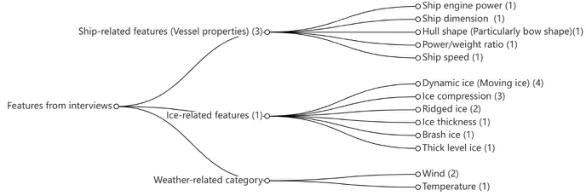
In analysing the responses of the participants concerning features considered when determining whether a vessel needs assistance, several key elements emerged. The findings are summarized in Figure 1. Among the ice- related features, “dynamic ice”was the most frequently mentioned, identified by four participants. One participant particularly emphasized moving ice near shallow water. This was followed by “ice compression”, noted by three participants, and “ridged ice”, mentioned by two participants. One participant cited the feature “ice thickness” and also detailed “heavy ice” in terms of “ridged ice,” “brash ice,” and “thick level ice.” Regarding ship-related features, general “vessel properties” were highlighted by three participants, while specific aspects such as “ship engine power,” “ship dimension,” “hull shape (particularly bow shape),” and “power/weight ratio” were each mentioned by one participant. Weather-related features were also considered, with “temperature” (without specifying whether it referred to air or surface temperature) and “wind” noted by one and two participants, respectively. While some participants described features at a general level, such as ship-related or ice-related characteristics, others provided more specific details on individual features as reflected in Figure 1.
Figure 1: Features considered when determining whether a vessel needs assistance, as identified from the interviews. The numbers in the brackets denote the number of participants who mentioned each feature.
Understanding Crew Estimations for Icebreaker Assistance in Ice-Covered Waters 587
Table 4 summarizes how participants ranked the features for determining whether a vessel needs assistance. In summary, ice-related features were frequently ranked as top considerations by three participants, with two participants specifically highlighting dynamic ice and ice compression as their top concerns. Ship-related features were also ranked as important, with one participant ranking them as the most important and another participant ranking them as the second most important. Weather-related features such as temperature and wind were noted as less critical but still considered by two participants. This analysis highlights the priority given to ice conditions and ship characteristics in the decision-making process for vessel assistance, with weather conditions being a secondary consideration.
Table 4: Ranking of features for determining whether a vessel needs assistance. A rank of 1 indicates the most important feature, and 3 indicates the least important feature. Details of features within each category are provided in brackets when available.
Table available in the original PDF paper.
Features Participant 1 Participant 2 Participant 3 Participant 4
1 2
Shiprelated features
3 (Engine power, dimension, bow shape, ice class)
Ice-related
2 (Dynamic ice), 3 (Ice thickness) 1
features
1 (Dynamic ice) 2 (Ice compression)
1 (Dynamic ice) 2 (Ice compression)
3 (Temperature) 3 (Wind)
Weatherrelated features
COMPARATIVE ANALYSIS AND DISCUSSION One aim of this paper was to compare the resulting experience-driven key features and rankings with the findings from the data-driven analysis by Liu et al. (2024). Liu et al. (2024) framed the estimation of icebreaker need as a binary classification problem using logistic regression. The Finnish Infrastructure Transport Agency provided data representing ship related features, including ship dimension, ship ice class, and ship type. The Helsinki Multi-category sea-ice model (HELMI) provided ice and weather-related factors, including ice concentration and thickness for level ice, ridged ice, and rafted ice, as well as air temperature, sea surface temperature, wind speed, and snow. However, the sea surface temperature value is constant in HELMI during the study period and hence does not add value to the impact analysis. Thus, this factor is not included in the analysis.
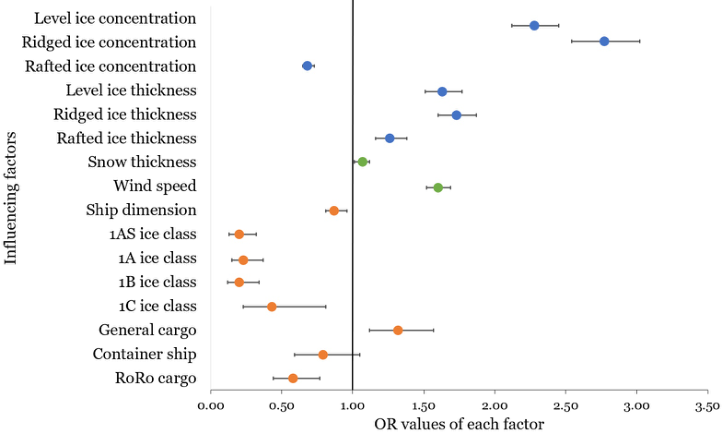
The key findings are presented in Figure 2. The figure shows the odds ratio (OR) values, indicating the quantitative effect of each factor on the need for icebreaker assistance. An OR greater than 1 increases the odds, while an OR less than 1 decreases them. The further the OR deviates from 1, the stronger its influence. As shown in the Figure 2, ice-related factors were the most significant influencers, with high OR, substantially
greater than 1 for most factors, indicating a strong association with the need for icebreakers. Specifically, ridged ice concentration had the most substantial impact, followed by the concentration of level ice. Ship-related factors were the second most influential category, where the ship’s ice class was particularly significant. Since ship ice class is a categorical variable, the ice class II, which is the lowest ice class of vessels, is used as the reference category to interpret its effect. For instance, the OR value of 0.20 for the 1AS ice class indicates that changing the ship’s ice class from II (lower ice class) to 1AS (higher ice class) reduces the odds of requiring icebreaker assistance by approximately 80%.
Among weather-related factors, wind was notable due to its role in driving ice movement and contributing to ice compression and ridges formation, reflected by an OR of 1.60, whereas snow thickness had little impact, with an OR value close to 1. Air temperature was included in the data-driven analysis. However, the OR value for it is close to 1, indicating a negligible effect, and the p-value exceeds 0.05, suggesting that the relationship is not statistically significant. Hence, the air temperature is not included in Figure 2. These results highlight the critical role of ice conditions and ship characteristics in determining the need for icebreaker assistance. For more detailed information, refer to Liu et al. (2024).
Figure 2: Quantitative impact of the factors on the need for icebreaker assistance.
A comparison of the interview results with the data-driven analysis reveals that ice-related features were deemed the most critical in both approaches. However, dynamic ice and ice compression, which were frequently mentioned and highly ranked by participants, were excluded from the data-driven analysis due to the lack of available data on these features. Additionally, the data-driven analysis primarily focused on level ice, ridged ice, and
Understanding Crew Estimations for Icebreaker Assistance in Ice-Covered Waters 589
rafted ice, neglecting other important ice conditions such as brash ice. Future data acquisition efforts should be directed based on these findings to include the overlooked features, ensuring comprehensive data collection. This will enhance the robustness of future data-driven research and inform the development of decision support tools for winter navigation.
Similarly, ship-related features were identified as critical in both the data- driven analysis and the interviews. The interview responses highlighted the influence of more detailed characteristics, such as bow shape and power/weight ratio. While ice class was not mentioned in the interviews, it was found to have the most significant impact in the data-driven analysis. This discrepancy can be explained by the fact that ice class implicitly encompasses multiple ship characteristics, such as hull strength and engine power, into a single standardized metric. Consequently, while interviewees focused on individual technical attributes, the quantitative analysis revealed that ice class, as an aggregate measure, has the most substantial influence within the ship-related features. Future data-driven efforts, including the development of decision support tools, can consider including both detailed and aggregated features, allowing users to select what suits their needs best.
The weather-related features were considered less critical by both the data- driven analysis and the interviews. While wind was identified as the most important weather-related feature in both cases, the data-driven analysis primarily focused on wind speed, whereas the interviews highlighted wind’s role in forming ice ridges and causing ice compression. This perspective aligns with the data-driven findings, which indicate that wind has an impact but ranks below ice-related factors, especially ridged ice. Among the other weather-related features, temperature was mentioned by only one participant and the impact of air temperature was also found to be non-significant in the data analysis. Future work could further investigate the role of weather- related factors by extending the datasets to include more variables or refining interview questions to better understand the influence of these factors.
It is worth noting that despite involving only four participants, the variability in the features they identified, and their respective rankings highlights the challenge of developing a unified, non-subjective assistance estimation method solely based on experiential knowledge. This difficulty is further evidenced by their inability to form a concrete rule for training purposes in response to a probe which was out of scope of this paper. These insights underscore the necessity for more objective solutions, such as data-driven approaches, to ensure consistency and reliability. While the interviews provide valuable insights into the key factors influencing the need for icebreaker assistance, they also reveal the complexities of knowledge transfer. Overall, a data-driven analysis informed by experiential knowledge can enhance the development of decision-support tools, combining the strengths of objective data and practical expertise.
CONCLUSION
Motivated by the complexities of winter navigation in the ice-covered Baltic Sea and the critical need for efficient icebreaker allocation, this study aims to
provide insights into the decision-making processes employed by experienced seafarers. By utilizing CDM and conducting in-depth interviews, the study identified safety of the vessel, particularly in dynamic ice conditions and fairway navigation, as the main goal for icebreaker intervention. Preventing vessels from becoming stuck, avoiding ice-induced damage, and managing risks associated with fast-moving ice and technical failures in the fairways were highlighted as critical reasons for the intervention. The findings emphasized the prioritization of ice-related and ship-related features in assessing the need for icebreaker assistance, with weather conditions being secondary. This aligns with findings from data-driven analyses while also revealing unique insights into factors like dynamic ice and ice compression. This study enhances the transparency of empirical decision-making in ice- covered waters and suggests ways to bridge the gap between experience- driven insights and data-driven approaches. Additionally, it reveals the potential for developing training programs and decision support tools that incorporate critical experiential knowledge, aiming to improve the transfer of such expertise. Ultimately, these contributions offer significant value for improving winter navigation safety and efficiency, as well as informing expert decision-making in other complex, uncertain environments.
ACKNOWLEDGMENT
The work was supported by The Research Council of Finland: Towards human-centred intelligent ships for winter navigation (Decision number: 351491).
REFERENCES
Harenˇcárová, H. (2015). Structured analysis of critical decision method data– emergency medicine case study. Human Affairs, 25(4), 443–459. Hoffman, R. R., Crandall, B. & Shadbolt, N. (1998). Use of the critical decision
method to elicit expert knowledge: A case study in the methodology of cognitive task analysis. Human Factors, 40(2), 254–276. Kulkarni, K., Kujala, P., Musharraf, M., & Rainio, I. (2022). Simulation Tool for Winter Navigation Decision Support in the Baltic Sea. Applied Sciences, 12(15), 7568. Klein, G., & Armstrong, A. A. (2004). Critical decision method. In Handbook of
human factors and ergonomics methods (pp. 373–382). CRC Press. Klein, G. A., Calderwood, R. & Macgregor, D. (1989). Critical decision method for eliciting knowledge. IEEE Transactions on Systems, Man, and Cybernetics, 19(3), 462–472. Liu, C., Kulkarni, K., Suominen, M., Kujala, P., & Musharraf, M. (2024). On the
data-driven investigation of factors affecting the need for icebreaker assistance in ice-covered waters. Cold Regions Science and Technology, 221(104173). Musharraf, M., Kulkarni, K., & Mallam, S. (2023). Cognitive Task Analysis to Understand Icebreaker Decision Making. TransNav, 17(4), 881-886. Soper, J., Veitch, E., Thistle, R., Smith, J., & Veitch, B. (2023). An analysis of factors
influencing ice management performance in an experimental marine simulator and their application to decision support system design. ASME.
LISTED IN THE AHFE DIGITAL BOOKSTORE CATALOGUE
Explore the complete digital volume
Advances in Human Factors of Transportation
Read this individual research paper free through the original publisher, or explore the full digital proceedings book.
ISBN 978-1-964867-62-5
Explore this ISBN in the AHFE Bookstore ↗Listed in the July 2026 bookstore catalogue; search by ISBN to confirm current availability · Digital book purchase optional