Sebastian Scheibe, Fabian Schmid, Marco Münster, Manuel Osebek, Gerhard Kopp, Tjark Siefkes (2025). The Interior Design of Research Demonstrators for Modular and Urban Last Mile Applications. In: Advances in Human Factors of Transportation. AHFE Open Access, vol. 186, pp. 390–398. https://doi.org/10.54941/ahfe1006528
Modularity is the smartest way to fit our vehicles to various specific needs optimizing on the materials, energy demand and user comfort. Therefore, we want to introduce human centered design approaches on our modular vehicle concepts: The Urban Modular Vehicle (UMV) and the U-Shift.The concept of the UMV vehicle family combines various derivatives for different use-cases. The UMV vehicle family consists of driver-controlled vehicles and automated movers for transporting people and goods.The UMV Peoplemover (PM) 2+2 is a derivative based on the UMV platform and is made for the automated transport for up to four occupants, which are sitting in a 2+2 vis-à-vis seat configuration. The Interieur of the UMV PM 2+2 includes luxury door covers with ambient light and four ergonomic singleseats with a large footwell. Because of swing doors that open on both sides without a conventional B-Pillar, there is a large entrance area. For the communication between the occupants and the vehicle and for the identification of passengers, there are displays implemented in the doors and below the roof.In addition to the UMV PM 2+2, there is the UMV Dualmover, which is intended for the combination of standing passenger and goods transport. Due to the different functions of this derivative, the interior can be customised to fit the needs of the current usecase. Due to the variable interior, the vehicle can transport standard package sizes and people with folding seats. Other derivatives with the same external dimensions as the Dualmover are the Peoplemover (large version), the Cargomover (large version) and the Hop On & Off, which is designed for very easy entry and exit.Another strategy for an electric, modular and automated concept is the U-Shift. It consists of the U-shaped Driveboard and different capsules as a loading unit. The Driveboard includes everything what is needed for (automated) driving like electrical drivetrain, steering, lifting system and automation system with sensors. With the lifting system, the Driveboard can lower itself, move into position, and the load the capsule via a rail system. The possibilities for capsule versions are infinite: passenger transport, cargo, garbage, supermarket, etc. The focus here will be the interior of a person capsule. Target was a prototypic but close-to-production implementation of a capsule for public transport. The seats are located on each side of the overhang of the capsule over the Driveboard, so there are three ergonomic seats left and right vis-à-vis and one at the front, orientated backwards. A space for a wheelchair is located in the rear end. This overhang allows an entrance on the right-hand side, which is equipped with a standard bus swing door and an automated ramp for wheelchairs. Big window areas ensure a good light incidence. In a workshop with disabled persons, some possibilities for improvement came up: Better positioning of door buttons, handrails at stairs, color highlighting of handrails, standard bus grabpoles, buttons with haptical feedback and seatbelts for every seat.Biggest difference to the first version is the implementation of a safety driver’s workplace. Due to security reasons, the safety driver has to stand in order to make it not too comfortable and ensure full attention. Only comfort is a motorized adjustable backrest. All the necessary input devices like joystick and control panel are arranged around the safety driver. Monitors on the left and right give him back view and view around the A-pillar.ReferencesU-Shift: https://www.dlr.de/de/fk/forschung-transfer/projekte/innovative-fahrzeugkonzepte/u-shiftUMV: https://www.dlr.de/de/fk/forschung-transfer/projekte/innovative-fahrzeugkonzepte/urban-modular-vehicle-umv Münster, Marco und Scheibe, Sebastian und Osebek, Manuel und Siefkes, Tjark (2022) Modulares Fahrzeugkonzept für die Mobilität von morgen. ATZ Automobiltechnische Zeitschrift (124), Seiten 16-21. Springer. doi: 10.1007/s35148-022-0906-4 <https://doi.org/10.1007/s35148-022-0906-4>. ISSN 0001-2785. Münster, Marco und Scheibe, Sebastian und Osebek, Manuel und Kopp, Gerhard und Hahn, Robert und Siefkes, Prof. Dr. Tjark (2022) Fahrzeugkonzepte für die Mobilität von morgen Vehicle concepts for the mobility of tomorrow. In: ATZlive Automatisiertes Fahren 2022. Springer. 8. Internationaler ATZ-Kongress: ATZlive Automatisiertes Fahren 2022, 2022-04-05 - 2022-04-06, Wiesbaden, Deutschland. Münster, Marco und Kopp, Gerhard und Friedrich, Horst und Siefkes, Tjark (2020) Autonomes Fahrzeugkonzept für den urbanen Verkehr der Zukunft. ATZ Automobiltechnische Zeitschrift, 122 (122), Seiten 26-31. Springer. doi: 10.1007/s35148-020-0216-7 <https://doi.org/10.1007/s35148-020-0216-7>. ISSN 0001-2785.
Whether cars or trucks for individual mobility and goods transportation or buses and streetcars as part of local public transport - demand will remain high and usage habits strong.
For the foreseeable future, road transportation will remain the dominant mode of transport. However, what needs to change - and this applies to both old acquaintances and newcomers on the asphalt - is that they all need to become more user friendly and human centered. These include safety, but also efficiency, modularity, ergonomics and comfort.
Modularity is the smartest way to fit our vehicles to various specific needs optimizing on the materials, energy demand and user comfort. Therefore, we want to introduce human centered design approaches on our modular vehicle concepts: The Urban Modular Vehicle (UMV) and the U-Shift.
The Interior Design of Research Demonstrators for Modular 391
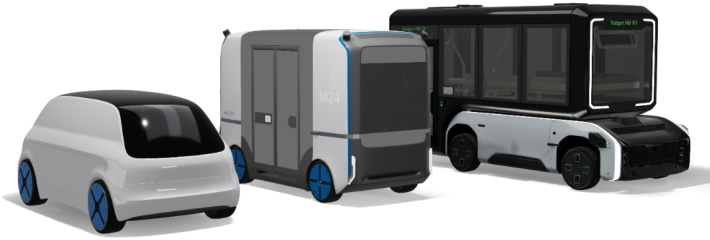
Figure 1: Overview of presented automated vehicle concepts for modular and urban last mile applications - UMV Peoplemover 2+2 (left), UMV Dualmover (middle), U-Shift (right) (source: DLR).
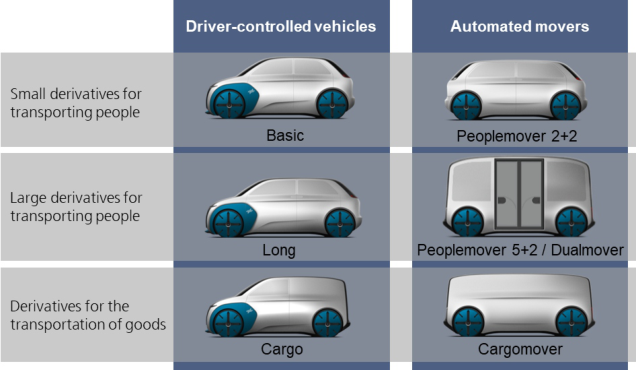
The Urban Modular Vehicle (UMV) The concept of the UMV vehicle family combines various derivatives for different use-cases, which are all based on the same platform. The UMV vehicle family consists of driver-controlled vehicles and automated movers for transporting people and goods. Because of the modularization strategy, which is implemented in the manufacturing process, the number of specific parts and components per derivative can be decreased. This is made possible by increasing the number of common parts and using the same vehicle front and vehicle rear parts for different derivatives. In addition, two rear parts of the UMV Long or Cargo can also be used to represent the Peoplemover 2+2 or the Cargomover.
Some of the derivatives of the UMV vehicle family and their use cases can be seen in Figure 2.
Figure 2: Schematic overview of the variety of some derivatives of the UMV vehicle family in relation to the use cases of driver-controlled vehicles and automated movers (source: DLR).
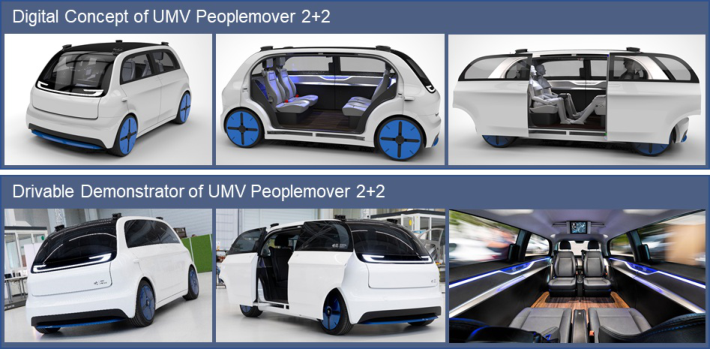
The UMV vehicle family was initially a digital concept that had already reached a high degree of maturity. In addition, a derivative, the UMV Peoplemover 2+2, has already been built as a drivable demonstrator to make the vehicle concept tangible and experiential.
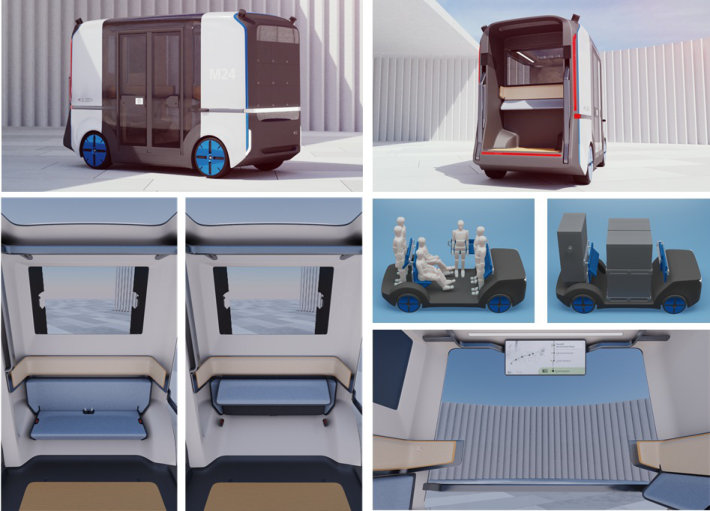
This derivative is designed for the automated transport of up to four passengers, seated in a 2+2 vis-à-vis configuration. The interior of the UMV Peoplemover 2+2 includes high quality door covers with ambient lighting and four ergonomic single seats with a large footwell. Due to the spacious conditions of the interior, cosy lighting, air conditioning and the implemented automated driving functions, this vehicle derivative is targeted particularly at a demand-oriented VIP shuttle service. Swing doors that open on both sides without a conventional B-pillar create a large entrance area. Even if the entrance width into the vehicle is large, the entrance height is low, resulting in a crouched posture when getting into the vehicle. In addition, a higher floor height of 340 mm makes boarding more difficult, because battery modules are integrated in the floor. This relates to all derivatives of the UMV vehicle family.
For these reasons, this derivative is less suitable for disabled persons. That’s also why there isn’t a ramp available. There are displays in the doors and under the roof for passenger communication and identification. The digital concept of the Peoplemover 2+2 and the drivable demonstrator can be seen in Figure 3.
Figure 3: Digital concept of the UMV Peoplemover 2+2 and the drivable demonstrator with a fully functional interior (source: DLR).
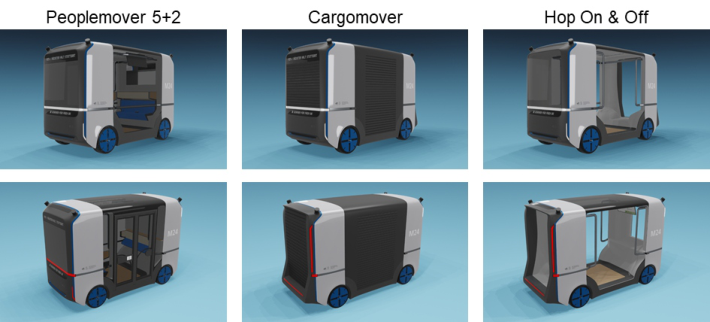
In addition to the UMV Peoplemover 2+2, there are also larger derivatives such as the Peoplemover 5+2, the Cargomover and the Hop On & Off. These derivatives are also based on the UMV platform and include modularization in the Z-direction, which means that the vehicles are higher. The increased interior space means that the Peoplemover 5+2 can transport three standing
The Interior Design of Research Demonstrators for Modular 393
passengers and two seated passengers. The Cargomover also has more capacity for transporting goods. Standardized transport units can be stored in the interior and rear of the vehicle. A special derivative is the Hop On & Off, which design simplifies entry and exit. The concept could avoid long walking distances for slow inner-city journeys. It is important that there are sufficient handholds and handrails for all occupants. Those derivatives are shown in Figure 4.
Figure 4: Large derivatives of the UMV vehicle family – Peoplemover 5+2, Cargomover and Hop On & Off (source: DLR).
To decrease the number of needed vehicles in an urban environment there is also a derivative which combines the use cases of the Peoplemover 5+2 and the Cargomover. Due to the modularization strategy there are a lot of common parts used from the other large derivatives for building this vehicle. That’s why the vehicle has the same external dimensions and looks pretty similar to the others.
To build the Dualmover some aspects of the other major derivatives can be adopted. For example, the rear area of the Dualmover can be used for easy entry and exit, similar to the Hop On & Off, or for transporting goods in standardized packing sizes, similar to the Cargomover. Furthermore, the interior of the vehicle offers space for up to five people or two people and a wheelchair with a disabled person who can enter the vehicle barrier-free using a ramp. In addition, the vehicle has large window areas, handrails and handholds and a screen to provide the occupants with information and interact with them. The customizable interior with folding seats enables goods to be transported inside the vehicle. People and goods can also be transported at the same time using the rear and the inside of the vehicle differently.
Figure 5 visualizes the Dualmover and its aspects and functions.
Figure 5: UMV Dualmover concept for combined transport of people and good with an adaptable interieur (source: DLR).
The U-Shift Concept The U-Shift is another demonstrator for an electric, modular and automated concept. The purpose of U-Shift is to solve different challenges in urban mobility: Last mile transportation of people and goods. Beyond the rush hours, big busses are sometimes empty or with only one or two passengers, which is not very efficient. To supply stores in the city, large trucks are used, which then block traffic.
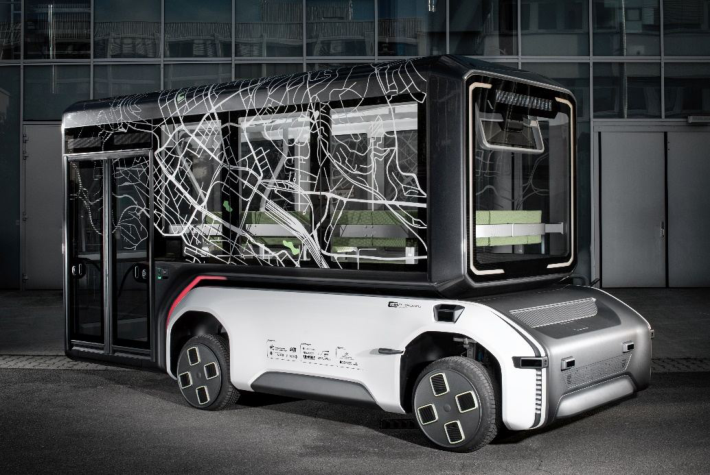
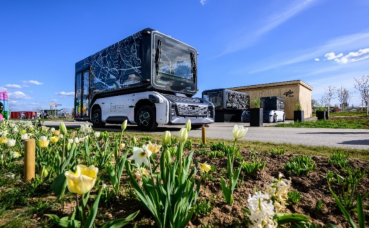
U-Shift can help in both cases. It consists of the U-shaped Driveboard and different capsules as a loading unit. The Driveboard is a fully autonomous electric vehicle and includes everything what is needed for driving like electrical drivetrain with in-wheel motors on the rear axle, steer-by-wire system, hydraulic lifting system and full stack automation system with sensors like lidar, radar and cameras. With the integrated lifting system, the Driveboard can lower itself, move into position, and then load the capsule via a rail system. The loaded capsules are then locked with four latches. These latches provide also a fine positioning on the rails. A retractable connector allows electric connection between Driveboard and capsules if needed. Figure 6 shows the U-Shift with the People Capsule The Driveboard acts as a transport system for the capsule. It can operate 24h a day, except charging times. A cargo capsule can be used to supply stores. The capsule will be positioned in front of the store. While unloading, the Driveboard can go on with the next mission. It could then load the person capsule and support public transport operations.
The Interior Design of Research Demonstrators for Modular 395
Figure 6: U-Shift with people capsule (source: DLR).
Beyond these use cases, the possibilities for capsule versions are infinite: passenger transport, cargo, garbage, movable supermarket, etc. This modular system can establish new business cases and products.
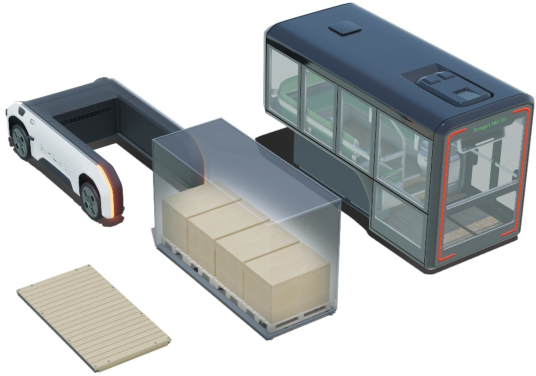
The dimensions for capsules are based on the U shape of the Driveboard. It provides space for three euro pallets. This space can be extended to four pallets with an overhang beyond the Driveboards dimensions on the rear side and an overhang above the Driveboard itself. The resulting useable area is about 10 m2. The Driveboard and some capsules are shown in Figure 7.
Figure 7: U-Shift Driveboard and variety of capsules (source: DLR).
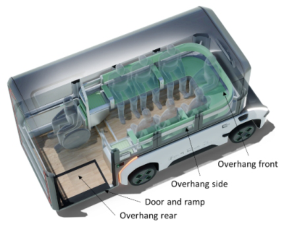
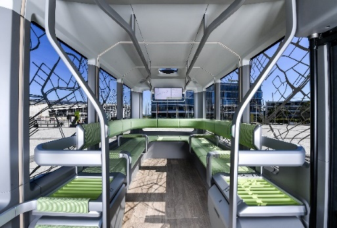
First Version of the Person Capsule The focus here will be the interior of a possible capsule for public transport. Target was a prototypic but close-to-production implementation of this capsule. The first version of this capsule type should already give the feeling of a ready product with realistic design elements and ergonomic features. The seats of the People Capsule are located on each side of the overhang over the Driveboard, so there are three ergonomic seats left and right vis-à-vis and one at the front, orientated backwards, plus one rather narrow seat in each corner. Armrests provide the space for the touch-sensitive stop request buttons and USB charging ports. As the seats are over the Driveboard, they have to be a bit elevated. Therefore, two steps are needed to get there and barrier-free access to these seats is not possible. On each side of the steps, there is a baggage rack. The steps are highlighted with a LED-lighting. The barrier-free space for a wheelchair or stroller and a folding seat for an accompanying person is located in the overhang in the rear end. This overhang allows an entrance on the right-hand side, which is equipped with a standard bus swing door. The doors have an opening width of 1,2 m. An automated ramp allows accessibility for wheelchairs at the same level as the bus stop board. If the height difference to the bus stop is still too great, the U-Shift’s ability to lower itself comes into play. Renderings of the interior design can be seen in Figure 8.
Figure 8: Interior concept of people capsule (source: DLR).
Large window areas, as depicted in Figure 9, ensure a good light incidence and a good view around. An AC-system with about 6 kW ensures a comfortable temperature. The elevated position of the seats provides some space under the floor for the electronics compartment. Here are the control units of door and ramp and the batteries located.
A screen was installed at the front and rear in the top corner to provide information of the route. On the outside, at the front and rear, LED matrices inform about the destination. An additional screen at the door can be used for information and ticket control via QR-code.
The Interior Design of Research Demonstrators for Modular 397
Figure 9: Actual interior of people capsule in front (left) and rear (right) (source: DLR).
Second Version of the People Capsule In 2023, we had the chance to present our concept to the public on the Federal Garden Exhibition in Mannheim. Therefore, a new Driveboard and also a new People Capsule were built (Figure 10 (right)). Due to regulatory reasons, some changes, like a special workplace for a safety driver, were needed. Additionally, a workshop with disabled persons was held, to identify their special needs (Figure 10 (left)). This included handrails at stairs, color highlighting of the handrails and edges and buttons with haptic feedback. The button for the ramp at the outside was placed a little further away from the door, so nobody collides with the extending ramp when pressing the button.
For driving operations on the Federal Garden Exhibition, a comprehensive safety concept was established. This affected also the design of the person capsule. City busses in Germany don’t need seatbelts. Nevertheless, the safety concept demands for safety belts for every seat and especially for the wheelchair place.
Figure 10: New U-Shift on the BUGA (left), workshop (right) (source: DLR).
While the first version had some special designed grabpoles, the second version got standard bus grabpoles with color highlighting and standard stop request buttons. Some of the stop and ramp request buttons also have Braille imprints.
The biggest difference to the first version is the implementation of a safety driver’s workplace in the left front corner. One seat was sacrificed for this
purpose. In order to ensure full attention, the safety driver operates in a standing position with a motorized adjustable backrest. All the necessary input devices like joystick, emergency button and control panel are arranged around the safety driver. Monitors on the left and right give him back view and a view around the A-pillar.
The experience from the first version also suggested a more powerful AC. It has now double the power with up to 12 kW, but also needs more powerful batteries with 25kWh. They are again located in the electronics compartment under the floor.
To communicate with the passengers, especially in emergency cases, a communication device with a camera was installed. The passengers can communicate with a remote operation center, which also supervises the operation of the car.
To communicate with other road users, LED matrices where installed around the capsule on eye level. They can show textual messages or symbols to indicate the intentions of the car or give instructions for the other road users.
CONCLUSION
With these two concepts, we are able to show our technologies and know how in vehicle construction. Additionally, we had the possibility to integrate our research topics regarding human centered and interior design approaches. Our next steps will be further improvements for the U-Shift concept and build up a drivable demonstrator of one of the lager derivatives of the UMV vehicle family.
REFERENCES
Münster, Marco und Kopp, Gerhard und Friedrich, Horst und Siefkes, Tjark (2020) Autonomes Fahrzeugkonzept für den urbanen Verkehr der Zukunft. ATZ Automobiltechnische Zeitschrift, 122 (122), Seiten 26–31. Springer. doi: 10.1007/ s35148-020-0216-7 <https://doi.org/10.1007/s35148-020-0216-7>. ISSN 0001- 2785. Münster, Marco und Scheibe, Sebastian und Osebek, Manuel und Kopp, Gerhard
und Hahn, Robert und Siefkes, Prof. Dr. Tjark (2022) Fahrzeugkonzepte für die Mobilität von morgen Vehicle concepts for the mobility of tomorrow. In: ATZlive Automatisiertes Fahren 2022. Springer. 8. Internationaler ATZ-Kongress: ATZlive Automatisiertes Fahren 2022, 2022-04-05 - 2022-04-06, Wiesbaden, Deutschland. Münster, Marco und Scheibe, Sebastian und Osebek, Manuel und Siefkes, Tjark (2022) Modulares Fahrzeugkonzept für die Mobilität von morgen. ATZ Automobiltechnische Zeitschrift (124), Seiten 16–21. Springer. doi: 10.1007/ s35148-022-0906-4 <https://doi.org/10.1007/s35148-022-0906-4>. ISSN 0001- 2785. U-Shift: https://www.dlr.de/de/fk/forschung-transfer/projekte/innovative-fahrzeugk onzepte/u-shift UMV: https://www.dlr.de/de/fk/forschung-transfer/projekte/innovative-fahrzeugko nzepte/urban-modular-vehicle-umv
LISTED IN THE AHFE DIGITAL BOOKSTORE CATALOGUE
Explore the complete digital volume
Advances in Human Factors of Transportation
Read this individual research paper free through the original publisher, or explore the full digital proceedings book.
ISBN 978-1-964867-62-5
Explore this ISBN in the AHFE Bookstore ↗Listed in the July 2026 bookstore catalogue; search by ISBN to confirm current availability · Digital book purchase optional