Jinlei Shi, Wei Zhang, Hao Fan, Chunlei Chai (2025). Design and Development of a Tactile Takeover Warning System Using a Tactile Seat for Automated Driving. In: Advances in Human Factors of Transportation. AHFE Open Access, vol. 186, pp. 421–425. https://doi.org/10.54941/ahfe1006531
Designing an effective takeover warning system is crucial for driving safety in conditionally automated vehicles. Given the advantages of the tactile modality in presenting takeover requests (TORs), this study designed and developed a seat-based tactile takeover warning system. A directional tactile TOR was used to instruct drivers on how to respond in various takeover scenarios. Additionally, the urgency of the tactile TOR was dynamically mapped to the time to collision with the hazard ahead, helping drivers perceive their proximity to the hazard. To evaluate the effectiveness of this novel takeover warning system, we recruited 24 participants and conducted a simulated driving study under varying levels of takeover event urgency and weather conditions. The results indicated that the developed tactile takeover warning system significantly reduced drivers' takeover time, regardless of the urgency level or weather condition. Therefore, this system has strong potential to enhance takeover performance and merits adoption by relevant practitioners.
With the advancement of cutting-edge technologies such as the Internet of Things and computer vision, automated driving has rapidly evolved over the past decade. It holds great potential to alleviate traffic congestion, enhance driving safety, and improve passenger experience (Hussain & Zeadally, 2019). SAE International (2021) classifies automated driving into six levels (L0–L5). Currently, partially automated driving (L2) has been widely commercialized, with Tesla being a notable example. Conditionally automated driving (L3) is expected to enter the consumer market in the near future. L3 automation allows drivers to engage in various non-driving-related tasks (NDRTs) while the system is active. However, when the automated driving system exceeds its operational design domain (ODD), drivers must
promptly resume control of the vehicle. Therefore, delivering an effective takeover request (TOR) is crucial to ensuring driving safety.
Utilizing the tactile modality to convey TORs offers several advantages. First, previous studies have shown that visual and auditory TORs can be disrupted by various visual and auditory NDRTs (Chai et al., 2024; Petermeijer et al., 2016). In contrast, tactile TORs are not susceptible to such interference. Second, the takeover process primarily involves visual-manual tasks. According to multiple resource theory (MRT), cognitive resources allocated to different modalities function independently and do not interfere with one another (Wickens, 2002). This allows drivers to simultaneously monitor the surrounding traffic environment (a visual task) while perceiving tactile TORs, thereby facilitating a more efficient takeover process (Meng & Spence, 2015; Petermeijer et al., 2017). These findings highlight the significant potential of employing tactile TORs in automated vehicles to enhance both safety and efficiency.
Thus, this study designed and developed a seat-based tactile takeover warning system aimed at enhancing drivers’ takeover performance. Additionally, we conducted a simulated driving experiment to assess the effectiveness of the tactile warning system.
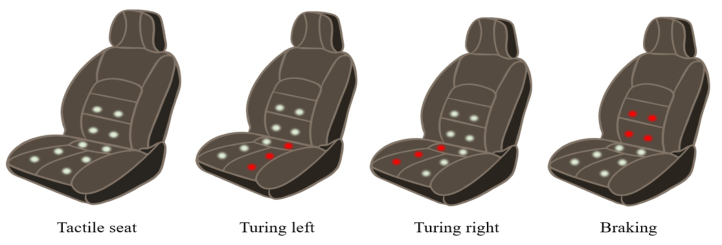
DESIGN AND DEVELOPMENT OF THE TACTILE TAKEOVER WARNING SYSTEM We integrated 10 vibrotactile motors into a seat, with six positioned on the seat pan and four on the seat back, arranged symmetrically relative to the seat center (as shown in Figure 1). Using this setup, we developed a novel tactile takeover warning system. The system primarily encoded information through vibration location and timing to assist drivers in taking over control.
Figure 1: Tactile seat and vibration pattern. Cyan circles represent vibration motors, while red circles denote activated vibration motors.
For the vibration location dimension, when drivers needed to steer left, right, or brake, the system activated the three motors on the corresponding side of the seat pan or the four motors on the seat back to indicate the required action.
For the vibration timing dimension, TOR urgency was manipulated by adjusting inter-pulse intervals, dynamically mapping urgency to the criticality
Design and Development of a Tactile Takeover Warning System 423
of the situation as the vehicle approached a hazard (a looming TOR).Previous research has shown that a looming TOR enhances drivers’ awareness of the temporal proximity to a hazard and improves takeover performance (Shi et al., 2024). The duration of each tactile pulse was set to 200 ms, and the inter-pulse intervals were dynamically controlled in real-time based on the time-to-collision (TTC) with the front hazard. The relationship between inter-pulse intervals (modulating perceived urgency) and TTC was modeled as follows, based on the study by Shi et al. (2024): Pulse interval = 38.07 ∗TTC + 1.41 (1)
Through these design elements, our tactile takeover warning system aimed to enhance drivers’ takeover performance effectively.
SYSTEM EVALUATION Participants
A total of 24 participants were recruited for the experiment, all of whom held a valid Chinese driving license. The participants had an average age of 25.75 years and an average driving experience of 5.79 years.
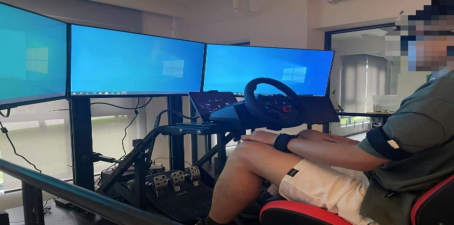
Simulator The evaluation experiment was conducted using a three-screen driving simulator (as shown in Figure 2). The simulated driving system comprised driving software (STISIMDRIVE-M1000-R), a control system (Logitech G29, including a steering wheel, brake, and accelerator), an adjustable seat, a high-performance workstation (Nvidia GeForce RTX 3080 [10GB], Intel Core i7-10700K), speakers, and three 32-inch displays (1366 × 768 pixel resolution), providing a 135
field of view.
Figure 2: The driving simulator.
Experimental Procedures Upon arrival, participants signed a consent form and completed a demographic questionnaire. The experimenter introduced them to the nature of L3 automated driving, the purpose of the experiment, and the meanings
of various tactile TORs. Participants then completed a practice session to familiarize themselves with automated driving and the takeover process.
During the formal experiment, participants completed two driving blocks. One block corresponded to our developed novel takeover warning system, while the other served as a baseline, featuring a standard tactile TOR consisting of three 200 ms tactile pulses with a fixed interval of 240 ms, activating all motors on the seat. Each block contained six driving trials, varying in takeover urgency (urgent [TTC = 4 s] vs. non-urgent [TTC = 8 s]) and weather conditions (sunny, light fog [visibility = 200 m], and heavy fog [visibility = 50 m]). The sequence of the six trials was randomly arranged.
During automated driving, participants were required to engage in a Tetris game as a NDRT. Additionally, there were two types of takeover events: braking and lane-changing maneuvers, with event types randomly assigned across trials. Between each trial, participants took a short break and completed subjective rating scales. The entire experiment lasted approximately 45 minutes.
RESULTS
We used a linear mixed model to analyze the data. It was found that regardless of takeover event urgency and weather conditions, our developed novel takeover warning system significantly reduced takeover time (ps < .05) (as shown in Table 1).
Table 1: Means and standard deviations of takeover time (s) under various conditions.
Given the advantages of the tactile modality in presenting TORs, this study developed a tactile seat and designed a novel takeover warning system based on vibration location and timing dimensions. Directional tactile information provided drivers with clear guidance on how to respond to takeover events (Cohen-Lazry et al., 2019; Shi et al., 2022), while looming information helped them better perceive the urgency of the situation and their proximity to the hazard (Shi et al., 2024).
Our evaluation experiment demonstrated that the novel tactile takeover warning system effectively reduced takeover time, regardless of event urgency and weather conditions. These findings highlight the robustness of the developed system in improving drivers’ takeover performance, offering practical implications for automotive industry practitioners.
Design and Development of a Tactile Takeover Warning System 425
However, in real-world driving environments, vehicle vibrations caused by motor operation and uneven road surfaces may create masking effects, potentially interfering with drivers’ perception of tactile takeover cues (Wan & Wu, 2018). Therefore, further research is needed to assess the effectiveness of the developed tactile takeover system in real-world conditions and explore design enhancements to mitigate the negative impact of vehicle vibrations.
ACKNOWLEDGMENT
The authors gratefully acknowledge support from the project ’Study of Multimodal Controlled Generation Technology and Its Digital-Intelligent Applications’ (No. 2025GJJH007), funded by the Innovation Center of Yangtze River Delta, Zhejiang University.
REFERENCES
Chai, C., Lei, Y., Wei, H., Wu, C., Zhang, W., Hansen, P., Fan, H., & Shi, J.
(2024). The effects of various auditory takeover requests: A simulated driving study considering the modality of non-driving-related tasks. Applied Ergonomics, 118, 104252. https://doi.org/10.1016/j.apergo.2024.104252 Cohen-Lazry, G., Katzman, N., Borowsky, A., & Oron-Gilad, T. (2019). Directional tactile alerts for take-over requests in highly-automated driving. Transportation Research Part F: Traffic Psychology and Behaviour, 65, 217–226. https://doi.org/ 10.1016/j.trf.2019.07.025 Hussain, R., & Zeadally, S. (2019). Autonomous Cars: Research Results, Issues,
and Future Challenges. IEEE Communications Surveys & Tutorials, 21(2), 1275–1313. https://doi.org/10.1109/COMST.2018.2869360 Meng, F., & Spence, C. (2015). Tactile warning signals for in-vehicle systems. Accident Analysis & Prevention, 75, 333–346. https://doi.org/10.1016/ j.aap.2014.12.013 Petermeijer, S., Cieler, S., & de Winter, J. (2017). Comparing spatially static and dynamic vibrotactile take-over requests in the driver seat. Accident Analysis & Prevention, 99, 218–227. https://doi.org/10.1016/j.aap.2016.12.001 Petermeijer, S. M., de Winter, J. C. F., & Bengler, K. J. (2016). Vibrotactile
Displays: A Survey With a View on Highly Automated Driving. IEEE Transactions on Intelligent Transportation Systems, 17(4), 897–907. https://doi.org/10.1109/ TITS.2015.2494873 Shi, J., Wu, C., Zheng, H., Zhang, W., Zhang, X., Lu, P., & Chai, C.
(2022). Toward Hazard or Action? Effects of Directional Vibrotactile Takeover Requests on Takeover Performance in Automated Driving. International Journal of Human–Computer Interaction, 0(0), 1–16. https://doi.org/10.1080/ 10447318.2022.2105479 Shi, J., Zhang, W., Wei, H., Yang, Z., Ma, S., Fan, H., & Chai, C. (2024). Investigating looming tactile takeover requests with various levels of urgency in automated vehicles. Accident Analysis & Prevention, 208, 107790. https://doi.org/10.1016/j.aap.2024.107790 Wan, J., & Wu, C. (2018). The Effects of Vibration Patterns of Take-Over Request and Non-Driving Tasks on Taking-Over Control of Automated Vehicles. International Journal of Human–Computer Interaction, 34(11), 987–998. https://doi.org/10.1080/10447318.2017.1404778 Wickens, C. D. (2002). Multiple resources and performance prediction. Theoretical
Issues in Ergonomics Science, 3(2), 159–177.
LISTED IN THE AHFE DIGITAL BOOKSTORE CATALOGUE
Explore the complete digital volume
Advances in Human Factors of Transportation
Read this individual research paper free through the original publisher, or explore the full digital proceedings book.
ISBN 978-1-964867-62-5
Explore this ISBN in the AHFE Bookstore ↗Listed in the July 2026 bookstore catalogue; search by ISBN to confirm current availability · Digital book purchase optional