Yaojiong Yu (2025). Dynamic Narrative Frameworks: Merging Creativity and Logic through systematic Card-Based Interactivity. In: Human Factors in Communication of Design. AHFE Open Access, vol. 177, pp. 78–88. https://doi.org/10.54941/ahfe1006333
Narrative is central to the design of creative writing support tools, enhancing immersive cognitive experiences and fostering creativity. Traditional single-line narratives excel in coherence and emotional depth but limit creative freedom, while multi-line narratives offer flexibility yet risk losing consistency and pacing. This study proposes a dynamic card-based narrative framework that integrates key event nodes to balance logic and flexibility. Experimental results show improved user immersion (8.4/10, p < 0.01) and creativity (7.9/10, p < 0.05), with 90% of participants praising smooth transitions between main and side story lines. The framework holds potential in education, cultural communication, and hybrid reality applications, supporting narrative design in digital platforms and AI-integrated tools. Future work will address complexity and broaden applications through AI-driven optimization, advancing sustainable and immersive storytelling experiences across virtual and physical domains.
Storytelling is an integral part of the design of creative writing tools, and it is widely recognized as a core element that enhances user (author/player) immersion and stimulates creativity (Jenkins, 2003; Murray, 1997; Zarei et al., 2020). Traditionally, story writing often takes the form of a single-line story or a multi-line story, and each has significant limitations. For example, in the field of literary creation, many classic short stories use single- line narratives, yet single-line narratives lack the flexibility of user choice, causing users to often passively accept content during participation (Orme, 2022; Wade, 2006). In contrast, multi-line storylines give users a higher degree of creative freedom; through branching options, it enhances users’ sense of narrative participation and control during the experience (Green & Jenkins, 2020; Ryan, 2010). But a multi-line narrative can easily lead to the problem of uncontrolled narrative rhythm or excessive plot complexity (Arrambide, 2019; Lan et al., 2021a; Zagal et al., 2006). Therefore, finding a balance between single-line and multi-line storylines has become an important topic. This balance ensures the logical coherence of the narrative
Dynamic Narrative Frameworks: Merging Creativity and Logic 79
and enhances the flexibility of creation. This topic is important for creative writing tools. It is also important for dynamic narrative design in subsequent education and cultural communication. Additionally, it is important for applications in creative studios, digital platforms, games, and mixed reality environments.
In recent years, cards have received a lot of attention in the field of interactive storytelling because of their modular design and flexible combination (“The Art of Nonfiction Documentary Literature Writing - An Interview with John McPhee”, n.d.; Juul, 2010; Scanagatta et al., 2020; Schwarz et al., 2019). The randomness of cards can provide unpredictable narrative branching which enhances user engagement and creativity. For example, Möbius Cards is a suite of tools for creative writing, narrative design, and thought stimulation. Each card contains a unique story element, question, or situational prompt and is designed to help users explore diverse narrative paths and generate new ideas from them. At the same time, the structured nature of the cards allows designers to predefine the logical sequence of events, so they can effectively control the narrative rhythm (Lan, Xu, & Cao, 2021; Björklund, Keipi, & Maula, 2020; Pacheco, Garbatov, & Goulao, 2021). In addition, card types like emotional relationship cards and event cards can further deepen the personalized expression of narratives through emotional triggering mechanisms and event development (Mori, Yamane, Ushiku, & Harada, 2019; Wade, 2006; Khoshkangini et al., 2021).
The unique advantages of cards as a narrative design tool lie not only in their flexibility and modularity but also in the following aspects. First, card design can break down complex narrative logic into easy - to - understand segments and enhance the user’s sense of control over the narrative process through specific rules and trigger mechanisms. Secondly, the physical characteristics or digital presentation of the card (such as patterns, text descriptions, trigger conditions, etc.) can bring more visual and interactive possibilities to the narrative design, and this effectively shortens the distance between the user (creator) and the story.
In addition, compared with other linear or procedural narrative forms, card narrative is more adaptable. It can dynamically generate different plot development paths through creator choices and random factors, thus balancing narrative controllability and user creativity. At the same time, the production cost of cards is low. Designers can quickly update or expand existing narrative models by simply modifying or adding card types. This feature makes it particularly suitable for narrative scenarios that require high flexibility and iterative updates, such as rapid prototyping or narrative content development for long-term operations. In practice, designers can adjust and optimize the narrative structure without going through complex programming or expensive development tools. This significantly lowers the development barrier and improves the maintainability and extensibility of the narrative framework. However, most of the current research focuses on the application of cards in a single narrative mode, such as the logical construction in a single-line narrative or the branch management in a multi- line narrative. There is still a lack of systematic exploration on how to
80 Yu
use cards to realize the dynamic combination of single-line and multi-line storylines (Green & Jenkins, 2020; Eladhari, 2009).
Based on this, this study proposes a dynamic card narrative framework, which attempts to combine the logical advantages of single-line narrative and the flexibility of multi-line narrative, and effectively integrate the main line and branch lines through key event nodes, so as to stimulate users’ creativity while optimizing the narrative rhythm. This framework not only expands the application scenarios of card narratives, but also provides new ideas for solving the contradiction between logical consistency and free choice in interactive narratives, and also provides more practical tools for future dynamic narrative design through the characteristics of low cost, high flexibility and easy maintenance.
Existing studies have shown something. The balance between narrative rhythm control and user freedom of choice is the key to achieving high- quality creative storytelling. (Jenkins, 2003; Juul, 2010; Scanagatta et al., 2020; Schwarz et al., 2019). However, in nonlinear narratives, satisfying the need for both logic and freedom is always a challenge for designers (Björklund et al., 2020; Lan et al., 2021b). Traditional approaches often rely on complex programming logic or digital tools to implement multi- line storylines, which are difficult in non-digital media, upfront framework building, and low-cost development (Pacheco et al., 2021; Zagal et al., 2006). Based on this, this study proposes an innovative card narrative framework. This framework combines the characteristics of single-line and multi-line storylines. It designs a set of dynamic narrative mechanisms that connect the main line and branch lines through key node events. The framework can optimize the narrative rhythm and ensure logic. It can also enhance the user’s freedom and creativity through branch selection. Thus, it provides a new practical reference for creative narrative design.
The purpose of this study is to explore how to use the card design of a combination of single-line and multi-line storylines. It aims to further enhance the user’s immersion and creativity by optimizing the narrative rhythm and enhancing the user’s freedom of choice. To this end, this paper first reviews the relevant theoretical and practical foundations. Then, it introduces the design methods and experimental process of card frameworks. Next, it analyses and discusses the actual effects of the frameworks. Finally, this paper also explores the application potential of the framework in the fields of creative tools, future technology integration, and education and cultural communication. This exploration provides theoretical and practical support for the design of dynamic narrative systems.
METHODS
The purpose of this study is to explore the impact of card narrative framework and dynamic branching design on user experience (such as immersion and creativity) to optimize the design and application of interactive storytelling tools. The research objectives include three points. One point is to analyze the role of narrative design elements, that is, to reveal the specific impact of card types and their combinations on the
Dynamic Narrative Frameworks: Merging Creativity and Logic 81
user experience (including efficiency, attractiveness, creative support, etc.). Another point is to quantify the user experience dimension. This is done through reliability analysis and system scoring to evaluate the role of different narrative frameworks in promoting user immersion and creativity. The third point is to optimize the design of narrative tools. Based on the experimental results, targeted improvement strategies are proposed to provide data support for the optimal design of the card narrative framework.
To achieve the above goals, this study adopts an orthogonal experimental design. It combines quantitative analysis (such as ANOVA and effect size calculation) and qualitative analysis (such as logical and creative scoring of user - generated content) to ensure the scientific nature of experimental data and the reliability of conclusions. In addition, to make the experimental results guide the optimization of card design, the research presupposes the association path between card design elements and user preferences in the method part. It will elaborate on the framework optimization logic in the discussion part.
The Independent Variable (Card Narrative Frame Type) is a storyline type. Including single-line and multiple-line. Single linear story fixed-order card quests, and users can’t choose branching paths. In the contract, Multi-line storyline, users can choose the path according to their preferences. Beyond these two types. It also could exist as a Dynamic Combination. This means combining the main line and branch lines, triggering the dynamic narrative through cards, and the user chooses to influence the development of the narrative.
In terms of the Dependent Variable (User Experience Dimension), it is divided into four dimensions: Cognitive Engagement, Emotional Engagement, Control, and Challenge.
Table 1: Demographic information collected of participants.
Table available in the original PDF paper.
Descriptive Information Age 13-40, Gender 15 Males, 15 Females Years of Education 12–25 years (M = 19.4, SD = 3.78) Occupation Students, Content creators, Hobbyists,
Published Authors Years of Writing Experience 5–27 years (M = 18.4, SD = 4.7) Years of Interaction Platform Experience 2–6 years (M = 3.37, SD = 1.44)
The experiment recruited 30 participants, all in the group of 13 to 40 years old, including 15 men and 15 women. All participants had some background experience in creative writing but no professional narrative design experience. To ensure the representativeness and objectivity of the experimental results. Participants must meet the following criteria. Firstly, major health problems (such as visual impairment or serious psychological or physical problems); secondly, at least two card game experiences in the past 6 months; Thirdly, willingness to participate in the experience of two different narrative frameworks and provide subjective ratings.
82 Yu
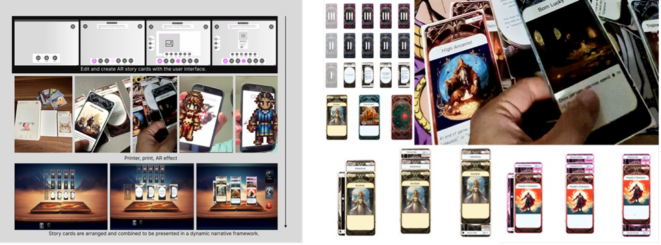
EXPERIMENTAL EQUIPMENT AND MATERIALS Card maker software (UI) printers and mobile phones that can provide AR scanning (see Figure 1). Printed cards include main event cards, branch event cards, and emotional relationship cards. A visual display board of mission backgrounds and storylines (see Figure 1). For Data Acquisition Equipment, video records user behaviour for later analysis. Finally, Analytical Tools, such as Data analysis, were performed using SPSS (e.g., ANOVA and effect size calculations). Python was used for text analysis and scoring statistics for user- generated content.
Figure 1: The process and presentation of AR story cards & paper-based cards (main- line event cards, branch-line event cards, emotional-relationship cards); visual display boards for task backgrounds and storylines. Users independently arrange the cards to form the main storyline.
Experimental materials: Cards: Include main event cards (e.g., “ Discovers the Truth” and “B’s Betrayal”), sub-event cards (e.g., “Cooperation” and “Independent Action”), and Relationship cards (e.g., “Trust” and “Conflict”). Then, we used a printed Questionnaire that included an Immersive Experience Scale (IES) and Creativity Score Scale, which are used to quantitatively measure user experience.
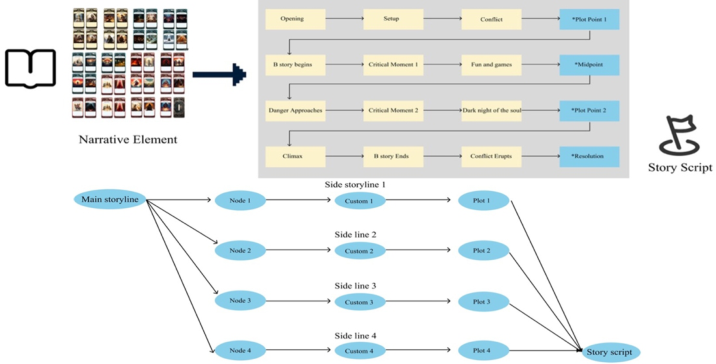
EXPERIMENTAL PROCEDURE The experiment is divided into the following steps: Firstly, participants were randomly divided into three groups to experience three types of frameworks: single-line, multi-line, and dynamic combination. In each framework, participants complete two rounds of tasks: the first is a fixed- sequence task, and the second allows the user to freely choose the branching path. Secondly, we set three task executions: Quest 1: Using a single-linear narrative framework (e.g., a single-line storyline), the user completes a fixed sequence of main card sequences (see Figure 3). Quest 2: Introducing a dynamic bonding framework where users can choose to trigger branch card events, i.e., plot point one; midpoint; plot point two, and finally, Resolution, and form four branch lines by combining and authoring (see Figure 2). Thirdly, record the user’s subjective immersion score using the Immersion Scale; video recordings of users’ behaviours and decisions in
Dynamic Narrative Frameworks: Merging Creativity and Logic 83
different frameworks; Randomly shuffle three groups of story scripts, recruit five graduate students majoring in literature, and subjectively score the user- generated story content to measure its logic, emotional depth and creative elements.
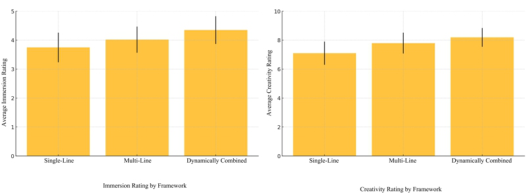
Figure 2: Narrative card - story structure mapping; narrative elements - story elements, characters, plots, emotions; typical story structure, opening, setup, conflict, critical moments, climax, and finally, resolution & “storyline framework; a diagram illustrating the structure of a story, including a main storyline that branches out into multiple side storylines, with nodes, custom elements, plots, and their connections leading to a final story script.”Figure 3: Immersion rating by framework: single-line; multi-line; dynamically combined & creativity rating by framework: single-line; multi-line; dynamically combined.
To begin with, for quantitative analysis, Analysis of Variance (ANOVA) was used. Its purpose was to assess the significant effects of different narrative frameworks on immersion and creativity scores, and the significance level was set to p < 0.05. Effect size calculations were carried out. Cohen’s d and Eta - squared were used to quantify effect sizes between different frames to support the results of ANOVA. After that, for qualitative analysis, Five graduate students majoring in literature were recruited. They scored the
84 Yu
logic, emotional depth, and diversity of creative elements of user - generated content, and then the average score was calculated. Typical plot and narrative patterns were extracted from user content to further optimize card design.
Application and optimization of results: The results of the experiment will be directly used to optimize the design of the card’s narrative framework. Firstly, for analyzing user preferences, Extract the highest - scoring narrative elements from the experimental data with the combination of user experience dimensions (e.g., “Sentiment Classification + Emotional Engagement + Creativity”). Match user preferences to card design elements and optimize the dynamic branching design of the main and the sidelines. Secondly, regarding the frame adjustment path: Adjust the hierarchy and content distribution of card frames according to the results of orthogonal experiments. Provide new templates for emotional relationship cards and branching events and show examples of optimizations in the discussion section.
POTENTIAL PROBLEMS AND CONTROLS Regarding the learning effect: The two rounds of missions use different plot content and task difficulty. This is to avoid affecting the results of the second round of experiments because of familiarity with the plot. Concerning subjective bias: Reduce the impact of bias through randomization and sample diversity. Also, explain possible limitations in the discussion section. As for environmental control, Experiments are performed in the same quiet environment. This reduces the impact of external interference on data acquisition.
In this experiment, an orthogonal experimental design system is used to explore the influence of different card narrative frameworks on user experience. The combination of quantitative and qualitative analysis provides empirical support for optimal design. Future studies can further expand the sample size. Future studies can explore the differences in user preferences in cross-cultural contexts. This exploration is to verify the applicability and universality of the optimization framework.
RESULTS
In this study, three groups of participants completed the tasks under the framework of single-line, multi-line, and dynamic combination. Participant rating data was collected through the Immersion Scale (IES) and the Creativity Score Scale, combined with a qualitative analysis of user-generated content. Here’s an overview of the key results: Immersion Score (Figure 3): The average immersion score showed that the dynamic frame (M = 4.35/5, SD = 0.48) was significantly higher than the single-line frame (M = 3.75/5, SD = 0.51) and the multi-line frame (M = 4.02/5, SD = 0.45). The results of ANOVA showed that the frame type had a significant effect on the immersion score (F (2, 87)=8.92, p < 0.01), and the dynamic combination frame was particularly prominent in the two dimensions of cognitive engagement and emotional engagement.
Dynamic Narrative Frameworks: Merging Creativity and Logic 85
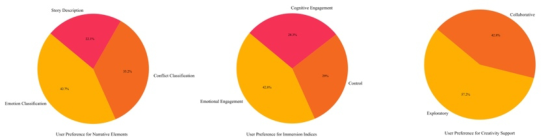
Creativity Score (Figure 3): The average creativity score for user-generated content was: dynamic combination frame (M = 8.2/10, SD = 0.65) > multi- line frame (M = 7.8/10, SD = 0.72) > single-line frame (M = 7.1/10, SD = 0.80). Qualitative scores show that user content in dynamic binding frames outperforms other frameworks in three dimensions: logic (8.5/10), emotional depth (8.3/10), and creative elements (8.1/10). Through collaborative analysis, the study quantifies the user’s preference for different card design elements, and the results show that: Narrative Element Preference (See Figure 4-left): Emotion Classification received the highest preference weight (42.7%), and users felt that emotion-driven card plots could enhance narrative engagement. Conflict Classification is the second most attractive (35.2%), especially in the context of dynamic integration. The preference for story description is low (22.1%), indicating that users are more inclined to actively participate rather than passively accept narrative content.
Figure 4: User preference for narrative elements: story description; conflict classification; emotion classification & user preference for immersion indices: emotional engagement; control; cognitive engagement & user preference for creativity support: collaborative; exploratory.
Immersion Index Preference (see Figure 4-middle): Emotional Engagement accounted for the highest proportion (37.5%), indicating that users pay more attention to the emotional triggering effect of card narratives. Control and Cognitive Engagement were 25.4% and 24.8%, respectively, reflecting users’ concerns about the degree of freedom of branch selection.
Creativity Support Preference (see Figure 4-right): The exploratory preference was the highest (40.3%), especially in the multi-line and dynamic combination frameworks. Collaborative is preferred by users in dynamic bonding frames but is rated lower in single-line frames.
Analysis of user - generated content shows that single - line frames lack plot twists, creativity, and emotional investment; multi - line frames have under - explored potential plots due to user path - choosing bias; while dynamically combined frameworks enhance story diversity, offer an attractive emotion - logic blend, and more coherent plot progression. Data analysis indicates that the dynamic bonding framework excels in immersion and creativity support, user preference points to sentiment classification and exploratory elements for optimization, and qualitative analysis validates the dynamic integration framework’s narrative potential. Based on experimental results,
86 Yu
the card narrative framework should be optimized by strengthening emotion and conflict design, improving branch selection logic and attractiveness, and enhancing user experience support.
DISCUSSION
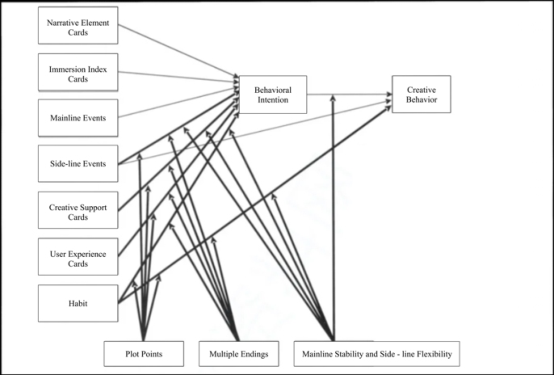
Design and implementation of a dynamic narrative framework supported by interdisciplinary (see Figure 5).
Figure 5: A model of the influencing factors of creative behaviour; bold lines represent dynamic branches.
This research framework combines narrative and card elements with a dynamic branching mechanism to model Creative Behaviour’s influencing factors, as depicted in a diagram showing relationships among factors like Narrative Element Cards, Immersion Index Cards, and more. It is complemented by technical implementation details such as AI-driven real-time analysis for plot generation and AI agents’ adaptive, emotion- driven, collaborative behaviors to enhance user experience. The framework integrates interdisciplinary approaches from psychology and narratology, achieving a balance in emotional triggering and narrative rhythm, and outperforms relevant studies in aspects like dynamic integration, multi- line framework design, and multidimensional immersion measurement. It has significant potential in practical application scenarios like education, cultural communication, psychotherapy, and team building, though different scenarios require card design optimization.
Based on experimental results and user feedback, future work should enhance emotion classification cards, adjust branching difficulty, support user personalization, and improve card visual design, while also exploring cross - cultural validation and deeper AI - framework integration.
Dynamic Narrative Frameworks: Merging Creativity and Logic 87
CONCLUSION
The framework proposed in this paper combines narrative and card elements. It provides an innovative, non-linear narrative design method through the dynamic branching mechanism. This significantly improves the user’s immersion and creativity and is of breakthrough significance in the creation and dynamic adjustment of the storyline. Experimental results show that the dynamic bonding framework performs well in the balance between narrative logic and user freedom of choice, especially in terms of emotional engagement and cognitive participation. This research provides a new theoretical basis for non-linear narrative design. It also provides an innovative solution for practical application development in the fields of education and cultural communication. In the future, the applicability of the framework can be verified in a wider range of scenarios. And the combination of AI technologies can be explored to enhance the flexibility and practical value of narrative design.
REFERENCES
Arrambide, K. (2019). Interactive Narratives in Games: Understanding Player Agency and Experience. Extended Abstracts of the Annual Symposium on Computer-Human Interaction in Play Companion Extended Abstracts, 1–5. https://doi.org/10.1145/3341215.3356334 Björklund, T. A., Keipi, T., & Maula, H. (2020). Crafters, explorers, innovators, and
co-creators: Narratives in designers’ identity work. Design Studies, 68, 82–112. https://doi.org/10.1016/j.destud.2020.02.003 Green, M. C., & Jenkins, K. M. (2020). Need for Cognition, Transportability, and Engagement with Interactive Narratives. Games for Health Journal, 9(3), 182–186. https://doi.org/10.1089/g4h.2019.0095 Jenkins, H. (2003). Game Design as Narrative Architecture. https:// www.semanticscholar.org/paper/Game-Design-as-Narrative-Architecture- Jenkins/f82f061e7a44530d1dee281b96d9b1640485aa74 Juul, J. (2010). A casual revolution: Reinventing video games and their players. MIT
Press. Lan, X., Xu, X., & Cao, N. (2021a). Understanding Narrative Linearity for Telling Expressive Time-Oriented Stories. Proceedings of the 2021 CHI Conference on Human Factors in Computing Systems, 1–13. https://doi.org/ 10.1145/3411764.3445344 Lan, X., Xu, X., & Cao, N. (2021b). Understanding Narrative Linearity for Telling Expressive Time-Oriented Stories. Proceedings of the 2021 CHI Conference on Human Factors in Computing Systems, 1–13. https://doi.org/ 10.1145/3411764.3445344 Murray, J. H. (1997). Hamlet on the holodeck: The future of narrative in cyberspace.
Free Press. Orme, S. (2022). “Just watching”: A qualitative analysis of non-players’ motivations for video game spectatorship. New Media & Society, 24(10), 2252–2269. https:// doi.org/10.1177/1461444821989350 Pacheco, J., Garbatov, S., & Goulao, M. (2021). Improving Collaboration Efficiency
Between UX/UI Designers and Developers in a Low-Code Platform. 2021 ACM/ IEEE International Conference on Model Driven Engineering Languages and Systems Companion (MODELS-C), 138–147. https://doi.org/10.1109/MODELS- C53483.2021.00025
88 Yu
Ryan, M.-L. (2010). Avatars of story. University of Minnesota Press. Scanagatta, M., Ferron, M., Deppieri, G., & Marconi, A. (2020). Calibration of game dynamics for a more even multi-player experience. Proceedings of the 25th International Conference on Intelligent User Interfaces, 443–453. https://doi.org/ 10.1145/3377325.3377521 Schwarz, A., Mertens, L., Simons, M., Spook, J. E., Thompson, D., Cardon, G.,
De Bourdeaudhuij, I., Chastin, S. F. M., & DeSmet, A. (2019). Which Game Narratives Do Adolescents of Different Gameplay and Sociodemographic Backgrounds Prefer? A Mixed-Methods Analysis. Games for Health Journal, 8(3), 195–204. https://doi.org/10.1089/g4h.2017.0178 Wade, A. (2006). Book Reviews: Half Real: Video Games between Real Rules and Fictional Worlds. The Sociological Review, 54(3), 612–614. https://doi.org/ 10.1111/j.1467–954X.2006.00631_6.x Zagal, J. P., Rick, J., & Hsi, I. (2006). Collaborative games: Lessons learned
from board games. Simulation & Gaming, 37(1), 24–40. https://doi.org/10.1177/ 1046878105282279 Zarei, N., Chu, S. L., Quek, F., Rao, N. “Jimmy,” & Brown, S. A. (2020).
Investigating the Effects of Self-Avatars and Story-Relevant Avatars on Children’s Creative Storytelling. Proceedings of the 2020 CHI Conference on Human Factors in Computing Systems, 1–11. https://doi.org/10.1145/3313831.3376331
LISTED IN THE AHFE DIGITAL BOOKSTORE CATALOGUE
Explore the complete digital volume
Human Factors in Communication of Design
Read this individual research paper free through the original publisher, or explore the full digital proceedings book.
ISBN 978-1-964867-53-3
Explore this ISBN in the AHFE Bookstore ↗Listed in the July 2026 bookstore catalogue; search by ISBN to confirm current availability · Digital book purchase optional