Oleksiy Chebykin, Olena Kosyanove, Inna Bedny (2025). Psychological Profiles of Deceivers and their Motives. In: Neuroergonomics and Cognitive Engineering. AHFE Open Access, vol. 167, pp. 73–82. https://doi.org/10.54941/ahfe1006129
Deception is a complex and multifaceted phenomenon that has a significant impact on interpersonal relationship and social structure. Study of psychological profiles of deceivers and motives that encourage them to deceive are important steps towards understanding this phenomenon. This paper examines various types of personality prone to deception and the psychological characteristics of each type. The authors’ model of operational psychodiagnostic and interpretation of data on deception attempts by different psychological profiles (psychotypes) is presented. The purpose of this study is to identify the main psychological profiles of deceivers and analyze the motives that encourage them to deceive. At the same time, we proceeded from the hypothesis that there are certain personal properties of an individual and motives, which can characterize the specificity of deception of each profile.The work summarizes and systematized the results of research on various personality characteristics that affect deception and its manifestations: responsibility as a determinant of the tendency to deceive; the attitude of individuals to various types of deception; analysis of the motives of affiliation and sincerity of the individual, the features of the motivation of adolescents and types of deception; features leading to life satisfaction and deceitfulness in adolescence; tendency to manifest risky behavior and deceitfulness of the individual; the role of the motivational-volitional sphere in the formation of characteristics of personality; the influence of predisposition to conflict inducing behavior on the tendency to various types of deception; comparative analysis of the types of deception in narcissistic and hysterical personalities, etc.To solve the above listed tasks we analyzed theoretical and methodological approaches to understanding the phenomenon of deception taking into account the psychological characteristics of the individual; substantiated methods and technologies of psychodiagnostics of deception; considered characterological, typological and individual psychological factors and determinants of deception; built a model and conducted an empirical study of the psychological profiles of deceivers and motives that encourage deception; formulated a conceptual authors’ model of operational psychodiagnostics and interpretation of data on attempts to deceive by different psychotypes.As a result of this study, we concluded that deceivers can have different psychological profiles, which include certain accentuations of character and socio-psychological attitudes. built a model of operational psychodiagnostics and interpretation of data on attempts to deceive by different psychotypes. Using the authors’ model allowed us to analyze these profiles in a detailed manner and identify key motives that encourage deception. The main motives for deception were the need for self-affirmation, avoidance of punishment, achievement of personal benefits and manipulation of others. The results of the study can be used to develop effective strategies for detecting and preventing deception in various areas of life, including business, law enforcement and interpersonal relationship.
Investigating an individual’s risk-taking and susceptibility to certain types of deception is important for understanding how and why people engage in deception. It includes analysis of theoretical and methodological approaches to understanding the phenomenon of deception; taking into account the psychological characteristics of the individual; substantiate methods and technologies of psychodiagnostics of deception; consider characterological, typological and individual psychological factors and determinants of deception; buil a model and conduct an empirical study of the psychological profiles of deceivers and motives that encourage deception; formulate a conceptual author’s model of operational psychodiagnostics and interpret data on deception attempts by different psychotypes of individuals.
It has been uncovered that deceivers have different psychological profiles, which include certain accentuations of character and socio-psychological attitudes. We’ve built a model of operational psychodiagnostics and interpretation of data collected when analyzing the attempts to deceive by different psychotypes. Using the author’s model allowed us to analyze these profiles in details and identify key motives that encourage deception. The main motives included the need for self-affirmation, avoidance of punishment, achieving personal benefits and manipulation of others. The results of the study can be used to develop effective strategies for detecting and preventing deception in various areas of life, including business, law enforcement and interpersonal relationships.
Risk-taking individuals may be more prone to deception because of their willingness to take risks and desire for immediate gain. They can use deception as a means to achieve their goals, regardless of the possible negative consequences. The combination of risky personality traits and gullibility allows for a better understanding of how these traits interact and influence human behavior. The risk-taking and deceitful personality profile include such characteristics as impulsivity, seeking new sensations, low fear of consequences, and a tendency to manipulate and lie. These individuals may use deception as a strategy to achieve their goals, often without regard to moral or ethical norms. They may be more prone to risky actions such as financial fraud or other forms of deception, which might have serious consequences for themselves and those around them.
We strived to understand the relationship between risky behavior and the tendency to cheat and attempted to build a profile of an individual who possesses such characteristics. Determining the main characteristics of motives that lead to such behavior will allow creating an accurate and detailed profile of an individual who is prone to risky behavior and to deception. Authors set the following tasks: to analyze the theoretical foundations of deceptiveness and risk-taking; to collect and analyze data on risky behavior and deception and their motives; to describe the profile of risk-taking and deceptive individuals based on collected data.
The following methods have been employed for this study: “Types of Deception” questionnaire (adapted by O.Yu. Kosyanova), used to determining various types of deception to which a person is prone; “Motives of Deception” questionnaire (adapted by Kosyanova O.Yu.) allows you to identify motives behind deception; “Diagnosis of the degree of readiness for risk” (T. Schubert) has been used to evaluates the readiness of the individual to accept risks in various life situations; “Responsibility, self- regulation, passion, risk” (V. Pryadein) has been used to comprehensively evaluate various aspects of personality, such as responsibility, ability to self- regulate, passion for certain types of activities and propensity to risk. The proposed methods made it possible to identify and quantify 18 indicators: etiquette deception (P1), altruistic deception (P2), fantasy deception (P3), deception-excuse (P4), deception-prediction (P5), gossip (P6), deception- self-presentation (P7), deception motives (P8), honesty motive (tell the true reason for one’s act) (P9), “self-defense” motive (invent explanation so as not to spoil the impression about oneself) (P10), “protecting others”
Psychological Profiles of Deceivers and Their Motives 75
(inventing an explanation so as not to upset other people) (P11), “preserving relationships”(inventing an explanation so as not to worsen the relationship) (P12), “privacy”(invent an explanation to hide the details of one’s life) (P13), willingness to take risks T. Schubert (P14), self-regulation (P15), passion for games (P16), responsibility (P17), risk (P18), self-regulation-responsibility (P19), passion for risky games (P20). The summary table of the diagnosis of the dominant types, causes and motives of students’ deceptiveness, their attitude to various types of other people’s deception, indicators of their readiness for risk, self-regulation, passion for games, responsibility and risk is the generalization of the conducted empirical research.
LITERATURE ANALYSIS The analysis of the literature on the phenomenon of deception revealed significant difference in the interpretation of this phenomenon There is a national and cultural specificity of the understanding of the concept of deception. For English speakers, it indicates the goal to influence, when the European mentality emphasis the intentional aspect and the distortion of the truth (Kosyanova, 2018).
The views of the various authors on deception can be classified as follows: firstly, deception for the sake of good (Plato, 380 BC; Hegel, 1807; Machiavelli, 1532), when it is believed that deception for the sake of good is permissible and even necessary; secondly, deception as an unacceptable form of human behavior (Bishop Aurelius Augustyn, 397; Kant, 1781); thirdly, modern studies of deception (Ekman, 1985), which always consider deception as an intentional act that can include both distortion of the truth and the suppression of essential facts. Deception is viewed as a volitional, outcome-oriented action that requires appropriate internal and external inhibitory factors (Lipman, 1922). Deception is a deliberate misrepresentation in order to achieve a certain goal (Stern, 1985); fourthly, deception as a broader concept (Bock, 1978; Hopper, 2001; Bell, 1976) in comparison with falsehood and deception. One can also deceive using gestures, symbols, codes; fifthly, the social aspect of deception in which it is a phenomenon of social order. A person lies primarily to others, and even in the case of self-deception, others are kept in mind (Berdyaev, 1994). There are three types of untruths within the interpersonal interaction: untruth as deception, untruth in the form of allegory, untruth in the form of deception. Deception is a communicative phenomenon that is a common way of establishing good relations with a partner (Znakov, 2001). A lie is an expression that is based on a sincere unconscious delusion of a person or on his complete misunderstanding of his own words (Kholodny, 2003); sixthly, the moral aspect of deception is a real powerful connection between deception and betrayal (Ilyin, 1997). Deception, in contrast to delusion and error, involves awareness of what has been done, so it is a morally unholy contradiction to the truth (Solovyev, 1999). Deception is a special influence through communication, which is aimed directly at the victim (Shalyutin, 2010); seventhly, intentional misinformation in which a person, possessing real and reliable information, provides another with deliberately distorted
data (Svintsov, 2008); eighthly, deception as manipulation is a deliberate and malicious message to the recipient of deliberately false information with a malicious purpose. Deception is considered as a peculiar form of fraud - manipulation by illegal methods (Sheynov, 2004).
Analyzing the phenomenon of risk, it should be noted that Zuckerman (1979) first singled out risk-taking as a psychological personality trait. He defined it as a desire for new, exciting and dangerous experiences. This trait may be associated with a tendency to cheat, as thrill seekers may be more willing to take risks, including cheating, to achieve their goals. The internal readiness of a person to take risks is often considered an innate quality. This means that some people may be naturally inclined to engage in risky behavior, including cheating, as a way to achieve desired outcomes (Kornilova, 2023). Research has found that people with a tendency to risky behavior are more likely to have an external locus of control (Myroshnyk, 2023). This means that they believe that their actions are controlled by external factors, which may reduce their responsibility for cheating and make them more prone to it. Modern studies show that a person takes risks due to circumstances, while he chooses the nature of the risk (action) on his own. This means that people can consciously choose deception as a form of risky behavior depending on the situation and circumstances (Lefebvre, 2023).
RESEARCH RESULTS AND ANALYSIS The first stage of the analytical work was primary statistical analysis of the data, the results of which are presented in the table below.
Table 1: Primary data of indicators of deceptiveness and riskiness.
Note: h (X) - Average value (mean) of the indicator; σ - Standard deviation (how much values vary from the average); CV - Coefficient of variability = (σ / X) × 100; shows relative variation; Me- Median (50th percentile); Mo- Mode (most frequent value); max / min - Maximum and minimum observed values in the sample; IN. p. (%) - Percentage of participants with above average values; S. year (%) - Percentage with average values; N. p. (%) - Percentage with below average values.
Psychological Profiles of Deceivers and Their Motives 77
Presented in the table data demonstrates that majority of students have average and (rarely) low levels of manifestation of the studied indicators (see Table 1). This is evidenced by the values of Mo, Me indicators, their closeness to the average arithmetic value of this sample, as well as the percentage ratio of different levels of expressiveness of indicators.
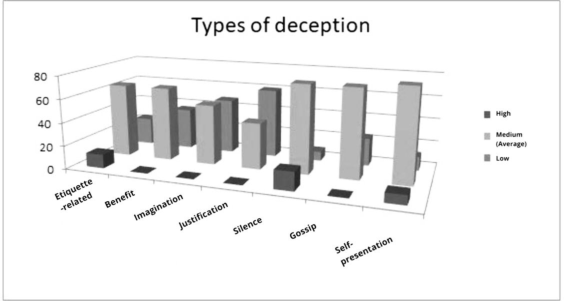
We will present the obtained statistical data more clearly in the form of diagrams (see Figure 1).
Figure 1: Distribution of the obtained results according to the “Types of deception” method.
As we can see, the vast majority of results were in the zone of average values, while there are almost no high scores for most of the indicated scales (see Figure 2). This shows that most of the students do not have an excessive tendency to deceptive. A small exception is etiquette deception and deception for the purpose of concealing the details of one’s life, which are generally considered harmless forms of manifestation of this phenomenon.
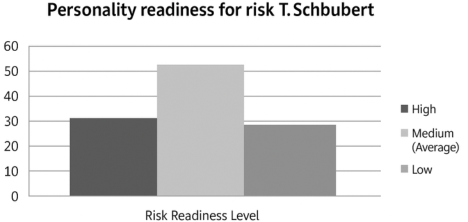
It can be seen from the graph that most of the respondents have an average indicator of readiness for risk. And a relatively small number of respondents showed a high degree of readiness for risk.
Figure 2: Distribution of the obtained results according to the method “Diagnostics of personality readiness for risk” T. Schubert.
Correlation analysis has been conducted according to the Pearson’s test, in order to find statistically significant relationships between the studied indicators (see Table 2).
Table 2: Statistically reliable relationships of indicators of deceptiveness and riski-taking.
Table available in the original PDF paper.
P14 P15 P16 P17 P18 P19 P20 P1 P2 –0.385* P3 0.370* 0.405* 0.399* P4 P5 0.476* 0.385* P6 0.344* 0.368* P7 P8 –0.506** 0.350* Business area P9 0.381* Business area P10 –0.338* –0.348* Business area P11 Business area P12 0.383* Business area P13 –0.356* Family sphere P9 Family sphere P10 –0.397* Family sphere P11 Family sphere P12 Family sphere P13 0.352* –0.647** 0.366* –0.450* 0.393*
Note: * – the correlation is statistically significant at p = 0.05 level; ** – the correlation is statistically significant at p = 0.01 level; empty cells – no statistically significant level of correlation.
Before proceeding to the descriptive analysis of the obtained results of the correlation analysis, it is worth noting that the data on the scale of motives of deception in the friendly sphere (according to the “Motives of deception” method) were excluded from Table 2, since there was no statistically significant relationship of this indicator with any others. As we can see from the summarized tabular data of the results of the correlation analysis, there is a statistically significant relationship between various indicators of deceptiveness and riskiness at two levels: p = 0.01 and p = 0.05. This allows us to draw a number of conclusions.
The negative correlation between altruistic cheating and gambling addiction (P2 and P16 (–0.385*)) reflects that individuals who are prone to altruistic cheating are less likely to have a gambling addiction because their actions are aimed at helping others and not at satisfying their own gambling needs.
The corelation between fantasy deception and willingness to take risks (P3 and P14 (0.370*)) suggests that people who frequently make up fantasies may be more prone to risky behavior because they are less afraid of the consequences of their actions. The positive correlation between fantasy deception and general risk-taking (P3 and P18 (0.405*)) indicates that fantasy deception may be associated with a high level of risk-taking, as such people often do not consider possible negative consequences of their actions. The positive correlation between fantasy deception and corelation between gambling addiction and risk-taking (P3 and P20 (0.399*)) suggests that
Psychological Profiles of Deceivers and Their Motives 79
people who make up fantasies may also be prone to gambling and risk-taking behavior.
The positive correlation between deception and responsible behavior (P5 and P17 (0.476*)) suggests that people who withhold information may be more responsible because they are willing to take risks to avoid revealing the truth. The relationship between deception-conditioning, self- regulation and responsible behavior (P5 and P19 (0.385*)) indicates that withholding information may be associated with high levels of self-regulation and responsibility. This means that people who tend to withhold information may also have a high level of self-control and responsibility for their actions, which allows them to effectively manage their behavioral risk.
The corelation between gossip and general risk-taking (P6 and P18 (0.344*)) shows that people who spread gossip may be more prone to risky behavior because they are willing to accept the risks associated with spreading false information. The positive correlation between gossip, gambling addiction and risk-taking (P6 and P20 (0.368*)) suggests that gossip may be associated with high levels of risk-taking and gambling.
The negative correlation between cheating motives and self-regulation (P8 and P15 (–0.506*))* reflects that people with a high level of self- regulation are less likely to cheat because they have better control over their behavior and emotions. The positive correlation between cheating motives and gambling addiction (Q8 and Q16 (0.350*)) indicates that people who have a high number of cheating motives may also be prone to gambling.
The positive correlation between the motive to be honest (business domain: refers to how people use specific deception motives (e.g., self-defense, protecting others) in workplace, professional, or formal settings) and the relationship between passion for gambling and risk-taking (P9 and P20 (0.381*)) suggests that people who are inclined to admit their deception may also have a tendency to gamble and take risks. This means that people who know how to admit their deception may be ready to accept the risks associated with gambling.
The corelation between self-defense motive in business and gambling addiction (P10 and P16 (–0.338*)) show that people who use deception for self-protection may be less inclined to gamble because they seek to avoid negative consequences.This means that such individuals try to avoid risky situations that could damage their image or lead to undesirable results. The negative correlation between self-defense motive in business and the relationship between gambling addiction and risk-taking (P10 and P20 (–0.348*)) indicates that people who use deception for self-protection may be less prone to gambling and risky behavior.
The positive correlation between the motive “relationship preservation” (business domain) and gambling addiction (P12 and P16 (0.383*)) suggests that people who seek to preserve relationships may be willing to accept gambling risks, to avoid conflicts and maintain harmony. This means that such individuals may use gambling as a way of maintaining relationships and avoiding conflicts.
The negative correlation between the motive “privacy” in the business sphere and self-regulation (P13 and P15 (–0.356*)) reflects that people who tend to hide the details of their lives may have a lower level of self-regulation.
The negative correlation between the self-protection motive (family sphere: refers to the same motives but in personal, intimate, or family relationships) and willingness to take risks (P10 and P14 (–0.397*)) reflects that people who use deception for self-protection in the family sphere may be less prone to risky behavior because they tend to avoid negative consequences. This means that such individuals try to avoid risky situations that could worsen their relationships or lead to undesirable results in family life.
The motive “privacy” in the family sphere (P13):
1. positively correlated with willingness to take risks (P14) (0.352*), which might show that people who tend to hide information about their lives may be more risk-averse. They may believe that risky actions will go unnoticed; 2. negatively correlated with self-regulation (P15) (–0.647**) indicates that people who tend to hide information about their lives may have a lower level of self-regulation. This may be due to the fact that they do not always control their impulses, and that leads to the need to hide their actions; 3. positive correlates with passion for games (P16) (0.366*), which suggests that people who tend to hide information about their lives may have a greater passion for games. Gambling is often a private activity that can be hidden from others; 4. negatively correlated with responsibility (P17) (–0.450*), which means that people who tend to hide information about their lives may be less responsible. They are not always ready to take responsibility for their actions; 5. positively correlates with risk (P18) (0.393*), indicating that people who tend to hide information about their lives may be more prone to risk. They may believe that their risky actions will go unnoticed.
The profile of a risk prone individual in terms of his tendency to cheat and taking into account the motives for cheating in various areas can be described as follows. Individuals who seek to hide information about their own lives may be more risk-averse, believing that their risky actions will go unnoticed. They may have a lower level of self-regulation because they do not always control their impulses, which leads to the need to hide their actions. They tend to hide information about their lives, may have a greater passion for gambling, as gambling is often a private activity that can be hidden from others. Such individuals may be less responsible, as they are not always ready to answer for their actions. Those persons who prone to altruistic deception, less likely to have a passion for gambling, since their actions are aimed at helping others, and not at satisfying their own gambling needs. Individuals who frequently fantasize may be more prone to risky behavior because they are less afraid of the consequences of their actions. They may also have a high level of self-control and responsibility for their actions, which allows them to
Psychological Profiles of Deceivers and Their Motives 81
effectively manage their behavioral risk. Persons who spread gossipers, may be more prone to risky behavior because they are willing to accept the risks associated with spreading false information.
Regarding the influence of motivation that prompts to deceive, it should be noted that individuals,who use deception for self-protection may be less inclined to gamble because they seek to avoid negative consequences. Individuals seeking to maintain a relationship may be willing to accept the risks associated with gambling in order to avoid conflict and maintain harmony. It can be assumed that they may use gambling as a way of maintaining relationships and avoiding conflict situations. Individuals who tend to hide the details of their lives may have a lower level of self-regulation. And those who use deception for self-protection in the family sphere may be less prone to risky behavior because they seek to avoid negative consequences. They try to avoid risky situations that could worsen their relationship or lead to undesirable results in family life.
CONCLUSION
In this paper social and cultural aspects of deception are analyzed. There is a national and cultural specificity of the understanding of the concept of deception. This affects how different cultures perceive and justify cheating.
There is a proven relationship between risky behavior and the tendency to cheat. Risk-taking individuals may be more prone to deception because of their willingness to take risks and desire for immediate gain. They can use deception as a means to achieve their goals, regardless of the possible negative consequences.
Motives of deception such as self-defense, protection of others, preservation of relationship and private life have been revealed. These motives can influence a person’s readiness for risk and deception in various life situations.
Correlation between deception and risky behavior is demonstrated. Data analysis showed that there is a statistically significant relationship between different types of deception and risky behavior. For example, fantasy deception is associated with a high level of risk-taking, and conditioning deception is correlated with a high level of responsibility and self-regulation.
A risk-taking and deceitful personality profile is described, which may include characteristics such as impulsivity, seeking new sensations, low fear of consequences, and a tendency to manipulate and lie. These individuals may use deception as a strategy to achieve their goals, often without regard to moral or ethical norms.
REFERENCES
Bok, S. (2011). Lying: Moral Choice in Public and Private Life. New York: Pantheon Books. p. 368. Chebykin O., Kosyanova O. (2017), Deceitfulness According to the Indicators
of Emotional Maturity Methodology and Polygraph Examination international article. Science and education. No. 7. pp. 21–31.
Chebykin O., Kosyanova O. (2017) Use of the polygraph and methods of emotional maturity to assess propensity for deception Monograph. Odesa: Leradruk LLC, 2017. p. 224. Chebykin O., Kosyanova O. (2024) Emotional Development and Youths’ predisposition an experimental study the polygraph method. Taylor & Francis Group. London and New York. p. 165. https://doi.org/10.4324/9781003483830 Ekman, P. (2009). Telling Lies: Clues to Deceit in the Marketplace, Politics, and
Marriage (4th ed.). New York: WW Norton. p. 368. Hopper, PJ (2001). Understanding Deception. Cambridge: Cambridge University Press. Kornylova, T. (2023) Adolescents of risk groups. Yurayt Publishing House, p. 273. Myroshnyk, O. G. Locus of control and reflexivity. “Habitus”, 45(2), 2023,
pp. 238–242. doi: https://doi.org/10.32782/2663-5208.2023.45.39. Zuckerman, M. (1979). Sensation Seeking: Beyond the Optimal Level of Arousal.
Hillsdale, NJ: Lawrence Erlbaum Associates.
LISTED IN THE AHFE DIGITAL BOOKSTORE CATALOGUE
Explore the complete digital volume
Neuroergonomics and Cognitive Engineering
Read this individual research paper free through the original publisher, or explore the full digital proceedings book.
ISBN 978-1-964867-43-4
Explore this ISBN in the AHFE Bookstore ↗Listed in the July 2026 bookstore catalogue; search by ISBN to confirm current availability · Digital book purchase optional