Oleksiy Chebykin, Marianna Skoromna, Inna Bedny (2024). On the Theory of Regulating Educational and Professional Activity. In: Neuroergonomics and Cognitive Engineering. AHFE Open Access, vol. 126, pp. 79–85. https://doi.org/10.54941/ahfe1004740
This paper is based on the experimental studies that demonstrate that motivational and target-oriented component are important in the structure of educational and emotional regulation of professional activity.It is known that the external motive of activity does not fully correspond to the cognitive process. This motive is mainly aimed at the final result, that is, the desire to avoid a bad assessment or desire for approval. Therefore, the emotions accompanying it, in this case, reflect the degree of relationship in the form of success or failure in the implementation of the chosen actions. A more complex structure has intrinsic motivation, which coincides with the target of educational and professional activity. The most generalized forms of manifestation of such activity are success or failure. The latter performs the function of a signaling device about the adequacy or inadequacy of intermediate performance results. Emotions are selective in nature, since they are associated with the intermediate results of the activity and are related to the achievement of its final product. They act in the form of a given product of activity, where the impulse arises from the qualitative and procedural motivation of the subject of activity, as a developing system. As we can see, there is a variety of targets that specify the development of the motive. At the same time, the emerging emotions are aimed not only at intermediate results, but also at significant connections and internal patterns of the subject content of cognitive activity. Based on the above-said and other data, the model of the mechanisms of emotional regulation of educational and professional activity can be represented by three phases. In the first phase, emotions reflect the ratio of external motives in the form of success or failure in the implementation of stereotypical action patterns. The nature of emotional manifestations is fixed, as a rule, in pleasure or not pleasure. At the same time, the mechanisms of emotional consolidation or emotional motivation for the target function. In the second phase, emotions reflect the relationship between internal motives and the final result or product. The states of success and failure that arise in this case, in contrast to satisfaction, perform the function of internal assessments of the adequacy-inadequacy of achieving intermediate results of the target. A specific mechanism of emotional regulation is the induction function, which manifests itself in confidence or doubt. In the third phase, emotional regulation characterizes the relationship between internal motives, against the background of a qualitatively developing subject content of educational and professional activity. All this allows here to apply the mechanisms of emotional regulation in the form of inductions or emotional evaluation of the result. The described functions in the conditions of real emotional regulation of educational and professional activity can be expanded: give incentive, activating, reinforcing, etc. at the first stage; reflective, selective, etc. at the second and heuristic, coordinating, and sanctioning at the final one.
Educational and professional activity is mainly focused on the training of specialists; after its successful completion, they can become certified teach- ers (trainers) in various fields of knowledge and practice. In this case, we are talking about masters degree, graduate students, doctoral students and other highly qualified specialists who in the future will independently train psychologists as teachers (trainers), managers and others. As a rule, the main bases for its implementation are various faculties of universities and special centres. The problem of improving educational and professional activities is quite relevant due to the fact that in its content it must foresee and lay in its participants not only a universe of specific skills, knowledge and necessary types of thinking, but also abilities, taking into account the advanced devel- opment of scientific achievements, innovations and practitioners in certain areas of human activity (Davydov et al., 1989). According to a lot of scientists (Vasiliev et al., 1980; Prokhorov et al., 1991), one of the important points in its content is the emotional potential that activates the cognitive activity of participants included in this process. Attempts to reveal its content can be traced in many theories of learning (Chebykin, 1999). A generalization of these and other theories allows us to single out among them three approaches regarding the disclosure of the conditions for the emotional regulation of edu- cational and cognitive activity. Thus, in the first approach, the developers of their teaching systems mainly actualize the importance of taking into account
the emotional enrichment of this process. However, they avoid describing its mechanisms and specific modelling tools in this process. Representatives of the second approach in their theories of learning mainly systematically reveal in details the logic of rational, cognitive processes and methods of introduc- ing knowledge, the formation of various types of thinking and skills. Here it is only indirectly fixed in the individual elements of the process of solv- ing a learning problem. As for the representatives of the third approach, two trends can be noted here. Within the framework of the first one, the devel- opers of their theories of learning actualize and even fragmentarily reveal the mechanism of emotional regulation of the cognitive activity of participants in the educational process. As a rule, this can be traced in theories where inno- vative approaches are fixed without their sufficient systematic presentation, which complicates the possibility of their wide use in practice. As for the sec- ond trend, here the developers of the theory of learning direct their efforts to reveal the conditions that stimulate the interest in the cognitive activity of the participants, as well as various methods that cause positive emotions. The learning theories that are associated with the third approach represent attempts to purposefully reveal the mechanisms and role of the emotional reg- ulation of the cognitive activity of the participants involved in this process. In one case, these specialists fix the mechanisms and conditions associated with the activation of interest, and reveal various techniques for its creation. In other cases, attempts are made to characterize and reveal the movements of cognitive emotions such as surprise, curiosity, inquisitiveness and others when solving a learning problem. At the same time, the tools for modelling the process of emotional regulation remain insufficiently disclosed and are actually left to the improvisation of the teacher.
In this paper, our goal is to develop a theoretical model of emotional regula- tion of educational and professional activities of trainers, future psychologists as trainers for various fields of knowledge based on a systematic approach. It is important to note that the key point in building such a model, from our point of view, should be: firstly, the stages of the process of deploying edu- cational and professional activities in the training of specialists; secondly, important emotional situations and effects stimulating cognitive activity; thirdly, organizational scientific and methodological conditions focused on creating the necessary emetogenic situations, taking into account the specifics of the cognitive process when solving a learning problem.
The results of the research also made it possible to note that an important key point in modelling the process of emotional regulation of educational and professional activity is the motivational and target-oriented component at all its stages of implementation when solving a cognitive task (Vasiliev et al., 1980, Morgun, 1984, Chebykin et al., 2008, Chebykin, 2023). Based on this provision in constructing the theory of emotional regulation of educational and professional activities, we made an attempt to reveal its content based on this component.
It is known that the external motive of activity performs the function of the target, but does not coincide with it, since it does not fully correspond to the cognitive process. Probably, this motive is more aimed at the final result, that is, the desire to avoid a bad assessment or desire for approval. Therefore,
On the Theory of Regulating Educational and Professional Activity 81
the emotions accompanying it, in this case, reflect the degree of relationship in the form of success or failure in the implementation of the chosen actions.
A more complex structure has intrinsic motivation, which coincides with the target of educational and professional activity. It can be presented: firstly, in the form of a result, where, unlike external motivation, the process of edu- cational and professional activity itself acts as an incentive. Here, the targets are strictly aimed at achieving a specific result. The most generalized forms of manifestation of such activity are also success or failure. The latter per- forms the function of a signalling device about the adequacy or inadequacy of intermediate performance results.
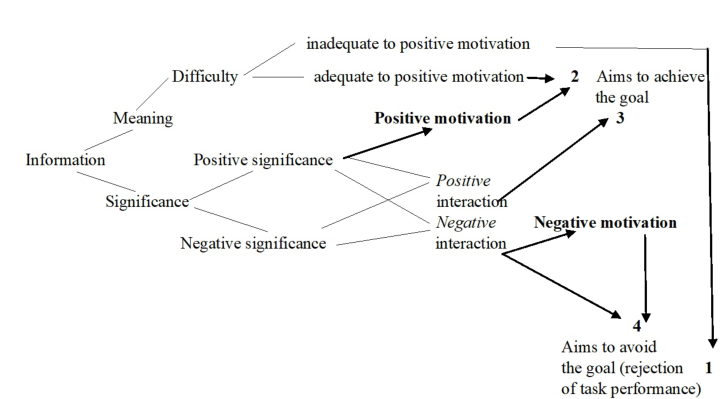
In (Bedny, 2019) the figure below describes dependence of motivation on the relationship between significance and difficulty of the task in hand.
Figure 1: The role of relationship between positive and negative significance and adequate and inadequate difficulty of task in motivation (Bedny, 2019).
Here, emotions are selective in nature, since they are associated with the intermediate results of the activity and are related to the achievement of its final product. Secondly, they act in the form of a given product of activity, where the impulse arises from the qualitative and procedural motivation of the subject of activity, as a developing system (decide in order to proceed to the next stage of knowledge; achieve in order to use; teach to gain knowl- edge; strive to be useful, etc.). As we can see, there is a variety of targets that specify the development of the motive. At the same time, the emerging emotions are aimed not only at intermediate results, but also at significant connections and internal patterns of the subject content of cognitive activity. In this case, the functions of emotion involve internal signalling about the formation of such neoplasms that lead to the transformation of the subject of activity. In this process, at its first stage associated with the development of individual educational actions, they are characterized by situational inter- est in the formation of mechanisms for the adoption of particular cognitive
targets. At the second stage, they are associated with the development of a sustainable cognitive interest, where the formation of meaning and decompo- sition of the final target in the system of intermediate ones takes place. At the third stage, a generalized selective interest arises, which becomes something like an incentive motivation for educational and professional activity.
Based on the above-said, the model of the mechanisms of educational and professional activity’s emotional regulation can be represented by three phases. In the first phase, emotions reflect the ratio of external motives such as success or failure in the implementation of stereotypical action patterns. The nature of emotional manifestations is fixed, as a rule, in pleasure or not pleasure. At the same time, the mechanisms of emotional consolidation or emotional motivation for the target function are in play here. In the second phase, emotions reflect the relationship between internal motives and the final result (product). The states of success and failure that arise in this case, in contrast to satisfaction, perform the function of internal assessments of the adequacy-inadequacy of achieving intermediate results. A specific mecha- nism of emotional regulation is the induction function, which manifests itself in confidence or doubt. In the third phase, emotional regulation character- izes the relationship between internal motives, against the background of a qualitatively developing of educational and professional activity. Here, the functions of emotions can consist of the internal signalling of the process of neoplasms’ formation leading to a change in the objects of activity in accor- dance with the laws of its development. All this allows to implement the mechanisms of emotional regulation in the form of inductions or emotional evaluation of the result. The described functions in the conditions of real emo- tional regulation of educational and professional activity can be expanded giving incentive, activating, reinforcing, etc., at the first stage; reflective, selective, etc., at the second stage and heuristic, coordinating, sanctioning at the final one.
EMOTIONAL REGULATION OF BOTH PROFESSIONAL AND EDUCATIONAL ACTIVITIES The generalization of various data (Chebykin, 2018) allowed us to dif- ferentiate three key stages in the content of educational and professional activities. At the first orienting-motivational stage of educational and pro- fessional activity, as a rule, a task that needs to be solved is presented. At the second executive stage, the search for the possibility of their solution is carried out. Here, the one that is focused on finding generalized ways to solve it can be promising. The latter makes it possible to transfer the mas- tered method to solving a whole class of various similar problems, thereby forming a theoretical (creative) type of thinking among specialists. The third reflective-evaluative stage is connected with the consolidation of the mas- tered method of solving the problem and its possible use in difficult stressful conditions. Considering these positions, as well as the results of other studies (Chebykin, 2023), we were able to conditionally present the features of mod- elling emotional situations focused on the desired effect, taking into account
On the Theory of Regulating Educational and Professional Activity 83
the deployment of educational and professional activities in this form (see Table 1).
Table 1. Peculiarities of modelling emotion-genic situations and expected effects in the process of educational and professional activities.
Essential in this process is also the movement of cognitive emotions that accompany and represent one or another emotional effect at different stages of solving a cognitive task. As our studies have shown, the latter include surprise, curiosity, boredom, resentment, bewilderment, pleasure, shame, inspiration, conjecture, interest, joy, doubt, anger, enthusiasm, disappoint- ment, fear, indifference and others. At the same time, if we talk about the ideal model of the movement of need-significant complex emotional experi- ences, taking into account the stages of the deployment of educational and professional activities, then they can be represented in this form (see Table 2).
Table 2. Necessarily significant emotional experiences taking into account the stages of educational and professional activities.
As already emphasized above, taking into consideration the severity of the described above experiences of trainees allows the teacher-organizer to man- age cognitive activity adequately. In this aspect, scientific and methodological conditions focused on ensuring the emotional regulation of educational and professional activities in the implementation of the above concepts are impor- tant. Various methods of technology, means and techniques focused on the impact of the emotional sphere of participants in educational and profes- sional activities can act here. All of them can be conditionally grouped into those that are intended for self-regulation of the emotional experiences of the teachers themselves himself and those that are aimed at the emotional regulation of students (Chebykin, 1999). The arsenal of the methods of self- regulation of the teacher’s emotional experiences that we proposed includes mainly well-known ones (Prokhorov, 2017) with a certain adaptation to
the specifics of his activity. In particular: simple (self-order words, switch- ing attention or changing activities, psycho-motor, expressive and others); complex (breathing, ideological training with elements of visualization and verbalization, autogenic training, and others). Methods of influencing the emotional sphere of students are conventionally divided into those that are associated: firstly, with the presentation of didactic material (visual and illus- trative, including using different colour and sound effects, problem tasks with varying complexity, gaming, competitive, and others); secondly, the ones implemented by the teacher himself to create the desired emotional effect on students. In particular, there are simple ones (expressive at the level of mimic and pantomimic actions, communicative, based on intonations, rhythms, various styles of communication, and others). And the complex once such as compositionally psycholinguistic at the level of improvisation or pre- prepared fragments containing humour, folklore, catchphrases, anaphora, gradations, turns, fantasies, fairy tales, etc. The latter methods are designed to act as if they were the main ones in emotional regulation in educational and professional activities, supporting and providing students with the necessary cognitive activity at each stage to effectively achieve the goals of solving the educational problem. We include in the special group of methods of emo- tional regulation of educational and professional activities those methods that are associated with the situational interaction of a teacher with students for the operational regulation of emerging spontaneous experiences, both at the individual and at the group level to reduce or level them, and vice versa for activation in order to create comfort in the audience. The latter include expressive, intonational, contacting, confidential, encouraging, prescriptive, relaxing attention switching once, etc.
The presented theoretical model of emotional regulation of educational and professional activity has been preliminary tested in the training of psy- chologists as future teacher-trainers and the possibility of its wider use for other specialists has been confirmed (Chebykin, 2017).
CONCLUSION
1. It is shown that educational and professional activities can be focused on the training of future teachers’ trainers in various fields of knowledge. It is noted that an important element in its content is the activation of the cognitive activity of trainees due to the emotional regulation of this process. 2. It is revealed that in traditional theories of learning the problem of emo- tional regulation of cognitive activity in some cases is considered only at the level of its relevance. Others are completely ignored. At the same time, there are a few theories that mainly consider fragmentary separate mechanisms and conditions for its modelling. 3. It has been revealed that the motivational and target-oriented component is the leading mechanism of the emotional regulation of cognitive activity. The authors described its features, as well as the functions of emotions and motives in relation to the deployment of educational and professional activities.
On the Theory of Regulating Educational and Professional Activity 85
4. It is highlighted that the process of emotional regulation of educational and professional activity can take place in three stages: initial acquain- tance with the conditions for solving the problem; search for a generalized way of solving it and fixing the learning method with the possibility of using it in solving other problems. 5. The leading emotional situations and effects, taking into account the deployment of educational and professional activities (at the first stage, unusualness, suddenness to create the effect of novelty, at the second stage, dramatization to create the effect of empathy, at the third stage, com- plication, encouragement to create the effect of tension, resolution) are presented. 6. The leading emotional experiences are characterized in accordance with the three stages of educational and professional activity respectively: surprise, curiosity; curiosity; interest, joy. 7. At the level of scientific and methodological support, the methods of emo- tional regulation of educational and professional activities are presented both for self-regulation of the emotional states of the teacher, and their influence on the emotional and cognitive activity of students.
REFERENCES
Bedny, G., Bedny, I. (2019). Applied and Systemic-Structural Activity Theory, Advances in Studies of Human Performance, 6, 140–141. Chebykin. O. (2023). Psycholinguistic Mechanisms of Emotion Regulation of Educa-
tional Activity. Insight: the psychological dimensions of society, 10, pp. 117–136. https://doi.org/10.32999/2663-970X/2023-10-6. Chebykin, O. (2017). Emotional Regulation of Cognitive Activity: Concept, Mechanisms, Conditions. Psychology and Society journal, vol. 69, pp. 86–102. Chebykin, O. (1999). Theory and methods of emotional regulation of educational
activity. Scientific and methodological manual. Publisher: Astro Print. Davydov, V., Lazareva, V., Nevirovich, S. (1989). On the problem of improving the methods of training leaders. Psychological journal, 1, 32–41. Milrud, R. (1987). Formation of emotional regulation of teacher’s behaviour. Issues
of psychology, 6, 47–55. Morgun, V. (1984). Typology of motives of educational activity. Study of the motivational sphere of personality. Publisher: Novosibirsk State Pedagogical Institute. Prokhorov, A. (2017). Technologies of mental self-regulation. Publisher: Kharkov. Prokhorov, A. (1991). Mental states of schoolchildren and teachers in the process of
interaction in the lesson. Issues of psychology, 5, 20–26. Vasyliev, N., Popluchnyi, V., & Tikhomirov, O. (1980). Emotions and thinking.
Publishing house of Moscow State University.
LISTED IN THE AHFE DIGITAL BOOKSTORE CATALOGUE
Explore the complete digital volume
Neuroergonomics and Cognitive Engineering
Read this individual research paper free through the original publisher, or explore the full digital proceedings book.
ISBN 978-1-964867-02-1
Explore this ISBN in the AHFE Bookstore ↗Listed in the July 2026 bookstore catalogue; search by ISBN to confirm current availability · Digital book purchase optional