Zhenhua Zheng, Qi Wang, Bo Yan, Houren Zhou, Ruofei Li (2025). Usability Analysis of Gesture Interaction in Virtual Cycling Games Based on Flow Theory. In: Intelligent Human Systems Integration (IHSI 2025): Integrating People and Intelligent Systems. AHFE Open Access, vol. 160, pp. 804–815. https://doi.org/10.54941/ahfe1005887
Virtual cycling has been increasingly implemented across various fields, including healthcare, fitness and gaming, providing a more immersive and engaging exercise experience. The authenticity of virtual cycling games relies on effective human-computer interaction, with gesture interaction demonstrating significant potential in virtual fitness applications. Currently, these games primarily utilize traditional controller interactions, requiring users to stop cycling, which results in low operational efficiency and interruptions in movement continuity. This study aims to explore user operational needs in virtual cycling games and to compare the efficacy of gesture interaction with controller interaction, thereby validating the advantages of gesture interaction. We developed a virtual cycling game using Unreal Engine, incorporating both interaction modes, and established an experimental platform to record players' speed, heart rate, and other physiological data in real time, as well as to gather user experience assessments from subjects following the experiment. The findings indicate that gesture interaction significantly enhances operational efficiency and facilitates continuity in cycling, thereby improving training outcomes. Additionally, gesture interaction fosters a more immersive flow experience. Therefore, gesture interaction in virtual fitness games can substantially elevate both user experience and exercise efficiency.
With growing health awareness and advances in entertainment technology, virtual fitness has become a popular choice for family entertainment. Over the past decade, research has shown that virtual exercise games offer a convenient, engaging, and healthy way to work out (Viana et al., 2021). These games are widely used in healthcare, rehabilitation, education and entertainment, particularly among younger users (Zayeni, Raynaud and Revet, 2020). Beyond enhancing physical health, they also improve emotional well-being and positively influence cognitive development in children and adolescents.
Usability Analysis of Gesture Interaction in Virtual Cycling Games Based on Flow Theory 805
Most current virtual sports games rely on manufacturer-provided controllers for interaction. For example, VR table tennis and VR badminton use controllers to simulate real-life motions, enhancing immersion but requiring auxiliary equipment, which limits interaction efficiency and user experience. This issue is especially pronounced in virtual cycling games, where using a controller disrupts the workout. Improving the seamlessness and naturalness of human-computer interaction has become a key focus in virtual fitness research. Gesture interaction, as a more intuitive and contactless method, addresses this challenge. To explore its potential, we developed a virtual cycling platform integrating gesture interaction with traditional inputs using Unreal Engine. We evaluated both methods in terms of user experience and workout efficiency through user experiments. This paper addresses the following research questions: RQ1: In what scenarios is gesture interaction necessary in virtual cycling games?
RQ2: Can gesture interaction enhance immersion compared to traditional controller inputs in fitness games?
RQ3: Does gesture interaction improve workout efficiency?
BACKGROUND
Gesture Interaction Gesture interaction technology captures human gestures and hand movements, translating them into commands (Yang, Premaratne and Vial, 2013). This natural form of human-computer interaction aligns more closely with user perceptions and enhances intuitiveness. Studies show that gesture interaction outperforms traditional controllers in enhancing immersion, enjoyment, and satisfaction in games and virtual reality applications. Interaction efficiency with VR controllers has also been found to be higher than with single-controller systems (Huang et al., 2020). Additionally, gesture interaction boosts engagement and entertainment in virtual exhibitions, AR games, and treadmill systems. Despite potential comfort issues, users still report interest and psychological satisfaction with this interaction method (Dardas, Silva and El Saddik, 2012). However, gesture interaction is mostly explored as a standalone approach, with limited direct comparisons to traditional methods to assess its advantages and areas for improvement.
Virtual Cycling Game Virtual cycling was initially applied in the medical field, aiming to enhance patients’ physical rehabilitation through virtual environments and make the rehabilitation process more enjoyable (Han, 2004). With technological advancements, the application has expanded beyond the medical field into education and entertainment. Zhao et al. integrated gamification design into traditional riding modes, elevating the entertainment value of virtual riding to new heights (Zhao et al., 2019). Design elements in cycling games are closely tied to users’ emotional experiences, with different designs effectively stimulating various emotions and enhancing immersion.
However, fewer studies have focused on gesture interaction methods in cycling games. Darda explored the use of gesture interaction in a riding-shooting game, translating steering and shooting tasks into gesture commands, allowing players to complete the game without dismounting from the vehicle (Dardas, Silva and El Saddik, 2012). This study offers valuable insights for our research.
METHODS
Flow Theory Introduced by Csikszentmihalyi in the 1970s, the flow theory refers to the state of immersion achieved when an individual is fully engaged in an activity. The theory has been widely applied in experience design, interaction design, and product design. Finneran and Ping Zhang proposed the PAT model (Person-Artifact-Task) within the framework of flow theory (Finneran and Zhang, 2003). Using this model, we analyze a virtual cycling game by identifying the “person” as a teenager, the “artifact” as the cycling system, and the “task” as the teenagers’ fitness activity within the cycling system. This model is applied to study the interactive behaviors in a virtual cycling game.
Physiological Experiment Numerous studies have shown that the flow experience can be reflected in physiological signals. Researchers like Harmat, Katahira, and Tian Y have investigated changes in indicators such as heart rate variability, cardiovascular function, respiratory depth and skin conductivity during flow states (Harmat et al., 2015; Tian et al., 2017). Our study follows a similar approach, examining the physiological indicators during adolescents’ interaction with the cycling game.
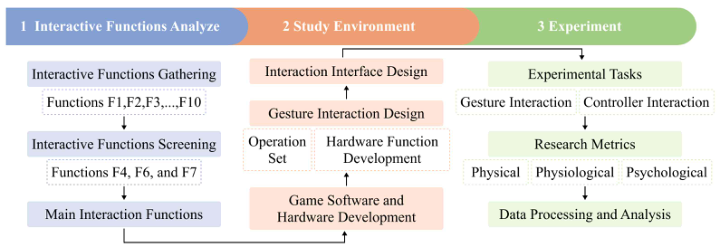
Research Path of Gesture Interaction Study for Virtual Cycling System Based on Flow Theory In this paper, the research on the online cycling fitness system is divided into two areas: online cycling software design and interaction behavior models. Drawing from the flow theory, we analyze the interaction experience between adolescents and the online cycling system through in-depth interviews and on-site observations, integrate the interaction requirements, and propose a gesture interaction design for the online cycling system. To verify the feasibility, we developed prototypes for the online cycling software and gesture interaction system. A controlled experimental method was then employed to explore whether the online cycling fitness system can induce a flow experience, using three dimensions: objective physical index, physiological signals and subjective psychological experience questionnaires. The research path is shown in Figure 1.
Usability Analysis of Gesture Interaction in Virtual Cycling Games Based on Flow Theory 807
Figure 1: Research path.
INTERACTIVE FUNCTIONS ANALYZE For the first research question (RQ1), we analyzed the core function of the virtual cycling system interface. Drawing from Daniel et al.’s research on the audiovisual and functional modules of the Zwift platform (Westmattelmann et al., 2021), and integrating features from Peloton and “Stubborn Deer Athletic,” we identified 10 core modules (F1 to F10). Then, we recruited 20 volunteers (13 males, 7 females), aged 19 to 25, all experienced in cycling games. The volunteers used the “Zwift” and “Stubborn Deer Athletic” platforms for a 30-minute session, and we recorded their use of interactive functions in real time (see Table 1).
Table 1. Summary of interactive features in cycling games.
Table available in the original PDF paper.
ID Function Cycling Phase Occurrence Frequency
19 95%
F1 Review Riding Records After Cycling 16 80% F2 Community Services Before Cycling 12 60% F3 Training Courses Before Cycling 17 85% F4 Select/Switch Cycling Maps Before Cycling / During Cycling
10 50%
F5 Select Cycling Mode Before Cycling 20 100% F6 Enter/Exit Voice Channel Before Cycling / During Cycling
12 60%
F7 Switch Background Music Before Cycling / During Cycling
17 85%
F8 Switch Riding Resistance Before Cycling / During Cycling
Before Cycling 8 40%
F9 Change Virtual Avatar Before Cycling 19 95% F10 Adjust Volume/Graphics and Other Auxiliary Functions
The results categorize interactive functions into three phases: before, during, and after cycling. Before and after cycling, users generally do not interact with the interface while on the bike. However, during the ride, some operations can affect or even interrupt the game. The time it takes to interrupt
and get back on the ride again for a simple function often exceeds the time required to make selections, negatively impacting the user experience. To improve this, gesture interaction is recommended for low-frequency, high- disruption functions F4, F6, and F7 (except for F8, which can be done on the bike). Thus, these functions were selected for conversion into interaction tasks in our experiments.
STUDY ENVIRONMENT Game Software and Hardware Development
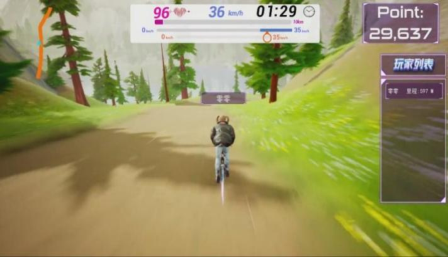
In terms of software, we developed a virtual cycling prototype system using Unreal Engine 4 (UE4) on a PC running Windows 10. The interactive functions were implemented using C++ and the Blueprint visualization programming tools, while the user interface and data presentation utilized UMG tools and gameplay mechanisms to display real-time data, such as heart rate, speed, and cycling time (as shown in Figure 2). To verify function F6, the system also supports multi-user online functionality through UE4’s RPC mechanism and Dedicated Service.
Figure 2: Data display interface of the virtual cycling software.
Regarding hardware, we utilized the ‘Han Ma’ exercise bike to input cycling data and monitor metrics such as cycling speed and heart rate in real-time. The data is transmitted to the UE4 platform through interfaces like serial communication and Bluetooth. The virtual cycling software was deployed on a laptop running Windows 10 and utilized a PICO VR device for output.
Gesture Interaction Design and Hardware Function Development Gesture design should prioritize low cognitive load, alignment with cognitive habits, minimized learning costs, and one-handed gestures to prevent fatigue, consistency, and conflict avoidance. Based on these principles, we developed the gestures in Table 2. Ten testers unfamiliar with gesture interaction scored above 85, indicating that the gesture design is easy to accept, learn, and operate.
Usability Analysis of Gesture Interaction in Virtual Cycling Games Based on Flow Theory 809
Table 2. Gesture interaction operation set.
Table available in the original PDF paper.
Open Menu Close Menu Confirm Select Function on the Right
Select Function on the Left
Spread Fingers
Fist Gesture Press Palm Forward
Swing Hand Leftward
Swing Hand Rightward
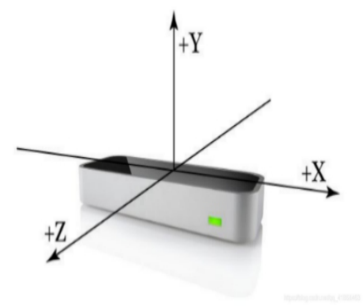
We use Leap Motion as the gesture acquisition device due to its high- precision tracking and lower environmental requirements. The effective recognition range of Leap Motion is from 0.03 to 0.6 meters above the device, with a field of view of approximately 150 degrees and a sample rate of 215 frames per second. The Cartesian coordinate system is employed to represent gesture motion (see Figure 3 (left)). To accommodate users’ operational needs and range of motion during cycling, we positioned the Leap Motion device between the handrails of the exercise bike to ensure that gestures were accurately recognized within a natural range (see Figure 3 (right)). The gesture interaction function is integrated with the virtual cycling software we developed, utilizing Leap Motion’s SDK and UE4’s Ultraleap Tracking plug-in to obtain spatial coordinate information of hand feature points through Blueprint scripting or C++ code, and employing a dynamic motion threshold for gesture recognition.
Figure 3: Leap motion coordinate system (left) device placement position (right).
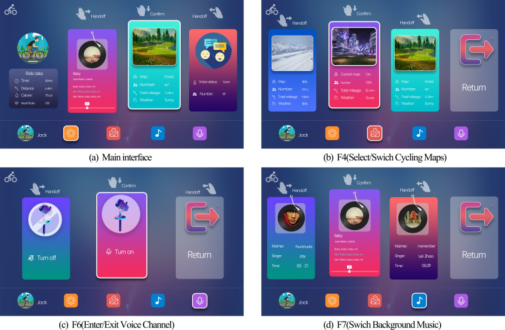
Interaction Interface Design For functions F4, F6, and F7, we designed a gesture interaction UI and added a main page as the entrance, which allows users to quickly access the selection interface for these functions from the home page via gestures (see Figure 4).
Figure 4: Gesture interaction interface.
EXPERIMENT Research Metrics
This experiment aims to comprehensively evaluate the advantages and disadvantages of gesture interaction versus controller interaction during cycling. We investigated the effects of these two interaction modes on users’ cycling experiences through an in-depth analysis from three dimensions: physical, physiological, and psychological.
(1) Physical dimension: We assessed time efficiency by measuring the operational times of functions F4, F6, and F7 using both interaction methods. (2) Physiological dimension: The depth of heart flow experience is positively correlated with physiological signals such as heart rate (HR) and heart rate variability (SDNN) and inversely correlated with the heartbeat interval (IBI) (Ullén et al., 2010). The specific indicators and their meanings are shown in Table X. In this experiment, these three indicators are used to measure exercise intensity and analyze the effects of different interaction modes on cyclists to maintain the optimal exercise effect (60%–70% of the maximum heart rate). (3) Psychological dimension: Considering the evaluation perspectives of most researchers and the characteristics of the “virtual sports scene” in this experiment, we evaluated the user experience of the two interaction modes in terms of interaction efficiency, learning difficulty, accuracy, overall satisfaction, memorability, and immersion.
Experiment preparation A total of 17 participants (14 males, 3 females), aged 18–25 years old, were recruited for this experiment. Among them, 52.2% had not been exposed to gesture interaction and 76.4% had been exposed to virtual cycling or similar virtual fitness games. The experiment was conducted indoors to minimize the effects of weather and humidity on physiological signals. Physiological
Usability Analysis of Gesture Interaction in Virtual Cycling Games Based on Flow Theory 811
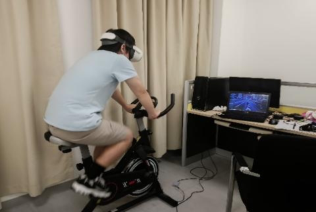
signals were measured using the Zinfar Technology ErgoLAB II system (ECG and RESP modules). The virtual cycling data were inputted using a “Han Ma” dynamic bicycle, the PICO VR device was used as the output, and Leap Motion was used for gesture acquisition, and the experimental scene is shown in Figure 5.
Figure 5: Physiological experiment scene.
Experimental Procedure Before the experiment, we explained the experimental procedure in detail to the 17 participants and asked them to familiarize themselves with the three functional interaction tasks of F4 (Select/Switch Cycling Maps), F6 (Enter/Exit Voice Channel), and F7 (Switch Background Music) and the related dynamic gestures. Before the experiment starts, we wore physiological data collection devices for the participants and instructed them to warm up moderately in order to avoid injuries during cycling.
After ready, participants started riding. While riding, the riding speed when their heart rate reached the optimal zone and remained stable was recorded, and the functions F4, F6, and F7 were completed using gesture interaction and controller interaction, respectively, for a total of 6 interactions with an interval of at least 5 minutes between each one to ensure that the heart rate returned to the initial level. Before each interaction, participants had 1 minute to recall the operation content to avoid relying on the outline and affecting the real interaction experience. Subjects completed a 30-minute riding experience, and the specific experimental procedure is shown in Table 3.
Table 3. Specific procedure of the subject riding experiment.
Table available in the original PDF paper.
Min Participants Behavior 0–5 Log into two software programs and perform tasks such as avatar customization, social interaction, and browsing information. 2–20 Maintained a constant cycling speed of 10 km/h. 20–23 The three tasks included selecting/toggling the ride map, entering/exiting the voice channel, and selecting/toggling the background music. Participants used both gesture interaction and controller input to complete these tasks. 23–30 Maintained a constant cycling speed of 10 km/h.
After completing all tasks, participants filled out an experience questionnaire for both interactions, rating the scale for five aspects about the experience. During the non-interactive phase, we observed and recorded the cycling speed in real time to ensure that the participants’ exercise intensity remained consistent, thus minimizing the effect of changes in exercise intensity on heart rate.
DISCUSSION
Physical and Physiological Data Processing and Analysis The measured physiological signal data were processed using wavelet noise reduction and high/low-pass filtering to eliminate interfering signals, such as environmental noise and pulse artifacts. The interaction data were organized as shown in Table 4. Here, T represents the time taken to complete the task using the two interaction methods; HD denotes the difference between the average heart rate during cycling and the heart rate during the interaction, indicating the degree of heart rate fluctuation; and BD represents the difference between the average respiratory rate during cycling and the respiratory rate during the interaction, reflecting the degree of respiratory rate fluctuation.
Table 4. Average data generated by 17 participants completing three tasks.
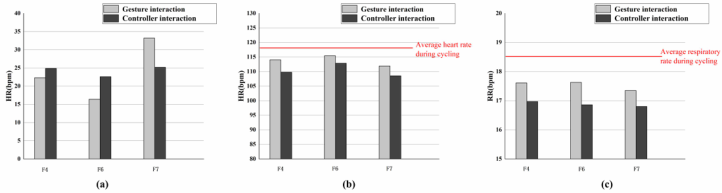
Figure 6: Time required (a), average heart rate (b), and average respiratory rate (c), during experiment using gesture interaction and controller interaction respectively.
As shown in Figure 6(a), gesture interaction required less time than controller interaction for the F4 and F6 functions, as the latter involved an additional “slow down or pause the game” step. However, for the F7 function (music selection/switching), gesture interactions took longer due to the need to swipe through options individually, while keyboard and mouse interactions allowed faster scrolling. Despite this, 94% of participants
Usability Analysis of Gesture Interaction in Virtual Cycling Games Based on Flow Theory 813
preferred gesture interaction for F7, citing clearer visibility and greater engagement. This aligns with our design objective of minimizing task complexity during cycling through gestures.
As shown in Figure 6(b), both interaction methods led to a heart rate decrease during F4, F6, and F7, though the decrease was less pronounced with gesture interaction. This is attributed to continuous, albeit lower-intensity, physical activity during gesture interaction compared to the pauses required for controller interaction.
As shown in Figure 6(c), the trend for respiratory rate is similar, with gesture interaction resulting in a smaller reduction compared to controller interaction. The degree of decrease was directly proportional to interaction time. Overall, gesture interaction maintained higher exercise intensity and facilitated quicker recovery of heart and respiratory rates post-interaction, thereby enhancing exercise efficiency.
The analysis indicates that gesture interaction better sustain the cyclist’s exercise state, leading to smaller decreases in heart and respiratory rates during interaction, thus faster recovery to the original intensity and enhancing exercise efficiency.
Psychological Data Processing and Analysis At the end of the experiment, participants rated satisfaction with gesture and controller interactions using a five-point Likert scale (1 = very dissatisfied, 5 = very satisfied). The results are shown in Table 5.
Table 5. Questionnaire survey data for two interaction modes.
As shown in Table 5, gesture interaction significantly outperforms traditional controller interaction in terms of efficiency and immersion, though it has slightly higher learning difficulty and error rates. Gesture interaction excels with fewer menu items, while controller interaction is more efficient with larger map or music menus. The need to dismount during controller interaction disrupts the riding state, reducing immersion. In contrast, participants were more familiar with controller interaction, leading to better accuracy and lower learning difficulty. Some participants reported feeling anxious during controller interaction, and eager to resume riding, whereas this anxiety was reduced with gesture interaction.
The results support our hypothesis that introducing gesture interaction in virtual cycling games enhances user experience. Gesture interaction enables quicker operations in most scenarios, particularly in simpler tasks. On the physiological level, gesture interaction allows users to continue exercising during interactions, helping to maintain exercise intensity and physical arousal. Psychologically, gesture interaction is more engaging and significantly improves user experience in terms of efficiency and immersion. Although gesture interaction shows advantages during cycling, controller interaction remains more suitable before and after riding. Therefore, combining both interaction modes offers a more comprehensive user experience.
CONCLUSION
With the growth of the virtual sports market and the increasing segmentation of online sports products, the need for designing online cycling fitness systems for teenagers has become more evident. Current online cycling fitness systems prioritize exercise outcomes but often neglect the cultivation of positive exercise emotions. This paper applies flow theory to the interaction design of youth virtual cycling games, enhancing user experience and interaction logic. It deepens the investigation into flow theory’s application, offering new insights for experience design and fitness platform development. It can be extended to other areas, such as “online running” and “online rowing.”
This study demonstrates the feasibility of gesture interaction in virtual cycling games from both physiological and psychological perspectives. It shows that combining gesture interaction with controller interaction offers a seamless user experience. However, limitations still exist, and future research can focus on reducing the high learning curve of gesture interaction for unfamiliar users. Enhancing the efficiency of gesture interaction for complex tasks by improving interface design and layout. Exploring the optimal placement of gesture recognition hardware, as this study used a fixed location on the riding platform.
ACKNOWLEDGMENT
The authors would like to thank Bo Yan for his kind guidance.
REFERENCES
Dardas, N. H., Silva, J. M. and El Saddik, A. (2012). “Target-shooting exergame with a hand gesture control”, Multimedia Tools and Applications, 70, pp. 2211–2233. Han, S. (2004). “Study of Interactive Gymnastic Bicycle System Based on Virtual
Reality”, Development & Innovation of Machinery & Electrical Products. Harmat, L., de Manzano, Ö., Theorell, T., Högman, L., Fischer, H. and Ullén, F.
(2015). “Physiological correlates of the flow experience during computer game playing”, International Journal of Psychophysiology, 97(1), pp. 1–7. Huang, Y. J., Liu, K. Y., Lee, S. S. and Yeh, I. C. (2020). “Evaluation of a Hybrid of Hand Gesture and Controller Inputs in Virtual Reality”, International Journal of Human–Computer Interaction, 37(2), pp. 169–180.
Usability Analysis of Gesture Interaction in Virtual Cycling Games Based on Flow Theory 815
Tian, Y., Bian, Y., Han, P., Wang, P., Gao, F. and Chen, Y. (2017). “Physiological Signal Analysis for Evaluating Flow during Playing of Computer Games of Varying Difficulty”, Frontiers in Psychology, 8, 1121. Ullén, F. et al. (2010), “The physiology of effortless attention: correlates of state
flow and flow proneness”, Effortless attention: A new perspective in the cognitive science of attention and action, 205, pp. 205–218. Viana, R. B., Oliveira, V. N., Dankel, S. J., Loenneke, J. P., Abe, T., Silva, W. F., Morais, N. S., Vancini, R. L., Andrade, M. S. and Lira, C. A. B. (2021). “The effects of exergames on muscle strength: A systematic review and meta-analysis”, Scandinavian Journal of Medicine & Science in Sports, 31(8), pp. 1592–1611. Westmattelmann, D. et al. (2021), “Exploring the adoption of mixed-reality sport
platforms: A qualitative study on Zwift”, European Conference on Information Systems. Yang, S., Premaratne, P. and Vial, P. (2013). “Hand gesture recognition: An overview”. In 2013 5th IEEE International Conference on Broadband Network & Multimedia Technology, IEEE, Guilin, China, pp. 63–69. Zayeni, D., Raynaud, J.-P. and Revet, A. (2020). “Therapeutic and Preventive Use of
Video Games in Child and Adolescent Psychiatry: A Systematic Review”, Frontiers in Psychiatry, 11(36). Zhao, D., Su, J., Tan, C. T., Alexandru Dancu, Lui, S., Shen, S. and Mueller, F. F.
(2019). “GameLight - Gamification of the Outdoor Cycling Experience”, DIS ’19: Designing Interactive Systems Conference 2019, Association for Computing Machinery, New York, pp. 73–76.
LISTED IN THE AHFE DIGITAL BOOKSTORE CATALOGUE
Explore the complete digital volume
Intelligent Human Systems Integration (IHSI 2025): Integrating People and Intelligent Systems
Read this individual research paper free through the original publisher, or explore the full digital proceedings book.
ISBN 978-1-964867-36-6
Explore this ISBN in the AHFE Bookstore ↗Listed in the July 2026 bookstore catalogue; search by ISBN to confirm current availability · Digital book purchase optional