Lai Man Tin, Xiaoqiao Li, Tsz Fung Lam (2025). Advanced Computational Modeling and Simulation for Immersive Virtual Reality Experiences: Preserving Hong Kong's Traditional Handicrafts. In: Intelligent Human Systems Integration (IHSI 2025): Integrating People and Intelligent Systems. AHFE Open Access, vol. 160, pp. 749–758. https://doi.org/10.54941/ahfe1005881
This research investigates the preservation of Hong Kong’s traditional handicrafts, specifically porcelain paintings (Guangcai), through advanced computational modeling and Cave Automatic Virtual Environment (CAVE) systems. The study develops an interactive digital platform that transforms traditional artistic expression into contemporary digital experiences by combining physics-based simulation, haptic feedback, and immersive narratives within a Virtual Reality (VR) framework. The methodology consists of several critical modeling and simulation components, including data digitalization, rendering optimization, real-time performance and interactive solutions, creating an essential framework for cultural heritage preservation in various fields while demonstrating the potential of computational modeling in bridging traditional handicrafts with modern technology.
Traditional Hong Kong handicrafts, particularly porcelain painting in this research, represent both artistic skill and cultural heritage, embodying generations of craft knowledge and historical stories. However, these precious cultural practices risk disappearing due to numerous factors such as globalisation, industrialisation, and a declining number of successors. Computational modeling and simulation techniques offer remarkable opportunities for digital preservation of traditional handicrafts. Current cultural preservation methods, ranging from conventional documentation such as photographs, videos, and written records, to digital means like electronic interactive displays, mobile devices and VR headsets, lack the complexity and interactive nature of handicraft techniques, nor do they provide narrative elements that allow users to immerse themselves in the cultural heritage. The limitations can be overcome through advanced computational modeling that simulates artistic craftsmanship, physical properties, and cultural narratives within the digital humanities context.
Our research investigates the application of advanced computational modeling techniques for the digital preservation of traditional Hong Kong porcelain painting within immersive virtual environments. We propose a novel framework through Cave Automatic Virtual Environment (CAVE) systems to create high-fidelity digital representations of traditional craft processes. The investigation explores the integration of virtual reality (VR) technology and simulation engine to bridge the gap between traditional artistic expression and contemporary digital preservation methodologies.
The proposed framework contains three key components: firstly, the integration of cultural narratives within the virtual space. Secondly, the development of digital representations of traditional porcelain painting production techniques. And thirdly, the implementation of real-time visualisation systems within an immersive environment. Through this technological implementation, we seek to establish an innovative digital platform for cultural heritage preservation and transmission.
TRADITIONAL HONG KONG PORCELAIN PAINTING Hong Kong’s tradition of porcelain painting began in the early 20th century with the establishment of Yuet Tung China Works by Tso Lu Song in 1928. Relocating from Guangzhou to Kowloon City, Yuet Tung became Hong Kong’s first ceramic factory, laying the foundation for a distinctive artistic legacy in the region. The craft experienced significant growth during the 1950s and 1960s, establishing Hong Kong as a central hub for artistic porcelain production. It reached its peak in the 1980s and 1990s, attracting international clients, including royal commissions (Hong Kong Memory, 2018). Chui and Tsoi’s research (2003) revealed that Hong Kong, with a history of over 6,000 years, has evolved from a humble fishing village into a prominent Asian financial hub. The city, grappling with significant challenges in safeguarding its historic structures due to limited land, high population density, and intense urban development pressures, underscores the importance of preservation efforts. The primary reasons for preserving heritage encompass historical and cultural significance, social value in fostering a sense of belonging, economic potential for tourism, and promoting sustainable development.
The tradition of porcelain painting in Hong Kong is being upheld through the dedicated efforts of various institutions. Both the Hong Kong Heritage Museum and the Sun Museum house extensive collections of historical pieces, providing a comprehensive record of the development of local styles and techniques. In addition to these efforts, contemporary preservation initiatives such as the “Clay-elaboration” initiative and the “Be a Little Porcelain Painter” Family Workshop at Hong Kong Heritage Museum have been introduced to breathe new life into ceramic arts by fostering collaborations between traditional craftsmen and modern artists. These innovative programs not only serve as educational platforms but also play a crucial role in ensuring the continuity of this cherished cultural tradition.
Advanced Computational Modeling and Simulation 751
The art of porcelain painting in modern Hong Kong faces several significant challenges, particularly regarding the transmission of traditional techniques. The apprenticeship model of passing down knowledge is struggling to remain relevant in today’s fast-paced society. Master artists at Yuet Tung China Works have encountered technical complexities in preserving this art form. These challenges include working with non- absorbent porcelain surfaces, managing water content in colour enamels, controlling pigment thickness, avoiding colour overlap, adapting painting techniques from paper to porcelain surfaces, and understanding specific mineral and silica-based pigment formulations (Hong Kong Memory, 2018).
Additionally, economic pressures often lead practitioners to compromise traditional methods for more commercially viable approaches. The distinction between traditional Guangcai - known for its rich colours and intricate designs - and the more artistic expressions of modern masters adds another layer of complexity to preserving this diverse tradition (Hong Kong Memory, 2018). Balancing commercial demands with the preservation of traditional craftsmanship remains a significant challenge for the continued vitality of Hong Kong’s porcelain painting heritage.
COMPUTATIONAL MODELING, REAL-TIME RENDERING PIPELINE AND CULTURAL NARRATIVES Cultural Narratives
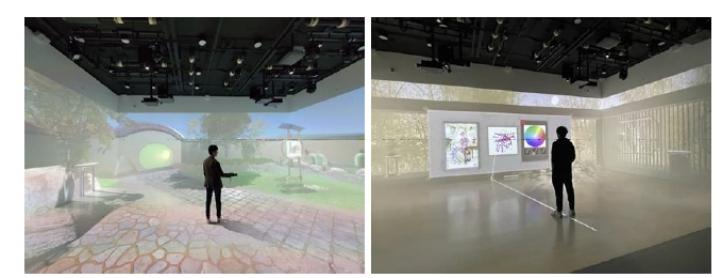
The Cave Automatic Virtual Environment (CAVE) systems used in this research consist of a multi-wall projected environment in the 270-degree CAVE system and a panoramic projection setting in the 360-degree CAVE system. Occupying an area of about 1,700 sq. feet, these systems represent a significant advancement in immersive visualization technologies for implementing cultural heritage preservation. The two CAVE systems enable users to have substantial spatial experiences through interaction with the virtual environment and digital artifacts. Moreover, with the 7.1 surround sound audio system installed, these effectively scaled CAVE systems offer advantages over VR headsets through users’ bodily experiences within the CAVE space, establishing richer and more interesting virtual experiences to the users (Christou et al., 2006).
The CAVE system architecture, powered by the Unity industrial game engine and equipped with laser motion-tracking (270-degree CAVE) and infrared motion-tracking (360-degree CAVE) systems, emphasizes high- fidelity visualization and precise interaction essential for traditional craft preservation within an interactive virtual space.
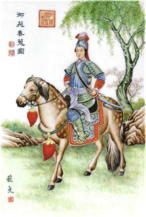
Under these configurations, the two CAVE systems enable immersive cultural narrative approaches. The porcelain paintings, provided by Mr. Lee Siu-man, a leading porcelain and antique painter in Hong Kong who is skilled in various Chinese and foreign subjects and respected for his porcelain paintings of ancient figures, are employed and presented in the two CAVE systems based on their specifications and relevancy to digital narratives.
Based on the current research about cultural heritage preservation through immersive technology, for example the use of Immersive VR experience to
motivate users interests in cultural heritage and the relevant application to the domain of digital cultural heritage experiences (Sun, et al., 2023), we further investigate cultural heritage representation and narrative structure implementation in CAVE systems to address research gaps regarding limited discussion of CAVE-specific navigation and storytelling for Hong Kong traditional handicrafts.
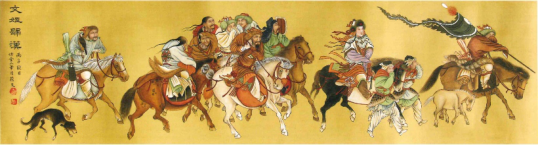
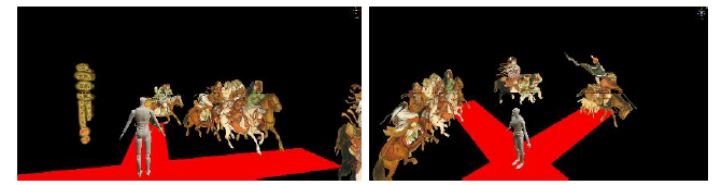
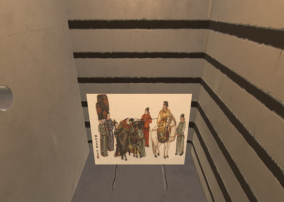
One porcelain painting, titled “Wen Ji Returning to Han,” (see Figure 1) is presented in the 360-degree CAVE, as the panoramic setting enables fully surrounded immersive imagery representation. The research explores the connection between traditional artistic expression and digital narrative. By utilizing the Unity engine and immersive technology, we investigate whether VR could simulate historical story settings and reinterpret classic tales, specifically “Wen Ji Returning to Han” in this case (see Figure 2).
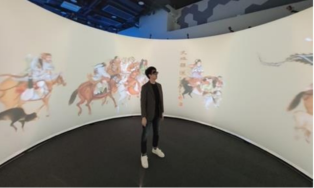
We simulated the historical story settings by recreating the scene of “Wen Ji Returning to Han,” where Wen Ji, a brilliant and beautiful woman from ancient China, escaped from Xiongnu and returned to the Han Dynasty. Our research transformed the static painting into an animated representation, simulating the movements of horses, dogs, flags, clothes, and the subtle movements of people riding horses and walking at different paces, while maintaining the ability to return to the painting’s original starting point. Through the Immersive VR system, the animated “Wen Ji Returning to Han” was seamlessly simulated and presented within the 360-degree CAVE. With 3D projection technology and active stereo 3D glasses, the project allows audiences to immerse themselves and perceive the historical story vividly (see Figure 3). The research illustrates the possibilities of VR systems, particularly CAVE-based systems, for simulating, representing, and serving educational purposes in historical storytelling for cultural narratives.
Figure 1: “Wen Ji Returning to Han” porcelain painting by Mr. Lee Siu-man.Figure 2: Simulation of “Wen Ji Returning to Han” porcelain painting in Unity, indicating audience’s viewpoint within a panoramic projection.
Advanced Computational Modeling and Simulation 753
Figure 3: Animated “Wen Ji Returning to Han” porcelain painting presented within a 360-degree Immersive CAVE system with 3D projection and effect.
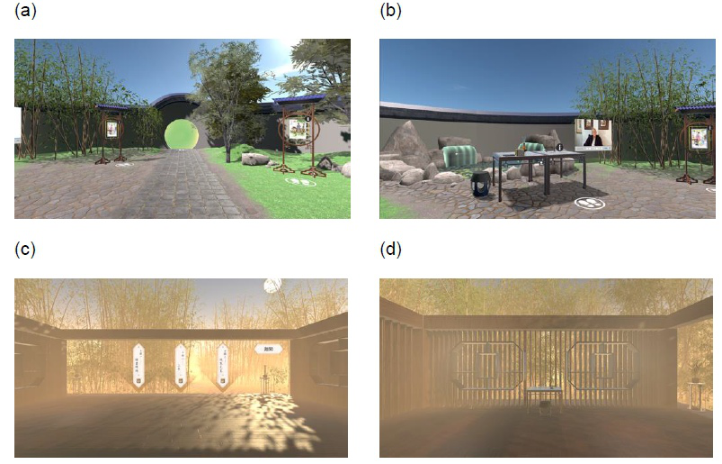
Similarly, we employed the 270-degree CAVE system to present selected porcelain paintings by Master Lee. We created two scenes that allow users to navigate through the virtual space within the immersive CAVE system and interact with digital artifacts, including the paintings and Master Lee’s documentary video, as well as a digital workshop to experience traditional porcelain painting production in an immersive VR environment respectively (see Figure 5). The scenes we developed are based on traditional Chinese garden and pavilion styles, maintaining consistency with traditional Chinese art forms and remaining cohesive with the traditional Hong Kong porcelain painting aesthetic styles (see Figure 4).
Figure 4: Scene 1 design for porcelain paintings and Mr. Lee Siu-man’s documentary video presentation in the 270-degree Immersive CAVE system (a-b). Scene 2 design for the workshop virtual environment in the 270-degree Immersive CAVE system (c-d).Figure 5: User’s interaction and navigation in scene 1 & 2.
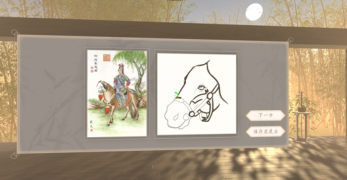
The research employed advanced 3D modeling and animation techniques to present traditional porcelain paintings into dynamic immersive VR environments (see Figure 6). The modeling pipeline utilized industry- standard 3D graphics software, including 3ds Max and Blender, to create 3D models to ensure surface details and visually compelling. Through these tools, we implemented high-quality polygon modeling for detailed architectural details and environmental designs, followed by processing effects for real-time rendering in the CAVE systems. The development of the paintings’ animations, utilizing keyframe animation techniques, focused on representing historical story while preserving the essence of the original paintings and reflecting cultural details.
The technical implementation was enhanced by skeletal animation systems and timeline management, which enriched the sequential presentation and animation across the paintings. For character animation in the paintings, we developed custom animation techniques to achieve natural movement patterns relevant to the story behind. The timeline implementation in Unity enabled precise control over animation sequences, allowing for seamless transitions between different narrative elements and environmental states.
Figure 6: Transformation of porcelain painting into 3D model and animated graphics.
The environmental design drew inspiration from traditional Chinese gardens and pavilions, featuring dynamic elements such as animated water surfaces using shader-based water effects, foliage with wind animation, and
Advanced Computational Modeling and Simulation 755
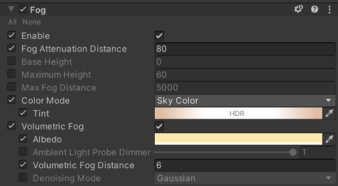
carefully crafted terrain with displacement mapping. The man-made items within the environment, including architectural elements and decorative objects, were modelled with attention to Chinese historical and cultural authenticity. Atmospheric effects such as mist and environmental fog were leveraged in Unity, enhancing the atmospheric feel and immersive quality of the virtual space (see Figure 7). The High Definition Render Pipeline (HDRP) in Unity utilizes Physically-Based Lighting techniques, linear lighting, HDR lighting, and a configurable hybrid Tile/Cluster deferred/Forward lighting architecture were added to create the dynamic and illumination, allowing for more advanced lighting effects and greater visual fidelity in the virtual environment.
Figure 7: Fog volume effect in unity to enhance atmospheric feel in the project.
DIGITISATION OF TRADITIONAL TECHNIQUES AND PRACTICES The workshop scene presents a unique challenge in interactive design, particularly with the real-time brush stroke drawing and painting simulation that responds to user input. We employed HDRP in Unity for high-fidelity, scriptable rendering. By obtaining the controller’s ray point position and generating lines point by point through Unity’s Line Renderer function, we can record each ray point position and connect them into a continuous line when the controller is pressed. We also implemented a snapping function to track the ray point along the line, making it easier for users to draw lines (see Figure 8).
Additionally, we adjusted the line renderer’s width to mimic the effect of a traditional Chinese brush by tapering at the start and end of each stroke. This code enhancement helps simulate the subtle techniques of brush strokes in porcelain art (see Figure 8). Moreover, to allow users to experience the challenges of porcelain art brush stroke drawing, we enhanced the snapping function to increase the difficulty of adhering to the intended line (see Figure 9).
The script records both the current and previous ray point positions. Tracking will be lost if it detects that the user deviates too far from the line.
Shader and VFX systems were employed in the research project to simulate the baking process, which is one of the crucial steps in porcelain painting art. The shader development utilized a custom-written shader language to control color manifestation based on temperature variations, which can be controlled
by the user through an interactive interface. The temperature-dependent color transformation was implemented using VFX system that accurately represents the chemical changes occurring during the baking process, ranging from the initial painted state through various temperature-induced color transitions from 100
C to 1000
C (see Figure 10).
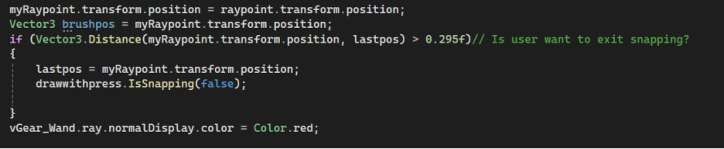
Figure 8: Real-time brush stroke drawing and painting in the workshop within Immersive VR system.Figure 9: Snapping function implemented in the workshop to demonstrate the challenge created for users to experience the difficulty of porcelain art brush stroke drawing.Figure 10: Simulation of baking process of porcelain painting in a virtual oven.
RESULTS AND EVALUATION The implementation of a CAVE-based virtual environment has demonstrated significant contributions in preserving porcelain painting heritage. The system effectively simulates historical story of the porcelain painting “Wen Ji Returning to Han” through transforming static artwork into dynamic immersive VR narative by leveraging the 360-degree CAVE environment. The system also reproduces intricate brushwork techniques validated by master artisans. It enables users to engage meaningfully with traditional porcelain painting practices, which can enhance the engagement levels and understanding of the art form through the immersive experience.
Advanced Computational Modeling and Simulation 757
However, the system faces two primary limitations. First, the accurate simulation of haptic feedback remains challenging, particularly in replicating the tactile sensations of painting on porcelain surfaces. Second, technological constraints affect the system’s ability to precisely reproduce the complex color gradients and glazing effects characteristic of traditional Guangcai (Canton porcelain) techniques. These limitations, to a certain extent, impact the authenticity of the virtual experience and educational value of simulation.
The research advances digital heritage preservation through several technical innovations. These include immersive CAVE Brush Physic Engine, an advanced brush engine integrating pressure sensitivity, visual stroke and color properties, and stroke dynamics for authentic brushwork. And Real- time Rendering System, which provides immediate visual feedback through implementation of efficient processing for complex visual effects such as line and paint behaviors within the CAVE environment. Moreover, the Customize Porcelain Shader System enables creation of shaders accurately simulating porcelain art and properties.
The research successfully converges traditional knowledge with modern technology, preserving both technical aspects and cultural narratives of porcelain painting. Through collaboration with master artisan Mr. Lee Siu-man, it authentically captures and replicates traditional techniques. While challenges exist in replicating traditional skills and embodied experiences, the system establishes a foundation for preserving and disseminating traditional Hong Kong porcelain art and techniques.
The framework established in our research, on the one hand, can serve as a framework for Guangcai, on the other hand, demonstrates the potential for scalability across diverse cultural preservation contexts. The system and technological design in our research allow adaptation to other Hong Kong traditional handicrafts for simulation, education, cultural heritage preservation and professional training, etc. through CAVE-based system and immersive VR experience. And more importantly, it facilitates further discussion and focuses on the human, social issues of sustainability of the contemporary art sector, as explored in Emma Duester’s research on digital art work and AI (2024).
Future scalability considerations include cloud-based distribution of cultural content, enabling more comprehensive access and dissemination beyond physical locations. Developing multi-user interaction capabilities would facilitate collaborative experiences, enhancing learning and engagement in educational and museum settings. Integration with existing museum digital infrastructure to streamline the adoption process and provide for different levels of interaction with the aim of engagement (Brischetto, et al., 2023). Leveraging AI technologies as collaborator in artistic creation facilitate reinvigorating interest at the intersection of art, creativity and machine learning (Miller, 2019).
CONCLUSION
This research has successfully demonstrated the effectiveness of computational modeling and CAVE-based virtual environment in preserving
traditional Hong Kong porcelain painting and techniques. Through the implementation of both 360-degree and 270-degree CAVE systems, converges with advanced simulation techniques, we have established a framework that transcends conventional preservation methods. The integration of traditional art forms with contemporary digital technology has several significant contributions, particularly in the transformation of static porcelain paintings into dynamic narratives, the development of sophisticated brush and porcelain art production and simulation systems. Despite current technical limitations, this research provides a foundational framework for future developments in digital cultural preservation, contributing to the field of digital humanities, as well as art and technology realms.
ACKNOWLEDGMENT
The work described in this paper was fully supported by Hong Kong Metropolitan University Research Grant (No. RD/2023/1.10).
The authors would like to acknowledge master artisan Mr. Lee Siu-man for his support and contribution by providing his porcelain paintings and artistic consultation for the research.
REFERENCES
Brischetto, A., Iacono, E., & Becchimanzi, C. (2023). Digital technologies in museums: Critical issues and opportunities for equal access to cultural heritage. Usability and User Experience. Christou, C. G., Angus, C., Loscos, C., Dettori, A., & Roussou, M. (2006). A
versatile large-scale multimodal VR system for cultural heritage visualization. Virtual Reality Software and Technology. Chui, H. M., & Tsoi, T. M. (2003). Heritage Preservation: Hong Kong & Overseas Experiences. The University of Hong Kong. Duester, E. (2024). Digital art work and AI: a new paradigm for work in the
contemporary art sector in China. European Journal of Cultural Management and Policy, 14. https://doi.org/10.3389/ejcmp.2024.12470 Hong Kong Memory (2018). Interest in Porcelain Painting. [online] Hkmemory.hk.
Available at: https://www.hkmemory.hk/MHK/collections/por/Appreciation_Gui de/Interest_in_Porcelain_Painting/index.html [Accessed 24 Oct. 2024]. Miller, A. (2019). The artist in the machine: the world of AI-powered creativity.
Massachusetts: MIT Press. Sun, T., Jin, T., Huang, Y., Li, M., Wang, Y., Jia, Z., & Fu, X. (2023). Restoring Dunhuang Murals: Crafting Cultural Heritage Preservation Knowledge into Immersive Virtual Reality Experience Design. International Journal of Human– Computer Interaction, 40, 2019–2040.
LISTED IN THE AHFE DIGITAL BOOKSTORE CATALOGUE
Explore the complete digital volume
Intelligent Human Systems Integration (IHSI 2025): Integrating People and Intelligent Systems
Read this individual research paper free through the original publisher, or explore the full digital proceedings book.
ISBN 978-1-964867-36-6
Explore this ISBN in the AHFE Bookstore ↗Listed in the July 2026 bookstore catalogue; search by ISBN to confirm current availability · Digital book purchase optional