Lai Man Tin, Xiaoqiao Li, Tsz Fung Lam (2025). Embodied Virtual Reality Experience in Cultural Heritage Preservation: Interaction and Engagement in Traditional Hong Kong Porcelain Art. In: Human Interaction and Emerging Technologies (IHIET 2025). AHFE Open Access, vol. 197, pp. 602–609. https://doi.org/10.54941/ahfe1006754
This study examines the role of embodied virtual reality experiences in presenting and appreciating Hong Kong's traditional porcelain art through advanced CAVE systems. Building upon existing research in computational approaches to cultural heritage preservation, this research investigates the relationship between embodiment and engagement mechanisms and the digital preservation of traditional craftsmanship. The study introduces a novel framework integrating motion-captured technology, haptic feedback systems, and spatially-aware interaction within an immersive virtual environment. By implementing real-time location and motion recognition, and force-feedback algorithms, the systems present a novel experience of traditional porcelain painting. The study demonstrates how embodied VR experiences can bridge the gap between digital preservation and artistic practice, offering new pathways for transmitting intangible cultural heritage.
INTRODUCTION Following the Convention for the Safeguarding of the Intangible Cultural Heritage (the Convention) of the United Nations Educational, Scientific and Cultural Organization (UNESCO), which has been extended to Hong Kong since 2004, an Intangible Cultural Heritage (ICH) Office was set up by the Government of the Hong Kong Special Administrative Region of the People's Republic of China to undertake the relevant work in compliance with the Convention, including to identify, document, research, preserve and promote ICH in Hong Kong. As one of the representative lists of traditional craftsmanship of the ICH of Hong Kong (Intangible Cultural Heritage Inventory of Hong Kong, 2024), the Porcelain Painting Making Technique (also known as Guangcai) represents the traditional technique and art form of painting on white porcelain. The transmission of porcelain painting from the Mainland to Hong Kong demonstrates the combination of Chinese traditions and new methods, as well as the transformation of the topics and artistic representations.
This research studies the porcelain painting originating from Chaozhou of Guangdong, with the fusion of Chinese and Western vibrancy and techniques, which embodies both visual artistry and intangible elements like traditional Chinese ink painting skills and cultural narratives.
This paper explores the possibilities of preserving porcelain art, which can transcend traditional preservation methods, such as physical collections and static digital archives, to enhance the crafts to dynamic artefacts, through the embodied nature of appreciation.
his paper proposes embodied virtual reality (VR) as a strategy for experiencing cultural heritage, emphasizing active participation and connection with the ICH. Embodiment refers to the physical body in virtual experiences, where users’ movements, reactions, and spatial awareness actively shape interactions (Slater et al., 2009). Drawing from phenomenology of perception, human perception is rooted in bodily engagement and environmental interplay, and this research argues that embodied VR aligns digital simulations with lived experience, enhancing interaction and immersion.
In this research, we deploy Cave Automatic Virtual Environment (CAVE) systems to facilitate embodied VR, allowing users to physically navigate, interact, and “experience” porcelain painting and the creation processes. Building on our prior research in advanced computational modeling and simulation for immersive virtual reality experiences (Tin et al., 2025) and other researh in immersive simulations (Sun et al., 2023), the research explores how the CAVE systems facilitate user experience by fostering deeper interactions with digital assets, such as animated paintings, virtual brushes and kilns, and discusses how this approach transcends traditional headset-based VR by enabling unencumbered, multi-sensory embodiment, which advances cultural transmission and proposes a novel method for heritage sustainability.
BACKGROUND AND RELATED WORK Porcelain painting originated in the Lingnan region during the Qing Dynasty, evolving in Hong Kong through Yuet Tung China Works, which was established in 1928 (Hong Kong Memory, 2018), and peaking in the 1980s and 1990s with international acclaim. It involves complex techniques such as color enamel control, brush manipulation on porcelain surfaces, and temperature and firing control.
Preservation efforts, such as museum collections, digitization, and workshops, such as the Hong Kong Heritage Museum’s collection of local porcelain works, have primarily focused on tangible and digital artefacts while lacking discussions of embodied knowledge in perceiving porcelain art (Chui & Tsoi, 2003).
Unlike ordinary folk-style colored porcelain paintings, which focus on patterns or employ relatively common painting techniques, the porcelain paintings studied in this research are imperial porcelain paintings, for which the technique and type of work were mainly reserved for the imperial court in ancient times. These pictures have a wide range of content, such as historical backgrounds and stories, and are exquisitely painted at a high artistic level to meet royal standards.
The research initially arose from an interest in the renowned Hong Kong porcelain painter, Mr. Lee Siu-man. Mr. Lee is a leading porcelain and antique painter in Hong Kong, skilled in various Chinese and foreign subjects and respected for his porcelain paintings of ancient figures.
Embodied Virtual Reality Experience in Cultural Heritage Preservation: Interaction and Engagement in Traditional Hong Kong Porcelain Art 604
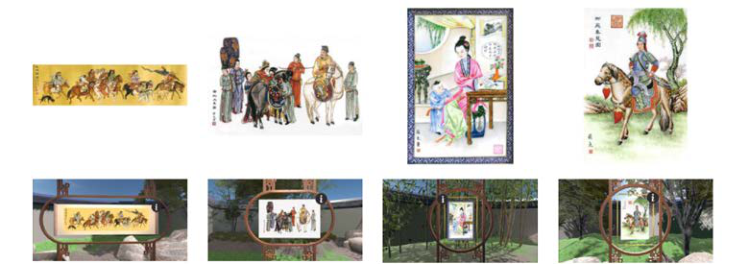
Four antique paintings, namely “Wen Ji Returning to Han,” “Yang Guifei Mounting a Horse,” “Kezi Tu,” and “Fragrant Concubine Riding Horse,” (see Figure 1) were included in this research as the source material to develop the conceptual framework and theoretical understanding of the embodied virtual reality experience in cultural heritage preservation through CAVE-based systems.
Figure 1: Four antique paintings and the respective representation in the CAVE system.
DIGITAL PRESERVATION TECHNOLOGIES AND THE EMBODIMENT GAP Current digital preservation of cultural heritage generally has three main areas: high-fidelity capture, XR (VR/AR) presentation, and AI-assisted creation. These approaches improve access, accuracy, and interpretation. However, most existing work treats users mainly as viewers or readers. It rarely addresses how people learn through the physical body, for example, by feeling and controlling tools with different viewing angles and coordinating movement. This paper argues that such a lack of attention to user embodiment limits the transmission of experience in cultural heritage. The research responds to this gap by focusing on embodied VR as a next step that can complement and extend current technologies.
3D digitization has established robust technical pipelines for capturing and preparing cultural assets. Reliable methods, including 3D scanning, photogrammetry, mesh optimization, and texture processing, balance visual quality with performance for interactive use (Badillo et al., 2024). Virtual museum settings further demonstrate how these assets can be curated in context. For example, the Hungry Ghosts Festival virtual museum combines reconstructed scenes and artefacts produced through photogrammetry and modeling technologies within a game engine, enabling close inspection and historical storytelling (Chan & Cai, 2023). However, user interaction remains primarily visual and confined to virtual spaces.
Secondly, generative AI has substantial potential for style preservation and accessible learning. The Hong Kong Polytechnic University’s (PolyU) “Beauty of Cantonese Porcelain” platform employs text-to-image models trained on extensive image datasets, incorporating “few-shot fine-tuning, layered generation, and symbolic element control.” It offers a beginner-friendly 2D/3D interface and real-time guidance from a large AI model to help users produce works that follow traditional Cantonese porcelain styles (The Hong Kong Polytechnic University, 2024).
It mainly operates on screens and images while lowering barriers and improving pedagogy. However, it does not concern the bodily aspects of making, such as brush control and coordinated movement in space.
Third, XR presentation helps present heritage in meaningful contexts. The Hungry Ghosts Festival virtual museum combines text and image panels, 3D reconstructions, and 360-degree video to convey objects, atmosphere, and social participation (Chan & Cai, 2023).
AR approaches add overlays and guidance in real settings, strengthening place-based understanding without replacing physical encounters (Rao, 2024). These projects deepen appreciation and presence, but they are mostly view-centred and link users’ movements through headset-bound navigation.
Moreover, comparative studies that evaluate different media report differences in engagement and understanding across modalities (Shrestha et al., 2016). However, they rarely include measures of embodiment such as body ownership, coordination of the senses and movement, or haptic realism. Evaluation tends to prioritize visual fidelity, usability, or general presence, leaving the bodily dimension under examined.
These gaps matter for cultural heritage, including porcelain painting, where knowledge lies in coordinated bodily experience. Embodied VR can address the need by synchronizing full-body experience with spatial systems and haptic feedback. It can also move beyond passive presence to foster a sense of body ownership and agency. In CAVE-based setups, these benefits can be shared by multiple users without headset boundaries, bringing users closer to reality participation. This study therefore designs and tests an embodied VR framework that integrates motion tracking, haptics, and spatial interaction, aiming to complement and transcend current technologies and studies.
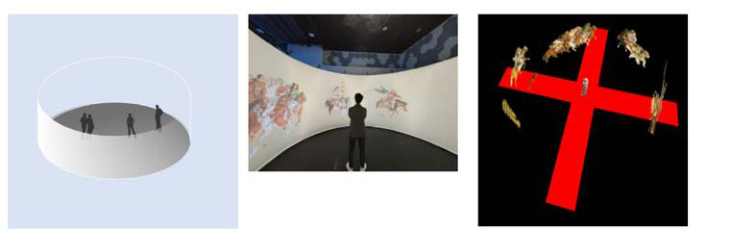
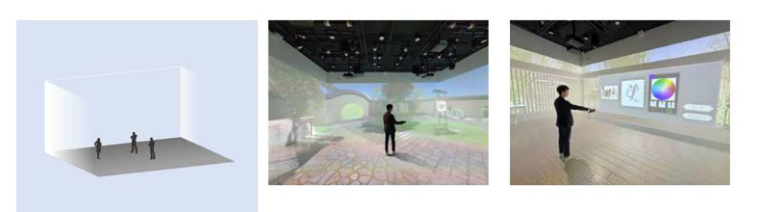
METHODOLOGY AND IMPLEMENTATION Two configurations were deployed in this study: a 360-degree panoramic CAVE for narrative immersion and situated experience (see Figure 2), and a 270-degree spatial CAVE designed as a virtual exhibition and studio-like workshop (see Figure 3). Both run on a Unity High Definition Render Pipeline (HDRP) stack optimized for low-latency, perspective-correct rendering. Motion tracking provides user position for viewpoint correction and interaction, while surround sound enhances the sense of the scenes, for example, firing porcelain sounds simulate the on-site firing effect. Calibration aligns physical and virtual coordinates so that users’ movements in the room interact with virtual assets, reducing perceptual- coordination mismatch and promoting a better bodily engagement.
Figure 2: 360-degree panoramic CAVE system and the presentation of the animated “Wen Ji
Returning to Han”.
606
Embodied Virtual Reality Experience in Cultural Heritage Preservation: Interaction and Engagement in Traditional Hong Kong Porcelain Art
Within the 270-degree spatial CAVE, users can navigate the virtual garden and studio, appreciate animated porcelain paintings, and explore details and information about both the porcelain art and the virtual scenes through haptic controllers. Users can also walk through the physical space in the 270-degree CAVE to align the body schema with the virtual scenes. Users’ observation and gaze trigger simple, personal experiences (e.g. artwork observation, tutorial overlays) while maintaining flow without complex menus. This approach moves beyond headset-bound navigation by replacing abstract inputs with lived movement, which deepens presence and creates conditions where learning also arises from bodily engagement rather than solely observing.
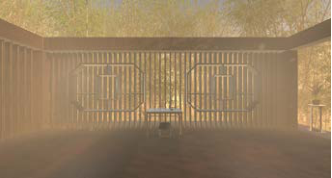
Haptic feedback is integrated to make digital tools feel responsive and informative. Hand-held controllers with snap-on markers attached can track users’ locations and deliver tactile cues that reflect contact events and porcelain work production behaviour. Algorithms map stroke speed, size, and line alignment, informing users to control strokes and develop personal artistic input (see Figure 3). Narrative and workshop simulations are structured to reinforce embodied practice. In the 360-degree CAVE, the system is equipped with medium-volume motion capture cameras which can track complex, multiple-actor scenes with an exceptional volume-to-setup ratio. Users can wear 3D glasses with head tracker and snap-on markers attached, the user’s movements such as turning around, moving forward and backwards toward the 360 screen, standing high and squatting low, can trigger direct responses by affecting the size of the panoramic virtual contents and thus changing the ways of perspective and narrative of the work, linking artistic and cultural context to bodily action. In the 270-degree garden and studio, the CAVE is equipped with VR base stations which can track users’ exact locations. Users navigate the garden to view and interact with the porcelain artwork by using the controllers with snap-on markers attached, and undertake step-by-step production of porcelain painting, including tracing outlines, layering colours, and controlling firing. The production result makes missteps informative, allowing users to learn from mistakes (e.g. adjusting the firing temperature to control the color density of the porcelain painting), which encourages exploration while preserving respect for authentic technique. To emphasize embodiment experience within the 270-degree CAVE, besides the simulation of the porcelain painting process, there is a virtual setting simulating a workstation with porcelain painting tools and materials on the left-hand side in the studio-like workshop (see Figure 4), virtual display stands on both the left and right-hand sides to present the porcelain work produced by the users (see Figure 4).
These settings encourage users to move around within the physical space of the CAVE in order to view the digital assets and the porcelain works.
Moreover, other participants can stand side by side with the user to engage in user-perspective demonstrations or move around within the CAVE area to conduct their own viewing experience. These “shared embodiment” conditions and interaction between the participants are closer to a real studio than solitary headset use.
The CAVE setup converts the viewer’s role from passive to active. It supports the transmission of knowledge through personal observation and bodily engagement, which are always an essential process in art practice, and viewers cannot acquire solely from images or text. The system complements existing technologies, including capture, AI, and XR presentation, with a practical path for embodied learning that is essential to preserving the experience of cultural heritage.
DISCUSSION The research findings highlight that embodied virtual reality can meaningfully change how users experience and learn traditional craft practices by engaging perception and action in the CAVE space. Maurice Merleau-Ponty’s phenomenology of perception argues that perception is a bodily way of being in the world. Thus, before reflection, the body already perceives the world through posture, reach, and movement (Merleau-Ponty, 1945/2012). In the CAVE-based systems in this research, users not only view porcelain works and information, and interact with the digital artefacts, but also move and reach within a space that responds to them.
The system’s facilitation of physical navigation is central to this shift. Physical movement, motion detection, haptic feedback, and spatial audio reinforce this alignment by connecting perspective to the user’s actual position. This coordination demonstrates a phenomenological view that establishes a sense of bodily situatedness in both the physical and virtual scene, which echoes Merleau-Ponty’s idea of this fundamental connection between the body and the world as “intentional arc” (Merleau-Ponty, 1945/2012). Users can approach the virtual scene intuitively or control the haptic controllers at a consistent angle without needing prompts. The CAVE space is not just a system to be interpreted, it is a field of possible actions that the body learns to navigate and interact.
The CAVE-based approach differs from many headset-based experiences. Headsets can provide intense visual immersion, but they often limit free movement, isolate users, and can lead to fatigue. In this research, users stand and move together, watch each other’s reactions and navigation, and receive real-time responses without covering their faces or eyes. This setup produces a form of social and bodily presence that is closer to studio teaching or museum exploring than solitary viewing.
Embodied Virtual Reality Experience in Cultural Heritage Preservation: Interaction and Engagement in Traditional Hong Kong Porcelain Art
608
Riva and some researchers have noted that presence is not only about convincing visuals, but about having control and agency within the environment (Riva, 2009). This sense of agency supported more extended engagement and richer descriptions of what the craft felt like to perform. While comparative work in related fields shows that interactive, immersive training can improve skill learning more than video-based approaches (Fortes et al., 2021), this paper demonstrates the application of this insight to heritage craft, in particular, porcelain painting, and links it to a phenomenological account of the importance of considering bodily action.
To offer a balanced framework that works with advanced CAVE to preserve ICH, future development should consider incoporating cloud-based distribution and synchronization of craft content and analytics to broaden access with physical sites, support multi-user modes for co-present and collaboration with low-latency audio– visual–haptic coordination. Leveraging AI technology as a creative system can further study user behaviour, analyze motion trace patterns, or personalize porcelain style and composition.
CONCLUSION This study shows that embodied virtual reality in an advanced CAVE can bridge digital preservation and the lived practice of Hong Kong’s traditional porcelain art. By integrating motion capture, real-time location, spatially-aware interaction, and the haptic feedback device, the system enhances appreciation and engagement while creating practical pathways for transmitting intangible cultural heritage through physical embodiment VR experience.
ACKNOWLEDGMENT The work described in this paper was fully supported by Hong Kong Metropolitan University Research Grant (No. RD/2023/1.10). The authors would like to acknowledge master artisan Mr Lee Siu-man for his support and contribution by providing his porcelain paintings and artistic consultation for the research.
REFERENCES Badillo, P. D., Parfenov, V.A., Raspopović, R., & Tishkin, V. O. (2024). 3D scanning in Cultural Heritage: model creation and digital restoration of the tombstone of the bishop Vasilije Petrović (Negosh) in Saint Petersburg. Journal of Physics: Conference Series, 2701. Chan, S. C., & Cai, S. (2023). PRESERVING AND EXHIBITING INTANGIBLE
Barbosa, B. T., & Ferreira, M. E. C. (2021). Virtual reality promotes greater improvements than video-stimulation screen on perceptual-cognitive skills in young soccer athletes. Human movement s cience, 79, 102856. https://doi.org/10.1016/j.humov.2021.102856 Hong Kong Memory. (2018). Interest in Porcelain Painting. [online] Hkmemory.hk.
Available at: https://www.hkmemory.hk/MHK/collections/por/Appreciation_Guide/Interest_in_Porce lain_Painting/index.html [Accessed 30 Jul. 2025].
Intangible Cultural Heritage Office of Hong Kong. (2024). Intangible Cultural Heritage Inventory of Hong Kong (2024 Edition). Retrieved from https://www.icho.hk/documents/Intangible-Cultural-Heritage- Inventory/2024/ich_inventory_2024_en.pdf Merleau-Ponty, Maurice. (2012). Phenomenology of Perception. (Original work published
1945). Translated by Donald A. Landers. London: Routledge. https://doi.org/10.4324/9780203720714 Rao, S. (2024). Innovative Approaches to Cultural Preservation: Integrating Ar/vr Technology in Kempegowda Museum – A Case of Bengaluru. International Journal For Multidisciplinary Research. Riva, G. (2009). Is presence a technology issue? Some insights from cognitive sciences.
Virtual Reality, 13, 159-169. Shrestha, S., Chakraborty, J., & Mohamed, M.A. (2016). A comparative pilot study of historical artifacts in a CAVE automatic virtual reality environment versus paper-based artifacts. Proceedings of the 18th International Conference on Human-Computer Interaction with Mobile Devices and Services Adjunct. Slater, M., Lotto, B., Arnold, M., & Sanchez-Vives, M.V. (2009). How we experience
immersive virtual environments: the concept of presence and its measurement *. Anuario de Psicología, 40, 193-210. Sun, T., Jin, T., Huang, Y., Li, M., Wang, Y., Jia, Z., & Fu, X. (2023). Restoring Dunhuang Murals: Crafting Cultural Heritage Preservation Knowledge into Immersive Virtual Reality Experience Design. International Journal of Human–Computer Interaction, 40, 2019–2040. The Hong Kong Polytechnic University. (2024). PolyU researchers harness generative AI to
preserve Cantonese porcelain art and heritage [Press release]. Retrieved from https://www.polyu.edu.hk/en/media/media-releases/2024/1021_polyu-researchers- harness-generative-ai-to-preserve-cantonese-porcelain-art-and-heritage/ Tin, L. M., Li, X., & Lam, T. F. (2025). Advanced Computational Modeling and Simulation for Immersive Virtual Reality Experiences: Preserving Hong Kong's Traditional Handicrafts. AHFE International.
LISTED IN THE AHFE DIGITAL BOOKSTORE CATALOGUE
Explore the complete digital volume
Human Interaction and Emerging Technologies (IHIET 2025)
Read this individual research paper free through the original publisher, or explore the full digital proceedings book.
ISBN 978-1-964867-73-1
Explore this ISBN in the AHFE Bookstore ↗Listed in the July 2026 bookstore catalogue; search by ISBN to confirm current availability · Digital book purchase optional