Jonas Bender, Klaus Bengler (2025). Digital Teaching to Develop Soft Skills – A User-Centered Approach. In: Intelligent Human Systems Integration (IHSI 2025): Integrating People and Intelligent Systems. AHFE Open Access, vol. 160, pp. 709–719. https://doi.org/10.54941/ahfe1005877
The development of soft skills, including teamwork, communication, critical thinking, and emotional intelligence, has become essential in the modern workplace. Despite this growing need, conventional teaching methods in higher education often fail to prioritize these competencies, favoring traditional lecture-based approaches. This paper addresses the gap by presenting a digital project management platform designed to enhance soft skills among university students through practical, team-based learning.Following a user-centered design process, the platform was developed using the ADDIE (Analysis, Design, Development, Implementation, Evaluation) model, which structured its creation and evaluation. Semi-structured interviews with faculty and students informed the design of user personas, which were key in aligning the platform's functionality with users’ needs. Central to the platform is a Kanban board that facilitates project management and encourages students to apply soft skills in realistic scenarios, such as organizing tasks, collaborating with peers, and communicating effectively. Additional features support group interaction and provide educators with tools to guide and assess students’ progress.Digital teaching offers distinct benefits for skill development, including greater accessibility and flexibility for learners. By allowing self-paced learning and access from any location, the platform supports personalized experiences tailored to individual preferences. Furthermore, its interactive elements, such as gamified components and simulations, promote active learning and provide students with a safe space to practice and refine their soft skills. The digital format also allows for scalability, enabling widespread adoption and cost-effective implementation across diverse educational contexts.The platform’s usability and impact will be assessed through an eye-tracking study to observe user interaction patterns. This study will help optimize design elements and ensure the platform effectively supports learning objectives. Technically, the platform consists of a client-side application built with React and D3.js for visualizations, and a server-side component that uses Node.js and MongoDB for data management. This architecture supports a seamless and user-friendly experience, enabling students to engage meaningfully with the content.In conclusion, this paper proposes a practical strategy for integrating soft skills training into university education through digital means. By leveraging a user-centered design and modern digital tools, the platform offers a dynamic, engaging learning environment that meets the demands of both academia and the workforce. This approach not only enhances students' readiness for future employment in a volatile, uncertain, complex, and ambiguous (VUCA) world but also encourages the development of essential life skills, bridging the gap between academic knowledge and practical, real-world application.
Digitalization has affected every aspect of our lives, not least how we work and live. Video conferencing has long been standard practice in multiple industries. Additionally, more and more individuals are increasingly ordering goods and services online. Change brought on by technology is accelerating.
However, this transition is not just occurring in the consumer market. The economy is generally becoming more and more digital; 3D printers are used to create machine parts, robots assemble them, and sales are almost exclusively online. Artificial intelligence (AI) has the potential to profoundly alter business and economic operations, posing a threat to the status quo in our global economy (Christakis, 2010).
The phrase VUCA World is frequently used to characterize this modern workplace. Here VUCA stands for Volatility, Uncertainty, Complexity, and Ambiguity. It characterizes the rapidly evolving business environment, which poses significant challenges for businesses because it has become faster, more unpredictable, and more complicated. Fixed rules no longer apply-the future is uncertain and multiple aspects must be considered. Due to the pace of market change, old theories and patterns are no longer viable. Companies’
long-term action programs are inherently ambiguous because determining the likelihood of events is becoming increasingly challenging (Prasch, 2022).
As a result, people are exposed to new expectations as the world of work changes, which results in new skills requirements. There have been other attempts to categorize these requirements, including the well-known division of the workforce into blue-collar and white-collar employees. White-collar employees typically handle managerial and administrative duties, whereas blue-collar employees typically carry out manual tasks.
However, because of the Internet’s role as an agent for change, quick product development cycles and businesses’ increasing need to foster innovation, a new class of worker has recently attracted the interest of academics: the knowledge worker or gold-collar worker. So-called knowledge workers are becoming increasingly important given the changes mentioned above (Cole, 2016). They gather, analyze, produce, and share knowledge (Ramírez & Nembhard, 2004).
In general, they are well-educated professionals who are capable of progressing a task on their own. In a world where information is just a mouse-click away, traditional teaching approaches such as rote learning are outdated.
Instead, 21st century innovators must possess competencies such as presentation skills, creativity, and communication skills. (United Nations, 2016). For example creativity, one of the most prevalent skills of the future (Prasch, 2022) relies heavily on interdisciplinary teamwork. A key factor to effective teams, however, are soft skills to foster team performance. This makes them imperative for future (knowledge) work.
Due to the COVID-19 pandemic, these skill sets have become especially important within the digital environment because communication takes place predominantly via the acoustic and visual channel and less via the non-verbal channel (Daft & Lengel, 1983). Therefore, teaching these skills digitally could be a great opportunity.
The term digital teaching is described as the application of digital technologies to the teaching and learning process. It entails the distribution of educational content and the facilitation of interactive learning experiences using various technical means, including computers, mobile devices, software applications, and the Internet (Esteve-Mon, Llopis-Nebot, & Adell-Segura, 2020). Many benefits, including adaptability, accessibility, and customized learning opportunities are provided by digital teaching. It enables students to access educational materials whenever they choose, from any location, while allowing them to learn at their own speed.
Additionally, digital education gives teachers the ability to design interactive, engaging learning experiences that are tailored to the unique requirements and learning preferences of each student.
Globalization and advancing digitalization are placing new expectations on businesses, and, ultimately, on their workforce. The conventional teaching techniques employed by educational institutions can only partially satisfy these new expectations. Consequently, new ideas should also be developed in the educational system to train and promote employee capabilities that are
Digital Teaching to Develop Soft Skills – A User-Centered Approach 711
commonly referred to as soft skills in the corporate environment (Haleem et al., 2022).
DEFINITION OF SOFT SKILLS AND THEIR IMPORTANCE Soft skills, also known as emotional intelligence, or non-technical skills, refer to a wide range of personal characteristics, social behaviours, and communication abilities that facilitate effective interactions with others. Soft skills differ from technical or hard skills, which are specific and job-related, such as programming, accounting, or engineering.
They are essential if employees are to be able to interact, communicate and adapt to changing conditions in today’s complicated and dynamic work environment. According to a survey conducted by the Harvard University, soft skills are frequently identified as the most important aspects of hiring, job performance, and career promotion (Mann, 1981). In fact, some professionals contend that soft skills are even more crucial than technical abilities, especially in knowledge-based industries such as healthcare, education, or technology where employees must be able to work well with clients, coworkers, and stakeholders (Yaacoub, Husseini, & Choueiki, 2011).
Additionally, soft skills are essential for success on a personal level not just in the workplace. People with soft skills are better able to interact with others, forge stronger bonds, and control their emotions and actions. Soft skills are important for both lifelong learning and adaptation because they enable people to accept change, take feedback onboard, and maintain their motivation in the face of difficulties (Schulz, 2008).
Skills such as empathy, collaboration, creativity, and leadership are essential for addressing global challenges such as poverty, climate change, and inequality - making them inevitable to meet the United Nations Sustainable Development Goals. By developing these skills, individuals and communities can become more effective agents of change and contribute to creating a more sustainable and equitable future (Ubiquity University, 2020).
THE POTENTIAL OF DIGITAL PLATFORMS IN DEVELOPING SOFT SKILLS Particularly in the context of education and training, digital tools and platforms have a lot of potential for supporting the development of soft skills. Digital technology can be used to improve the accessibility, engagement and cost-effectiveness of soft skills development and therefore increasing the learning quality and results. This section of the paper considers some of the major benefits of using digital technologies described by Çelik and Aytin (Çelik & Aytin, 2014).
Accessibility and Convenience Digital technologies and online platforms offer great convenience and ease for students. The simplicity of smartphones, tablets, and laptops eliminate the need for students to travel or attend remote classes to continue have access
712 Bender and Bengler
to qualitative education. This can be particularly helpful for students which face time, financial, or geographical constraints - as well as to those who prefer self-paced learning. Since a personal choice is guaranteed and matched at all levels, digital tools and platforms provide the alleviation of control to students.
Personalization and Flexibility Adaptive algorithms, data analytics, and artificial intelligence technology enable the learning experience to be customized to the unique needs and capabilities of each learner. A personalized learning approach is more engaging and productive than traditional concepts as learners are more likely to be engaged and stimulated by content that is familiar and pertinent to their background and interest. In addition to personalized learning, digital technologies enable multiple pathways and options to be made available to learners (National Academies of Sciences, Engineering, and Medicine, 2018). Thus, depending on their learning style, preference, and abilities, learners can choose between different modes of instruction and autonomous by having access to various multimedia resources.
Interactive and Engaging Interactive and engaging digital tools and platforms can help develop and maintain soft skills. Soft skills are easily adduced in interactive and engaging manners in the form of gamification, simulations, and social learning that create immersive and real-world-like learning experiences where learners can safely and actively test and apply their soft skills in a low-risk setting. Apart from enhancing interpersonal communication and collaboration, they foster a sense of community and mutual learning between the learners and the teachers.
Cost-Effectiveness and Scalability Finally, the cost-effectiveness and scalability of digital tools and platforms address many of the challenges encountered when implementing traditional soft skills development programs. Online resources can be used to reduce the cost of goods, facilities and staff. Furthermore, they can also minimize the time and energy spent on administration and logistics. In turn, they increase the reach and demographic of the target audience, including students from different regions, cultures and traditions.
In summary, digital tools and platforms have the power to drastically change the practice of soft skills development, making it easier to access, personalize, and engage in. However, the use of digital tools does have certain disadvantages and limitations, such as the lack of face-to-face communication and technological problems. For this reason, it is crucial to use digital resources carefully, relying on established best practices and methodologies that consider and eliminate concerns, focusing on reaping as many benefits as possible from soft skills development.
As the development of such systems proves to be difficult, a stringent approach is essential. In this context, Nielsen recommends involving the user
Digital Teaching to Develop Soft Skills – A User-Centered Approach 713
in the development process to secure a solid representation of user needs (Nielsen, 2012).
THE POTENTIAL OF DIGITAL PLATFORMS IN DEVELOPING SOFT SKILLS A crucial stage in the creation of digital tools and platforms is prototyping. A prototype is a simplified version of a good or service that designers and developers may use to test and improve their concepts before making them available to the public (Gamma et al., 2015). In addition to gathering user input and insights, prototyping can assist in detecting and remedying any problems with usability, functionality, and user experience.
An established method for user-centered design is the user centered design process defined in ISO 9241–210 (ISO 9241-210, 2010). To provide goods and services that are useful, efficient, and rewarding for the consumers, this method prioritizes the demands and preferences of the end-users. Understanding the usage context, identifying user needs, developing design ideas, prototyping, testing the design with users, incorporating user feedback into the design, and putting the final design into practice are all processes in the user-centered design process.
Since the user-centered design process according to ISO 9241–210 is a very general approach to the development of interactive systems, it is better to use a system that is more tailored to the specific system.
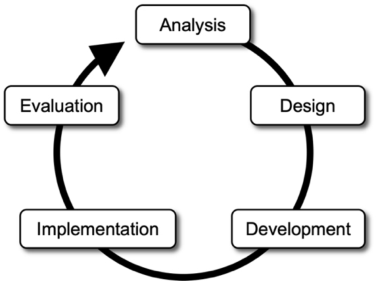
The ADDIE instructional model also has the iterative character and the user-centered orientation of the user-centered design process but is specifically tailored to the development of digital learning environments (see Figure 1).
Figure 1: 5 steps of the ADDIE model (Çelik & Aytin, 2014).
The process of creating a digital prototype is further described by Branch (2009) and involves five key stages: Analysis, Design, Development, Implementation and Evaluation.
Initially, the specific challenges and target audience are identified, along with relevant soft skills. Next, the design elements are determined and a low-fidelity prototype is created using simple materials. This evolves into a
714 Bender and Bengler
high-fidelity prototype using advanced technologies such as HTML, CSS or JavaScript, which is then tested by a broader audience to gather feedback. This iterative process ensures that the final product effectively meets user needs and objectives.
DESIGNING A FIRST PROTOTYPE Based on the user-centered design process described above, a first prototype was developed in a first iteration of the ADDIE model. This was carried out in strict compliance with the above-mentioned 5 steps, which are explained below.
Understand and Specify the User Context (Analysis) A semi-structured interview was used to derive personas to better understand the users of the platform. In addition to demographic questions, the areas of learning, teaching, digitalization, communication and knowledge sharing were covered. The sample for the creation of the personas consisted of 10 participants, divided into 5 teachers and 5 students (MTe = 28.4 years, SD = 2.73; MSt = 24.2 years, SD = 0.83).
Figure 2: From Persona to usability requirement.
Figure available in the original PDF paper.
Based on these interviews, personas and user stories were derived, which were then used to create the usability and user requirements of the platform following the instructions by Cooper (Cooper, Reimann, & Dubberly, 2003).
Specify User Requirements Based on the User Context (Design) Information about the intended users of a product or service, their needs, objectives, and behaviours must be gathered and analyzed to describe user requirements based on user context. Understanding how the product or service will fit into users’ daily lives, what problems it will address for them, and how it can be developed to match their expectations and preferences are the main objectives. The success of this process depends on the target market’s ability to use and requirement for the finished good or service. Among other strategies, the process makes use of user research, persona development, user stories, and usability testing.
By considering the user context, the demands of the users can be met while also meeting the designers’ and developers’ objectives of providing goods and services that benefit the users in general and help them to succeed in their learning. User stories and potential usability requirements for the platform were derived using the two personas derived from the data collected in the semi-structured interviews. Mark, the researcher, and Jane, the student, form
Digital Teaching to Develop Soft Skills – A User-Centered Approach 715
the two archetypal personas with the help of which the following usability requirements were identified:
Student Jane: – Organizational: The tool should help users stay organized and on track with their projects. – Collaborative: The tool should allow users to easily communicate and collaborate with team members. – Centralized: The tool should provide a central location for storing and accessing project-related documents.
Researcher Mark: – Data-driven: The tool should provide insights and analytics to help users make informed decisions about their projects. – Streamlined: The tool should streamline workflows and improve efficiency. – Evaluable: Data collection should be interpretable to give feedback.
Create a First Prototype (Development) Three processes are particularly important in this phase: storyboarding, media production, and the quality assurance procedure. In storyboarding, the educational material is developed with the objective of producing the interaction concept while being personalized to meet the needs of the learners. As a result, the storyboard is a component of the comprehensive design and provides information for producing audio or video as well as the integration of the media using an authoring tool.
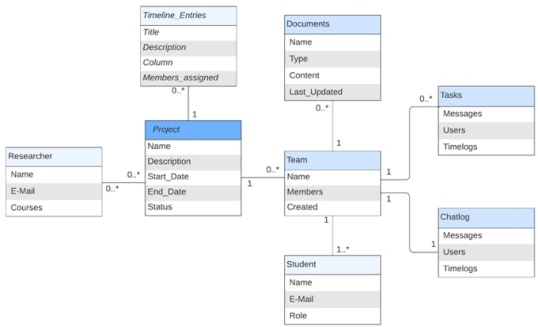
A first HiFi prototype can then be created in a vector graphics program. The individual entities of the prototype can be sketched in the form of a UML diagram to ensure a good overview of the platform to be developed. Based on the previously developed functional requirements and the storyboards, individual chunks can now be implemented based on the framework of Parush (Parush, 2015).
Entities include project, team, student, researcher, documents, timeline entries, and a chat log. Using these elements, a cluster can now be created by arranging them in a suitable way, which can then also be used as a database model later in the development phase. The main objective is to support interdisciplinary teams of students in tracking, managing and developing projects during the semester while providing meaningful insights to teachers.
In a first step, a sketch of a user interface can be developed from the functional requirements. To ensure a solid macro typographic structure, the F-shaped pattern is used for creation. The pattern illustrates a common way in which people read pages and media content. This involves starting at the top left and scanning down and across the page and helps in aligning the User Interface elements (Pernice, 2017).
716 Bender and Bengler
Figure 3: UML diagram for the first prototype.
Based on the Gestalt Principles of Design and the colour contrast calculation within ISO 9241–3 the first sketch was further developed in a vector graphics editor (Wertheimer, 1923). The center of the application forms a Kanban board which intends to provide students with the opportunity to learn practical soft skills such as teamworking and team communication in addition to managing team tasks. Kanban serves a visual project management tool that helps teams to visualize their workflow and manage their work in progress. Its advantage lies in its ability to promote transparency, collaboration, and continuous improvement by providing a clear understanding of the work process and identifying bottlenecks and inefficiencies (Corona, Eros & Diee, 2013).
Furthermore, a Team Management screen is designed to facilitate organization, collaboration, and communication between the Kanban board members. It can be accessed via the navigation bar on the left. The screen includes features such as task assignment and tracking, team member profiles and roles, project timelines, and messaging tools. The primary function of a Team Management screen is to streamline team workflows, increase productivity, and enhance teamwork by providing a centralized location for team coordination. It helps team members stay organized, track progress throughout the team, and communicate effectively with one another, which can ultimately lead to more successful project outcomes. Moreover, a chat screen and a document repository were created to guarantee efficient digital communication between team members.
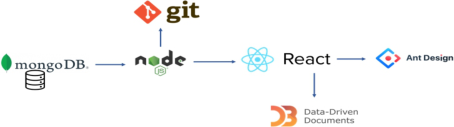
Implement the Predefined Ideas Within a Programming Environment (Implementation) To ensure a satisfactory testing of the individual interaction possibilities, a high-fidelity prototype is developed. This digital platform consists mainly of two parts: A client-side application that users interact with and a server-side application that stores and manages data (Berson, 1996).
Digital Teaching to Develop Soft Skills – A User-Centered Approach 717
Figure 4: Full-stack of the digital platform.
The client-side application uses React and D3.js to build the user interface and display data in charts and graphs. It communicates with the Node.js- based server-side application that gets data from a MongoDB database. Users submit requests for data through the client-side application, which then processes these requests, retrieves the requested data, and returns it to the client-side application in JSON format.
Typically, HTTP requests are used to communicate between the client- side and server-side applications. For instance, to retrieve data from the MongoDB database, the client-side application could issue a GET request to the server-side program. After processing the request, the data is then retrieved from the database by the server-side application, and it is then returned to the client-side application in JSON format.
Overall, this architecture offers a scalable and effective method for developing online apps that can deal with enormous volumes of data and offer detailed visualizations using D3.js.
Test the Prototype (Evaluation) Eye tracking is a common technique for assessing the usability of products and websites. Participants will be given a variety of activities to perform while having their eye movements monitored. In most cases, the setup entails creating a working prototype that roughly resembles the finished item but may not have all the final features or details (Holmqvist et al., 2011).
The eye tracking data is reviewed once the study has concluded to find trends in how participants interacted with the prototype. When used to inform design choices, this research can offer insightful information on how users interact with a product or website, enhancing its usability and efficiency.
CONCLUSION
This paper develops a feasible strategy to address the soft skills gap among university students. The impact of the platform could change the way that soft skills are taught and learned at university level and could have trans- formative implications for education and workforce capacity building.
The paper summarizes the features of the platform, including how it adapted a user-centered design progress to meet the individual learning needs and preferences of learners. Key benefits of the platform are addressed in the paper, including its capacity to increase student motivation and engagement, enhance learning outcomes and better prepare students for the demands of the contemporary workplace, where soft skills such as communication,
718 Bender and Bengler
cooperation, and problem-solving are becoming increasingly important. This is achieved by making the platform interactive, personalized, and relevant to their interests. Providing regular feedback will further help to foster a sense of community and collaboration through group projects the entire lifecycle.
ACKNOWLEDGMENT
The Authors would like to say thank you to all the colleagues and students, who assisted with the design process of the prototype.
REFERENCES
Berson, A. (1996). Client/server architecture. McGraw-Hill. Branch, R. (2009): Instructional Design: The ADDIE Approach. Çelik, S., & Aytin, K. (2014). Teachers’ Views on Digital Educational Tools in English Language Learning: Benefits and Challenges in the Turkish Context. Tesl-Ej. Christakis, N. A. (2010). How Is the Internet Changing the Way You Think? https:
//www.edge.org/responses/how-is-the-internet-changing-the-way-you-think. Cole, T. (2016). Fragen zur Digitalen Transformation in Deutschland. Cooper, A., Reimann, R., Dubberly, H. (2003). About Face 2.0: The Essentials of Interaction Design, John Wiley & Sons, Inc., USA. Corona, E., Eros, F., & Diee, P. (2013). A Review of Lean-Kanban Approaches in the
Software Development. Daft, Richard & Lengel, Robert. (1983). Information Richness. A New Approach to Managerial Behavior and Organization Design. Research in Organizational Behavior. 6. 73. Esteve-Mon, F. M., Llopis-Nebot, M. Á., & Adell-Segura, J. (2020). Digital teaching
competence of university teachers: A systematic review of the literature. 15(4) Gamma, E., Helm, R., Johnson, R., & Vlissides, J. (2015). Design patterns: Entwurfsmuster als Elemente wiederverwendbarer objektorientierter Software. MITP-Verlags GmbH & Co. KG. Haleem, A., Javaid, M., Qadri, M. A., & Suman, R. (2022). Understanding the
role of digital technologies in education: A review. Sustainable Operations and Computers, 3, 275–285. https://doi.org/10.1016/J. SUSOC.2022.05.004 Holmqvist, K.; Nyström, M.; Andersson, R.; Dewhurst, R.; Jarodzka, H.; Van de Weijer, J. (2011). Eye Tracking: A Comprehensive Guide to Methods and Measures, 1. Aufl., New York 2011. ISO 9241–210 (2010). “ISO 9241-210:2010 - Ergonomics of human-system
interaction – Part 210: Human-centred design for interactive systems,” p. 15, 2010. Mann, C. R. (1981). Teaching a Study of Engineering Education. Harvard University.
106–108. National Academies of Sciences, Engineering, and Medicine. 2018. How People Learn II: Learners, Contexts, and Cultures. Washington, DC. Nielsen, J. (2012). Usability 101: Introduction to Usability. Parush, A. (2015). A Layered Framework for the Conceptual Model. Pernice, K. (2017). F-Shaped Pattern of Reading on the Web: Misunderstood, But
Still Relevant (Even on Mobile). Available from: https://www.nngroup.com/articl es/f-shaped-pattern-reading-web-content/ [accessed 13 July, 2024]. Prasch, L. (2022). Creativity - a human factors challenge. https://doi.org/10.13140/ RG.2.2.31941.73440.
Digital Teaching to Develop Soft Skills – A User-Centered Approach 719
Ramírez, Yuri & Nembhard, David. (2004). Measuring Knowledge Worker Productivity: A Taxonomy. Journal of Intellectual Capital. 5. Schulz, B. (2008). The Importance of Soft Skills: Education beyond academic
knowledge NAWA. Journal of Language and Communication, 146–155. Ubiquity University. (2020). Ubiquity’s Foundation in Soft Skills Training. www.ubiquityuniversity.org. United Nations. (2016). Sustainability Development Goals. Wertheimer, M. (1923). Untersuchungen zur Lehre von der Gestalt II, in Psycologische Forschung, 4, 301–350. English translation. Yaacoub, H. K., Husseini, F., & Choueiki, Z. (2011). Engineering soft skills: a comparative study between the GCC area demands and the ABET requirements. In Competition Forum (Vol. 9, No. 1, p. 88). American Society for Competitiveness.
LISTED IN THE AHFE DIGITAL BOOKSTORE CATALOGUE
Explore the complete digital volume
Intelligent Human Systems Integration (IHSI 2025): Integrating People and Intelligent Systems
Read this individual research paper free through the original publisher, or explore the full digital proceedings book.
ISBN 978-1-964867-36-6
Explore this ISBN in the AHFE Bookstore ↗Listed in the July 2026 bookstore catalogue; search by ISBN to confirm current availability · Digital book purchase optional