Naomi Y Mbelekani, Klaus Bengler (2023). Systemizing Long-Term Research: Assessing Long-Term Automation Effects and Behaviour Modification. In: Emerging Technologies and Future of Work. AHFE Open Access, vol. 117, pp. 151–162. https://doi.org/10.54941/ahfe1004415
Over the past years, numerous studies have paved the way towards a better understanding of human-automation interaction (HAI). However, there is neglect in research that focuses on the long-term effects of automation on user behaviour. The reason behind this has been highly emphasised. As, long-term research is one of the most critically challenging approaches and is quite expensive to conduct, among others. Moreover, many scholars argue that a major source of difficulty is defining how long a period is enough to consider the potential change in user behaviour or behaviour modification. In this discussion, we consider what constitutes long-term research, to prolifically draw knowledge on taxonomies and benchmarks for empirical evaluation strategies on changes in user behaviour. Further, we consider the trade-offs between long-term effects and learning effects. In addition, the reader should note that this paper is a fragment of dualistic parts of knowledge distribution on the topic of constructing a long-term research strategy for assessing learning effects, long-term effects and behaviour modification.
To profusely comprehend the translation of long-term effects research the- ory into practice, we consider the correlation between learning effects and behaviour modification through the power law of learning. Therefore, it is important that we theorise the power law of learning from a systematic auto- mated driving point of view. The aim is to consider how long-term effects and learning effects influence behaviour modification (e.g., behaviour adapt- ability/changeability [BAC]) towards automation. Thus, it is important to understand how humans learn and what happens when they learn and attain new knowledge models. In this case, the term learning is used in a variety of capacities to exude BAC towards automation, such as learning how to interact/use, learning how to trust, and learning how to accept automation systems. The aim is to shape a roadmap for standardising long-term research benchmarks for human-centred studies, by answering the questions: ‘What is long-term?’ ‘How long is long enough?’, as well as ‘What research strategies
are useful in knowledge discovery?’ As a result, we need to derive effective toolboxes to come up with prolific insights that add to knowledge discovery in the field of automation and artificial intelligent systems. For example, in the field of automated driving, automated trucking, automated flying and automated (tractor) farming. The ultimate goal for long-term research using this scenario would be to allow for reliable prediction of behaviour. However, effective solutions to practical automated driving problems are often con- strained by limited time and resources on long-term research. It is paramount that advanced long-term research strategies are selected and implemented with the highest chance for success and knowledge discovery.
CONTEXTUAL DISCUSSION When people use automation over time, they will experience BAC. However, how to go about investigating this behaviour modification is seen as time con- suming and a complex process. Especially within the automotive domains, for example. In short, there are causal-effect assumptions at the core of the defi- nition of learning and behaviour. Now picture this: Let’s explore the idea of an on-road and in-traffic-related death, now imagine a driver has a fatal heart attack while driving his vehicle, for example. After he dies, the vehicle sud- denly comes to a stop and a second vehicle crashed/collides with the first, and the second driver also dies. In this situation, it is likely that only the second driver will be considered an automated driving traffic-related death because the first driver did not die due to an automated driving traffic-related factor. However, if evidence materialises presenting that the second driver also suf- fered a fatal heart attack before she crashed/collided with the first vehicle, then a new consideration can be formed on whether the death of the second driver ultimately depends on what we may consider a direct cause of death (e.g., was the second driver’s heart attack due to the sight of the first car). Essentially, what this scenario exemplifies is that the ultimate benchmark for determining an automated driving traffic-related death is not an objective characteristic of the situation (e.g., did the driver have a heart attack, was the ADS a result of the crash/accident, did the death happened in an auto- mated driving traffic-related situation, etc.). Reasonably, it is constructed on the basis of what is a direct cause of death (e.g., did the driver die due to a medical condition that was present prior to the automated driving traffic- related situation, or was the heart attack a consequence of the automated driving traffic-related situation). De Houwer and Hughes (2020) argued that at times, the cause of something is easy to determine, for example, the fact that pressing a button turns on a light, and conversely, at other times, there is a reason for doubt, and more exploration or assessments are required. As a result, the same rings true when we want to conclude whether a change in behaviour (e.g., prolonged takeovers, etc.) is a result of a learning effects (e.g., over trust, etc.).
The Power Law of Learning and BAC It is not surprising that learning is a promising field in human factors and ergonomics research. Especially concerning automated driving systems (ADS)
according Society of Automotive Engineers (SAE J3016: 2021, taxonomy and definitions for terms related to on-road motor vehicle automated driving systems). In a sense, learning can be defined as “the observable change in behaviour of a specific organism as a consequence of regularities in the envi- ronment of that organism” (De Houwer & Hughes, 2020). For example, this includes exposure to an automation system over time, on-road and in-traffic. Thus, in this paper, we infer the description of “regularities” (as automation- induced effects), “organism” (as the human user), and “the environment of that organism” (as the automated vehicle). In essence, borrowing from this definition, it is arguable that learning and behaviour modification (e.g. BAC) are mutually exclusive. Thus, when aiming to understand behaviour, it is important to also understand the power law of learning. Moreover, in order to identify that learning has occurred, De Houwer and Hughes (2020) indicates two conditions that are likely to occur,
An observation change in behaviour must occur during the lifetime of the organism.
The change in behaviour must be due to regularities in the environment.
Essentially, learning is thus seen as an effect – that is, as an apparent change in behaviour that is attributed to a factor in the environment (De Houwer & Hughes, 2020), with adaptation also used as an example. Furthermore, De Houwer and Hughes (2020) argue that, it is important to recall that the observed change in behaviour can occur at any point during the lifetime of an organism, for instance.
The impact of a regularity on behaviour might be evident immediately, or
The impact of a regularity on behaviour might be evident only after a short delay (e.g., one hour), or
The impact of a regularity on behaviour might be evident even after a long delay (e.g., one year).
Additionally, the meaning of behaviour may be ambiguous, in that, there may be differences on what is meant by it, and therefore, what constitutes a change in behaviour. In this paper, we adopt a broad definition that includes any observable reactions, regardless of whether that reaction is produced by the somatic nervous system (regulates voluntary physiologic processes, e.g., pressing a pedal), the autonomic nervous system (regulates involuntary physi- ologic processes, e.g., blood pressure or heart rates), or neural pro-cesses (the way the brain works, e.g., thoughts, memories, and feelings). In principle, the concept of behaviour also refers to reactions that are observable only by the individual themselves (e.g., a conscious mental image or thought) (De Houwer and Hughes, 2020). Moreover, a significant component of apply- ing the power law of learning entails that we make a causal provenance or attribution of BAC. Granting, when we reflect on the power law of learn- ing as an effect, for instance, a change in behaviour due to factors in the environment. Such as the context use of automation, for example. There is therefore an assumed causal relation between environment and behaviour built into the definition of learning itself (De Houwer & Hughes, 2020). And
154 Mbelekani and Bengler
these causal relations cannot always be observed directly, they may be derived from experiential evidence.
Learning Maturation Another argument formed is knowledge maturation through continuous exposure to automation systems. This maturation hypothesis upholds that during the first few months of exposure, new neural connections (e.g., men- tal models/user models) are moulded because of characteristic factors that have to do with the user’s continuous interactions or use of the automation system. These automatically formed neural connections (based in the men- tal model/user models) mature or evolve so that, by a certain phase of user experience (UX), they obstruct a tenet effect, exclusively over the sequence of time. In this case, the change in behaviour (i.e., BAC) is due to character- istically and fundamentally unwavering maturation, and not necessary only regularities in the environment and would therefore qualify as an example of extended learning reinforcements. Ultimately,
On one hand, the learning theory to practice, would predict that a decrease in trust (resulting in distrust) for an ADS, for example, may be depended on the ADS situational regularity (i.e., the frequency with which the user’s mind is stimulated and inspired to behave in a specific way).
On the other hand, the maturation theory to practice, could predict that the reflex effect (a decrease in trust for an ADS, e.g., resulting in distrust) may disappear as a function of time rather than due to the frequency of mind stimulation.
Learning and Memory The process by which changes in behaviour arise as a result of changing UX interacting with automation systems, in that, the goal of learning is a change in behaviour. The process of learning itself, however, is not explained, besides the mentioning of gainful experience over the sequence of time. Lieberman (2012) noted that not every experience will automatically result in a change of behaviour, which suggest learning, and thus, experience that arises by storing information in the brain is a result of learning. Lieberman (2012) noted that whether this experience will result to a change in behaviour does not matter. Equally, refers to a definition where learning is defined as a relatively per- manent change in behavioural disposition, and not necessarily in behaviour. Brown, Roediger, and McDaniel (2014) on the other hand, describes it as “acquiring knowledge and skills and having them readily available from memory so you can make sense of future problems and opportunities.” Thus, a crucial aspect of this definition is the mentioning of what a user can learn: knowledge and skills. And thus, Brown et al. (2014) see learning as a pro- cess of acquisition of knowledge and skills. In a sense, knowledge and skill can only be considered as learned, if there is the possibility of retrieving this knowledge and skill from memory in order to use it for further prob- lems and opportunities. Thus, memory (emphasizes its retention) plays a key role in learning (emphasizes the acquisition of information), thus “learning and memory are intimately, perhaps inextricably, intertwined” (Lieberman,
2012). However, both memory and learning are facets of a single system for storing information about our experiences, hence “you cannot remem- ber an experience unless you first create a record of it (learning), and you cannot learn from this experience unless you retain this record (memory)” (Lieberman, 2012). This description shows how closely interdependent learn- ing and memory are, in that, learning involves memory and memory depends on learning (Lieberman, 2012).
Learning Experience and Phases There already exist multiple theories of learning, constructed by different schools of thought and scientists, and some of these theories somewhat over- lap with each other. These theories may describe the dynamics of learning from a pedagogical, psychosocial, neurocognitive, and behavioural point of view. Essentially, learning results in a change in the user’s mental model or reasoning, resulting in behaviour modification (BAC) towards an automa- tion system based on continuous information processing. To ensure a strong connection between learning theory and practice, we refer to the creation and development of a linking science or an engineering analogy as an aid for translating transformative theory into practice. Thus, the value of such a bridging utility would be the ability to translate relevant aspects of learning into optimal actions. Furthermore, considering behaviourism, cognitivism, constructivism when it comes to learning (Ertmer & Newby, 2013). Learn- ing theories provide the foundation for intelligent and reasoned strategy selection, and adequate repertoire of interaction design strategies (IxDSs). According to Grossman, Fitzmaurice, and Attar (2009), learning phases consist of initial learning (novice users’ initial encounter with the system and considers the initial learning experiences), extended learning (consider a larger scope of learning, and learning takes account of the long-term inter- action with a system, and considers the prolonged learning experiences). Conversely, Grossman et al. (2009) were also aware of how experience can influence interaction and learning effects, so they argued learning as a func- tion of experience. For instance, it is vital to consider those who have no specific system experience but experience with a similar type of system and/or in a similar domain (Grossman et al., 2009). Equally, when people stop using a system for a prolonged period, and then encounter the system again, their experience level will be different, especially in the condition that the system has been updated. Therefore, it is important to consider how they would tap into their cognition (long-term memory: LTM) or knowledge banks to re- learn how to interact or use the automated system, yet again. For example, this includes:
Describing memory and mental maps,
The relationship between learning and memory,
The mental model of information processing,
Tracking down the neuropsychology of working memory,
The priming effects in which prior experience to a system (the prime) facilitates or obstructs the processing of new information,
The effect of remembering, misremembering and disremembering, etc.
156 Mbelekani and Bengler
Equally, as much as the initial and long-term learning is important, the intermediate (transitional: in-between two points of experiences) learning is important to consider. Important to consider is that, both the length/duration of experience with automation and experience in different situational con- texts influences behaviour modification. Thus, behaviour towards automa- tion may fundamentally change when experiencing the system in different situational context (Mbelekani & Bengler, 2023). And that includes user experience, trust, acceptance, mental models, etc.
How Long Is Long Enough?
The topic of long term is not a new one. However, the topic is in its infancy when referencing vehicle automation systems or automated driving. As many scholars have highlighted the challenges in conducting such a research type. Hence, the question that needs to be explored is that of what constitute a reasonable amount of time. How can we come to a conclusion that a specific timeframe is enough or reasonable, as humans are different and constantly changing their behaviours to suit the nature of the context of use, environ- ment, different system designs, and human factors such as user states and social influence, etc. In terms of “longitudinal” studies that focused on learn- ing effects of ACC; they used a repeated measures of 2 weeks – 2 months (i.e., 2 weeks: Simon, 2005; 4 weeks: Weinberger et al., 2013 & Ojeda et al., 2006; 2 months: Beggiato et al. 2013 & 2015; etc.). Martens and Jenssen (2012) described five phases of BAC applicable to ADAS based on: first encounter/ day (1-6 hours), learning (3-4 weeks), trust (1-6 months), adjustment (6-12 months), and readjustment (1-2 years). As much as these five phases are a good starting point of reference, however, the “durations given in the literature for the different phases of BAC partly relate to the time period during which an equipped vehicle is available” to the user rather than to the period an automation is actually used (Metz et al., 2021: 85). Pat- ten (2013: 163) noted that short-term studies range from a few hours to a few weeks, whereas “long-term studies by definition require long periods of study (e.g., more than 6 ≤months).” Nonetheless, Metz et al. (2021: 84) argued that these durations might assist in studying systems on the mar- ket but not prototype systems, and do not help in designing experimental studies. Similarly, in reference to a repeated usage study (five 30-minute jour- neys) examining six participates’ secondary task engagement during highly automated driving (using AV simulator), no reported findings on behaviour changes (Metz et al., 2021). This can be due to the limited timeframe used to evaluate BAC. Noticeably, Shin, Feng, Jarrahi, and Gafinowitz (2019) conducted a mixed-methods exploration into the motivation for long-term activity tracker use, and described anything below (i.e., <6 months) as short term.
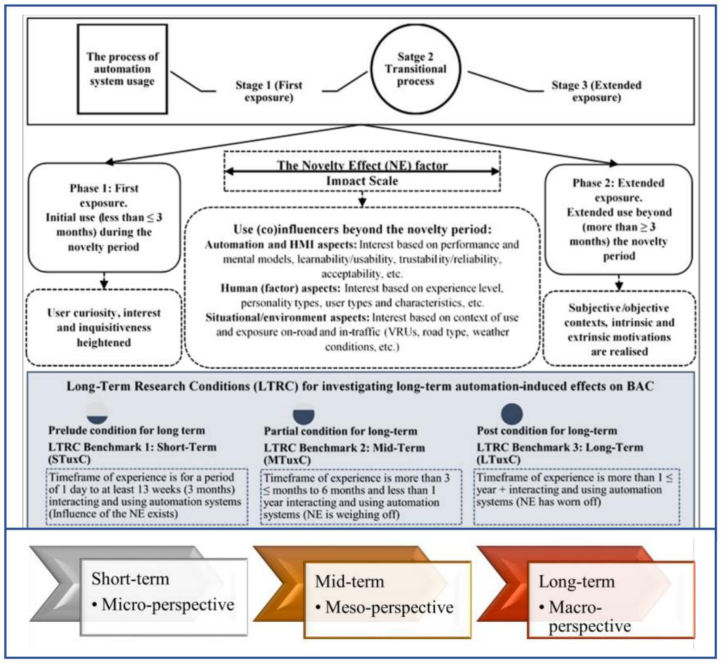
Essentially, in order to fully understand learning effects and predict BAC, it is important to rule out the Novelty Effect (NE). Chwo, Marek and Wu (2016) reasoned that humans often perform better when a learning experi- ence is new, and this is called the “Novelty Effect” (NE). NE in this context is can be understood as the tendency for users to show heighten interest when
new technology is introduced. In HCI research, the NE is defined as a per- son’s subjective “first responses to [using] a technology, not the pattern of usage that will persist over time as the product ceases to be new, to him or her” (Shin, Feng, Jarrahi, & Gafinowitz, 2019). Prior studies have distin- guished that as the NE wears off, many users discontinue the use of new technologies. Stockwell and Hubbard (2014) found that short-term studies and particularly short experimental interventions, do not account for the NE, at which the newness of using a specific technological system in a new way, primes temporary increases in performance. Clark and Sugrue (1991) sug- gested that it entails at least two (2) months for the NE factor to drop to a minimal level (20% of a Standard Deviation for more than eight weeks, which is < 1% of the variance). Thus, novelty may serve as a confounding variable for studies lasting less than two (2) months, skewing research results to the positive (Chwo, Marek & Wu, 2016). As a result, studies in which the intervention or learning activity lasts for more than two (2) months may be considered acceptable (Chwo, Marek & Wu, 2016). Arguably, findings in most studies tends to gloss over the NE, as many are conducted over rel- atively short periods, as already realised. Even so, researchers should raise the likelihood of the NE’s impact in a situation where their study is less than (≤) 3 month (especially with a new technology), as users/participants may be influenced by the NE factor. This research limitation underscores the necessity for long-term studies to investigate users’ motivation after early use, and particularly after the NE has worn off (Shin et al., 2019). Another fac- tor that is usually neglected is the effect of ‘delayed Novelty Effect (dNE)’ (the curiosity and inquisitiveness about automation is deferred). In this case, the user may not experience the NE as they are introduced to a new tech- nology, but after a duration of owning and using the system. Even so, it is important to consider the activation, deactivation, reactivation of the NE over time.
Systemizing Long-Term Research: A Design Framework Systemizing infers to the drive to discover patterns and the cognitive pro- cesses involved in identifying the phenomena, in this case, long-term research in automated driving. Therefore, understanding what drives certain user behaviours and what are drivers of behaviour modification. The follow- ing discussion aims to formulate a reasonable framework for measuring long-term effects of automation, thus we consider the initial (short-term interaction [StI]), transitional (mid-term interaction [MtI]), as well as the extended (long-term interaction [LtI]) strategy. However, to delimit UX, we consider learning effects, learnability, trustability, and acceptability in the context of long-term research. Our operational definition of how long is long enough is intended to be comprehensible and applicable regard- less of research domain or study discipline, user types, level of automa- tion, and field of study. In our forthcoming paper outline the taxonomy (Fig. 1) in-depth.
158 Mbelekani and Bengler
Figure 1: Knowledge discovery in long-term assessment research (KLEAR).
KLEAR consider the following Long-Term Research Conditions (LTRC) for investigating automation effects and BAC: Short-Term UX Conditions (STuxC), Mid-Term UX Conditions (MTuxC) to Long-Term UX Conditions (LTuxC).
Our Definition and Operationalisation Based on our prior interview study with industry experts, user-centred stud- ies, and literature review, the resulting propositions are what we propose for studying long-term effects and BAC in both laboratory and real-world set- tings, with the condition of less than (≤) and more than (≥) time benchmarks. We thus describe long-term research in the context of automated driving or automation usage as: “the prolonged assessment of learning effects/long-term effects (considering long-term use of automation towards user behaviour) and BAC, measured by experience factors (e.g., learnability, trustability, and acceptability).” Emphasise is also placed on a behaviour spectrum of desir- able behaviour (safety, efficient interaction, etc.) and undesirable behaviour
(risky, inefficient and error-prone interaction, etc.). Moreover, consider- ing pragmaticity and hedonicity aspects of UX and ergonomic qualities of desirability.
Essentially, current literature in the automotive field, does not deduce “how many hours of driving with an active system or how many occurrences of a certain system intervention/warning is needed” Metz et al. (2021: 85). We thus consider the context of high system-usage in comparison to low system-usage of an automation system as a parameter definition of experi- ence, and both these cases must be defined according to a precise matric for them fall under a specific benchmarks (described in-depth our forthcoming journal paper). Thus, the driving mileage (what is the driving mileage of using the system?), the intensity they use the automation system (how intensely do they use the system?), and the timeframe ownership of the system (how long have they owned the system?) are all important factors to consider, among others. Fundamentally, we can track learning effects and long-term effects as a timepiece to BAC during and after the NE. It can be argued that the time dur- ing which a system is actively used is important, because BAC occurs mainly through actively experiencing and using automation (Metz, et al., 2021). And thus, the power law of learning-unlearning-relearning new behaviours over time.
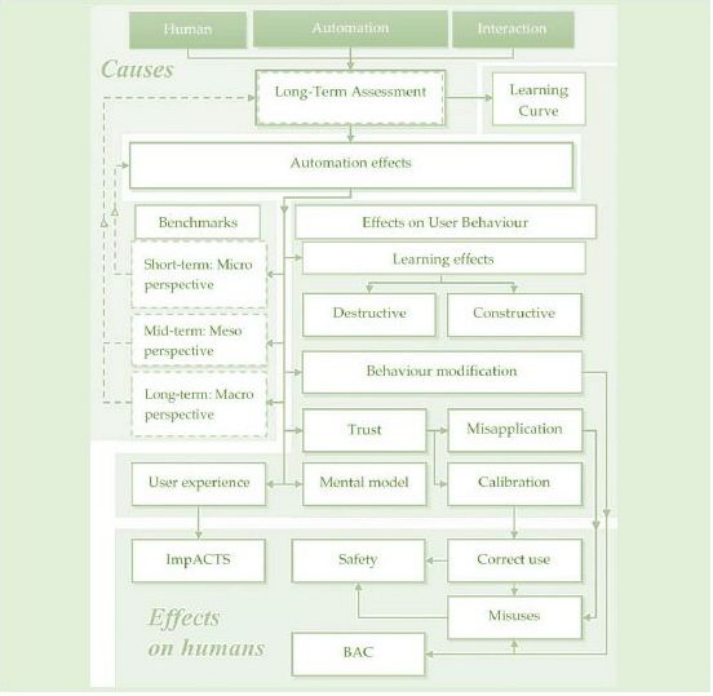
As people learn to interact with and use automation, their behaviour will adapt or change depending on the preferred interaction condition and perceived use cases or expectations. This is supported by a study that was conducted by Weinberger, Winner and Bubb (2001), which aimed to inves- tigate the learning effects of users towards an ACC, with focus placed on the duration of the learning phase and its influence on the user’s behaviour. Accordingly, when we investigate how users learn to interact/use automa- tion, it is important to consider the different learning phases, curves, and their time-based effects. Moreover, the transition point from short-term to long-term. We adopt a broad view of automation effects, by considering the type of effects, the automation system/HMI design principles, active and reactive behaviour spectrums, user types, as well as structural and procedu- ral mental models, etc. As a result, effects correlated to these characteristics are important to classify (using micro, meso, and macro perspectives). In addition, the objective is that of predicting behaviour over the sequence of time, in complex environments and with multifaceted ADS. It is important to highlight the validity of effects, in that long-term UX is not synony- mous to long-term effects. Thus, a user may have long-term UX using an automation system but that does not infer the realisation of long-term effects. But may result in short-term effects that disappear and sometimes reap- pears with time. A user might be exposed to automation for a long-term period but be diagnosed with some temporary short-term effects (STEs) – effects that last for a short-term period of time. Also, they may experience long-term effects (LTEs) – effects that are endured for a lengthy time- frame. Also, effects may be critical/precarious or noncritical, destructive or constructive, etc.
160 Mbelekani and Bengler
Figure 2: A fundamental relationship between causes and effects.
Our Contextualisation and Conceptualisation Our research strategy considers a mix-method approach. Therefore giving the possibility to fruitful and insightful knowledge discovery by assessing users through the lens of quantitative and qualitative approaches over the sequence of time and across user types. Thus, we contextualised this process as “the capacity to consider user types and states, environmental (on-road and in-traffic) factors, road types, different ADS and automation systems, context of use and context of exposure, use cases/scenarios, weather condi- tions, venerable road users (VRUs), and multi-agent social interaction (MASI) patterns, to name a few. In order to properly assess the quality automated driving (QAD) and learning curves.” For instance: human factors characteris- tics, AV/automation system technological characteristics, environmental and situational characteristics are all important to consider as contextual empha- sis. Interestingly enough, there are existing intrinsic and extrinsic motivations (social and personal contexts) that influences users to continue or discontinue using a system beyond the NE period which should also be considered. It is important to also consider the influence of self-determination theory’s types of motivation: self-determined intrinsic motivations and non-self-determined
extrinsic motivation. Essentially, intrinsic motivation may be highly associ- ated with long-term adherence to system use. For instance, various intrinsic and extrinsic motivational factors play different roles at different stages of UX and user’s acceptance, trust, interaction and use, while use is fostered by greater intrinsic motivation than extrinsic motivation. A set of core ques- tions need to be addressed to describe the contextualised peculiarity, and to operationalise the context of research in human factors and ergonomics engineering. These represent important elements for operationalising and researching log-term effects, learning effects and BAC over time. Empirically exploring these questions is intended to provide detailed information about important aspects for investigating long-term effects of automation on user behaviour: the for what, to what, of what, and through what of the long-term research strategy. In our forthcoming paper, we have developed a concise taxonomy framework that should be more accessible to a diverse range of scientists/researchers, but which still grasps the key constructs of human fac- tors engineering research. We propose addressing these questions to afford fundamental research models valid to a wide range of fields.
CONCLUSION
Drawing on various concepts, approaches and models across multiple lit- eratures, this discussion considers long-term research as a useful strategy. Moreover, the discussion frames knowledge from the research perspectives of short-term (initial) to long-term (extended), as a processing of assessing behaviour modification over time. Moreover, employing an array of methods, such as controlled field research, frequent diary logs, prolonged qualitative and quantitative assessments, etc. It is important to identify the effect of varying research properties when it comes to BAC. It can be perceived in two context, desirable (i.e., accurate use) or undesirable (i.e., inaccurate use). This induces knowledge on user behaviour and the functioning mental/user model of how humans behave or misbehave with automation over time, and how this changes, primarily. Therefore, the goal is to fill the knowledge gap when it comes to long-term research in the context of automated driving, on the basis of short-term to long-term validity, by considering the effects spectrum (positive and negative values), as a way to manage QAD configura- tions through IxDSs and research frontiers. In conclusion, long-term research is important predicting the interaction between automation and artificially intelligent (AI) systems and human users. Moreover, the evolution of this interaction over the sequence of time. Knowledge on how humans adapt or change their behaviour towards automation is useful in guiding IxDS for useful assimilation into human social spaces. As efficient, effective, and sat- isfactory partners in society. Fundamentally, we argue for the normalisation of long-term research that enhances usability, learnability, trustability and acceptability over time.
ACKNOWLEDGMENT
This project has received funding from European Union Horizon 2020 research and innovation program, Marie Skłodowska-Curie, Grant no: 860410.
162 Mbelekani and Bengler
REFERENCES
Beggiato, M., Pereira, M., Petzoldt, T., & Krems, J. (2015). Learning and development of trust, acceptance and the mental model of ACC. A longitudinal on-road study. Transportation research part F: traffic psychology and behaviour, 35, 75–84. Beggiato, M., & Krems, J. F. (2013). the evolution of mental model, trust and accep-
tance of adaptive cruise control in relation to initial information. transportation research part f: traffic psychology and behaviour, 18, 47–57. Brown, P. C., Roediger III, H. L., & McDaniel, M. A. (2014). Make it stick: The science of successful learning. Harvard University Press. Chwo, S. M. G., Marek, M. W., & Wu, W-C. V. (2018). Meta- analysis of MALL research and design. System, 74, 62–72. Doi: doi.org/10.1016/j.system.2018.02.009. De Houwer, J., & Hughes, S. (2020). The psychology of learning: An introduction
from a functional-cognitive perspective. MIT Press. Ertmer, P. A., Newby, T. J. (2013). Behaviourism, cognitivism, constructivism: comparing critical features from an instructional design perspective. Perform. Improv. Q. 26(2), 43–71. Lieberman, D. A. (2012). Human learning and memory. Cambridge University Press. Mbelekani, N. Y., & Bengler, K. (2023). Learning Design Strategies for Optimizing
User Behaviour Towards Automation: Architecting Quality Interactions from Concept to Prototype. In: Krömker, H. (eds) HCI in Mobility, Transport, and Automotive Systems. HCII 2023. Lecture Notes in Computer Science, vol. 14048. Springer, Cham. Martens M. H., & Jenssen G. D. (2012). Behavioural Adaptation and Acceptance.
In: Eskandarian A. (eds) Handbook of Intelligent Vehicles. pp. 117-138, Springer, London. Metz, B., Wörle, J., Hanig, M., Schmitt, M., Lutz, A., & Neukum, A. (2021a).
Repeated usage of a motorway automated driving function: Automation level and behavioural adaption. Transportation Research Part F: Traffic Psychology and Behaviour, 81, 82–100. Ojeda, L., & Nathan, F. (2006). Studying learning phases of an ACC through verbal reports. Driver support and information systems: Experiments on learning, appropriation and effects of adaptiveness. Del, 1 (3), 47–73. Patten, C. J. (2013). Behavioural adaptation to in-vehicle intelligent transport
systems (Chapter 9). Behavioural adaptation and road safety: Theory, evidence and action, edited by Christina Rudin-Brown, Samantha Jamson. pp. 161–176. Shin, G., Feng, Y., Jarrahi, M. H., & Gafinowitz, N. (2019). Beyond novelty effect: a mixed-methods exploration into the motivation for long-term activity tracker use. JAMIA open, 2(1), 62–72. Simon, J. H. (2005). Learning to drive with advanced driver assistance systems:
empirical studies of an online tutor and a personalised warning display on the effects of learnability and the acquisition of skill. Weinberger, M., Winner, H., & Bubb, H. (2001). Adaptive cruise control field operational test—the learning phase. JSAE review, 22(4), 487–494.
LISTED IN THE AHFE DIGITAL BOOKSTORE CATALOGUE
Explore the complete digital volume
Emerging Technologies and Future of Work
Read this individual research paper free through the original publisher, or explore the full digital proceedings book.
ISBN 978-1-958651-93-3
Explore this ISBN in the AHFE Bookstore ↗Listed in the July 2026 bookstore catalogue; search by ISBN to confirm current availability · Digital book purchase optional