Patrizia Marti, Giampiero Cai, Sara Parri, Agata Di_Noi, Sebastiano Mastrodonato, Antonino Gullì (2025). Plant to fork: from sustainably sourced bio-based feedstock to 3D printed delicacies. In: Intelligent Human Systems Integration (IHSI 2025): Integrating People and Intelligent Systems. AHFE Open Access, vol. 160, pp. 550–558. https://doi.org/10.54941/ahfe1005860
The study explores the use of vegetable by-products, specifically tomato peels, to promote sustainable consumption of plant-based foods. The case study presented focuses on optimising the cultivation of tomatoes for the synthesis of bioactive compounds such as polyphenols, which are typically concentrated in the peel and discarded during industrial and domestic processing. In Europe, over 200,000 tonnes of tomato waste, primarily peels and seeds, are generated annually, posing environmental and economic challenges. To address this, the project utilises hydroponic and aeroponic cultivation methods to enhance polyphenol production in tomatoes. The bioactive-enriched tomato peels are subsequently transformed into a nutritious and innovative food product—3D printed pasta. The research outlines a detailed methodology involving the drying, pulverising, and incorporation of tomato peel powder into pasta dough, followed by 3D printing and cooking. The pasta’s bioactive content is measured at various stages of the process, from fresh tomatoes to cooked pasta, to ensure the retention of nutritional properties. This project demonstrates the potential of utilising food waste in a sustainable, technologically advanced manner, offering both environmental and health benefits through the creation of visually appealing, enriched food products. The results highlight the viability of transforming food by-products into value-added consumer goods.
The research presented in this article reflects on the theme of vegetables byproducts as a material to encourage the consumption of plant-based food in a sustainable perspective. We present a case study of the cultivation of tomatoes optimised for the synthesis of bioactives such as polyphenols, which are usually concentrated in the peel and normally discarded during industrial and domestic processing.
It is estimated that the European tomato industry produces more than 200,000 tonnes of waste - peels and seeds - annually, which constitute an
Plant to Fork: From Sustainably Sourced Bio-Based Feedstock to 3D Printed Delicacies 551
environmental problem and an economic cost. Currently, industrial tomato waste is used in the production of animal feed and biogas, with low efficiency.
In our project, the feedstock produced in hydroponic and aeroponic cultivations is transformed into food enriched with bioactive components and transformed through additive manufacturing, to offer an innovative, engaging and sustainable consumption experience.
The main objective of this study is to explore how tomato by-products, particularly peels enriched with bioactive compounds, can be utilised to create innovative and sustainable food products. By integrating advanced cultivation techniques, such as hydroponics and aeroponics, with modern food manufacturing technologies, including 3D printing, this research aims to transform what is typically considered waste into nutritious, appealing, and environmentally friendly food. Specifically, the project seeks to optimise the production of polyphenols in tomato peels and incorporate them into a novel 3D printed pasta, thereby promoting sustainable food practices while delivering enhanced nutritional value.
The structure of the paper is as follows: Section “Growing Plants Under Controlled Conditions” provides a description of the controlled cultivation of tomatoes using hydroponic and aeroponic systems, focusing on increasing polyphenol production. The next section outlines the methodology of transforming tomato peels into enriched food, detailing each stage of the process, from cultivation to 3D printing. The analysis of bioactive components at various stages of the transformation process follows, to ensure the nutritional integrity of the final product. Finally, a discussion of the findings is followed by conclusive remarks, which highlight the significance of the project in promoting sustainable food production and valorising food by-products through innovative technological solutions.
GROWING PLANTS UNDER CONTROLLED CONDITIONS The development of food ingredients from sustainably sourced bio-based feedstock leverages hydroponic and aeroponic systems to grow plants under controlled conditions. Hydroponics, a soilless cultivation method, utilises nutrient-rich water solutions to precisely control the growing environment, leading to accelerated plant growth and increased yields (Fussy & Papenbrock, 2022). Similarly, aeroponics is a soilless technology that optimises efficiency by using minimal nutrient solutions and water. This method allows for even more precise nutrient delivery to plants, resulting in reduced environmental impact and energy savings (Lakhiar et al., 2018). Both hydroponic and aeroponic systems enable meticulous control over various plant growth parameters, which can be adjusted to enhance the synthesis of bioactive compounds (Verdoliva et al., 2021). For example, different elicitors such as methyl jasmonate (MeJA) and silver nanoparticles (AgNPs), or even light intensity and moderate UV radiation, as well as altered temperatures, controlled drought, and moderate salinity can have effects on plants grown hydroponically. All elicitors increase photosynthetic pigments and total phenolic compounds. This highlights the potential of using elicitors to increase bioactive metabolites in plants, including crops,
to enhance nutraceutical production (Mubeen et al., 2023). These stressors stimulate polyphenol synthesis enhancing the nutritional and health benefits of the plants. Polyphenols are naturally occurring compounds in a variety of plant foods that are known for their antioxidant and anti-inflammatory properties. They may help reduce the risk of chronic diseases such as cancer, heart disease and diabetes. Polyphenols, for example, are abundant in tomato peels and seeds and offer numerous health benefits, including neutralising cell-damaging free radicals, making them valuable in the prevention of chronic disease. Szabo et al. (2019) highlighted the antimicrobial activity of polyphenols, attributing it to their action on the cell walls of microorganisms, while Valdez-Morales et al. (2014) showed the nutraceutical potential of tomato polyphenols, supported by studies demonstrating their efficacy in inhibiting cancer cell proliferation. The high concentration of antioxidants (especially polyphenols) in tomato waste, confirmed by various analyses of its phenolic composition (Conti et al., 2022; Cesare et al., 2021), makes it an economical and sustainable source for the extraction of these bioactive compounds.
METHODOLOGY FOR PLANT TO FORK ENRICHED FOOD Our plant to fork process develops in different phases, which are optimised to maximise efficiency and maintain the nutritional and structural properties of the final product:
Tomato plants are grown in hydroponic and aeroponic systems to increase polyphenol production in response to stress conditions like drought, UV exposure, and pathogen attacks, particularly in exposed plant parts like leaves and fruit peels, enhancing flavour, shelf life, and resistance.
Tomatoes obtained with this type of cultivation are harvested and peeled after a quick boiling. Peels are selected and cleaned to remove impurities and prepared for drying. Drying is a critical step in the process, necessary to remove moisture from the peels and facilitate their subsequent pulverisation. The method used in the trial, hot air drying, uses a professional machine to dry the peels at a controlled temperature and airflow (45
, 0%–1% humidity, 5–7 hours, fan power of 2 on a scale of 1 to 7). This approach provides faster and more uniform drying than solar drying. The peels are placed in a drying chamber, where temperature, airflow and humidity are monitored to ensure optimal results.
Once dried, the peels are pulverised to obtain a fine powder, necessary to be incorporated into the dough. During this step, it is essential that the powder is completely free of residual moisture to avoid the formation of lumps during mixing with the flours. The pulverisation is carried out using a blender, which guarantees a homogeneous and fine grain size. The powder obtained from the peels is then mixed with type 00 flour and durum wheat semolina. The blender is used also to ensure uniform mixing and obtain a homogeneous and elastic dough, by constantly mixing the flours with the tomato peel powder. The dough is obtained by mixing 40 gr of tomato peels, 50 gr of semolina flour, 50 gr of durum wheat flour, 60 ml of water, 2 gr of salt, and extra virgin olive oil to taste.
Plant to Fork: From Sustainably Sourced Bio-Based Feedstock to 3D Printed Delicacies 553
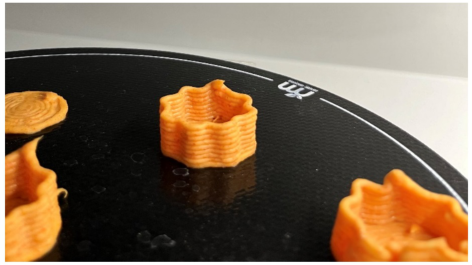
Once the dough is ready, it is subjected to printability tests using the Foodini food 3D printer to obtain various shapes of tomato pasta that can be consumed as fresh or dry pasta (Figure 1). Key printing parameters are carefully monitored, including extrusion temperature (52
), nozzle size (1.5 mm), and distance between layers (2mm).
Figure 1: 3D printed tomato pasta.
Once printed, the pasta is subjected to a drying phase (8 hours, 12% humidity, 40
/50
temperature) to avoid structural collapse and promote more homogeneous cooking.
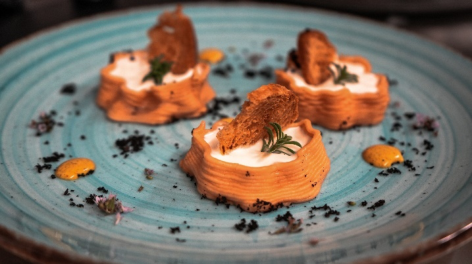
The pasta is cooked in boiling water for 10 minutes and then stuffed and served as finger pasta (Figure 2).
Figure 2: Enriched finger pasta.
ANALYSIS OF ENRICHED FOOD The antioxidant power is analysed at each of the following stages of the food transformation process.
Freshly harvested tomatoes (peel and pulp).
Peels and pulps after a quick boiling.
Dried peels.
Dried peel powder and flour homogenised.
Fresh extruded pasta.
Dried extruded pasta.
Cooked pasta (previously dried).
Samples from each step are finely homogenised in acetone for extraction of antioxidant molecules. The antioxidant capacity of each extract is measured using the FRAP assay (Benzie & Strain, 1996), which measures the ability of a mixture of antioxidant molecules to reduce ferric iron (Fe3+) to ferrous iron (Fe2+). To monitor the preservation of the antioxidant capacity of the dried peels used in the dough, the antioxidant power is calculated as the dough antioxidant value divided by the w:w ratio of the dried peel to the total dough.
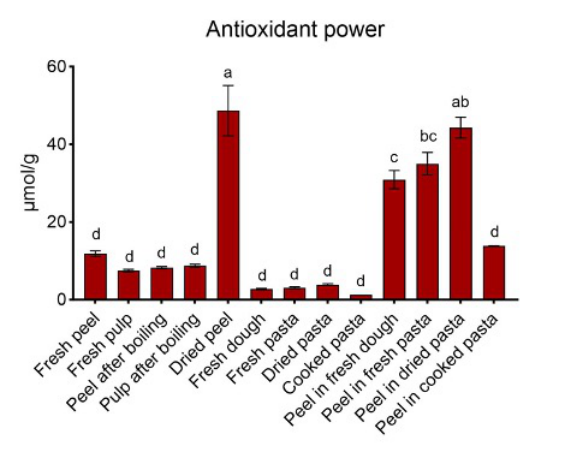
Antioxidants were found in both fresh skin and fresh pulp of tomatoes; the relative content is expected, with peel containing slightly more antioxidants than pulp (Figure 3). The difference in antioxidant content decreased after boiling, a process that likely degrades or washes out some of the antioxidant molecules. After drying, the content of antioxidants in the dried peel was very relevant, as shown by Nour et al. (2018). When antioxidant content was measured in fresh dough, fresh pasta, dried pasta and cooked pasta, low levels were detected, as also reported in Gull et al. (2018). However, considering the antioxidant value calculated for dried peel used in dough and pasta, the antioxidant content resulted only slightly affected by the
Figure 3: Spectrophotometric analysis of bioactive contents along the entire transformation process from fresh tomato to cooked pasta. The antioxidant content was evaluated by FRAP method and expressed as µmol/g. Values for “peel in fresh dough”, “peel in fresh pasta”, “peel in dried pasta” and “peel in cooked pasta” were calculated taking into account the w/w ratio of dried peel to total dough. Letters above bars indicate statistical significance (p-value < 0.05) between samples according to Tukey’s multiple post-hoc test.
Plant to Fork: From Sustainably Sourced Bio-Based Feedstock to 3D Printed Delicacies 555
transformation process. A decrease in antioxidant content was observed in samples of cooked pasta supplemented with tomato peel. In parallel, a decrease in antioxidant content was also observed in the “cooked pasta” sample. Both suggest that the decrease is likely due to the higher temperature of the cooking process, which can degrade some of the antioxidant molecules (Jiménez-Monreal et al., 2009), and the possibility that cooking can rehydrate the peel fragments and dilute the antioxidant molecules. However, if we compare the antioxidant content in the “cooked pasta” sample with the calculated value in the “peel in cooked pasta” sample, we observe that the antioxidant content of the latter sample is significantly higher. This suggests that the tomato peels in the final food product retain most of their original antioxidant capacity.
DISCUSSION
Abundant bioactive compounds, including polyphenols, can be found in tomato processing by-products and have promising applications as functional food ingredients. Tomato waste, such as peels and seeds, is a rich source of antioxidants in general and polyphenols in particular, and is generated in large quantities by the processing industry, representing both a disposal problem and an untapped resource (Szabo et al., 2019). In particular, polyphenols are bioactive compounds with antioxidant, chemopreventive and cardioprotective properties, and numerous studies have demonstrated the health benefits associated with their consumption, making them desirable food ingredients (Stajˇci´c et al., 2015). Various extraction techniques, including solvent extraction, microwave-assisted extraction, and supercritical fluid extraction, can be used to recover molecules with antioxidant capacity (such as polyphenols) from tomato waste, with the choice of method depending on factors such as desired yield, cost, and environmental impact. Such bioactive enriched extracts from tomato waste can be used as functional food ingredients in various products such as beverages, sauces and baked goods, contributing to the nutritional value of the product, improving oxidative stability and providing health benefits (Solaberrieta et al., 2022). A specific example is the use of tomato peels described in this paper, a byproduct of tomato processing that typically represents 7–10% of the waste stream. This work highlights the potential of tomato waste as a sustainable, antioxidant-rich alternative. It shows that the addition of tomato peels to dough can significantly increase the antioxidant capacity of the final food product (pasta), and that such an increase is not affected by modern pasta preparation techniques such as 3D printing. This results in a large and important increase in antioxidant content compared to unmodified pasta, making such a widely consumed, innovatively produced food a source of beneficial bioactives for the human diet. Compared to other studies documented in the literature (Padalino et al., 2017; Betrouche et al., 2022), this work shows that tomato peel can be added to dough and used efficiently in modern 3D printing food preparation techniques without losing the bioactive content. Modern 3D pasta preparation techniques can be significant in today’s food preparation because they allow for customization,
creating unique shapes and designs for an enhanced culinary experience; they also integrate advanced technology with traditional culinary practices, fostering innovation and enabling chefs and restaurants to create visually stunning and unique pasta dishes (Sun et al., 2018). This work also highlights another critical point, which is that these techniques promote sustainability by enabling the use of local ingredients. When modern pasta preparation techniques meet tomato waste as a source of antioxidants, a positive impact can be obtained due to the high global consumption of pasta and the environmental benefits of reusing this waste, not only reducing disposal costs but also contributing to a more sustainable and circular food system. The growing scientific and industrial interest in the recovery and utilisation of antioxidants from tomato waste is a promising opportunity to create innovative and functional food products while promoting environmental sustainability.
CONCLUSION
The project is a concrete example of a sustainable process from plant to fork to valorise food by products enriched with bio-active components and transformed with 3D printing technologies to allow for an aesthetically attractive rendering of food with beneficial properties for health and the environment.
The research described in this paper successfully demonstrates a sustainable and innovative approach to valorising food by-products, specifically tomato peels, by transforming them into bioactive-enriched food. By utilising hydroponic and aeroponic systems, the study optimised the synthesis of antioxidants in tomatoes, enhancing the nutritional value of what is typically considered waste. The process of peeling, drying, pulverising, and incorporating tomato peel powder into 3D printed pasta retained the bioactive components, offering a health-promoting and visually appealing food product. The main achievements of this study include the successful development of a plant-to-fork process that not only reduces food waste but also creates value-added products with enhanced nutritional properties. The integration of modern cultivation and manufacturing techniques led to the creation of a 3D printed pasta that serves as a sustainable and functional food. Furthermore, the research highlights the potential of leveraging food waste for new food solutions, providing environmental and economic benefits. This research paves the way for further exploration into the use of food by-products, offering a promising avenue for sustainable food systems and healthier consumer choices.
ACKNOWLEDGMENT
The research received fundings by the following projects: Metrofood.it, funded by the European Union – Next Generation EU under the National Recovery and Re-silience Plan (NRRP)- Mission 4 – “Education and Research”, Component 2: from research to business, Investment 3.1:
Plant to Fork: From Sustainably Sourced Bio-Based Feedstock to 3D Printed Delicacies 557
“Fund for the creation of an integrat-ed system of research and innovation infrastructures”.
GNAM - Growing Novel food living lAbs in corporate Museums, funded by the Research and Innovation Programme of the innovation ecosystem “ONFOODS - Research and innovation network on food and nutrition Sustainability, Safety and Security”, funded by the European Union - Next Generation EU under the National Recovery and Resilience Plan (NRRP).
REFERENCES
Benzie, I. F., & Strain, J. J. (1996). The ferric reducing ability of plasma (FRAP) as a measure of “antioxidant power”: The FRAP assay. Analytical biochemistry, 239(1), 70–76. Betrouche, A., Estivi, L., Colombo, D., Pasini, G., Benatallah, L., Brandolini, A.,
& Hidalgo, A. (2022). Antioxidant properties of gluten-free pasta enriched with vegetable by-products. Molecules, 27(24), 8993. Cesare, M. M., Felice, F., Conti, V., Cerri, L., Zambito, Y., Romi, M.,... & Di Stefano, R. (2021). Impact of peels extracts from an Italian ancient tomato variety grown under drought stress conditions on vascular related dysfunction. Molecules, 26(14), 4289. Conti, V., Romi, M., Guarnieri, M., Cantini, C., & Cai, G. (2022). Italian tomato
cultivars under drought stress show different content of bioactives in pulp and peel of fruits. Foods, 11(3), 270. Fussy A, Papenbrock J. (2022). An Overview of Soil and Soilless Cultivation Techniques—Chances, Challenges and the Neglected Question of Sustainability. Plants. 2022; 11(9):1153. https://doi.org/10.3390/plants11091153 Gull, A., Prasad, K., & Kumar, P. (2018). Nutritional, antioxidant, microstructural
and pasting properties of functional pasta. Journal of the Saudi Society of Agricultural Sciences, 17(2), 147–153. Jiménez-Monreal, A. M., García-Diz, L., Martínez-Tomé, M., Mariscal, M. M. M. A., & Murcia, M. A. (2009). Influence of cooking methods on antioxidant activity of vegetables. Journal of food science, 74(3), H97-H103. Lakhiar, I. & Gao, J. & Syed, T., Chandio, F. A., Buttar, N. (2018). Modern plant
cultivation technologies in agriculture under controlled environment: A review on aeroponics. Journal of Plant Interactions. 13. 10.1080/17429145.2018.1472308. Mubeen, B., Hasnain, A., Jie, W., Zheng, H., Peijnenburg, W. J., Rozali, S. E.,... & Negm, S. (2023). Enhanced production of active photosynthetic and biochemical molecules in Silybum marianum L. using biotic and abiotic elicitors in hydroponic culture. Molecules, 28(4), 1716. Nour, V., Panaite, T. D., Ropota, M., Turcu, R., Trandafir, I., & Corbu, A. R. (2018).
Nutritional and bioactive compounds in dried tomato processing waste. CyTA- Journal of Food, 16(1), 222–229. Padalino, L., Conte, A., Lecce, L., Likyova, D., Sicari, V., Pellicanò, T.,... & Del Nobile, M. A. (2017). Functional Pasta with Tomato By-product as a Source of Antioxidant Compounds and Dietary Fibre. Czech Journal of Food Sciences, 35(1). Solaberrieta, I., Mellinas, C., Jiménez, A., & Garrigós, M. C. (2022). Recovery
of antioxidants from tomato seed industrial wastes by microwave-assisted and ultrasound-assisted extraction. Foods, 11(19), 3068.
Stajˇci´c, S., ´Cetkovi´c, G., ˇCanadanovi´c-Brunet, J., Djilas, S., Mandi´c, A., & ˇCetojevi´c- Simin, D. (2015). Tomato waste: Carotenoids content, antioxidant and cell growth activities. Food chemistry, 172, 225–232. Sun, J., Zhou, W., Yan, L., Huang, D., & Lin, L. Y. (2018). Extrusion-based
food printing for digitalized food design and nutrition control. Journal of Food Engineering, 220, 1–11. Szabo, K., Diaconeasa, Z., C˘atoi, A. F., & Vodnar, D. C. (2019). Screening of ten tomato varieties processing waste for bioactive components and their related antioxidant and antimicrobial activities. Antioxidants, 8(8), 292. Valdez-Morales, M., Espinosa-Alonso, L. G., Espinoza-Torres, L. C., Delgado-
Vargas, F., & Medina-Godoy, S. (2014). Phenolic content and antioxidant and antimutagenic activities in tomato peel, seeds, and byproducts. Journal of agricultural and food chemistry, 62(23), 5281–5289. Verdoliva, S. G., Gwyn-Jones, D., Detheridge, A., Robson, P. (2021). Controlled comparisons between soil and hydroponic systems reveal increased water use efficiency and higher lycopene and β-carotene contents in hydroponically grown tomatoes, Scientia Horticulturae, Vol. 279, 2021, 109896, ISSN 0304-4238. https://doi.org/10.1016/j.scienta.2021.109896
LISTED IN THE AHFE DIGITAL BOOKSTORE CATALOGUE
Explore the complete digital volume
Intelligent Human Systems Integration (IHSI 2025): Integrating People and Intelligent Systems
Read this individual research paper free through the original publisher, or explore the full digital proceedings book.
ISBN 978-1-964867-36-6
Explore this ISBN in the AHFE Bookstore ↗Listed in the July 2026 bookstore catalogue; search by ISBN to confirm current availability · Digital book purchase optional