Yuncheng Ge, Yewei Huang, Ye Julei, Huazixi Zeng, Hechong Su, Zengyao Yang (2024). DMGR: Divisible Multi-complex Gesture Recognition Based on Word Segmentation Processing. In: Human Factors in Design, Engineering, and Computing. AHFE Open Access, vol. 159, pp. 878–888. https://doi.org/10.54941/ahfe1005654
In the realm of gesture recognition and computer algorithm optimization, traditional approaches have predominantly focused on recognizing isolated gestures. However, this paradigm proves inadequate when confronted with complex gestural sequences, resulting in cumbersome recognition processes and diminished accuracy. Contemporary human-computer interaction (HCI) applications often necessitate users to perform intricate series of gestures, rather than isolated movements. Consequently, there is a pressing need for systems capable of not only recognizing individual gestures but also accurately segmenting and interpreting sequences of complex gestures to infer user intent and provide natural, intuitive responses.Drawing parallels with natural language processing (NLP), where understanding complex sentences requires word segmentation, structural analysis, and contextual comprehension, the field of HCI faces similar challenges in multi-complex dynamic gesture interaction. The cornerstone of effective gesture-based interaction lies in precise gesture segmentation, recognition, and intention understanding. The crux of the matter is developing methods to accurately delineate individual gestures within a continuous sequence and establish contextual relationships between them to discern the user's overarching intent. To address these challenges and facilitate more natural and user-friendly multi-complex dynamic gesture interaction, this paper introduces a novel recognition model and segmentation algorithm. The proposed framework draws inspiration from word processing techniques in NLP, applying a list model to the multi-complex gesture task machine. This approach decomposes complex gestural sequences into constituent operations, which are further subdivided into consecutive actions corresponding to individual gestures. By recognizing each gesture independently and then synthesizing this information, the system can interpret the entire complex gesture task. The algorithm incorporates the concept of action elements to reduce gesture dimension and employs a probability density distribution-based segmentation and optimization technique to accurately partition gestures within multi-complex tasks. This innovative approach not only enhances recognition accuracy but also significantly reduces computational complexity, as demonstrated by experimental results on a multi-complex gesture task database.The paper is structured as follows: First, it elucidates the algorithm framework for divisible multi-complex dynamic gesture task recognition and the underlying model based on word processing techniques. Subsequently, it provides a detailed exposition of the algorithm's implementation, encompassing feature extraction, gesture classification, segmentation, and optimization methodologies. Finally, the paper presents the experimental design and results, offering empirical validation of the proposed approach's efficacy.This research represents a significant advancement in the field of gesture recognition, particularly in handling complex, multi-gesture sequences. By addressing the limitations of traditional single-gesture recognition systems, this work paves the way for more sophisticated and intuitive human-computer interaction paradigms. The proposed model's ability to accurately segment and interpret complex gesture sequences opens up new possibilities for applications in various domains, from virtual reality interfaces to robotic control systems. The integration of concepts from NLP into gesture recognition underscores the interdisciplinary nature of this research, highlighting the potential for cross-pollination of ideas between different fields of computer science. Furthermore, the emphasis on reducing computational complexity while maintaining high accuracy addresses a crucial concern in real-time interactive systems. In conclusion, this study makes substantial contributions to the field of gesture recognition and HCI, offering a robust framework for handling multi-complex dynamic gesture tasks. The proposed algorithms and models not only advance the state of the art in gesture recognition but also lay the groundwork for more natural and efficient human-computer interaction modalities in future applications.
Gesture recognition has become an integral component of human-computer interaction (HCI), with applications spanning virtual reality, assistive technologies, and robotic control systems. While traditional approaches have focused on recognizing isolated gestures, contemporary HCI applications often require the interpretation of complex gestural sequences. This paradigm shift necessitates systems capable of not only recognizing individual gestures but also accurately segmenting and interpreting sequences of complex gestures to infer user intent. Drawing parallels with natural language processing (NLP), where understanding complex sentences requires word segmentation and contextual comprehension, HCI faces similar challenges in multi-complex dynamic gesture interaction. The key lies in developing
methods to accurately delineate individual gestures within a continuous sequence and establish contextual relationships between them.
This paper introduces DMGR (Divisible Multi-complex Gesture Recognition), a novel algorithm that addresses the existing and potential challenges. Inspired by word processing techniques in NLP, DMGR employs a list model to decompose complex gestural sequences into constituent operations and actions. The paper is structured as follows: First, it elucidates the algorithm framework for divisible multi-complex dynamic gesture task recognition and the underlying model based on word processing techniques. Subsequently, it provides a detailed exposition of the algorithm’s implementation, encompassing feature extraction, gesture classification, segmentation, and optimization methodologies. Finally, the paper presents the experimental design and results, offering empirical validation of the proposed approach’s efficacy.
The algorithm incorporates action elements to reduce gesture dimension and utilizes a probability density distribution-based segmentation technique for accurate partitioning. By enhancing recognition accuracy and reducing computational complexity, DMGR represents a significant advancement in gesture recognition, particularly for complex, multi-gesture sequences. This research paves the way for more sophisticated and intuitive human- computer interaction paradigms, contributing to the evolving landscape of gesture-based interfaces.
METHOD
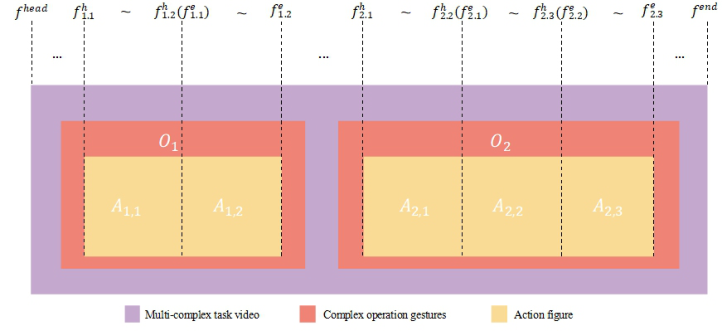
Model of Divisible Multi-Complex Gesture Recognition (DMGR) In the process of human-computer interaction (HCI), there are often many complex gesture operation tasks, and it is very difficult to recognize these complex gesture tasks directly. Therefore, this paper proposes a multi- complex dynamic gesture task recognition model similar to word processing, as shown in Figure 1. Compared with word segmentation in the field of NLP, it is considered that a multi-complex dynamic gesture task can be divided into a series of complex gesture operations, and each gesture can be divided into several continuous gesture actions, each action corresponds to a single gesture.
T is a given multi-complex dynamic gesture task, and V is the video input data recorded corresponding to the multi-complex dynamic gesture task T. V can represent a collection of a series of digital image frames, i.e
Equations and mathematical formulas are available in the original paper PDF.
Where ft represents the image of frame t List is a list of consecutive elements in strict order. Each frame in V corresponds one by one to each element in the ListList (V) = [f1, f2, · · · , ft−1, ft, ft + 1, · · · ], t = 1, 2, · · · Based on the above principles, the following definitions are given: Definition 1: A is a gesture composed of consecutive frames ft, P is the number of consecutive frames ft in A, then there is
Figure 1: Model of multiple-complex gesture task recognition algorithm.
Definition 2: O is a complex gesture operation composed of multiple continuous gesture actions A, M is the number of continuous gesture actions A in O, then there is List (O) = [A1, A2, · · · , AM], M = 1, 2, · · ·
Definition 3: T is a multi-complex dynamic gesture task composed of multiple continuous complex gesture operations O, N is the number of complex gesture operations O in T, then there is List (T) = [O1, O2, · · · , ON], N = 1, 2, · · ·
Definition 4: S is a cutting function that intercepts elements in the List between a given starting point and an ending point. fh
i,j and fe
i,j are multiple complex dynamic gestures task T, where the i complex gesture operates the first frame and the last of the j gesture action Ai.j in Oi, and there is
Extraction of Multi-Complex Gesture Feature For any frame image, the static feature matrix FStatic t from f1 to ft can be defined as
[Equation or mathematical symbol available in the original paper PDF]
[Equation or mathematical symbol available in the original paper PDF]
f Static
1 f Static
FStatic
Equations and mathematical formulas are available in the original paper PDF.
Where f Static
t is the static feature vector of ft, Znm
t and f Type
t , VHOG
t are Zernike moments (Khotanzad and Hong, 1990) and directional gradient squares respectively Graph and gesture type characteristics.
This algorithm mainly uses Zernike moment (Khotanzad and Hong, 1990) and Histogram of Oriented Gradient (HOG) (Dalal and Triggs, 2005) to extract static representation features.
(1) Zernike moments p ′ t(xt, yt) is defined as a two-dimensional matrix of the normalized image ft, and its Zernike moment of order n m is defined as:
X
X
Znm
p′
t (ρt)e−jmθt
Rnm
Equations and mathematical formulas are available in the original paper PDF.
s!
!
!
t is Zernike polynomial, Rnm
t (ρt) is radial polynomial, n and m are non-negative integers, and m ≤n, n −m is odd, ρt is extreme, and θt is polar Angle.
(2) Histogram of Oriented Gradient (HOG) The gradient of each pixel in the horizontal and vertical directions, as well as the gradient size and direction of each pixel position in the normalized input gesture image are calculated respectively:
t(xt −1, yt)
q
Gtx(xt, yt)2 + Gty(xt, yt)2
Gty (xt, yt) /Gtx (xt, yt)
xt, yt xt, yt
and θtG
are the gradient of pixel
xt, yt
in the horizontal and vertical directions, and the gradient amplitude and gradient direction respectively.
(3) Dynamic feature extraction For a frame of image, define p(xc t, yc t) as the centroid point of the hand in image ft. According to the continuous frames in the input video data V, two vectors can be constructed through the centroid point p(xc
t, yc
t), i.e
1 , yC 2 , · · · , yC t ) Considering that the range and speed of gesture movement vary from person to person, the vectors Xt and Yt are averaged to make them translation
invariant and more stable. We then get two new vectors X
′ t:
′ t and Y
X′
1 −Yt, yC 2 −Yt, · · · , yC t −Yt)
Where Xt and Yt are the mean value of Xt and Yt respectively. And the feature of dynamic gesture FDyn
Recognition and Classification of Divisible Multi-Complex Gesture In order to improve the efficiency of gesture recognition, the concept of action element is introduced in this paper. L is defined as the length of the action element. The selection of L value should be neither too large nor too small. A large L will increase the computational complexity and affect the computational efficiency, while a small L will affect the recognition accuracy. In the study of this paper, the selection of the length L of the action element is verified through the experiment, and L = 5 is set.
The action element is defined as follows: for any frame image, ft and its front row L −1 frame constitute an action element Ut, namely
List(V), ft−L + 1, ft
= [ft−L + 1, ft−L + 2, · · · , ft] Through the application of action elements, in the process of gesture recognition, the feature dimension can be reduced to L dimension. If the parameter L is reasonably selected, the computational complexity and time can be reduced without sacrificing the accuracy of the recognition algorithm. Moreover, the computational complexity of the recognition algorithm after the application of action elements is not greatly affected by the length of input video data, and even the input data of long and complex tasks can be recognized and classified quickly and effectively.
EXPERIMENTS Divisible multi-complex gesture recognition based on word segmentation processing are presented in two public databases: Sheffield Kinect Gesture (SKIG) (Liu and Shao, 2013a) and Sebastien Marcel Dynamic Hand Posture (SMDHP) (Marcel et al., 2000) and a self-built database (Multi-complex Gesture). The algorithm proposed in this paper is compared on three data sets above, and the evaluation index is defined as segmentation accuracy (SA).
Experimental Setup In each database, 20% of the data of various gestures were selected to train the template gesture feature sequence, and the remaining 80% data was used to test the accuracy of the algorithm. In the gesture recognition algorithm, the selection of the length L of the action element is verified through the
experiment. According to the results, considering the trade-off of recognition accuracy and computational complexity, the length of action element L = 30 frames is set. In the gesture segmentation and optimization algorithm, the error threshold of T1 = 0.3 s and T2 = 2 s is set through the statistics of the gesture duration in the commonly used gesture database.
The Evaluation Index In this paper, a Segmentation Accuracy (SA) is defined as an index to evaluate the performance of the proposed segmentation algorithm. Segmentation accuracy refers to the percentage of overlap between experimental segmentation results and target segmentation results in target segmentation results, which is defined as follows:
Where Fresult is the experimental segmentation result and Fgroundtruth is the target segmentation result. As can be seen from the formula, the higher the coincidence degree between the segmentation result obtained by the algorithm and the actual segmentation result, the greater the value of SA. The larger the SA value is, the higher the segmentation accuracy of the algorithm is. Otherwise, the lower the segmentation accuracy is.
The experimental results on SKIG database are shown in the table. In order to verify the effectiveness of the algorithm, this paper compares it with RGGP + RGB-D (Liu and Shao, 2013a), 4DCOV (Cirujeda and Binefa, 2014), Depth Context (Liu, 2016), HOG + LBP (Azad et al., 2019) and DLEH2 (DLE+ HOG2) (Zheng et al., 2017).
The DMGR algorithm demonstrates superior performance in gesture recognition compared to HOG+LBP and DLEH2 methods. While HOG+LBP employs multi-level time sampling to improve intra-class similarity and inter-class differences, it lacks focus on spatio-temporal consistency, which is a key feature of DMGR. This consistency proves crucial in gesture recognition, as evidenced by DMGR’s superior experimental results. Although DLEH2 integrates depth sequence gesture
shape with temporal and spatial features, its reliance solely on HOG for feature extraction limits its ability to capture overall texture and edge information. In contrast, DMGR’s comprehensive approach to feature learning and emphasis on spatio-temporal relationships enables it to more effectively recognize and interpret complex gesture sequences, resulting in higher accuracy and robustness in gesture recognition tasks. (2) Sebastien Marcel Dynamic Hand Posture (SMDHP) Discriminant Canonical Correlation Analysis (DCCA) (Kim, Kittler and Cipolla, 2007), Tensor Canonical Correlation Analysis (TCCA) (Kim, Wong and Cipolla, 2007), Product Manifold (PM) (Lui, Beveridge and Kirby, 2010), Genetic Programming (GP) (Liu and Shao, 2013b), Tangent Bundle (TB) (Lui, 2012) and 3D spatio-temporal covariance descriptors (Cov3D) (Sanin et al., 2013) and other algorithms are compared, and the comparison results are shown in the table.
Table 2. Recognition accuracy of SMDHP database.
Table available in the original PDF paper.
Method Accuracy of Recognition (%) DCCA 65.5±5.5 TCCA 82.1±2.7 PM 88.4±3.4 GP 85.0±1.1 TB 91.7±0.9 Cov3D 93.3±1.2 DMGR 96.8±0.4
The proposed DMGR algorithm demonstrates superior recognition performance, surpassing DTW by up to 11.8%. Cov3D ranks second, effectively maintaining spatio-temporal consistency but lacking comprehensive gesture description. These results underscore the importance of balancing static features and dynamic spatio-temporal consistency in complex gesture recognition, highlighting DMGR’s efficacy in capturing both aspects for improved accuracy. (3) Multi-complex Gesture On the self-built Multi-complex Gesture database, 50% cross validation is used, i.e. 80% of the data is used for training the model and the remaining 20% is used for validation. Table 3 shows the recognition results of the proposed algorithm on the Multi-complex Gesture database, and the comparison results between the proposed algorithm and SSBoW (Laptev and Lindeberg, 2005), DSBoW (Laptev et al., 2008), DTBoW (Hao et al., 2013; Wang et al., 2013), DFW (Kulkarni et al., 2015) and other algorithms.
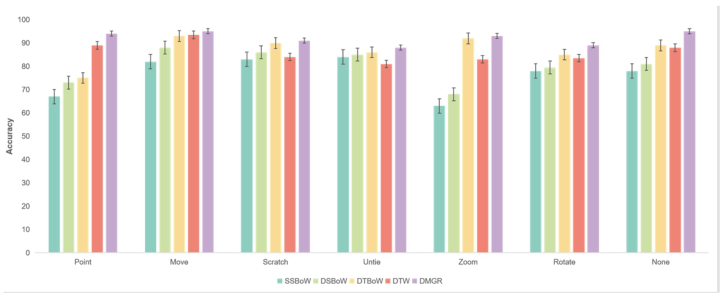
It can be seen that the recognition accuracy of each type of gesture in the proposed algorithm is above 90%, and the overall average recognition rate is 92.9%. Compared with other algorithms, the proposed algorithm also achieves the highest recognition accuracy, especially for the two gestures of pointing and zooming, which is much higher than other algorithms. Figure 2 shows the frame-to-frame recognition results of each comparison algorithm.
Figure 2: Accuracy of frames recognition on multi-complex gesture database.
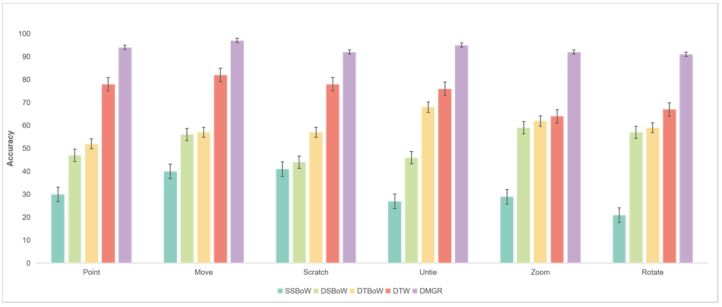
In order to verify the effectiveness of the segmentation algorithms, the segmentation performance of different algorithms is evaluated and compared, as shown in Figure 2. The DMGR algorithm demonstrates superior segmentation performance compared to SSBoW, DSBoW, DTBoW, and DFW methods. Its effectiveness is attributed to the accurate identification of meaningful gestures and iterative optimization of segmentation boundaries. This precise segmentation contributes to the algorithm’s higher recognition
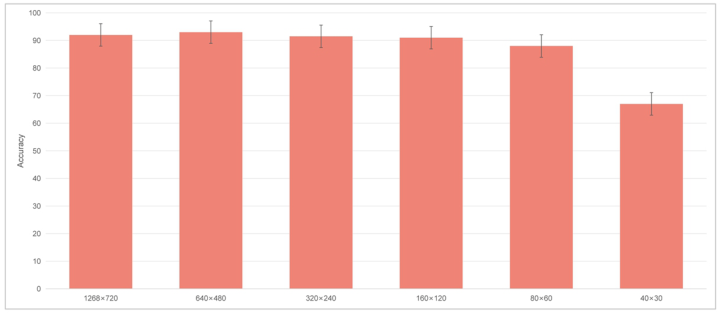
accuracy. In Figure 3, experiments with varying image resolutions reveal that DMGR maintains over 90% accuracy for resolutions above 160×120. Performance declines for lower resolutions, with 64% accuracy at 40×30. However, such low-resolution inputs are uncommon in practical applications, suggesting the algorithm’s reliability under most real-world conditions. These findings validate DMGR’s effectiveness in gesture segmentation and recognition across diverse camera conditions, underscoring its potential for widespread application in gesture-based interfaces.
Figure 3: Accuracy of action boundary segmentation on multi-complex gesture database.Figure 4: Effect of image resolution on accuracy.
CONCLUSION
This study presents a novel algorithm for recognizing multi-complex dynamic gesture tasks. A key innovation of this research is the development of a gesture segmentation and optimization algorithm founded on probability density distribution. This component significantly enhances the accuracy of gesture segmentation within multi-complex gesture tasks, addressing a critical challenge in gesture recognition systems. Empirical evaluation
of the proposed algorithm demonstrates its efficacy, revealing substantial improvements in both recognition accuracy and computational efficiency when processing multi-complex gesture tasks.
In conclusion, this research presents a robust and efficient solution to the challenging problem of multi-complex dynamic gesture task recognition, paving the way for more sophisticated and natural gesture-based interaction systems in various technological domains.
DISCLOSURE STATEMENT The authors report there are no competing interests to declare.
ACKNOWLEDGMENT
This research was funded by Provincial Training Program of Innovation and Entrepreneurship for Undergraduates.
REFERENCES
Azad, R., Asadi-Aghbolaghi, M., Kasaei, S. and Escalera, S. (2019) ‘Dynamic 3D Hand Gesture Recognition by Learning Weighted Depth Motion Maps’, IEEE Transactions on Circuits and Systems for Video Technology, 29(6), pp. 1729–1740. Available at: https://doi.org/10.1109/TCSVT.2018.2855416. Cirujeda, P. and Binefa, X. (2014) ‘4DCov: A Nested Covariance Descriptor of
Spatio-Temporal Features for Gesture Recognition in Depth Sequences’, in 2014 2nd International Conference on 3D Vision. 2014 2nd International Conference on 3D Vision (3DV), Tokyo: IEEE, pp. 657–664. Available at: https://doi.org/10. 1109/3DV.2014.10. Dalal, N. and Triggs, B. (2005) ‘Histograms of Oriented Gradients for Human Detection’, in 2005 IEEE Computer Society Conference on Computer Vision and Pattern Recognition (CVPR’05). 2005 IEEE Computer Society Conference on Computer Vision and Pattern Recognition (CVPR’05), San Diego, CA, USA: IEEE, pp. 886–893. Available at: https://doi.org/10.1109/CVPR.2005.177. Hao, Z., Zhang, Q., Ezquierdo, E. and Sang, N. (2013) ‘Human action recognition by
fast dense trajectories’, in Proceedings of the 21st ACM international conference on Multimedia. MM ‘13: ACM Multimedia Conference, Barcelona Spain: ACM, pp. 377–380. Available at: https://doi.org/10.1145/2502081.2508123. Khotanzad, A. and Hong, Y. H. (1990) ‘Invariant image recognition by Zernike moments’, IEEE Transactions on Pattern Analysis and Machine Intelligence, 12(5), pp. 489–497. Available at: https://doi.org/10.1109/34.55109. Kim, T.-K., Kittler, J. and Cipolla, R. (2007) ‘Discriminative Learning and
Recognition of Image Set Classes Using Canonical Correlations’, IEEE Transactions on Pattern Analysis and Machine Intelligence, 29(6). Kim, T.-K., Wong, S.-F. and Cipolla, R. (2007) ‘Tensor Canonical Correlation Analysis for Action Classification’, in 2007 IEEE Conference on Computer Vision and Pattern Recognition. 2007 IEEE Conference on Computer Vision and Pattern Recognition, Minneapolis, MN, USA: IEEE, pp. 1–8. Available at: https://doi.org/10.1109/CVPR.2007.383137. Kingma, D. P. and Ba, J. (2014) ‘Adam: A Method for Stochastic Optimization’,
CoRR [Preprint]. Available at: https://www.semanticscholar.org/paper/a6c b366736791bcccc5c8639de5a8f9636bf87e8 (Accessed: 18 July 2024).
Kulkarni, K., Evangelidis, G., Cech, J. and Horaud, R. (2015) ‘Continuous Action Recognition Based on Sequence Alignment’, International Journal of Computer Vision, 112(1), pp. 90–114. Available at: https://doi.org/10.1007/s11263-014- 0758-9. Laptev, I., Marszalek, M., Schmid, C. and Rozenfeld, B. (2008) ‘Learning realistic
human actions from movies’, in 2008 IEEE Conference on Computer Vision and Pattern Recognition. 2008 IEEE Conference on Computer Vision and Pattern Recognition (CVPR), Anchorage, AK, USA: IEEE, pp. 1–8. Available at: https: //doi.org/10.1109/CVPR.2008.4587756. Liu, L. and Shao, L. (2013a) ‘Learning Discriminative Representations from RGB-D Video Data’, in In Proceedings of the Twenty-Third international joint conference on Artificial Intelligence. Twenty-Third international joint conference on Artificial Intelligence, AAAI Press. Liu, L. and Shao, L. (2013b) ‘Synthesis of spatio-temporal descriptors for dynamic
hand gesture recognition using genetic programming’. Liu, M. (2016) ‘Depth Context_ a new descriptor for human activity recognition by using sole depth sequences’. Lui, Y. M. (2012) ‘Tangent Bundles on Special Manifolds for Action Recognition’,
IEEE Transactions on Circuits and Systems for Video Technology, 22(6), pp. 930–942. Available at: https://doi.org/10.1109/TCSVT.2011.2181452. Lui, Y. M., Beveridge, J. R. and Kirby, M. (2010) ‘Action classification on product manifolds’, in 2010 IEEE Computer Society Conference on Computer Vision and Pattern Recognition. 2010 IEEE Conference on Computer Vision and Pattern Recognition (CVPR), San Francisco, CA, USA: IEEE, pp. 833–839. Available at: https://doi.org/10.1109/CVPR.2010.5540131. Marcel, S., Bernier, O., Viallet, J.-E. and Collobert, D. (2000) ‘Hand gesture
recognition using input-output hidden Markov models’, in Proceedings Fourth IEEE International Conference on Automatic Face and Gesture Recognition (Cat. No. PR00580). Fourth International Conference on Automatic Face and Gesture Recognition, Grenoble, France: IEEE Comput. Soc, pp. 456–461. Available at: https://doi.org/10.1109/AFGR.2000.840674. Sanin, A., Sanderson, C., Harandi, M. T. and Lovell, B. C. (2013) ‘Spatiotemporal covariance descriptors for action and gesture recognition’, in 2013 IEEE Workshop on Applications of Computer Vision (WACV). 2013 IEEE Workshop on Applications of Computer Vision (WACV), Clearwater Beach, FL, USA: IEEE, pp. 103–110. Available at: https://doi.org/10.1109/WACV.2013.6475006. Wang, H., Kläser, A., Schmid, C. and Liu, C.-L. (2013) ‘Dense Trajectories and
Motion Boundary Descriptors for Action Recognition’, International Journal of Computer Vision, 103(1), pp. 60–79. Available at: https://doi.org/10.1007/ s11263-012-0594-8. Zheng, J., Feng, Z., Xu, C., Hu, J. and Ge, W. (2017) ‘Fusing shape and spatiotemporal features for depth-based dynamic hand gesture recognition’, Multimedia Tools and Applications, 76(20), pp. 20525–20544. Available at: https://doi.org/ 10.1007/s11042-016-3988-8.
LISTED IN THE AHFE DIGITAL BOOKSTORE CATALOGUE
Explore the complete digital volume
Human Factors in Design, Engineering, and Computing
Read this individual research paper free through the original publisher, or explore the full digital proceedings book.
ISBN 978-1-964867-35-9
Explore this ISBN in the AHFE Bookstore ↗Listed in the July 2026 bookstore catalogue; search by ISBN to confirm current availability · Digital book purchase optional