Serge Chaumette (2024). What if we Could Entangle Drones? Towards the Management of a Swarm of Drones as a Non-Local Quantum Object. In: Human Factors in Design, Engineering, and Computing. AHFE Open Access, vol. 159, pp. 72–81. https://doi.org/10.54941/ahfe1005569
Since a few years, swarms of drones are used in both the civil and military domains. They might be composed of tens, hundreds if not thousands of drones (e.g. to achieve saturation effect). It thus becomes hard to deal with each of the individual drones that make it. Therefore, making a swarm a single object, that could then be controlled as a single entity, whatever its size and its surface, is the grail.Many projects have been working on this issue. Still, as far as we know, none has been convincingly successful. There are a number of reasons for that.From a conceptual point of view, the controls that make sense at the level of a swarm are not simply an upscale of the operations that make sense for the drones that compose it. Some controls are easy to upscale (take off, land) and to map back from the swarm to its individual components. Some are more difficult. For instance, what does it mean and does it even make sense to move a swarm to a given location? There is an underlying notion of synchronization that remains hidden if stating things so simply: when should the move begin, should the members go together, when is the move terminated, etc.? Whatever the answers to these questions, this requires stable communication and strong synchronization between the members of the swarm, which cannot be guaranteed in most theaters of operations, especially for large swarms. Additionally, there are operations that only make sense at the level of a swarm, not of an individual drone. For instance, it might be useful to split a swarm into two smaller sub swarms, and later reconnect them as a single object.From a technical point of view, two major configurations are to be considered. First, it the swarm is controlled by some central system on the ground (C2, Command and Control) it makes things partly tractable. The C2 has a global view of all the members of the swarm and the above issues can be dealt with, knowing the required information about each unitary system. Still this does not solve the problems of congestion, latences and disruptions. Second, if the swarm is composed of autonomous systems, i.e. when the swarm is composed of drones that decide on their own on their behavior, it becomes much more difficult. Still, this is the most interesting configuration in real world operation because autonomy makes it possible to address BLOS (Beyond Line of Sight) missions and avoids swarm to ground communication.The question to solve is what do we precisely expect when willing to make a swarm a single object? We claim that the perfect result would be to break the locality of each individual drone making the swarm a non-local object as if the drones were some sort of entangled (by analogy with quantum physics and the EPR principle). Therefore, our provocative claim that future swarms generation will be quantum swarms.
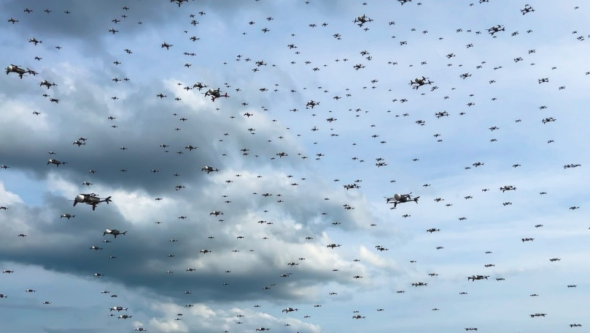
Since a few years, swarms of drones (Chaumette, Chapter 8: Cooperating UAVs and Swarming, 2016) are used in both the civil and the military domains. They might be composed of tens, hundreds if not thousands of drones (e.g. to achieve saturation effect, see Figure 1). It thus becomes hard to deal with each of the individual drones that compose it. Therefore, making a swarm a single object that could then be controlled as a single entity, whatever its size and its surface, is the grail.
STATE OF THE ART Several projects have actively addressed this issue. Still, as far as we know, none has been fully successful, even though each of them significantly contributes to the field and to real world operations. We illustrate various approaches by means of a number of examples. Even though we do not cover the entire domain, these examples illustrate our purpose.
What if We Could Entangle Drones? Towards the Management of a Swarm 73
Figure 1: A swarm of 1000 drones (Courtesy Icarus Swarms).
Drones That Assemble With Each Other In these systems, the drones composing the swarm can assemble with each other during the operation thus becoming a single object.
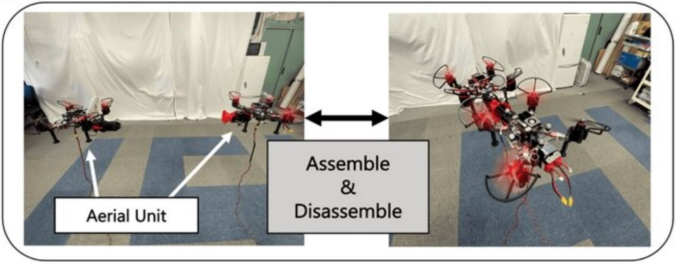
Trady (Sugihara, Nishio, Nagato, Nakao, & Zhao, 2023) stands for Tilted- Rotor-Equipped Aerial Robot With Autonomous In-Flight Assembly and Disassembly Ability. The authors have developed a control model that makes it possible to switch between one single drone to a set of drones connected together. Once assembled, the structure remains rigid until disassembly.
Figure 2: Trady drones (courtesy The University of Tokyo, Japan).
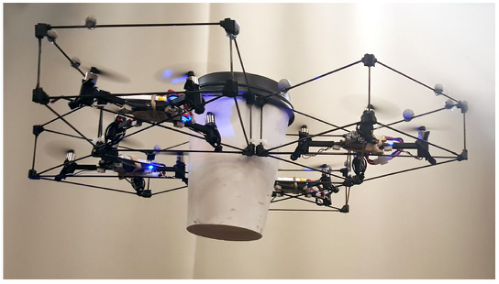
The system developed by the GRASP laboratory consists of drones contained within cuboids with the ability to assemble together (Gabrich, Saldaña, Kumar, & Yim, 2018).
The scenario illustrated Figure 3 consists in carrying a cup from a given location to another. The control of the drones is decentralized and the embedded system and sensors are additionally fed with the data of an external observer that gives the aperture angle necessary to support the cup. The control is highly dependent on the mission at hand. Even though the mission
74 Chaumette
can be dealt with as if using a single system, this is (to the best of our understanding) hard coded and dedicated to the gripping scenario.
Figure 3: GRASP cuboid drones (courtesy GRASP Laboratory, University of Pennsylvania, Philadelphia, PA, USA).
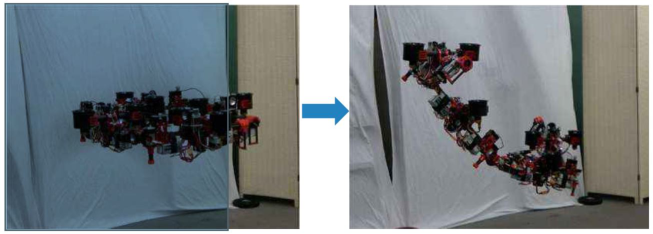
Another system, called Dragon (Zhao, K., & Inaba, 2023) has been developed at the University of Tokyo (like Trady that was presented above). It offers much more flexibility and the ability to dynamically reconfigure the assembly while flying and to adapt the configuration to its environment. Even though it features a single articulated system and is thus out of the precise scope of this paper, we believe it is worth considering here because of its high level of adaptability which is relevant for our purpose.
Figure 4: Dragon reconfigurable drone (courtesy The University of Tokyo, Japan).
Dedicated Ground Control Stations The most widely adopted solution to pilot a swarm of drones is to build a dedicated Ground Control Station (GCS). A classic GCS is adapted to deal with several drones. Such a GCS can provide a high-level definition of a mission.
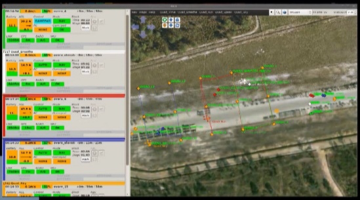
Fly-n-Sense, one of the first French drone companies, has developed, 15 years ago, a ground control station to collect the health management information of a swarm of drones. This was part of the CARUS (Chaumette, et al., CARUS, an operational retasking application for a swarm
What if We Could Entangle Drones? Towards the Management of a Swarm 75
of autonomous UAVs: First return on experience, 2011) project that flew the first autonomous swarm of drones. This system removes some of the load of the operator but does not make it possible to handle the swarm as a single object.
Figure 5: Ground control station, extended to support a swarm of drones (CARUS).
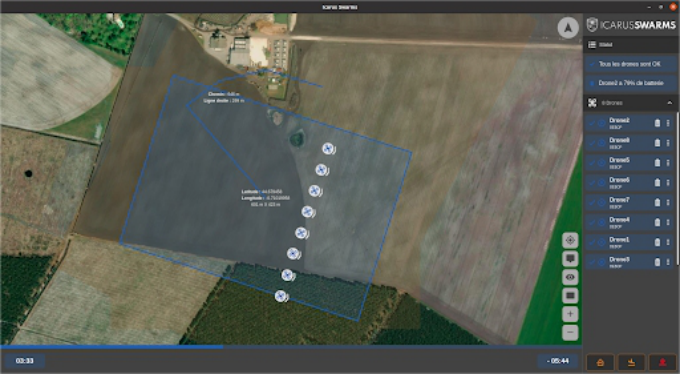
More recently, the Icarus Swarms company has developed a GCS that makes it possible to define the mission of a swarm that then operates autonomously. Here, it is much easier for the operator to manage the swarm globally prior to the flight. Additionally he/she has some control over individual drones during the operations. Nevertheless, it does not offer swarm management as a whole strictly speaking, i.e. with all the operations one would expect (see below).
Figure 6: The swarm oriented GCS of Icarus swarms (courtesy Icarus swarms).
Leader Follower Approaches The leader follower strategy is one the many formation control algorithms for a swarm of drones (Do et al., 2021). It selects (by a dynamic election process or prior to the operation) one of the drones of the swarm as the
76 Chaumette
group leader. This drone plays a coordination role in the system, serving as a reference to follow for the other drones. The pilot can then deal with this unique leader and does not have to care about the other drones. However, the level of freedom in terms of the operations that can be achieved by the swarm is very limited.
Full Autonomy A fully autonomous swarm makes it possible to free the pilot/the ground from the management of the swarm. However, there is little control of the swarm because no one can intervene at any time (no man in the loop). The mission is defined in advance, making it possible to get rid of control during the operation. The group of the author at University of Bordeaux has implemented such an approach with full autonomy of the swarm in the framework of the CARUS project (Chaumette, Laplace, Mazel, & Godin, Secure cooperative ad hoc applications within UAV fleets -- Position paper --, 2009). Additionally, depending on the operation and on the regulation at the considered location, the level of autonomy (Nextech), from full autonomy to low autonomy, has to be mitigated, what affects the above considerations.
IMPLICATIONS OF THE STATE OF THE ART The above approach and the cited projects highlight a number of features we would like to have in a single object swarm (i.e. a swarm that could be considered as a single object). Among these are:
1. Regarding swarm management
a. Swarm seen by the operator as one single object b. Possible management of the swarm by a single operator c. Little load on the operator d. Directions/operations described at the level of the swarm (single object) e. Possibility to split the swarm into a number of sub swarms (each seen as a single object) f. Etc.
2. Regarding the intrinsic nature of the swarm as a single objet
a. Possibly large distance between the drones composing the swarm (space separation) b. Global resilience of the swarm (even though communication can be lost and/or some drones of the swarm can disappear) c. Etc.
None of the systems presented above, and none in the literature, to the best of our knowledge, support all of these features.
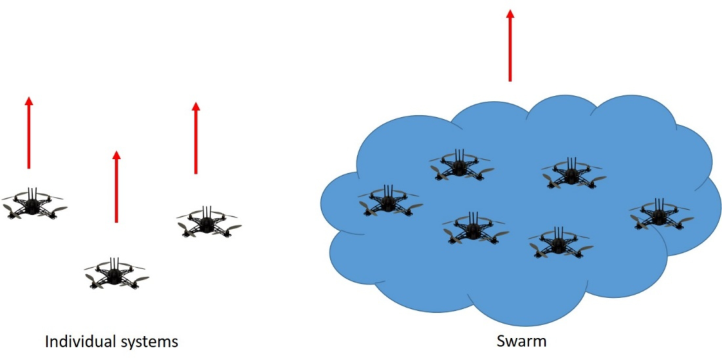
The major issue is that the controls that make sense at the level of a swarm are not simply an upgrade of the operations that make sense for each of the individual drones that compose it. Therefore managing a swarm as a single drone is all but simple. Some controls are easy to adapt (e.g. take off – see Figure 7 - and land) and to map between the swarm level and the level of its individual components.
What if We Could Entangle Drones? Towards the Management of a Swarm 77
Figure 7: Take off adaptation.
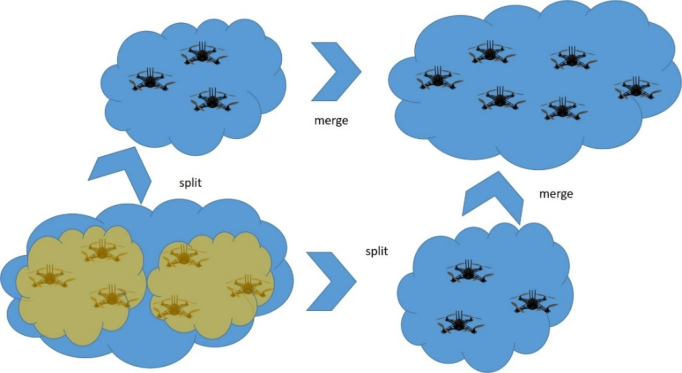
Some are more difficult. For instance, what does it mean and does it even make sense to move a swarm to a given location? Additionally, there is an underlying notion of synchronization that remains hidden when saying “move a swarm to a given location”: when should the move begin, should the members of the swarm go together, when is the move terminated, etc.? Whatever the answers to these questions, this requires to implement stable communication and strong synchronization between the members of the swarm, which cannot be guaranteed in most theatres of operations, especially for large swarms. Additionally, there are operations that only make sense at the level of a swarm, not of an individual drone. For instance, it might be useful to split a swarm into two smaller sub swarms, and later reconnect them as a single object (see Figure 8).
Figure 8: Split and, a unique swarm level operation.
78 Chaumette
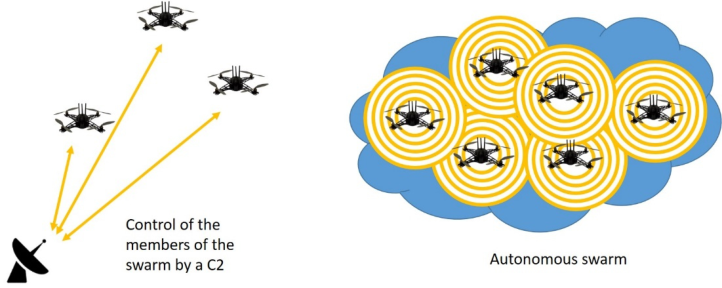
TECHNICAL CONSIDERATIONS From a technical point of view, two major configurations exist (Figure 9).
First, if the swarm is controlled by some central system on the ground (C2, Command and Control) it makes things partly tractable. The C2 has a global view of all the members of the swarm and the above issues can be dealt with, knowing the required information about each unitary system, controlling each of them and serving as a communication relay. Still this does not solve the problems of congestion, latency and disruptions that are critical to implement some swarm level operations (see above).
Second, if the swarm is composed of autonomous systems, i.e. when the swarm is composed of drones that decide on their behavior on their own, it becomes much more difficult. Still, this is the most interesting configuration in real world operations because autonomy makes it possible to address BLOS (Beyond Line of Sight) missions – once a global operation has been attributed to the swarm - and possibly avoids swarm to ground communication. However, the level of collaboration between the drones that is required to implement high level swarm operations is very demanding in terms of communication resilience for both communication and drones themselves.
Many variations between these two extreme configurations exist that raise similar if not exactly the same issues.
Figure 9: Swarm control configuration.
QUANTUM ENTRANGLEMENT AND DRONES ENTRANGLEMENT – A CONCEPTUAL ANALOGY The question to solve is what do we precisely expect when willing to make a swarm a single object? We claim that the perfect result would be to break (at least from the operator point of view) the locality of each individual drone making the swarm a non-local object as if the drones were some sort of entangled (by analogy with quantum physics and the EPR paradox).
What if We Could Entangle Drones? Towards the Management of a Swarm 79
Quantum entanglement is the idea that laid to the present article. Should this paper raise a dispute between the believers on the feasibility of such non- local swarms and the others, it might be useful to recall the dispute between Einstein and Bohr.1 The following paragraph is based on (Klein).
Enstein believes that quantum physics is incomplete. He thus sets up the EPR experiment (Einstein, Podolsky, & Rosen, 1935) to try to demonstrate it. The fact that with no relationship the state of an electron appears on a second simply means that the model does not describe things properly because of “the reality principle”. Borh on his side claims that there is not an issue with quantum theory but that the EPR paradox is only due to the fact that the theory can only describe a system not affected by the measuring system itself (this is the so called Copenhagen interpretation). As soon as you make a measure, the theory does not apply any longer. In the meantime, John Bell shows that a theory that would satisfy the reality principle as set by Enstein would give birth to a number of restrictions (referred to as Bell’s inequalities (Bell, 1964)) on some values predicted by the quantum theory. Alain Aspect, the French Nobel Prize achieved an experience that definitely resolved the dispute, showing that it was possible to adhere to the predictions of the quantum physics, still violating Bell’s equations (Aspect, Dalibard, & Roger, 1982). This implies that the reality principle of Enstein does not hold in the domain of quantum physics (at least as far as hidden local variables are concerned).
Thus, to conclude ≪in an EPR type quantum state, that is to say a “non- factorizable” state, we can no longer talk about the individual properties of each electron, even if they are very far from each other. The two particles form an inseparable whole, a sort of unbreakable couple even when it is very spread out spatially≫(translated by the author from (Klein)).
This is precisely what we would like to achieve with a swarm of drones to make it a single object. Therefore, our provocative claim that future swarms generations will be quantum swarms or swarms of entangled drones.
WHAT NEEDS TO BE ADAPTED OR REDEFINED It thus appears that to achieve our goal of a non-local swarm, it is necessary to adapt or redefine a number of features.
First, some notions are to be revisited to make sense at the level of a swarm. Among these are:
- Location Location is clear at the level of an individual drone. However, what does it mean at the level of a swarm? - Speed
What is the speed of a swarm? The speed of the most rapid drone? The mean speed of the drones of the swarm?
1This is for the sake of the discussion; the author does not pretend any sort of great idea or one to one mapping of the quantum theory to the issues of swarming.
80 Chaumette
- Altitude What is the altitude of a swarm? The altitude of the highest drone, of the lowest drone, of the barycenter of the swarm?
Some other aspects even though clear in terms of what they are raise technical issues, for instance:
- Obstacle avoidance Obstacle avoidance at the level of a swarm means making it loose. Each of the individual drones should avoid obstacles by itself but it should at the same time remain part of the whole unique system. The swarm should thus be in some sense fluid. - Communication management
How do you communicate with a non-local swarm? There can be no central point of communication identified as such, i.e. by definition this cannot be one of the drones of the swarm, each drone being “diluted” within the single swarm object.
Some are a mix of concepts and technical issues, one of the most important being the synchronization between successive actions of the swarm. For example, assume the following mission: “take off and move to (x, y, z), make a photo of the area, get back and land”. It can be translated into the following sequence of actions at the swarm level:
1. Take off 2. Move to (x, y, z) so as to cover the given area 3. Make a photo (by running a mosaicking algorithm in cooperation between the drones) 4. Get back 5. Land Each individual action raises a number of questions as seen above. Even more challenging, there probably needs to be a sort of synchronization between each of them. For instance, what is the temporal relationship (if any) between action 1 and 2, i.e. when should action 2 begin? As soon as one of the individual drones has taken off, or when all the drones have taken off? And once decided, how do you inforce the selected policy?
CONCLUSION
In this paper, we claim, in a provocative and we believe though stimulating manner that the drones of a swarm should be entangled to make the swarm a unique global object. In addition to explaining why this claim, we have identified a number of theoretical and technical issues that need to be addressed to approach such a view of swarming.
Based on this preliminary analysis, we are now working on the issues raised and will possibly build a prototype that would illustrate and give birth to this hypothetical system that we believe would be a new generation of swarms.
What if We Could Entangle Drones? Towards the Management of a Swarm 81
ACKNOWLEDGMENT
The author would like to acknowledge the academics and companies he has been working with in the past years and that made the ideas presented in this paper an evidence.
REFERENCES
Aspect, A., Dalibard, J., & Roger, G. (1982, December 20). Experimental Test of Bell’s Inequalities Using Time-Varying Analyzers. Phys. Rev. Lett., 49(25). Retrieved from https://journals.aps.org/prl/abstract/10.1103/PhysRevLet t.49.1804 Bell, J. (1964). On the Einstein Podolsky Rosen Paradox. Physics, pp. 195–200. Chaumette, S. (2016). Chapter 8: Cooperating UAVs and Swarming. In J. H. Kamesh
Namuduri, UAV Networks and Communications. Cambridge Press. Chaumette, S., Laplace, R., Mazel, C., & Godin, A. (2009). Secure cooperative ad hoc applications within UAV fleets -- Position paper --. 28th IEEE Military Communications Conference (MILCOM 2009), (pp. 1–7). Boston. Chaumette, S., Laplace, R., Mazel, C., Mirault, R., Dunand, A., Lecoutre, Y., &
Perbet, J.-N. (2011). CARUS, an operational retasking application for a swarm of autonomous UAVs: First return on experience. Milcom 2011. Baltimore: IEEE. Do, H., Hua, H., Nguyen, M., Nguyen, V.-C., Nguyen, H., & Nguyen, N. (2021).
Formation Control Algorithms for Multiple-UAVs: A Comprehensive Survey. EAI Endorsed Transactions on Industrial Networks and Intelligent Systems. Einstein, A., Podolsky, B., & Rosen, N. (1935). Can Quantum-Mechanical Description of Physical Reality Be Considered Complete? Phys. Rev., 47, pp. 777–780. Gabrich, B., Saldaña, D., Kumar, V., & Yim, M. (2018). A Flying Gripper Based
on Cuboid Modular Robots. 2018 IEEE International Conference on Robotics and Automation (ICRA) (pp. 7024–7030). Brisbane, Australia: IEEE. DOI: 10.1109/ICRA.2018.8460682. Klein, E. (n.d.). EINSTEIN-BOHR : LE GRAND DÉBAT QUANTIQUE. Retrieved from https://indico.in2p3.fr/event/7293/attachments/33254/40989/20130716_ Revue-de-synthese-Einstein-Bohr-Etienne_Klein.pdf. Nextech. (n.d.). 8 Levels of Drone Autonomy. Retrieved from nextech.online: https:
//nextech.online/drone-autonomy/ Sugihara, J., Nishio, T., Nagato, K., Nakao, M., & Zhao, M. (2023). Design, Control, and Motion Strategy of TRADY: Tilted-Rotor-Equipped Aerial Robot With Autonomous In-Flight Assembly and Disassembly Ability. Adv. Intell. Syst., 5. Retrieved from https://onlinelibrary.wiley.com/doi/full/10.1002/aisy.202300191 Zhao, M., K., O., & Inaba, M. (2023). Versatile articulated aerial robot DRAGON: Aerial manipulation and grasping by vectorable thrust control. The International Journal of Robotics Research, 214–248. Retrieved from https://jour nals.sagepub.com/doi/abs/10.1177/02783649221112446
LISTED IN THE AHFE DIGITAL BOOKSTORE CATALOGUE
Explore the complete digital volume
Human Factors in Design, Engineering, and Computing
Read this individual research paper free through the original publisher, or explore the full digital proceedings book.
ISBN 978-1-964867-35-9
Explore this ISBN in the AHFE Bookstore ↗Listed in the July 2026 bookstore catalogue; search by ISBN to confirm current availability · Digital book purchase optional