Laura Henriques, David Whitney, Chi-ah Chun, Kim-Phuong L. Vu, Arturo Zavala (2024). Pre-Professor Program: A Virtual Training Program to Improve Faculty Diversity. In: Human Factors in Design, Engineering, and Computing. AHFE Open Access, vol. 159, pp. 1871–1881. https://doi.org/10.54941/ahfe1005754
The number of science, technology, engineering, and mathematics (STEM) degrees awarded to underrepresented students has increased over the past two decades, but these graduates still represent a small percentage of STEM career professionals (Fry et al., 2021) and faculty members (Bennett et al., 2020). For diversifying faculty, Bennet et al. identified a barrier to be the lack of programs to support underrepresented groups at the postdoctoral and early career stages. The Pre-Professor Program (PREPP) was designed to support advanced doctoral students’ and postdoctoral scholars’ transition to faculty positions by engaging them in a semester-long virtual program within the California State University (CSU) system, which consists of 23 campuses across the state of California. PREPP Fellows receive individual mentorship from an experienced PREPP Mentor who engages them during weekly meetings to explore 15 topics and a few dozen activities related to teaching, service, and research at comprehensive and ethnically diverse institutions, as well as the process for applying for tenure track positions at such institutions. PREPP Mentors also discuss tenure and promotion processes and coordinate various campus and departmental activities to introduce PREPP Fellows to campus resources and learn perspectives of faculty life within their discipline. Initially designed as a local, in-person program, PREPP morphed into an online, virtual training program that allowed the program to grow and be implemented throughout the entire CSU system. The flexibility provided by the virtual platform enabled PREPP participants to be effectively immersed in learning about faculty life at a CSU campus without requiring them to be in the local area. This paper describes PREPP and how it can be used as a model to provide a pathway for highly competitive and diverse applicants to faculty positions.
Broadening participation of underrepresented groups (URG) in the science, technology, engineering, and mathematics (STEM) fields is critical to maintaining and growing U.S. competitiveness in innovation, the knowledge and science economy, and broadly equipping the 21st century workforce.
Bennett et al., 2020 (p. 5) Many programs have been aimed at preparing underrepresented students in research as a high-impact practice for retention and pursuit of advanced degrees (e.g., Bayliss et al., 2018; Hall et al., 2016; Vu et al., 2023).
These programs have been successful, with data showing that intensive undergraduate research training programs help students, especially those from underrepresented groups, enter Ph.D. programs. According to the National Science Foundation, the 2020 Integrated Postsecondary Education Data System (IPEDS) data shows that traditionally underrepresented minority (URM: Hispanic, Black, and American Indian or Alaska Native) students in science, technology, engineering, and mathematics (STEM) disciplines collectively earned 26% of bachelor’s degrees, 24% of master’s degrees, and 16% of doctoral degrees awarded in those fields. Nevertheless, Bennet et al. (2020) report that only 10% of STEM faculty at four- year institutions are from URM groups. They indicate that the number of programs intended to support URM groups at the postdoctoral and early career faculty stages are significantly fewer than at the undergraduate and graduate stages. This lower level of support at the more advanced levels may be a critical barrier for URM groups to enter and remain in faculty positions.
The California State University (CSU) system comprises 23 R2 and comprehensive teaching-intensive master’s degree-granting institutions. As a system, the CSU employed 11,132 tenured/tenure-track faculty members and approximately 17,000 lecturers in Fall 2023. Only 16% of the tenured/tenure-track faculty were Black/African American or Hispanic/Latinx. (California State University, 2023). The percentage was more promising for lecturers (21%), but even this number reflects a significant disparity given that these two racial/ethnic groups make up more than 50% of the CSU student enrollment in Fall 2023 (see California State University, 2024a).
There are different types of faculty positions that doctoral students and postdoctoral scholars may not be aware. Although CSU awards nearly half of California’s bachelor’s degrees, the number of master’s and Ph.D. degrees awarded are significantly smaller, given the size of the CSU system (see California State University, 2024). As such, faculty members who join the CSU, or most other colleges or universities, typically earn their doctorate degrees at R1 universities. California is also home to the UC system, which comprises 10 campuses and produces the largest number of doctoral degrees in the state (see University of California, Office of the President, 2024). The potential synergy between the CSU-UC campuses provides an opportunity to establish a pathway for doctoral students and postdoctoral scholars at partnering UC campuses to learn about faculty roles at a CSU campus with the goal of having their graduates apply for faculty positions at that campus.
In 2019, the National Institute of Health (NIH) awarded the California State University Long Beach (CSULB) Phase II BUilding Infrastructure Leading to Diversity (BUILD) award to institutionalize interventions shown to be effective for diversifying the health-related workforce. One of these interventions was the Pre-Professor Program (PREPP). PREPP was designed to support advanced doctoral students and postdoctoral scholars at the University of California Irvine (UCI) in transitioning to faculty positions by engaging them in a semester-long program at CSULB. In 2021, the program was expanded across the CSU system to become CSU PREPP and was implemented virtually. Having a diverse faculty that resembles
Pre-Professor Program: A Virtual Training Program to Improve Faculty Diversity 1873
the student composition can significantly impact the development of the future workforce because CSU is the largest public 4-year university system in the U.S., enrolling over 450,000 students. Moreover, the successful implementation of CSU PREPP provides a model for other institutions to adopt to increase faculty diversity. The following sections describe the virtual CSU PREPP and data showing its feasibility.
PRE-PROFESSOR PROGRAM (PREPP) CSU PREPP stemmed from a localized version of PREPP conducted in person in collaboration with the CSULB BUILD program and its R1 partner institution, UCI. It was initially implemented in 2019 with a small cohort of 2 PREPP Fellows and expanded to a cohort of 6 Fellows per semester within two years (the current cohort includes 12 UCI PREPP Fellows). Informal interviews and focus groups were conducted with a range of key PREPP stakeholders (e.g., Fellows, Mentors, Administrators) to provide an initial evaluation of PREPP and inform modifications. All stakeholders were uniformly positive in their responses, with administrators being particularly enthusiastic about PREPP serving as a blueprint for diversifying the faculty. Unfortunately, no available faculty positions at CSULB at that time matched the PREPP Fellows’ disciplines and research expertise. Thus, it became clear that this program would work in its intended ways only with a larger consortium of participating CSU campuses to increase the pool of available faculty positions and the range of disciplines and openings for which the PREPP Fellows can apply.
Because the COVID-19 pandemic resulted in campus closures during Spring 2020, PREPP transitioned from an in-person format to a virtual implementation. This unintended shift to a virtual training mode created opportunities to include technology for remote participation and online training. In fact, the virtual version of PREPP during 2020–21 increased the number of activities completed by the Fellows. At the same time, fewer hours were devoted to the project overall because Fellows did not have to be physically present on campus. Short but more frequent meetings between PREPP Fellows and various CSULB faculty and staff were possible online in ways that would not make sense in person. For example, traffic and parking issues deter a Fellow from coming to CSULB for a 20-minute meeting. With virtual meetings becoming the norm, those sorts of interactions easily happened. Thus, as the campuses repopulated beginning in Fall 2021 after COVID-19 restrictions were lifted, remote training modality continued to be adopted, with in-person opportunities made available to PREPP Fellows for CSULB campus visits. In summary, being online allowed for more opportunities for involvement, streamlined the scheduling of group meetings (as travel time was no longer a consideration), and enabled vital meetings to be recorded for Fellows unable to attend. Additionally, it allowed the program to consider geographic expansion.
Going entirely virtual enabled a CSU-wide PREPP to be implemented as a pilot project in 2021. For the 2021–2022 academic year, CSU PREPP brought together five CSU campuses throughout California to serve as host campuses
for the semester-long virtual PREPP experience. PREPP Faculty Mentors and Campus Liaisons from the five pilot campuses participated in online training during Fall 2021 with the established PREPP personnel from CSULB, where they learned about the program, resources, and expectations. CSU PREPP also partnered with the CSU Chancellor’s Doctoral Incentive Program (CDIP) at the CSU Chancellor’s Office to expand the pool of PREPP Fellows beyond the UCI doctoral students and postdoctoral scholars. Since 1987, the CDIP program has prepared doctoral students nationwide for CSU faculty positions by providing financial support (i.e., conference/research travel grants, mini-grants for research, and loan forgiveness for CDIP participants who become faculty at the CSU) and mentorship by a CSU faculty sponsor who also provides professional development (see California State University, 2024b). For CSU PREPP, CDIP recruited participants about 1–2 years from entering the job market to participate, similar to the recruitment conducted by UCI. Finally, the CSU-wide implementation offered greater opportunity for faculty position alignment with the Fellow’s discipline due to the larger number of positions available across the 23 CSU campuses. The virtual implementation of PREPP also helped pave the pathway for making this a true CSU-wide program.
CSU PREPP Components Although implemented in a virtual format, CSU PREPP was designed to immerse PREPP Fellows in the life of a faculty member at a CSU campus (either an R2 or comprehensive master’s granting institution). Through Zoom and other online collaboration and meeting tools, PREPP Fellows attend department meetings, experience/observe job expectations and faculty work, guest lecture in a class, mentor students, and so forth. PREPP Fellows also receive individual mentorship from an experienced PREPP Faculty Mentor at the CSU campus they are assigned to in three broad areas: 1) Instruction, 2) Understanding the Campus Culture, and 3) Service. Since research is emphasized at the PREPP Fellow’s home institution (i.e., at an R1 University), CSU PREPP focuses instead on how research is conducted within the CSU (e.g., working with undergraduates and master’s students and understanding internal research support). Overall, the goal and activities of the virtual version of PREPP were intended to match the in-person version.
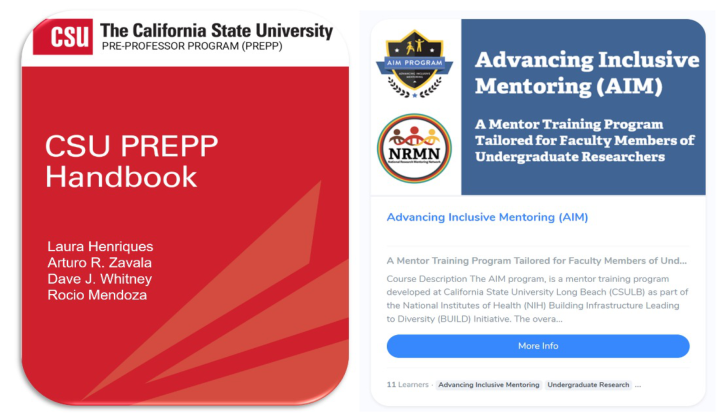
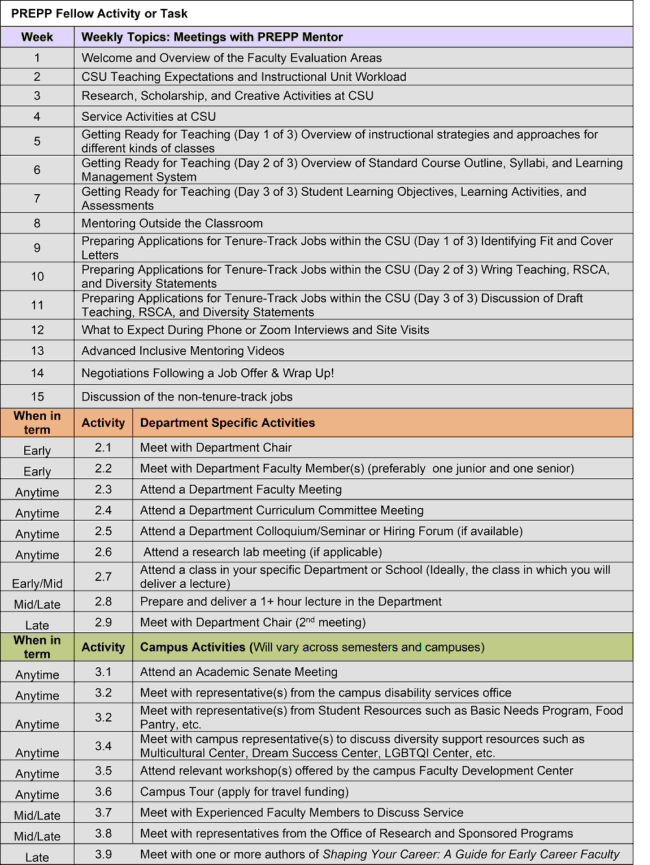
A CSU PREPP Handbook (Henriques et al., 2021; see Figure 1) was developed to provide in-depth coverage of the roles and responsibilities of PREPP campus personnel (e.g., Campus Liaison and Mentors), coordination efforts required for activities at the department/campus level versus the ones provided by the PREPP Mentor, best practices for recruitment and selection, and general recommendations. The handbook also provides weekly discussion prompts, readings, related activities, and sample communications to department chairs, faculty, and campus staff introducing CSU PREPP. The weekly discussion topics are shown in Figure 2. An online platform for Mentors was used to organize program resources, making it easy to find readings, discussion prompts, and program documents. Course management systems (e.g., Canvas) were utilized so fellows could easily access the program resources. Readers interested in adopting CSU PREPP components/activities should reference the CSU PREPP Handbook (available upon request).
Pre-Professor Program: A Virtual Training Program to Improve Faculty Diversity 1875
Figure 1: Left: Image of the CSU PREPP Handbook; Right: Image of the advancing inclusive mentoring (AIM) course of myNRMN.
Figure 2 also shows the activity log that PREPP Fellows received outlining the activities and tasks they could complete throughout the semester. The log includes suggestions for when the activities should occur during the semester and becomes part of the documentation for the Fellows, documenting their level of participation in the professional learning experiences. The suggested activities are structured to help Fellows better understand life as a faculty member in their discipline (Fellows meet the department chair and faculty in their home discipline, which is usually not the discipline of the PREPP Mentor); learn about resources to help them become more successful as teachers (from faculty in their discipline, the faculty center for professional learning1, the multicultural resource center, student services, and by interacting with students); learn about resources for research (meeting with staff in the office of grants and sponsored programs); connect with people who will help them understand service (attending a meeting of the faculty senate, meeting with service-oriented campus leaders). Finally, PREPP Fellows discuss with their PREPP Mentor how to identify faculty positions, successfully prepare themselves for the hiring process, and navigate expectations for tenure. As part of learning about working and mentoring undergraduates (as opposed to being the mentee), Fellows are expected to complete an introductory module of a faculty-inclusive mentoring training developed for CSULB faculty participating in the BUILD program (Young et al., 2021). Fellows have the option to continue through the entire course (See Figure 1; https://courses.nrmnet.net/course/c/AIM). One of the last PREPP activities is a meeting between the Fellows and the Provost. PREPP Fellows found this meeting particularly meaningful, and the Provosts value the opportunity to meet a diverse group of potential job applicants.
1Names for these centers or resources vary by campus
Most PREPP activities and meetings occur synchronously, but some tasks and learning occur asynchronously (e.g., Advancing Inclusive Mentoring training, written tasks, planning for teaching). Upon successful completion of the PREPP semester, Fellows receive a PREPP certificate, a copy of their activity log, and an AIM certificate if they completed the entire AIM course. These professional learning experiences enhance their CVs and provide practical experience and knowledge that aids them in the job application process. In addition, Fellows leave the program with a fuller understanding of faculty life at an R2 or comprehensive university, making them better able to decide if that is the type of academic home in which they would thrive.
Figure 2: Weekly discussion topics with PREPP mentors and CSU PREPP fellow activity and task log.
Pre-Professor Program: A Virtual Training Program to Improve Faculty Diversity 1877
Initial Evaluation and Outcomes A survey of 63 PREPP Fellows was conducted for an initial evaluation of PREPP. The results show that these Fellows were highly engaged in PREPP, spending an average of 3 hours weekly on PREPP activities. All PREPP Fellows reported enjoying and benefitting from the semester-long PREPP experience. Multiple Fellows indicated that the most valuable part of the experience was the one-to-one mentoring they received with the PREPP Mentor. Other benefits Fellows reported included learning how to work with CSU undergraduates on research, balancing teaching, research, and service at the CSU, the CSU tenure process, and job interview tips. PREPP Fellows indicated that the amount of time and effort put into the program was worth it based on the benefits they received. Fellows appreciated that their PREPP Mentors were highly responsive to their needs and guided them successfully through the program activities. Of note, nearly three-fourths of the Fellows indicated they would apply to a CSU campus if they were on the job market and there was an opening in their respective field. A more detailed report of the PREPP Fellows’ program experience and outcome evaluation, including qualitative and quantitative data, is being prepared for a future publication.
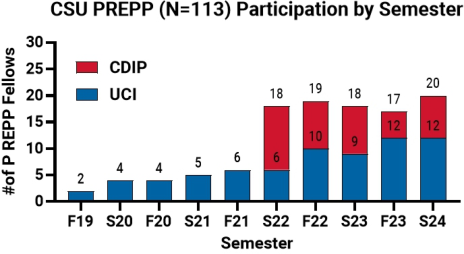
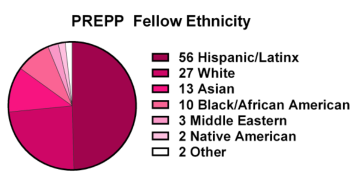
Since its initial implementation in Spring 2019 through the most recent one in Spring 2024, PREPP has trained a total of 113 Fellows (see Figure 3). PREPP Fellows come from diverse racial/ethnic backgrounds (e.g., 50% Hispanic/Latinx, 9% Black/African American, 2% Native American, see Figure 4), which more closely aligns with the student demographics of the CSU than current CSU faculty. The Fellows also represent a diverse range of disciplines: Arts, Business, Education, Engineering, Health and Human Services, Humanities, Natural Sciences and Mathematics, and Social and Behavioral Sciences.
Figure 3: Number of PREPP fellows participating in the program since it was first implemented in 2019. CDIP: Chancellor’s doctoral incentive program (CDIP); UCI: University of California, Irvine.Figure 4: Ethnic breakdown of PREPP fellows who have participated in the program since it was implemented in 2019.
As of Spring 2024, 78% of PREPP Fellows are still graduate students or postdoctoral scholars, but of the remainder, nine have joined the faculty as Assistant Professors at a CSU campus, and nine are faculty at other 4-year institutions. Recognizing that Fellows do not leave the program and immediately start a faculty position due to having to finish their doctorate and/or continue to postdoctoral experience, these preliminary results capture the early success of the program and its potential impact.
While the focus of PREPP has always been on the Fellow, there is a benefit to the campus in terms of having faculty members who are more aware of, and attentive to, the needs of junior faculty as a result of being part of PREPP (Mentors, deans, chairs, and department faculty who meet with Fellows). Most campuses keep the same mentor each semester, while some rotate mentors. For those campuses that regularly bring on new mentors, a small but growing cadre of faculty are more attuned to the struggles of new faculty and can serve as a support to them, even when not in an official mentoring capacity.
Implementation Costs and Return on Investment The initial outcomes of CSU PREPP are positive, with early data showing that the program can be successfully exported to other campuses in a fully virtual format to provide a feasible pathway for diverse groups of graduate and postdoctoral students to enter faculty positions. However, a known barrier to the adoption of any program is its cost. Below is a list of costs associated with implementing CSU PREPP (details about specific roles and responsibilities and desired qualifications of PREPP personnel can be found in the CSU PREPP Handbook).
Campus Liaison: This person coordinates CSU PREPP activities on the specific campus and works with PREPP Faculty Mentors and partner institutions to reach and recruit PREPP Fellows (in this case, UCI or CDIP). The Liaison also oversees the overall coordination and evaluation of PREPP on their campus and within CSU PREPP. One course release per academic year is recommended.
PREPP Mentor: Typically a tenured faculty member, the PREPP Mentor will work directly with the PREPP Fellows, usually three per semester. The success of PREPP is most dependent on a dedicated Faculty Mentor who
Pre-Professor Program: A Virtual Training Program to Improve Faculty Diversity 1879
meets one-on-one and whole group with the cohort of Fellows and sets up meetings for each Fellow with relevant faculty and staff in the Fellows’ respective home disciplines and the campus provost. On average, PREPP mentors put in the same amount of time as prepping, teaching, and grading for a 3-unit class. Hence, one course release is recommended.
PREPP Fellows: Although PREPP Fellows are the immediate beneficiaries of the program, it is recommended that the Fellows receive a small award for completing the program (recommended amount of $500 - $1,000) and travel funds to visit the specific CSU campus (recommended amount varies by distance to their assigned CSU campus). This funding is provided by partner institutions of the Fellows (UCI or CDIP, not the CSU campus) as part of their commitment to PREPP.
For the pilot phase of CSU PREPP, Liaisons and Mentors from the five initial campuses participated in initial onboarding and semester-long training to learn about PREPP and how to implement it on their campus. Additionally, a few meetings took place during the first semester of implementation to ensure that fellows had similar experiences. Faculty received some compensation for their time during the training. After the pilot, new campus mentors undergo individualized training with the CSULB Liaison to familiarize themselves with project expectations and their duties.
The teaching load at the CSU is nominally 4-4. Thus, the recommended course release for Campus Liaison and Faculty Mentors allows adequate time for them to work on PREPP activities. Other institutions may adopt other forms of compensation, such as summer pay. Regardless, we consider the cost low relative to the potential return on investment.
CONCLUSION
Using a virtual platform, PREPP effectively immersed advanced doctoral students and postdoctoral scholars in learning about faculty life at a CSU. PREPP was also influential in having its Fellows consider CSU for their academic careers. It should be noted that CSU PREPP continues to evolve as different campuses participate yearly or rotate in, and the PREPP leadership receives feedback about the usefulness of specific program components and program outcomes. Evaluation data shows that in its current form, CSU PREPP serves as a feasible model for strengthening the pipeline of highly competitive and diverse applicants to tenure-track positions that other institutions can adopt. While the payoff is not immediate, PREPP is a promising investment in the future.
ACKNOWLEDGMENT
The authors would like to acknowledge Laura Kingsford and Christian Molidor for contributions to the development of PREPP; Nada Rayyes and Erin Arruda for evaluation efforts of PREPP; Frances M. Leslie, former Vice Provost for Graduate Education and Dean of the Graduate Division at UCI, for the initial conceptualization of and support for the program; Brian Jersky and Karyn Scissum Gunn, Provosts at CSULB, for their steadfast commitment
and generous financial support; Emily Magruder, Director, Innovative Teaching and Future Faculty Development, and Elizabeth Sanchez, CDIP Program Manager, at the CSU Chancellor’s Office for their assistance in the CSU systemwide integration of PREPP; Gillian R. Hayes, Vice Provost for Graduate Education and Dean of the Graduate Division at UCI, for her expanded support of the program, and Rosie Victor, Kaeleigh Hayakawa, Kayleigh Anderson, Annabel Ortiz, and Celina Mojica at UCI Graduate Division for their help in coordinating PREPP; and all the PREPP Liaisons and Mentors across the CSU campuses that make the program successful. This research was partly supported by the National Institute of General Medical Sciences of the National Institutes of Health under Award Numbers UL1GM118979 and RL5GM118978. The content is solely the authors’ responsibility and does not necessarily represent the official views of the NIH.
REFERENCES
Bayliss, F., Peterfreund, A., & Rath, K. (2018). STEM Mentoring Programs to Prepare Career Scientists at San Francisco State University. In J. McClinton, D. S. Mitchell, G. B. Hughes and M. A. Melton. Mentoring at Minority Serving Institutions (MSIs): Theory, Design, Practice and Impact. Information Age Publishing, Inc. Bennett, J., Lattuca, L., Redd, K., & York, T. (2020). Strengthening Pathways to
Faculty Careers in STEM: Recommendations for Systemic Change to Support Underrepresented Groups. Washington, DC: Association of Public and Land- grant Universities. https://ncses.nsf.gov/pubs/nsf23315/report/science-and-engin eering-degrees California State University (2023). The employees of the California State University.
Long Beach, CA: The California State University. Retrieved on May 19, 2024 from: https://www.calstate.edu/csu-system/faculty-staff/employee-profile/Docum ents/2023-Employee-Profile-Brochure.pdf California State University (2024a). Fact Book 2024. Long Beach, CA: The California State University. Retrieved on May 19, 2024 from: https://www.cals tate.edu/csu-system/about-the-csu/facts-about-the-csu/Documents/facts2024.pdf California State University (2024b). The Chancellor’s Doctoral Incentive Program
(CDIP). Retrieved on May 19, 2024 from: https://www.calstate.edu/csu-system/ faculty-staff/cdip Fry, R., Kennedy, B., & Funk, C. (2021). STEM jobs see uneven progress in increasing gender, racial and ethnic diversity. Pew Research Center. Hall, A. K., Miklos, A., Oh, A., & Gaillard, S. D., (2016). Educational
Outcomes from the Maximizing Access to Research Careers Undergraduate Student Training in Academic Research (MARC U-STAR) Program. Retrieved on July 10, 2022 from: https://www.nigms.nih.gov/News/reports/Documents/MAR C-paper031416.pdf Henriques, L., Zavala, A. R., Whitney, D. J., & Mendoza, R. (2021). CSU PREPP Handbook. Long Beach, CA. University of California, Office of the President (2024). Institutional Research and
Academic Planning. Retrieved on May 19, 2024 from: https://www.ucop.edu/ins titutional-research-academic-planning/content-analysis/graduate/index.html
Pre-Professor Program: A Virtual Training Program to Improve Faculty Diversity 1881
Vu, K.-P. L., Mendoza, R., Chun, C.-A., Dillon, J., & Kingsford, L. (2023). The CSULB BUILD Scholars Program: A research-intensive, upper-division program to broaden and diversify the behavioral and biomedical research workforce. Understanding Interventions, 14(1), 1–37. Young, K. A., Finney, M. A., Marayong, P., & Vu, K.-P. L. (2021). Advancing Inclusive Mentoring Through an Online Mentor Training Program and Coordinated Discussion Group. In: Yamamoto, S., Mori, H. (eds) Human Interface and the Management of Information. Information-Rich and Intelligent Environments. HCII 2021. Lecture Notes in Computer Science, vol. 12766. Springer, Cham.
LISTED IN THE AHFE DIGITAL BOOKSTORE CATALOGUE
Explore the complete digital volume
Human Factors in Design, Engineering, and Computing
Read this individual research paper free through the original publisher, or explore the full digital proceedings book.
ISBN 978-1-964867-35-9
Explore this ISBN in the AHFE Bookstore ↗Listed in the July 2026 bookstore catalogue; search by ISBN to confirm current availability · Digital book purchase optional