Yuwen Fang, Yitong Qiu, Gang Liu, Anthony Kong (2024). Semantic Difference Method for Artificial Intelligence Assisted Cruise Ship Cabin Design. In: Human Factors in Design, Engineering, and Computing. AHFE Open Access, vol. 159, pp. 139–148. https://doi.org/10.54941/ahfe1005576
In the traditional design process, for determining the form of a single project or product, designers often need to create hundreds to thousands of sketches. However, in the field of cruise ship interior decoration design, this issue becomes more complex. Each large cruise ship has thousands of rooms. Due to restrictions on room types and user needs, they each require unique interior decoration plans; at the same time they must maintain consistency with the theme of the entire cruise ship. Therefore, in the process of cruise ship interior design, designers often have to draw thousands of detailed interior design drawings. Facing such a huge amount work task under an industrial age background undoubtedly puts great pressure on designers.As we gradually step into the era of artificial intelligence, generative AI technology continues to achieve significant breakthroughs, such as ChatGPT and Midjourney, which can generate required images or text information based on keywords or prompts. Designers leverage these advanced technologies like AIGC to generate images by inputting a few keywords and can thus create vast image resources to provide them with abundant sources of inspiration. This method significantly enhances the design efficiency and creative quality of designers in an academically translated way.However, stark differences exist between the comprehension of images by artificial intelligence generative technology and designers. Machines struggle more with understanding adjectives than other types of words, such as 'luxurious' or 'classical', which are highly associated with people's cognitive preferences. Designers often find in using AIGC that the system-generated images do not fully meet their anticipated needs; a large proportion of the images generated by AIGC require subsequent adjustments and cannot be directly applied. This raises the issue at focus in this research: there is a discrepancy between human cognition of vocabulary and machine understanding.Therefore, in this context, we have chosen cruise ship interior design as the case study for our research. From a designer's perspective, we delve deeply into understanding the cognitive discrepancies that exist between artificial intelligence and humans. Firstly, we thoroughly examine the differences in understanding adjectives between AI and humans, incorporating existing research results to empirically construct a semantic evaluation scale specifically for cruise ship-related terminology. This scale aims to describe, measure and analyse these cognitive discrepancies and ultimately provide an effective tool to assist cruise ship interior designers conduct innovative designs more accurately and efficiently.The method adopted in this research is the integration of Kansei engineering and AI generative technology AIGC applied to the relatively novel field of cruise ship interior design, combined comprehensively with Semantic Differential (SD) approach. The SD method can use adjectives to reflect group preferences for images and environments to a large extent. We have selected the most representative words associated with cruise ship style through analysis, collected typical images, and categorized them. Then we utilized the SD method to conduct detailed analysis on accumulated vocabulary and pictures, creating descriptive statistical reports which ultimately form a language evaluation scale specifically reflecting elements and concepts characteristic of cruise ships.In theoretical terms, this study employs the method of Kansei Engineering to construct a semantic evaluation scale specifically for cruise interior design, thereby further enriching the evaluation framework in this field. In practical terms, it introduces AIGC as an aid to stimulate designers' innovative thinking and provide reference image inspiration to enhance their overall design efficiency.
In traditional design, designers often need to produce hundreds or even thousands of sketches before the final form of a product is determined. However, this issue becomes more complex in the field of cruise interior decoration design. Each large cruise ship has thousands of rooms which, due to restrictions by room type and user demand, must maintain their own independence while also aligning with the theme of the cruise ship. Thus, during the process of designing cruise interiors, designers often need to draw several thousand detailed interior design drafts. Faced with such an enormous workload under industrial conditions undoubtedly places significant pressure on designers (Chen, Cheng, & Simatrang, 2021).
As we gradually step into an era dominated by artificial intelligence (AI), AIGC-assisted software such as ChatGPT and Midjourney greatly enhance efficiency for designers (Dodge & Karam, 2017). Yet there are notable differences between AI-generated technology and human understanding when it comes to image interpretation--the focal point for this study: biases exist between how humans perceive vocabulary compared to machines.
Against this backdrop, focusing on examples from within cruise interior designs aims at not only exploringdeep-seated cognitive biases between AI and humans but also generating corresponding semantic evaluation scales for future designer +use in creating images.
This study applies the research methodologies of Kansei Engineering and AIGC to the relatively novel field of cruise ship interior design assistance, utilizing cluster analysis and semantic differential techniques. Theoretically, this paper explores the differences between AI and human cognition of adjectives through Kansei Engineering methods, generating a semantic evaluation scale for cruise ship interior design, thereby enriching the content related to interior design evaluation in the cruise industry. Practically, this study introduces AIGC-assisted interior design generation, significantly enhancing designers’ efficiency.
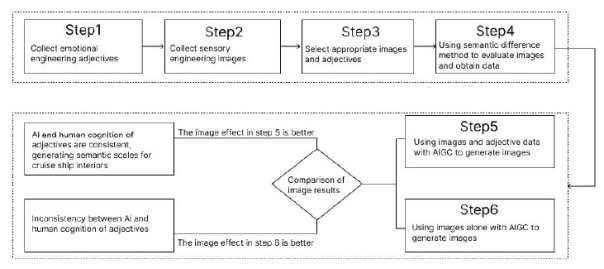
TECHNOLOGICAL PATHWAY This research is conducted in two stages:
(1) Collection of adjectives and images related to Kansei engineering, using the semantic differential method to evaluate these images, thereby generating a semantic scale for cruise ships (Wang & Hsiao, 2018).
(2) Utilization of this cruise ship semantic scale for generating AIGC images, followed by verification of the validity of this scale.
The main experimental process comprises two steps: firstly, evaluating existing cruise cabin photographs using the semantic differential method; seeking experiment participants to score these photos and collecting their scoring data. The second step involves feeding selected adjectives, data and original photos into our chosen AIGC software to generate new pictures. Based on image quality we continuously adjust chosen adjectives until they achieve substantial generation effects with their corresponding datasets - thus giving birth to a relevant semantic scale for cruise ships. Applying this scale generates pertinent AIGC imagery for cruises which are then compared against non-scale-applied pictures from before - yielding final conclusions (Huang, Chen, & Khoo, 2012).
SEMANTIC WORDS AND IMAGE COLLECTION Semantic Words Collection
Adjectives related to cruise ship furniture and cabins were collected from magazines, newspapers, and the internet. The collection criteria included adjectives describing cruises. The method involved identifying relevant sentences that described a cruise ship on the internet and extracting appropriate adjectives from these sentences (Lai, Zhang, Mao, Liu, & Chen, 2022). After eliminating duplicates, deleting words irrelevant to cruise ship furniture and interior decoration, as well as further part-of-speech filtering, a total of 115 words were selected for further evaluation.
Excluding certain words unrelated to cruises and preliminary synonym categorizations were carried out. The principle of classification is to merge as much as possible the vocabulary with similar or close meanings in order to reduce research workload. For instance, regarding the expression “luxury”, we collected synonymous adjectives like “luxurious”, “top-notch”, “opulent”, “enjoy luxuriously”,”top- grade”,”honorable”,”exclusive”,”revered”,”indulge fully”,”gorgeous”, “high-end”, “ultimate” and “expensive”. Eventually, we chose “luxurious” as representative vocabulary.
By filling the researched semantic words with antonyms, adjective pairs can be formed which serve as semantic scales for later research evaluations. For example - if you select ten vocabularies such as ‘Luxury’, Understated’, ‘Friendly’, ‘Spacious’, ‘Bright’,’Fashionable’,’Simple’,’Comfortable’,’Novelty’ and ‘Exquisite’ serving evaluative standards; then these ten vocabularies could be assigned their respective antonyms thereby forming descriptive pairs readying them up for next step: Semantic Evaluation.
A wide range of images from mainstream cruise ships was extensively collected and classified according to categories such as interior cabins, ocean- view rooms, balcony rooms, deluxe suites, standard suites, and duplex suites.
The research images can be specifically selected or suitable ones can be identified through cluster analysis for studies. The principle of clustering is that the individual objects contained in the same category or cluster have a high degree of similarity while those in different categories or clusters have significant differences. Based on this principle, we ultimately chose ten pictures for use in experiments.
Considering the inconsistent quality of online images, both excessively low or high pixel count can affect test subject judgments. Therefore, our first criterion for image selection is similar pixel counts; living cabins can be divided into interior cabins, ocean-view rooms, balcony ocean-view rooms and suites based on functionality and characteristics. Consequently, our second standard for image selection was to uniformly select from interior cabin options; there are many types of cruise ship brands online but we aimed to select those well-known among the public as they would hold more representativeness which served as our third criterion for picture selection. By adhering to these three criteria mentioned above - we were finally able to filter down ten images.
EXPERIMENTAL DESIGN Compilation of Semantic Differential Method Research Software
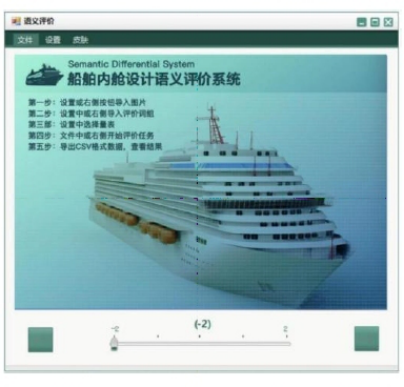
The semantic differential method software employs several pairs of antonyms to evaluate multiple images, such as ten bedroom design diagrams using words like “luxurious-cheap”, “exquisite-rough” etc. The space between the words is divided into several grades. Users can select which end of the word their impression of the image leans towards (Li, Luh, & Chen, 2023).
1. The primary function of the software is to efficiently rate subjective impressions of schemes (images, physical objects, spaces etc.) through semantic word pairs. 2. The software allows for importing sets of words and pictures, for example word pairs such as “advanced-backward”, “exquisite-rough”, and a number of images that need evaluation. 3. After importing suitable photos, it could be handed off to test subjects who would operate this tool in order to score these evaluated items. 4. Post-scoring - results are exported in a format recognizable by Excel for potential further statistical analysis. 5. The evaluation form uses a Likert scale ranging from -2 to 2. 6. Firstly, based on Windows platform we have written research software. 7. After completing the software development, multiple rounds of debugging and optimization were carried out, and it was eventually used for experimentation.
Upon conducting survey experiments using the Semantic Differential Method, analysis results can be exported.
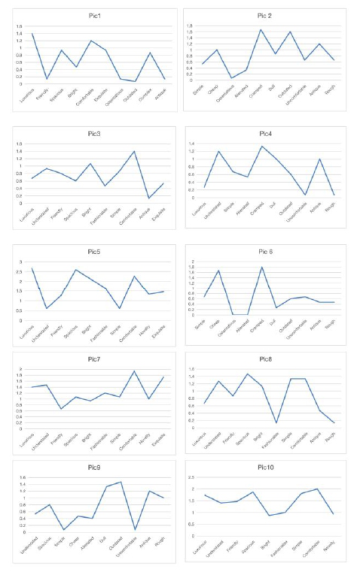
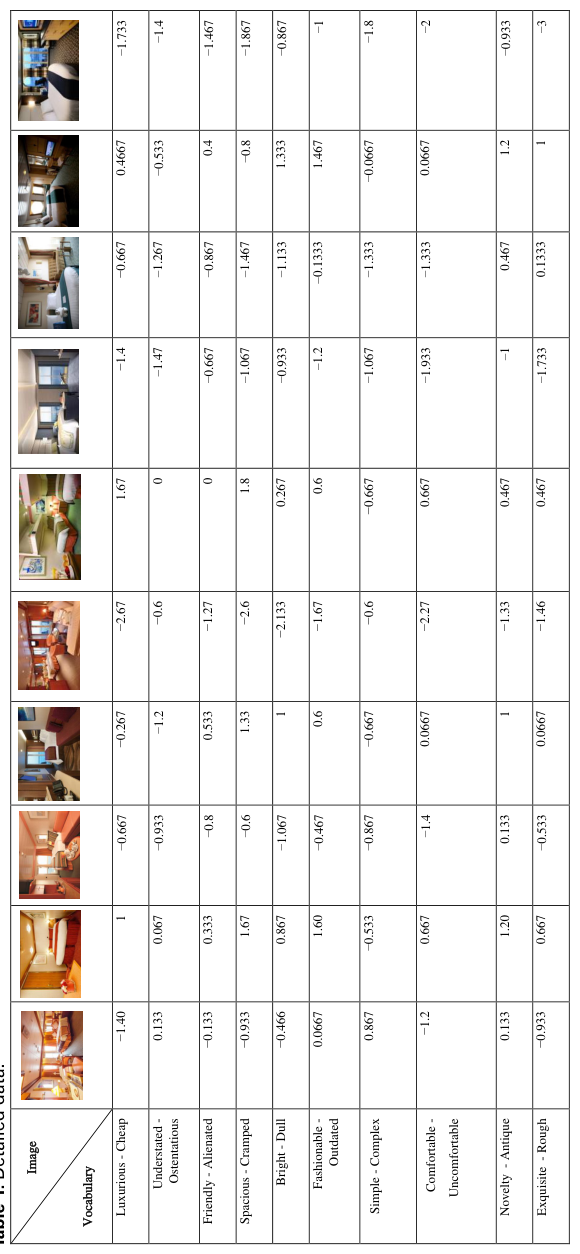
Experiment and Statistics Fifteen subjects were selected for the study. The experimental process involved importing ten pre-selected cruise interior pictures and ten groups of vocabulary into the software, using a -2-2 level Likert scale to have the fifteen subjects score.
EXTRACTION OF SEMANTIC WORDS FOR USE IN ARTIFICIAL INTELLIGENCE-ASSISTED DESIGN Application of Word Description in Artificial Intelligence Systems
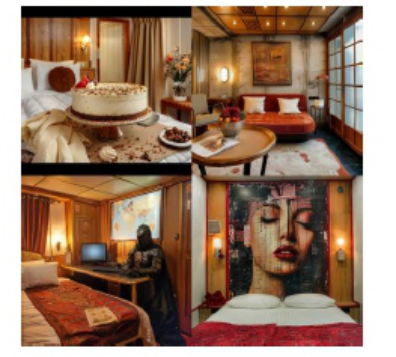
The AIGC model we selected is MidJourney. (Insert introduction to MidJourney). Since MidJourney restricts the use of compound keywords to no more than seven at a time, and it tends to generate content unrelated to the theme when there are significantly more adjectives than nouns (Figure 4), we chose the highest and second-highest scoring adjectives for each image. These adjectives can significantly represent the features of the images. Using these adjectives along with the original images helps assist AIGC in generating designs. If there is a tie for the average score of secondary keywords, we then select the adjective with the lowest average score to assist in design generation.
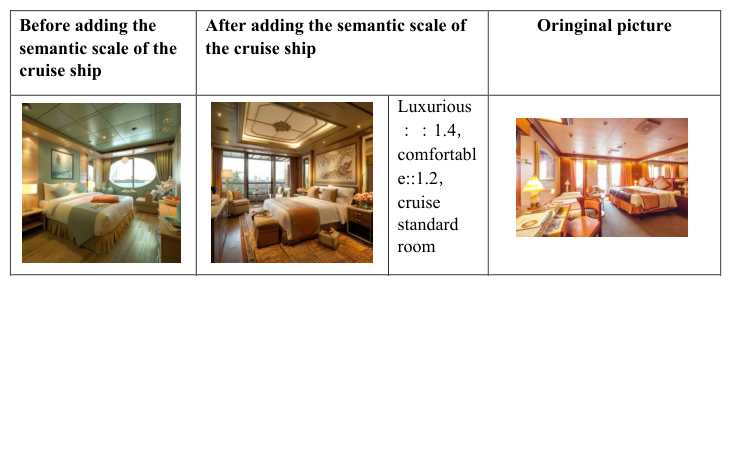
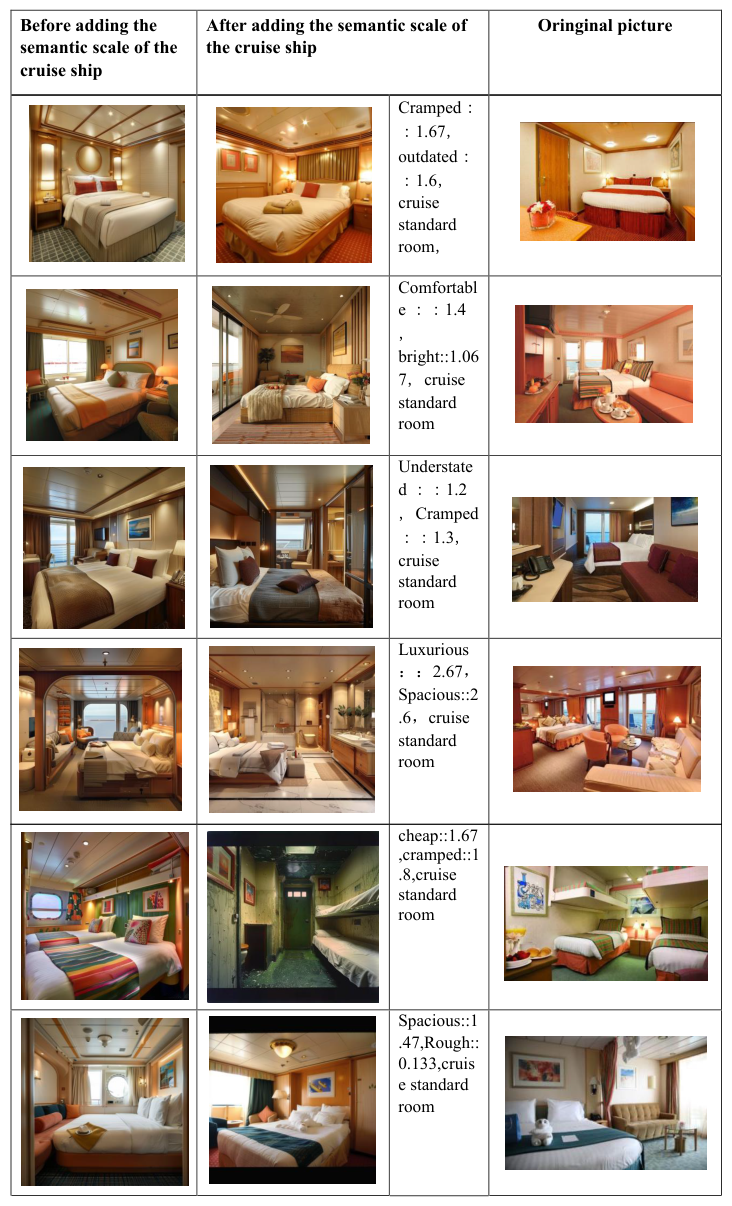
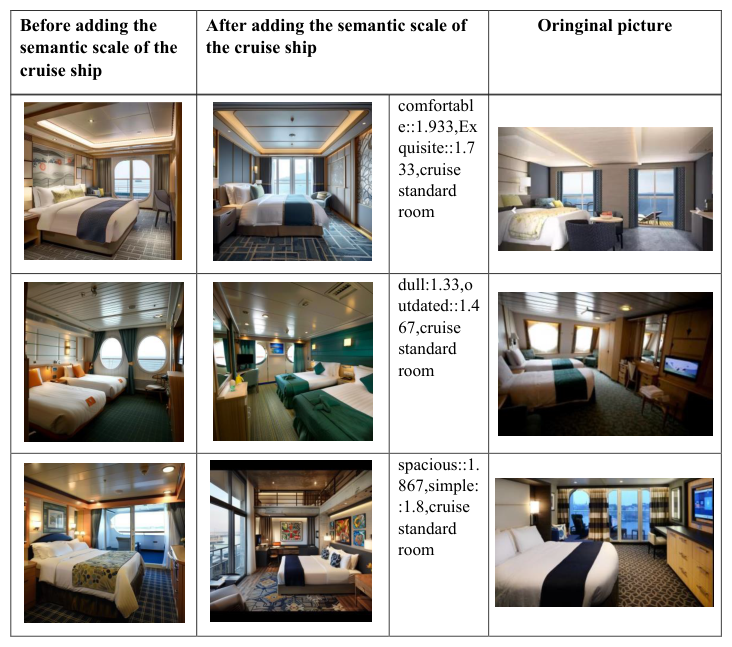
Experimental Conclusions (1) Construction of Cruise Ship Design Feature Scales Using Adjectives: The key adjective library for cruise interior styles obtained through the semantic differential method can serve as a scale to measure the style characteristics in interior design.
(2) Enhanced AI Understanding Through Adjective Inclusion: Comparing images generated by AI before and after incorporating adjectives reveals that the use of precise adjectives enables AI to produce images that better align with human expectations, thus generating more accurate pictures.
Applications of Conclusion The experimental results of this study demonstrate that using the semantic differential method along with artificial intelligence technology to assist interior design allows AI to generate more accurately styled images. This conclusion has several practical applications:
(1) After determining the theme and layout of cruise interiors, this method can be used to optimize design images, ensuring that more images meet designers’ requirements while aligning with the interior theme.
(2) This research provides new insights into applying artificial intelligence in the design field. Utilizing adjectives within the semantic differential
framework can offer AI clearer and deeper instructional understanding, effectively assisting in interior design processes and thereby promoting a more efficient and personalized approach to styling within cruise ship designs and related industries.
ACKNOWLEDGMENT
This article was collaboratively completed by students from the School of Design at Shanghai Jiao Tong University and the School of Design at The Hong Kong Polytechnic University, under the joint supervision of professors from both institutions.
REFERENCES
Chen, D., Cheng, P., Simatrang, S. & Joneurairatana, E. (2021). Kansei Engineering as a Tool for the Design of Traditional Pattern. Autex Research Journal, 21(1), 125–134. https://doi.org/10.2478/aut-2019-0052 Dodge, S., & Karam, L. (2017). A study and comparison of human and deep learning recognition performance under visual distortions. In Proceedings of the 26th International Conference on Computer Communication and Networks (ICCCN ’17), Article No.: 1–7, Vancouver, BC, Canada. https://doi.org/10.1109/ICCCN.2017.8038465 Huang, Y., Chen, C. H., & Khoo, L. P. (2012). Kansei clustering for emotional design
using a combined design structure matrix. International Journal of Industrial Ergonomics, 42(5), 416–427. Lai, X., Zhang, S., Mao, N., Liu, J., & Chen, Q. (2022). Kansei engineering for new energy vehicle exterior design: An internet big data mining approach. Computers & Industrial Engineering, 165, 107913. Li, X., Luh, D. B., & Chen, Z. (2023, August). The Application of Kansei Engineering
System for Vehicle Interior Color Design. In 2023 IEEE International Conference on Image Processing and Computer Applications (ICIPCA) (pp. 1186–1192). IEEE. Wang, M. F., & Hsiao, S. W. (2018, May). A Kansei-oriented method for interior design. In 2018 IEEE 22nd International Conference on Computer Supported Cooperative Work in Design ((CSCWD)) (pp. 485–490). IEEE.
LISTED IN THE AHFE DIGITAL BOOKSTORE CATALOGUE
Explore the complete digital volume
Human Factors in Design, Engineering, and Computing
Read this individual research paper free through the original publisher, or explore the full digital proceedings book.
ISBN 978-1-964867-35-9
Explore this ISBN in the AHFE Bookstore ↗Listed in the July 2026 bookstore catalogue; search by ISBN to confirm current availability · Digital book purchase optional