Başak Süller Zor, Arzu Vuruskan (2024). Use Of Assistive Technologies For People With Visual Impairment: Smart Glove Design For Clothing Field. In: Human Systems Engineering and Design (IHSED2024): Future Trends and Applications. AHFE Open Access, vol. 158, pp. 83–92. https://doi.org/10.54941/ahfe1005531
Assistive technology is a current area that has the potential to enhance the quality of life for individuals with visual impairment through innovative initiatives. This research involves a comprehensive review of assistive and wearable technology for visually impaired people, covering areas such as mobility, communication, and daily activities. It was observed that existing assistive technologies primarily focus on navigation and communication, with limited research on clothing-related assistive devices. Additionally, existing products often lack aesthetic appeal and functionality due to the high weight and size of technical materials and insufficient integration of electronics into clothing. Therefore, based on the user-centred design approach, the construction of the Smart Glove which involved detailed consideration of user needs, requirements, tasks, limitations, and barriers was carried out in this research. It was developed to address the challenges faced by visually impaired individuals in identifying the color, silhouette, details, and pattern of garments. In this context, two glove prototypes (e.g. knitted and neoprene gloves) were produced, with electronics integrated into the design. These prototypes were evaluated for pragmatic and hedonic qualities through testing with five users. Considering the feedback obtained from user tests, both hedonic and pragmatic, the gloves were generally satisfied with their weight, stitching, fit and feel.
“Visual impairment” refers to all cases of moderate or severe vision impairment (i.e. low vision) and blindness (WHO, 2022). According to estimates from World Health Organization data, there are 2.2 billion people with near or distance vision impairment and blindness worldwide in 2019 (WHO, 2022). Looking at the figures in Turkey, according to the disabled and elderly statistical bulletin published by the Ministry of Family and Social Services of the Republic of Turkey (2021), 1,039,000 people are visually impaired in Turkey. In terms of the distribution of this population by gender, it is stated that 478,000 of the men and 561,000 of the women are visually impaired.
On the other hand, over the past 20 years, the social model of disability, in which disability is seen more as a social construction than a medical reality has come to the fore. For these people, mobility, communication, education and other daily activities, such as clothing related issues or shopping can be very compelling. At this point, the medical model and the social model both agree that physical environment and opportunities should be made as accessible as possible for individuals with special requirements (Kaduwanema, 2016). Bringing such people to the collective communication environment, and facilitating their social, educational and the other daily life activities are significant social responsibilities. In response to this, there has been a significant surge in the development and application of assistive technology and wearable devices to enhance accessibility and independence for individuals with visual impairments.
Assistive technology encompasses a broad spectrum of tools and devices designed to solve the challenges posed by visual impairment. Besides, wearable technology has emerged as a game-changer in the realm of assistive solutions for visual impairment. For instance, one of the critical areas where assistive and wearable technologies focuses is in mobility and navigation support (Kammoun et al., 2012). Assistive and wearable technologies have also revolutionized educational and professional landscapes for individuals with visual impairments. Screen readers (Muche, 2015), speech-to-text software, and magnification applications are some examples that have revolutionized the way individuals interact with digital content. Even important developments have been made for visually impaired people, these developments have mostly focused on navigation, education, or health issues, so developments in assistive and wearable technologies that assist in social and daily activities have remained limited, in fact, a niche area. In addition, challenges persist in ensuring the widespread adoption and affordability of these technologies. Further research and development are needed to address specific user needs, improve user interfaces, and enhance the overall user experience.
The ideas of “accessibility and equal opportunities for all” have become increasingly prominent in recent years. However, when these ideas are discussed under the “design” notion, different approaches such as universal design, design for all, usable design, user-centred design etc. come to exist (Persson et al., 2015). All these approaches can serve for the design of products and services which are easier for everyone to use, including people with disabilities (Washington Edu., 2017). In order to refer in the design process, the user-centred design (UCD) approach was selected as the most appropriate concept. The selection of the UCD approach for developing a wearable assistive technology product for visually impaired people in this study can be justified by several academic considerations. For instance, UCD is a methodology that prioritizes the end-users throughout the design process, ensuring that the final product meets their needs, preferences, and usability requirements. It also considers usability and accessibility factors, so developing a wearable device for visually impaired users requires a well understanding of their interactions with technology, tactile preferences, and sensory capabilities. This is particularly important when designing assistive
Use of Assistive Technologies for People With Visual Impairment 85
technology where user needs may be diverse, and a one-size-fits-all solution is unlikely to be effective. On the other hand, UCD encourages the collection of pragmatic data through usability testing and user studies. This data-driven approach ensures that design decisions are supported by evidence rather than assumptions, so in the context of assistive technology, it is crucial to ensure that the designed solution effectively addresses the identified needs of visually impaired users. Also, the needs of users, especially in the context of assistive technology, may evolve over time. UCD’s iterative and flexible nature allows for adaptability to changing user needs and technological advancements. Disability is a unique and individual experience, and incorporating pleasure and emotion into the design process is crucial for establishing a positive connection between users and assistive products (Preece et al., 2002). This approach aims to provide not only style and functionality but also emotional quality, inspiring innovative processes that align with users’ real needs. This is particularly important for individuals who continually face challenges with temporary solutions due to a lack of considerate design.
Accordingly, although 1,039,000 visually impaired individuals are reported in Turkey, there are very few studies in the literature about assistive and wearable technology for the visually impaired. In particular, no studies have been found on wearable technologies that will solve the problems of visually impaired people in the field of clothing. Therefore, the aim of this study is to address the challenges faced by the visually impaired people in clothing field and suggest solutions. Regarding this, a 10-question survey was conducted specifically for clothing related issues in order to identify the relationship between individuals with visual impairment and concept of design, clothing and AT/ WT.
In relation to the obstacles in clothing field, the main goal is to create a wearable as an assistive technology product for visually impaired people that identifies various garments and combines them to selecting appropriate clothing for diverse social occasions, thereby enhancing the independence and confidence of those people in their daily lives. Towards this objective, a wearable garment identifier a smart glove- system, has been designed to help their clothing selection process. Before developing the smart glove, user scenarios were constructed to demonstrate the use process in home and in shopping (Süller Zor and Vuruskan, 2022). And following, the Smart Glove was developed to empower users with the ability to discern and combine different clothing items effortlessly. In the following part, the development and testing process of the Smart Glove are explained.
DEVELOPMENT OF SMART GLOVE Design Considerations of Smart Glove
Before commencing the design and production of the glove, extensive research was conducted to determine how the glove would be handled in terms of user experience and to identify the necessary requirements it should meet. Therefore, the discussion of user experience has been made by diverse fields, leading to the various definitions within the literature. The most cited definition of user experience is provided by the
86 Zor and Vuruskan
International Organization for Standardization (ISO), which characterizes it as an individual’s perceptions and reactions arising from the utilization or expected utilization of a product, system, or service. According to the ISO, “User experience covers a broad range of elements such as emotions, beliefs, preferences, perceptions, physical and psychological responses, behaviours, and achievements that occur before, during, and after engaging with a product” (ISO, 2010). Besides, it has three main factors as user, design (product, system, service) and context of use (Bongard-Blanchy and Bouchard, 2022). Regarding this, Hassenzahl (2004) introduced a user experience evaluation model that comprises pragmatic and hedonic qualities.
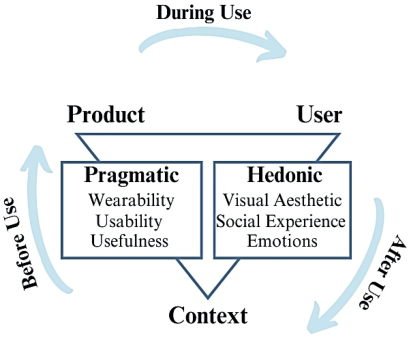
Pragmatic qualities involve features facilitating the product’s functionality and usability, while hedonic quality focuses on features that draw positive emotional responses tied to the user’s psychological state. Besides, based on the pragmatic and hedonic model, Ba¸skan and Goncu-Berk (2022) outlined three pragmatic qualities (wearability, usability, and usefulness) and three hedonic qualities (visual aesthetic, social experience, and emotions) for wearable technologies (Figure 1). While pragmatic qualities include product- essential qualities such as thermal comfort, fit, ease of use, performance and understandability, hedonic qualities include user-related subjective elements such as perceived aesthetics, social experience and emotions.
Figure 1: User-experience framework of the study (adapted from the study of Ba¸skan and Goncu-Berk, 2022).
Accordingly, pragmatic features were taken into consideration when designing Smart Glove prototypes; and the specific set of performance requirements are determined as follows: functionality and connectivity, wearability, durability. Therefore, firstly, to determine functionality and connectivity elements, the questions that were answered in electronic components of the system towards the objective of the study, are as follows:
What types of electronic components (camera/ microcontroller/ power supplier etc.) are required?
Use of Assistive Technologies for People With Visual Impairment 87
How many cameras are needed to capture image clearly?
What is the required power consumption for the system?
What is the most useful placement for those components?
How the data will be processed, which types of signal processing units are required?
What algorithms are needed to provide accuracy in processing data gathered by cameras?
Thus, the functionality and connectivity of the Smart Glove system required that it can detect and identify a garment with the attached camera and microcontroller unit. The glove camera should be able to connect to microcontroller units to compute the acquired data. On the other hand, wearability required that it be lightweight, breathable, conformable to the skin, comfortable to wear, and easy to assemble with electronic components.
The last critical requirement was the durability to endure repeated deformation due to use over-time. Thus, the study aimed to achieve these design components by carefully selecting materials and employing suitable production techniques.
Prototype 1: Knitted Smart Glove The smart glove is expected to be worn daily for at least one hour, so thermophysical comfort of the glove is important regarding wearability parameters. The comfort aspect is linked to the overall tactile characteristics of the hand, encompassing attributes like softness, smoothness, air permeability, moisture management and stretchability. The glove should provide physiological comfort and be breathable with soft cloth handle, so should eliminate overheating and sweating. Regarding those requirements, glove samples were knitted, and textile material used in this prototype was selected as the high-performance polyester based yarn “Coolmax®”, which is composed of rectangular cross-sectional shape of the fibres and can facilitate moisture diffusion and evaporation, ensuring a greater surface area for enhanced evaporation rates. Through its breathability, easy drying feature and easy evaporation of sweat, the body does not lose anything from its comfort due to sweating. Also, it is easy to care for and can be washed in the washing machine. Besides, for fitting, and shape retention ability, 70 Denier polyester multifilament yarn and Lycra were blended with Coolmax®.
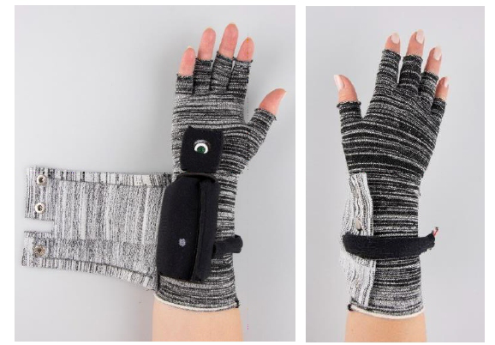
On the other hand, strategically arranging the electronic components within the smart glove is a crucial step in its design. Besides, since touching is one of the most important senses in daily life of people with visual impairment, index finger and thumb should be left free. Therefore, answers were sought to the questions such as: (1) which area of the hand can capture the angle to take a photo of the garment from above, (2) which area has the space and stability to carry the processor, battery, and sound card together, and (3) which area has the position to hold the speakers closer to the ear to receive audio feedback. In a short summary as seen in the Figure 3, the palm region of the hand hosts the micro camera, while the inner part of the wrist accommodates the processor, battery, and sound card together. For optimal positioning, the micro speakers are placed on the inner left part of the wrist.
88 Zor and Vuruskan
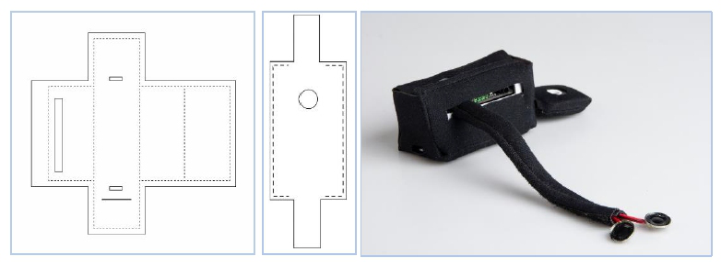
Once the position of the electronic components had been determined, it was time to decide how these components would be brought together with the glove. Accordingly, considering that the components used should not come into contact with water and that the glove should be washable, the electronic components must be integrated into the glove in a removable structure. Besides, the materials on the glove should be ensured that they are completely protected against external factors, and electronics should not meet skin for both safety and comfort. Therefore, firstly to ensure both durability and user-friendliness, a textile-based protective case was developed to encase all electronic components (Figure 2). This case allows for easy attachment and removal from the glove, minimizing the risk of damage.
Figure 2: Protective case 2D pattern development (microcontroller & camera).
After creating the protective cover, the next step was to design and manufacture the glove itself. In this process, first of all, the glove was knitted seamlessly, based on standard women’s hand sizes. Due to the characteristics of the knitting machine used, the glove was first knitted with all fingers, and then the structure of the glove was modified.
Figure 3: Final prototype of knitted smart glove.
Use of Assistive Technologies for People With Visual Impairment 89
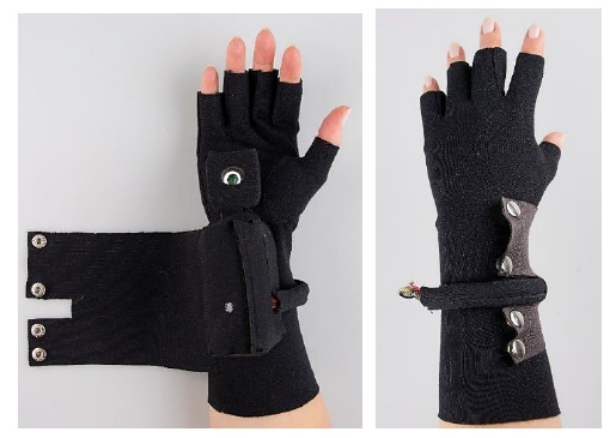
Prototype 2: Neoprene Smart Glove The second prototype of Smart Glove was developed through multi-step process including preparing the patterns and combining each small section by sewing. For this prototype, since ready-made fabric is used, instead of yarn decision, fabric selection was realized for the glove. Neoprene, which is the same fabric as used in protective case was chosen for its lightweight (320g/m2 weight) and flexible nature, ensuring optimal comfort, and fit for users during wear. The fingertips were first sewn closed, then they were cut, and the ends were folded with adhesive interlining to obtain a clean finish. Just like the knitted glove, an additional piece of its own fabric was prepared and sewn on the wrist part of this glove to both support the electronic components and provide an aesthetic appearance. Again, just like the knitted glove, the electronic components, together with their protective cases, are attached to the glove with a velcro tape. Snaps were used to close the additional piece on the wrist.
Figure 4: Final prototype of neoprene glove.
Comparison of Two Prototypes and User Testing Exploring the pragmatic features of wearable technology reveals critical insights into manufacturability, maintainability, wearability, usability, and durability. Accordingly, when examined in terms of manufacturability, which is the first of the pragmatic features, neoprene glove in this study were simpler to manufacture due to the material being easy to cut and sew. Especially due to the structure of the fabric, it is very suitable for laser cutting and allows for a clean finish, so it does not curl or run away at the fingertips and wrist ends, as in knitted gloves. Regarding the size range, the base of both gloves can be produced accurately with the measurements given during the production stage. However, when considering the protective cover, laser cutting on neoprene fabric by preparing its pattern provided better results than applying
90 Zor and Vuruskan
it on a knitted fabric, since the connection points and cable entries must be left open millimetrically. Considering maintainability including washability, easy drying and repairable criteria, since the electronic components can be attached/ detached onto the glove, both gloves are washable.
However, in the washing and drying test performed under the same conditions, it was determined that the neoprene glove dried faster. On the other hand, regarding wearability, it was seen that Coolmax yarns provide an advantage to knitted gloves compared to neoprene fabric in terms of thermal comfort as air permeability, moisture management. While neoprene is water- resistant, it may not be as breathable as knitted materials, but it has been determined that glove sewn with neoprene fabric perform better in terms of waterproofness, softness, and fit. In terms of lightness, both gloves measure equal weight. Considering usability, both gloves have similar patterns and design details, so the usability and usefulness of both gloves can be said to be at a similar level. The last item is in terms of durability, neoprene glove is more durable in terms of strength with better abrasion resistance compared to knitted glove.
When these two gloves are compared considering hedonic qualities, the smoother surface appearance of the glove sewn with neoprene provides more advantages than the knitted glove, both in terms of aesthetics and the feeling it provides to the user’s skin.
For a more detailed comparison “user testing” was conducted based on the user-centred design approach. Both gloves were tested with 5 users, and the ergonomics of the gloves, and ease of use were tested. Considering the feedback obtained from user tests, both hedonic and pragmatic, the gloves were generally satisfied with their weight, stitching, fit and feel. In this regard, while 3 users preferred neoprene gloves, two users preferred the knitted one due to its fit and moisture management feature. Thanks to the information/guidance in the user manual and the ornamental stitching on the top board, the on/off and touch button of the device can be easily found. One user commented that it would be more convenient if the location of the on/off button was in a more accessible, prominent spot. Charging has been identified as a limitation. The location of the charging port was easily found, but the charging port could not be installed. The design aspect will be strengthened in future studies on this subject. Finally, users have stated that they may generally prefer such a wearable technology product, but that minimizing the device part with new technologies may be more effective in terms of design.
CONCLUSION
The Smart Glove, was developed to address the challenges faced by visually impaired individuals in the realm of clothing (e.g., defining the color, silhouette, details, and pattern of the garment). The research involved a comprehensive review of assistive and wearable technology examples for people with visual impairments, spanning areas such as mobility, communication, and daily activities. It has been observed in the literature that assistive and wearable technology products developed for visually
Use of Assistive Technologies for People With Visual Impairment 91
impaired individuals are mostly aimed at navigation and written and verbal communication tools. It has been determined that research in this field on a subject that is socially effective, such as clothing, is limited. Especially in Turkey, no assistive wearable technology product has been found specifically for clothing for visually impaired individuals. Also, it was found that the examples in the literature often lack aesthetic appeal and functionality due to high weight and size of technical materials, and also insufficient integration of those electronics into clothing and textiles.
Two different glove prototypes were produced in this research, in which the electronics would be integrated with the case. Following these two glove alternatives were evaluated for pragmatics, and hedonic qualities in terms of their advantages/disadvantages by testing the initial system and by testing the glove itself with 5 users. With regard to initial system testing, the system works properly and the process works as stated. The image is captured with a micro camera, processed, and audio feedback is provided to the user.
When both gloves were examined in terms of manufacturability, neoprene glove in this study was simpler to manufacture, as the material was easy to cut and sew. Regarding maintainability including washability, easy drying and repairable criteria, since the electronic components can be attached/ detached onto the glove, both gloves are washable. However, in the washing and drying test performed under the same conditions, it was determined that the neoprene glove dried faster. In addition, it was stated that in terms of wearability as the other pragmatic feature, Coolmax yarns provide an advantage to knitted gloves compared to neoprene fabric in terms of thermal comfort as air permeability and moisture management. Thus, in terms of usability, both gloves have similar patterns and design details, so the usability and usefulness of both gloves can be said to be at a similar level. The last item, durability, neoprene glove is more durable in terms of strength with better abrasion resistance compared to knitted glove.
In addition, these two gloves are compared considering hedonic qualities, the Smart Glove prototypes demonstrated success in meeting the identified needs and requirements, providing both comfort and aesthetic appeal. Despite some limitations, including size considerations and device charging, the study suggests potential avenues for future research, such as integrating AI-based garment recognition and recommendation systems into wearable assistive technologies for enhanced independence and style assistance for individuals with visual impairments.
On the other hand, the iteration of design is a crucial process in the development of innovative solutions, such as the creation of the Smart Glove for visually impaired individuals. Through constant refinement and feedback, the Smart Glove can be enhanced the functionality, usability, and overall user experience of the glove. Further studies can be conducted to enhance the design of the smart glove, specifically focusing on the integration of electronic components with the glove. Improving the electronic components’ functionality, efficiency, and integration within the glove structure is crucial for optimizing the overall performance and usability of the device.
92 Zor and Vuruskan
ACKNOWLEDGMENT
This paper is based on the Ph. D Thesis entitled “Use of Assistive Technologies for People with Visual Impairment: Smart Glove Design for Clothing Field” defended by Ba¸sak Süller Zor in 2024.
REFERENCES
Baskan, A. and Goncu-Berk, G. (2022) User Experience of Wearable Technologies: A Comparative Analysis of Textile-Based and Accessory-Based Wearable Products. Appl. Sci. 2022, 12, 11154. https:// doi.org/10.3390/app122111154 Bongard-Blanchy, K.; Bouchard, C. Dimensions of User Experience—From the Product Design Perspective. J. d’Interaction Pers. 2014. Available online: https://www.researchgate.net/publication/278828656_Dimensions_of_ User_Experience_-_from_the_Product_Design_Perspective (accessed on 10 September 2022). Disabilities, Opportunities, Internet Working, and Technology (2017) What is
the Difference Between Accessible, Usable, and Universal Design? [Online]. Available: https://www.washington.edu/doit/what-difference-between-accessible -usable-and-universal-design (Accessed: 22 June 2023). Hassenzahl, M. The Thing and I: Understanding the Relationship Between User and Product. In Funology: From Usability to Enjoyment; Blythe, M. A., Overbeeke, K., Monk, A. F., Wright, P. C., Eds.; Springer Netherlands: Dordrech, The Netherlands, 2004; pp. 31–42. Kaduwanema, J. (2016) Defining Disability Today [Online]. Available: https://
www.disabled-world.com/definitions/disability-today.php (Accessed: 15 October 2023). Kammoun, S., Parseihian, G., Gutierrez, O., Brilhault, A., Serpa, A., Raynal, M., Oriola, B., Macé, M. J.-M., Auvray, M., Denis, M., Thorpe, S. J., Truillet, P., Katz, B. F. G. and Jouffrais, C. (2012) Navigation and Space Perception Assistance for the Visually Impaired: The NAVIG Project, IRBM Innovation and Research in BioMedical Engineering, 33(2), pp. 182–189. Muche, K. (2015) How Technology is Working to Help Blind and Partially
Sighted People? [Online]. Available: https://csprod.verizonwireless.com/news/ar ticle/2015/12/how-technology-is-working-to-help-blind-people.html (Accessed: 14 May 2024). Persson, H., Åhman, H., Yngling, A. A. and Gulliksen, J. (2015) Universal Design, Inclusive Design, Accessible Design, Design for All: Different Concepts— One Goal? On the Concept of Accessibility—Historical, Methodological and Philosophical Aspects, Universal Access in the Information Society, 14(4), 505– 526 [Online]. Available: https://link.springer.com/article/10.1007/s10209-014- 0358-z (Accessed: 12 June 2023). Preece, J., Rogers, Y. and Sharp, H. (2002) Interaction Design: Beyond Human-
Computer Interaction. 6th edition (2023), ISBN: 978-1-119-90109-9. Seneviratne, S.; Hu, Y.; Nguyen, T.; Lan, G.; Khalifa, S.; Thilakarathna, K.; Hassan, M.; Seneviratne, A. A Survey of Wearable Devices and Challenges. IEEE Commun. Surv. Tutor. 2017, 19, 2573–2620. Süller Zor, B. and Vuruskan, A.2022. Developing an assistive technology for
individuals with visual impairment: Smart glove concept. Autex 2022, 21st World Textile Conference, 7–10 June, Poland. World Health Organization. (2022) Vision impairment and blindness, fact sheet [Online]. Available: https://www.who.int/mediacentre/factsheets/fs282/en/ (Accessed: 03 July 2023).
LISTED IN THE AHFE DIGITAL BOOKSTORE CATALOGUE
Explore the complete digital volume
Human Systems Engineering and Design (IHSED2024): Future Trends and Applications
Read this individual research paper free through the original publisher, or explore the full digital proceedings book.
ISBN 978-1-964867-34-2
Explore this ISBN in the AHFE Bookstore ↗Listed in the July 2026 bookstore catalogue; search by ISBN to confirm current availability · Digital book purchase optional