Takeshi Hamasaki, Jo Kawabata, Yujie Li, Yoshihisa Nakatoh (2025). Improving the Accuracy for Biometrics using External Auditory Canal. In: Human Interaction and Emerging Technologies (IHIET 2025). AHFE Open Access, vol. 197, pp. 339–344. https://doi.org/10.54941/ahfe1006726
The use of biometrics authentication technology has become widespread such as the face recognition is increasingly being used in the airport, hospital. If a technology with the same level of accuracy and convenience is developed in the future, it is expected to be used in a variety of fields. The purpose of this study is to improve the convenience of biometrics authentication. We are focusing on external auditory canal, which is less susceptible to the effects of the outside environment. We are conducting research and development into a personal authentication system using images of external auditory canal, and our findings underscore the fact that have the features of individual differences inside the ear canal. In the proposed method, images taken using a light source were processed to artificially enhance the red color, and the accuracy of personal identification using VGG16 was evaluated on images of both ears of 13 people. Specifically, as a preprocessing step, we created a thermography-like image from the original image and extracted the red regions from it. Using a trained model with processed image data, we evaluated the accuracy of classification, and the accuracy improved from 0.989 to 0.999. The results of this study suggest that slightly higher accuracy can be achieved than with conventional methods. The multiple image data were extracted from video data in the ear canal, and the images were classified using the representative CNN algorithm VGG16, and it was confirmed that a high level of accuracy could be achieved. In the future, we plan to verify the shortening of the learning time.
Biometric authentication system is a security system that identifies an individual by using a part of the body or a human physical characteristic such as a face, fingerprint, or voice. Biometric authentication systems have various advantages, including a high level of security, superior user convenience, and smooth authentication.
In recent years, biometric authentication systems using fingerprint, facial recognition have been widely to unlock smartphones. They are also widely used for payment and office access control. Other biometric authentication systems such as vein authentication, iris authentication, voice authentication, and auricular authentication are also utilized. In case of fingerprint, the condition of finger may decrease the accuracy of the authentication. Glasses
and masks are more likely to decrease facial recognition accuracy. However, modern technology is beginning to overcome these challenges.
The purpose of this study is to improve the convenience of biometrics authentication. We are focusing on external auditory canal, which is less susceptible to the effects of the outside environment. We are conducting research and development into a personal authentication system using images of external auditory canal, and our findings underscore the fact that have the features of individual differences inside the ear canal (Yuki Muramoto et al., 2022). In this research, a camera is used to acquire images of the inside of a person’s right and left ears, or ear canals, from various angles. Next, features are extracted from the selected image data, and these features are compared to a previously trained learning model using images of the human eardrum and the inside of the ear canal. Finally, the system authenticates the individual based on the results.
PROPOSED METHOD
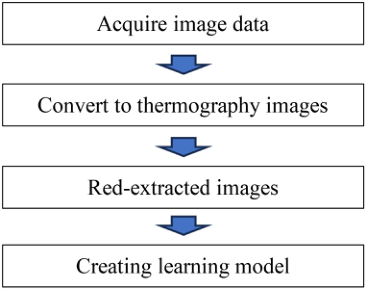
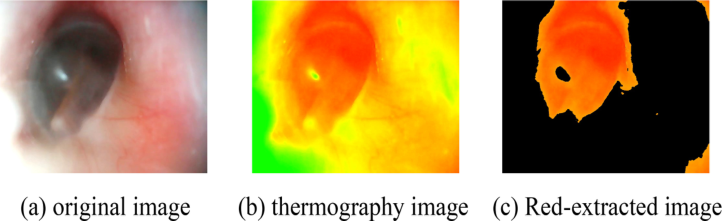
Figure 1 shows an overview of the proposed method. In this study, the same dataset as in previous studies (Yuki Muramoto et al., 2022) is used. The image data is converted from the original image data to a simulated thermography image and the image data from which red are extracted. Next, the features extracted from the simulated thermography image and the red-extracted image are compared with the model that was previously trained using the tympanic membrane image. Finally, individuals are identified based on the results of the comparison.
Figure 1: Overview of the proposed method.
In this experiment, the camera used to photograph the inside of the ear canal and eardrum was a device called EARPICK, originally designed for ear cleaning. As the camera was moved, the LED light caused the image to appear white, or the camera was too close to the ear canal, resulting in image data that was close to black. Therefore, we set three rules when selecting these image data and excluded them.
Improving the Accuracy for Biometrics Using External Auditory Canal 341
Images that are 80% or more black.
Images that are 80% or more white.
Images that are out of focus and blurry.
The number of classes was classified into 26 classes with left and right ears for 13 people, and about 800 to 1000 images per person were randomly divided in the ratio of Train: Validation: Test = 7: 2: 1. The number of epochs was 20 for transfer learning, and the learning model was used to assess individuality according to blood vessels and thin skin in the ear canal.
Figure 2: Sample of image processing.
EVALUATION METHOD In this study, Accuracy (percentage of correct answers), Recall (percentage of repeatability), Precision (percentage of fit), and F-measure (F-value) were used for evaluation. The formulas for each evaluation method are summarized in Table 1.
The meanings of TP, TN, FP, and FN are shown below.
TP (True Positive): A positive result is correctly classified as positive.
TN (True Negative): A negative result is correctly classified as negative.
FP (False Positive): A negative result is incorrectly classified as positive.
FN (False Negative): A positive result is incorrectly classified as negative.
EXPERIMENTAL RESULTS As shown in Table 2, the accuracy of the images converted into simulated thermography images was about 99.9%. Also, the accuracy of the Red- extracted images was about 99.9%.
These results indicate that personal authentication is possible from blood vessels and thin skin areas within the ear canal.
In the previous study, a personal authentication system using images of the ear canal yielded a 98.9% result. The accuracy was slightly higher with the simulated thermography images and the Red-extracted images.
Table 2: Machine learning evaluation result.
Table available in the original PDF paper.
Training Data Accuracy Precision Recall F1-Score Original images 0.9890 0.9893 0.9891 0.9890 Thermography images 0.9996 0.9995 0.9998 0.9996 Red-extracted images 0.9992 0.9992 0.9993 0.9992
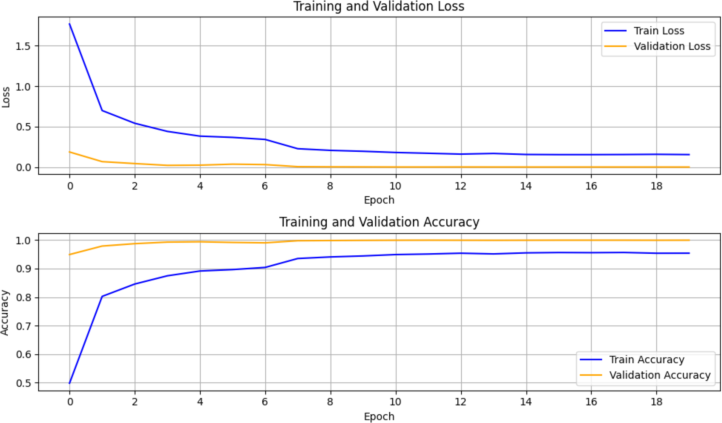
Figure 3 shows a result of the learning curve using the Red-extracted images as training data. The training and validation losses converge and the validation loss is stable, which suggests that the model is well trained. The training and validation accuracy remain high and stable, indicating that the model performs well on both the training and validation data.
Figure 3: Learning curve (training data = red-extracted images).
RELATED WORK
Various biometric authentication has already been used in the real world, and we have investigated in particular previous research related to this study.
Vein Authentication Vein authentication authenticates individuals by reading the shape and branching of blood vessels. Most vein authentication sensors are non- contact, meaning that the sensor does not need to be touched. The common
Improving the Accuracy for Biometrics Using External Auditory Canal 343
measurement principle of vein reading sensors involves the use of infrared light. Vein patterns are unique to each person and do not change easily. Furthermore, vein patterns are likely to be used in conjunction with other biometrics in a multi-modal system (Lingyu Wang et al., 2005).
Auricular Authentication Auricular authentication is a method of personal identification based on the shape of the ear, such as length, width, and cartilage shape. The human outer ear is shaped by the intricate irregularities of the saddle bone for sound collection and amplification, and these irregularities vary considerably from person to person. In recent years, multimodal authentication technology using image data of the auricular has also been proposed (Shunji Itani et al., 2021).
CONCLUSION
When developing a biometric authentication system, it is important to know what information to obtain and how to obtain them. We focused on information inside the ear canal, and in this study, we investigated how to improve the accuracy of personal authentication using images of the external auditory canal. Regardless of the type of biometric authentication used, it is necessary to register learning data in advance in order to authenticate the individual. When authenticating an individual for purposes such as access control or logging in to a website or network, confirmation is required each time. For this reason, we are also evaluating the robustness of the system to the intensity of light and noise in the usage environment (Takeshi Hamasaki et al., 2024). We are also researching the impact of changing the shooting method or shooting time (Takeshi Hamasaki et al., 2025).
In this study, we experimented to see whether accuracy could be improved by using the same dataset as in the previous study for the simulated thermography converted images and Red-extracted images. As a result, using the same VGG16 model as in the previous study, the learning results for both the simulated thermography images and the Red-extracted image has been extremely high, at 99.9%. Currently, we are building a device camera that can fit inside the ears, and are attempting to collect more pre-training data, confirming further improvements in recognition accuracy.
REFERENCES
Lingyu Wang and Graham Leedham (2005). “A Thermal Hand Vein Pattern Verification System” In: S. Singh, M. Singh, C. Apte, and P. Perner, editors, Pattern Recognition and Image Analysis, volume 3687 of Lecture Notes in Computer Science, pages 58–65. Springer Berlin Heidelberg, 2005. Shunji Itani, Shunsuke Kita and Yoshinobu Kajikawa (2021). “Multimodal Personal
Ear Authentication Using Smartphones”. Takeshi Hamasaki, Jo Kawabata, Hironori Uchida, Yujie Li, and Yoshihisa Nakatoh (2024). “Robustness of Biometric Authentication Method Using Image of External Auditory Canal”In: 2024 IEEE 13th Global Conference on Consumer Electronics (GCCE).
Takeshi Hamasaki, Jo Kawabata, Hironori Uchida, Yujie Li, and Yoshihisa Nakatoh (2025). “Evaluation of the Shooting Method for Biometric Authentication in External Auditory Canal” In: 2025 IEEE International Conference on Consumer Electronics (ICCE). Yuki Muramoto, Yujie Li, Hideaki Kawano, and Yoshihisa Nakatoh (2022).
“Personal Authentication Method Using Geometrical Features of External Auditory Canal” In: Human Interaction & Emerging Technologies (IHIET 2022), vol. 68, 2022. pp. 619–624.
LISTED IN THE AHFE DIGITAL BOOKSTORE CATALOGUE
Explore the complete digital volume
Human Interaction and Emerging Technologies (IHIET 2025)
Read this individual research paper free through the original publisher, or explore the full digital proceedings book.
ISBN 978-1-964867-73-1
Explore this ISBN in the AHFE Bookstore ↗Listed in the July 2026 bookstore catalogue; search by ISBN to confirm current availability · Digital book purchase optional