Ji-yeon Kim, Ki-hwan Kim, Young-jin Kang, Seok-chan Jeong (2024). Predicting Key Substance Levels in Aquaculture through AI-Based Water Quality Monitoring. In: Human Interaction and Emerging Technologies (IHIET 2024). AHFE Open Access, vol. 157, pp. 215–220. https://doi.org/10.54941/ahfe1005480
Land-based aquaculture farms use seawater transported from nearby seas instead of large amounts of freshwater. A seawater recirculating filtration system is essential for sustainable fish farming; however, this system has limitations in improving the levels of ammonia, nitrite, and nitrate, which are directly linked to fish mortality. Therefore, most land-based aquaculture farms periodically exchange a certain amount of seawater to maintain optimal water quality. Despite these efforts, managing water quality remains a significant challenge due to the fluctuating levels of these harmful substances.This study aims to address this challenge by predicting the levels of ammonia, nitrite, and nitrate—the primary causes of fish mortality in land-based aquaculture—using AI models. The training data were collected from various sensors installed in the farms, including those measuring water temperature, dissolved oxygen, dissolved solids, pH level, oxidation-reduction potential, salinity, nitrate, and ammonia. By leveraging this comprehensive dataset, we evaluated the performance of multiple models, such as Random Forest (RF) and K-Neighbors Regressor (KNN).The study demonstrated that these models could achieve remarkable performance metrics, with the Random Forest model recording an MAE of 0.0150, MSE of 0.0008, RMSE of 0.0289, R² of 0.9999, RMSLE of 0.0039, and MAPE of 0.0024. Such high accuracy levels indicate that AI-based water quality prediction models have significant potential for effectively monitoring and predicting fish health in aquaculture farms. Implementing these AI models can lead to more proactive and precise management of water quality, ultimately reducing fish mortality rates and enhancing the sustainability and profitability of aquaculture operations.
Aquaculture in underwater farms is increasingly gaining importance globally as a response to the rising demand for seafood. However, securing optimal conditions for fish growth and health within aquaculture facilities continues to be a challenging task. This is particularly true in land-based facilities, where there is an absolute dependence on seawater circulation and filtration systems.
Land-based aquaculture requires monitoring and measuring various water quality parameters such as pH, temperature, and dissolved oxygen (DO) (Tziortzioti et al., 2019; Mwegoha et al., 2010). Dissolved oxygen, the most critical factor for fish survival, does not dissolve well in water, and its solubility decreases sharply as temperature and salinity increase (Timmons et al., 2018; Chumkiew et al., 2019). DO affects fish growth and feed efficiency (Buentello et al., 2000; Zhang et al., 2011). Fluctuations or suboptimal temperatures can affect feed utilization and cause stress in fish when grown at temperatures higher or lower than ideal, potentially leading to disease (Timmons et al., 2018).
The Recirculating Aquaculture System (RAS) provides advantages for efficiently managing fish growth by maintaining appropriate water temperatures and optimal oxygen saturation levels, as well as purifying impurities. Physical and biological filters in the RAS system reduce concentrations of nitrogen compounds such as ammonium and nitrites, which are the existing alternatives to diluting seawater. Ammonium and nitrites, being toxic to fish (Timmons et al., 2018), are critical components that must be managed in aquaculture. Ammonia, a key element of ammonium and nitrites, occurs naturally from the decomposition of fish waste and leftover feed but is highly toxic (Wicks et al., 2002), weakening the gills and potentially causing death. RAS converts ammonia into less toxic nitrites and further into nitrates, thus increasing the water reuse rate (Suurnäki et al., 2020). The standards for recycled water vary by fish species, but maintaining nitrates below 100 mg/L for Atlantic salmon has been shown not to significantly affect their growth and health (John Davidson et al., 2017). Chronic exposure to NO3 in turbot has been found to cause persistent toxicity leading to death, particularly causing methemoglobinemia, ion homeostasis disruption, lipid peroxidation, and abnormal cell apoptosis in flounder (Jiachen Yu et al., 2021). Additionally, attention needs to be paid to the accumulation of metabolites such as cortisol and testosterone, particularly steroids (Mota et al., 2017). It has been indicated that highly toxic hydrogen sulfide (H2S) can be produced during the RAS filtration process, and early detection is crucial (Salim et al., 2023).
Efforts to predict water quality using AI are continuously being made. Experiments using convolutional neural networks (CNN) and long short- term memory (LSTM) have been conducted to predict basic water quality information (Haq et al., 2022). These experiments have forecasted fundamental water quality data. Common basic water quality parameters such as temperature, pH, and dissolved oxygen (DO) can be measured using portable devices like the Multi 3410 (WTW GmbH) (Chun et al., 2018). While portable alternatives are available, nitrates, nitrites, and phosphates are often more accurately measured in laboratories using ion exchange chromatography and suppressed conductivity detectors (e.g., Dionex DX- 500, Dionex ICS1600, Dionex Integration HPIC; Chun et al., 2018; Lindholm-Lehto et al., 2020, 2021).
This paper investigates an AI model that infers the presence of substances such as ammonia, nitrites, and nitrates, which significantly impact fish mortality, using basic sensor data.
Predicting Key Substance Levels in Aquaculture 217
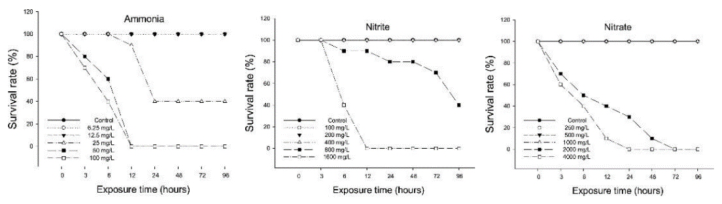
EXPERIMENTS ENVIRONMENT The experimental species is the olive flounder, and it has been observed that there is no mortality rate when ammonia levels are up to 12.5 mg/L, but survival rates begin to decrease when exposed to 25 mg/L for more than 12 hours (Kim et al., 2019). Similarly, nitrite and nitrate concentrations also impact survival rates. For nitrite, a significant decrease in survival rate was observed at 800 mg/L (40% survival), and no fish survived 12 hours later at 1600 mg/L. There was no mortality under nitrite concentrations of 100, 200, and 400 mg/L. For nitrate, survival rates decreased at concentrations above 2000 mg. No fish survived after 72 hours at this concentration. However, no mortality was observed at control concentrations and at levels below 1000 mg/L.
Figure 1: Survival rate (%) of flatfish, paralichthys olivaceus exposed to ammonia, nitrite, and nitrate for 96 h (Kim et al., 2019).
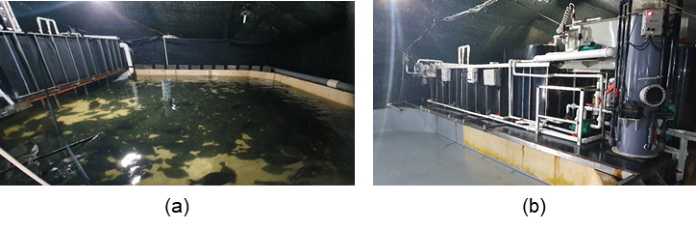
An experiment was conducted to observe changes in water chemical concentrations in an indoor aquaculture facility raising olive flounder. Approximately 300 fish were cultured (see Figure 2(a)), and significant variations in water concentrations were evident with fish growth. The recirculating aquaculture system (RAS) utilized in the facility includes a module combining a 40-ton drum filter, a skimmer, and a biological filtration unit, as depicted (see Figure 2(b)).
Figure 2: Integrated overview of aquaculture density and recirculating aquaculture system components.
Sensors were installed in the aquaculture facility to facilitate real-time monitoring of water temperature, dissolved oxygen, total dissolved solids, acidity, oxygen redox potential, and salinity, while ammonia levels were measured manually. Experiments were conducted to identify the optimal water quality conditions for the growth of flatfish, considering factors such as temperature, salinity, and pH.
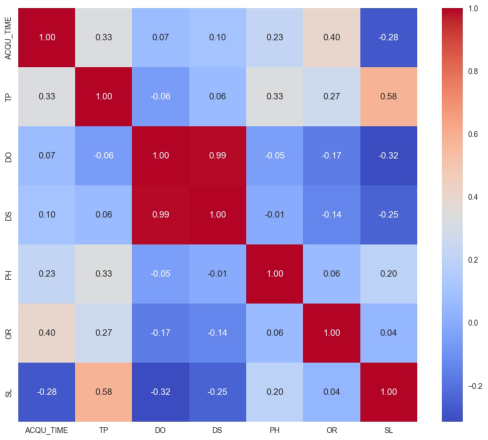
EXPERIMENTS The heatmap illustrates the correlation coefficients between various water quality parameters. Each cell represents the correlation between two variables, with color intensity indicating the strength of the relationship, ranging from blue (negative correlation) to red (positive correlation). Subsequently, various water quality data such as Total Phosphorus (TP), Dissolved Oxygen (DO), Total Dissolved Solids (DS), acidity (pH), Oxygen Redox Potential (OR), and Salinity (SL) were collected, and the correlation analysis results (see Figure 3) revealed several characteristics. DO and DS parameters demonstrate a very strong positive correlation with a coefficient of 0.99, indicating that increases in dissolved oxygen are closely associated with increases in dissolved solids. A moderately strong positive correlation of 0.58 is observed between TP and SL, suggesting that higher concentrations of total phosphorus are generally accompanied by higher salinity levels. OR and ACQU_TIME exhibit a positive correlation with a coefficient of 0.40, implying a potential relationship between the measurement duration and changes in redox potential. A negative correlation of -0.28 between SL and ACQU_TIME is observed, indicating a decrease in salinity over time.
Figure 3: Correlation heatmap of key water quality parameters in aquaculture settings.
Predicting Key Substance Levels in Aquaculture 219
CONCLUSION
In conclusion, this study highlights the efficacy of AI-based models in predicting levels of critical substances such as ammonia, nitrite, and nitrate in land-based aquaculture environments. Through extensive data collection from various sensors and subsequent analysis using advanced AI algorithms, including Random Forest and K-Neighbors Regressor, the research has demonstrated that these models can achieve high accuracy. The Random Forest model, in particular, showed exceptional performance metrics, with a mean absolute error (MAE) of 0.0150, mean squared error (MSE) of 0.0008, root mean square error (RMSE) of 0.0289, R2 of 0.9999, root mean square logarithmic error (RMSLE) of 0.0039, and mean absolute percentage error (MAPE) of 0.0024. These results indicate that AI-driven approaches can significantly enhance the monitoring and prediction of water quality parameters, crucial for maintaining fish health and reducing mortality rates in aquaculture settings.
ACKNOWLEDGMENT
This work was supported by Innovative Human Resource Development for Local Intellectualization program through the Institute of Information & Communications Technology Planning & Evaluation(IITP) grant funded by the Korea government (MSIT) (IITP-2024-2020-0-01791).
REFERENCES
Buentello, J. A., Gatlin III, D. M., & Neill, W. H. (2000). “Effects of water temperature and dissolved oxygen on daily feed consumption, feed utilization and growth of channel catfish (Ictalurus punctatus)”, in: Aquaculture, Volume 182, Issues 3–4, pp. 339–352. Chumkiew, S., Jaroensutasinee, M., Tina, F. W., Jaroensutasinee, K., & Koad, P.
(2019). “Physical factors affecting oyster diversity and distribution in Southern Thailand”, in: Journal of Environmental Biology, Volume 40, No. 1, pp. 3–8. Chun, S. J., Cui, Y., Ahn, C. Y., & Oh, H. M. (2018). “Improving water quality using settleable microalga Ettlia sp. and the bacterial community in freshwater recirculating aquaculture system of Danio rerio”, in: Water Research, Volume 135, pp. 112–121. Davidson, J., Good, C., Williams, C., & Summerfelt, S. T. (2017). “Evaluating
the chronic effects of nitrate on the health and performance of post-smolt Atlantic salmon Salmo salar in freshwater recirculation aquaculture systems”, in: Aquacultural Engineering, Volume 79, pp. 1–8. Kim, J. H., Kang, Y. J., Kim, K. I., Kim, S. K., & Kim, J. H. (2019). “Toxic effects of nitrogenous compounds (ammonia, nitrite, and nitrate) on acute toxicity and antioxidant responses of juvenile olive flounder, Paralichthys olivaceus”, in: Environmental Toxicology and Pharmacology, Volume 67, pp. 73–78. Lindholm-Lehto, P. C., Pulkkinen, J. T., Kiuru, T., Koskela, J., & Vielma, J. (2021).
“Efficient water treatment achieved in recirculating aquaculture system using woodchip denitrification and slow sand filtration”, in: Environmental Science and Pollution Research, Volume 28, pp. 65333–65348. Lindholm-Lehto, P., Pulkkinen, J., Kiuru, T., Koskela, J., & Vielma, J. (2020).
“Water quality in recirculating aquaculture system using woodchip denitrification and slow sand filtration”, in: Environmental Science and Pollution Research, Volume 27, pp. 17314–17328.
Mota, V. C., Martins, C. I. M., Eding, E. H., Canario, A. V. M., & Verreh, J. A. J.
(2017). “Water cortisol and testosterone in Nile tilapia (Oreochromis niloticus) recirculating aquaculture systems”, in: Aquaculture, Volume 468, pp. 255–261. Mwegoha, W. J. S., Kaseva, M. E., & Sabai, S. M. M. (2010). “Mathematical modeling of dissolved oxygen in fish ponds”, in: African Journal of Environmental Science and Technology, Volume 4, No. 9, pp. 625–638. Rasheed Abdul Haq, K. P., & Harigovindan, V. P. (2022). “Water Quality Prediction
for Smart Aquaculture Using Hybrid Deep Learning Models”, in: IEEE Access, Volume 10, pp. 60078–60098. Salim, M. S. (2023). “Early Warning Signs and Dynamics of Hydrogen Sulfide Production in Recirculating Aquaculture System (RAS): With Nitrate and Iron (III) Addition”, Master’s thesis, Norwegian University of Science and Technology (NTNU). Suurnäkki, S., Pulkkinen, J. T., Lindholm-Lehto, P. C., Tiirola, M., & Aalto, S. L. (2020). “The effect of peracetic acid on microbial community, water quality, nitrification and rainbow trout (Oncorhynchus mykiss) performance in recirculating aquaculture systems”, in: Aquaculture, Volume 516, 734534. Timmons, M. B. (2002). Recirculating aquaculture systems. Tziortzioti, C., Amaxilatis, D., Mavrommati, I., & Chatzigiannakis, I. (2019). “IoT
sensors in sea water environment: Ahoy! Experiences from a short summer trial”, in: Electronic Notes in Theoretical Computer Science, Volume 343, pp. 117–130. Wicks, B. J., Joensen, R., Tang, Q., & Randall, D. J. (2002). “Swimming and ammonia toxicity in salmonids: the effect of sub lethal ammonia exposure on the swimming performance of coho salmon and the acute toxicity of ammonia in swimming and resting rainbow trout”, in: Aquatic Toxicology, Volume 59, Issues 1–2, pp. 55–69. Yu, J., Xiao, Y., Wang, Y., Xu, S., Zhou, L., & Li, X. (2021). “Chronic
nitrate exposure cause alteration of blood physiological parameters, redox status and apoptosis of juvenile turbot (Scophthalmus maximus)”, in: Environmental Pollution, Volume 283, 117103. Zhang, S. Y., Li, G., Wu, H. B., Liu, X. G., Yao, Y. H., Tao, L., & Liu, H. (2011). “An integrated recirculating aquaculture system (RAS) for land-based fish farming: The effects on water quality and fish production”, in: Aquacultural Engineering, Volume 45, No. 3, pp. 93–102.
LISTED IN THE AHFE DIGITAL BOOKSTORE CATALOGUE
Explore the complete digital volume
Human Interaction and Emerging Technologies (IHIET 2024)
Read this individual research paper free through the original publisher, or explore the full digital proceedings book.
ISBN 978-1-964867-33-5
Explore this ISBN in the AHFE Bookstore ↗Listed in the July 2026 bookstore catalogue; search by ISBN to confirm current availability · Digital book purchase optional