Haijing Tang, Qin Gao (2024). Factors Influencing Chinese College Students’ Simultaneous Smartphone Use in the Classroom. In: Usability and User Experience. AHFE Open Access, vol. 156, pp. 402–411. https://doi.org/10.54941/ahfe1005451
Across the world, students enrolled in higher education are utilizing their smartphones in a variety of learning environments, which has become a prevalent practice. The objective of the present study is to investigate the factors influencing smartphone use among students in classrooms. Based on a thorough literature review and semi-structured interviews, a conceptual framework has been developed to better understand how college students utilize their smartphones in offline classroom learning settings. A survey based on the framework was conducted among 319 Chinese college students to investigate the impact of various factors on smartphone use. Results indicate a positive correlation between students' smartphone use and all individual factors, with entertainment, social connection, and self-control exhibiting more pronounced effects than other factors. Additionally, high levels of importance placed on course content and convenience significantly promote smartphone use. Overall, the findings support the implementation of the proposed framework to elucidate students' smartphone use behavior in the classroom, which can inform the redesign of curricular and academic-related activities to enhance students' learning, engagement, and overall academic performance.
Smartphone use has become common in almost every facet of human life, like driving, sleeping, and learning etc. Its ubiquity and popularity among college students is on the rise in recent times (Olufadi, 2015a). Around the globe, college students are using their smartphones during class lectures, while completing homework assignments and preparing for exams (Junco & Cotten, 2012; Le Roux & Parry, 2018; Patterson, 2017). Thus, the use of smartphones (either “appropriate” or “inappropriate”) among the students has been a focused debate among the information systems, education, and communication researchers.
Many studies explored the specific behaviors of smartphone use in the classroom and the effect of smartphone use on students’ academic perfor- mance. On the one hand, students use their phones for more than 25% of
Factors Influencing Chinese College Students’ Simultaneous Smartphone 403
effective class duration, and phone distractions occur every 3–4 min for over a minute in duration (Kim et al., 2019). Social media, instant messenger and web browsers were used frequently in classroom (Kim et al., 2019). On the other hand, the majority of studies reported a significantly negative associa- tion between smartphone use and academic performance in colleges (Amez & Baert, 2020). For example, sending and receiving text messages unrelated to class content negatively impacted learning and note taking (Kuznekoff et al., 2015). When using digital devices, long-term retention of the learning con- tent will be reduced because of divided attention, which impaired subsequent unit exam and final exam performance (Glass & Kang, 2019). These findings suggest that smartphone use has a negative effect on student’s academic per- formance, which consist of a significant decrease in performance when tasks are performed simultaneously and an increase in time taken to complete tasks (McCoy, 2016; O’Bannon & Thomas, 2015).
Despite acknowledging it is distracting them, students continue smart- phone use in learning settings (Barry, Murphy, & Drew, 2015). Dahlstrom & Bichsel (2014) found that many college students use mobile devices for academic purposes but were concerned about their potential for distraction. This brings a question that why do students use their mobile phones dur- ing different learning settings despite acknowledging its negative effect (e.g., distraction) on their academic performance. Limited studies explore the ques- tion based on different theoretical framework. Six dimensions (boredom, class-related use, social connection, emergency, addiction, and perceived behavioral control) are seemed to releted to mobile phone use in traditional classrooms based on theory of consumption values (Olufadi, 2015). Overall, previous studies have been limited to demonstrating the negative impact of using smartphones on academic performance, lacking in-depth exploration of the factors influencing students’ use of smartphones. In addition, researchers are more concerned with the impact of personal factors on students, but there is insufficient consideration of the impact of course elements, classmates, and teachers. Thus, the present study tries to fill the gap by examining the factors of students’ smartphone use in three different learning settings.
Therefore, the current study aims to: (i) develop a new framework that con- ceptualize the antecedents of students’ smartphone use behavior in learning settings; (ii) explore Chinese students’ smartphone use behaviors and factors of smartphone use in offline classroom learning setting. Through this study, researchers and policymakers can have a deep understanding of why stu- dents use their smartphones while learning. Additionally, understanding the factors behind students’ use of smartphones while learning has the potential to inform the redesign of the curricular and academic-related activities (e.g., homework) to improve students’ learning, engagement, and overall academic performance.
DEVELOPING A NEW CONCEPTUAL FRAMEWORK Pilot Study
The current study aims to examine factors of smartphone use of students in different learning settings. Given the limited research and the fact that most
404 Tang and Gao
of prior research was about western people, we first conducted a pilot study of semi-structural interview to obtain qualitative understanding about the behaviors, reasons, attitudes, effects and control behaviors of smartphone use in the classroom. Participants were recruited from Tsinghua university, who were taking offline class during the semester. Questions about the fre- quency and time of their smartphone uses while learning were asked first. This information was used to screen participants to ensure that all used smartphone in the classroom and were willing to share their reasons and thoughts. Finally, 8 participants, consisted of 4 males and 4 females, aging from 18–24, participated in the study. All of them were college students, including 3 undergraduates and 5 graduate students.
Reasons for students using smartphone while learning were complicated. Analysis based on their specific behavior of smartphone uses implied that they used smartphone for handling some emergencies, keeping social connec- tion, obtaining immediate gratification and relieving the feeling of boredom and fear of missing out. For example, they browsed the social applications to keep up the news, the latest experiences of their friends and what was hap- pening around them, which helped to strengthen their social connection and relieve the fear of missing out. Furthermore, the factors of smartphone use were reported to be related to the learning process and environment. All par- ticipants agreed that high degree of fatigue, uninterested and boring classes or learning contents, and high convenience of using smartphone would lead to more use in the classroom. 6 participants reported that perceived ease of learning would promote students to shift their attention, whether learn- ing contents were too difficult or too easy. Besides, 3 participants mentioned that if the teacher seemed restrict and cared about students using smartphone, they would reduce the use of smartphone, which could be seem as a kind of perceived supervision.
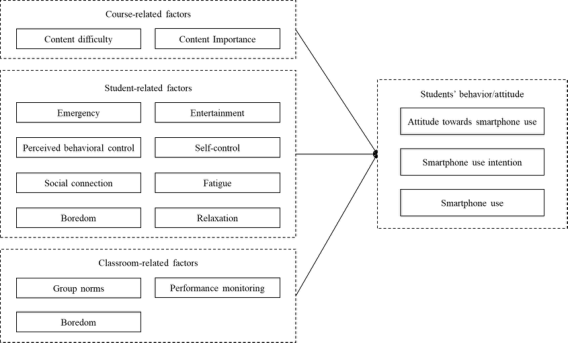
A New Conceptual Framework Smartphone use in learning settings is a complex phenomenon that involves the media factors, person factors and the dynamic structural factors between the media and the person. Based on previous studies and the pilot study, the present study proposed a new theoretical framework that synthesized the theoretical models and empirical evidence across the fields of consumer psychology, abnormal psychology, educational psychology, mobile learning and cognitive psychology (Amez & Baert, 2020; Busch & McCarthy, 2021; Harris et al., 2020; Kim et al., 2019; McCoy, 2016; Olufadi, 2015a). Specifi- cally, we proposed that three categories of factors contribute to student smart- phone use in learning settings: course-related factors, student-related factors and classroom-related factors. Later sections use the abbreviation CSC to refer to the proposed theoretical framework. Figure 1 shows the proposed model.
Factors Influencing Chinese College Students’ Simultaneous Smartphone 405
Figure 1: The CSC model for student smartphone use in the classroom.
MATERIALS AND METHODS
Variables and Measurement Independent variables were selected according to the proposed model. Depen- dent variables include students’ attitude, smartphone use intention, and smartphone use. All measurement items were drawn from the literature and translated into Chinese, back-translated into English, and then carefully examined by the authors. Items for all constructs were worded in regards to the learning settings to match the context of the study. Constructs were measured using five-point, seven-point and nine-point Likert scales ranging from “strongly disagree” (1) to “strongly agree” (5, 7 or 9).
Survey Administration Data were collected among internet users in Chinese colleges. Participants were asked to recall their learning activities in the classroom and respond to the survey questions based on their experience. A total of 319 responses were collected. All respondents learned one or more college courses in the past year and lasted more than one month. 46.4% of the respondents (148 participants) were males and 53.6% (171 participants) were females. They aged from 15 to 29 (M = 21.1, SD = 2.36). 28.8% of the respondents (92 participants) were graduate students and 71.2% (227 participants) were undergraduates. Other demographic variables (e.g., smartphone use experi- ence, major) were collected. Overall, we believe that our sample represents the students who are taking class in the classroom in Chinese colleges.
Data Analysis The proposed hypotheses were tested using partial least squares structural equation modelling (PLS-SEM), which is a causal-predictive approach that allows for estimating complex models with latent variables. Compared with other structural modelling techniques, PLS fits a composite model instead of a common-factor model, which maximizes the amount of variance explained
406 Tang and Gao
with restrictions on measurement scale, sample size, and residual distribu- tion (Chiu et al., 2012). Hence it was selected to fit our model with a limited sample. We utilized SmartPLS 2.0 to assess the model. Bootstrapping tech- nique (5000 resample) was applied to determine the significant levels of the proposed hypothesis.
RESULTS
Descriptive Results The descriptive statistics of the measured variables in the three learning set- tings were shown in Table 1. Analysis of correlation indicated that the content importance of the course is negatively correlated with smartphone use, while almost all student-related factors are positively correlated. Among these fac- tors, entertainment, social connection, and self-control showed the most significant correlations with smartphone use intention and smartphone use. Additionally, perceived behavioral control and attitude towards smartphone use are positively correlated. Finally, convenience is positively correlated with smartphone use intention and smartphone use.
Table 1. Descriptive statistics of variables of participants.
Table available in the original PDF paper.
Number Variable Mean Standard Deviation 1 Smartphone use 4.76 1.44 2 Smartphone use intention 4.82 1.36 3 Attitude towards smartphone use 3.45 1.19 4 Convenience 5.49 1.11 5 Content difficulty 5.29 1.19 6 Content importance 5.54 1.05 7 Emergency 3.13 0.85 8 Entertainment 3.25 0.92 9 Social connection 2.95 0.89 10 Relaxation 3.48 0.87 11 Fear of missing out 2.43 0.82 12 Boredom 4.75 1.75 13 Fatigue 2.92 0.77 14 Perceived behavioral control 2.38 0.83 15 Group norms 3.76 0.71 16 Performance monitoring 2.42 0.85
Structural Models Results Two models were constructed and evaluated for students’ attitude towards smartphone use and smartphone use. The evaluation of PLS-SEM models involves two steps: measurement model and structural model assessment. The first step, measurement model assessment, is to examine the relation- ships between the observed data and the latent variables, and the criteria differ for reflective and formative measures. In our model, “attitude toward smartphone use”, “convenience”, “smartphone use intention”, and “smart- phone use” were measured with formative items, and the rest constructs
Factors Influencing Chinese College Students’ Simultaneous Smartphone 407
were measured with reflective items. Reflective measurement models were evaluated based on the following criteria: factor loadings, internal consis- tency, convergent validity, and discriminant validity (Bollen, 1989; Chin & Gopal, 1995). In our models, factor loadings of all items were above 0.50, indicating that more than 50% of the items’ variance was explained by the construct. The internal reliability was measured by composite reliability and Cronbach’s alpha (Bagozzi, 1981), which were both higher than the recom- mended boundary of 0.7, indicating adequate internal reliability (Raykov & Marcoulides, 2011). Convergent validity was examined by average vari- ance extracted (AVE), and the result showed that all constructs had an AVE of at least 0.51, well above the threshold of 0.5 for acceptable convergent validity (Bagozzi, 1981). Discriminant validity can be assessed by examining whether the square root of AVE for each construct is larger than the correla- tions between the construct and other constructs (Fornell & Larcker, 1981). Our measurement model exhibited satisfactory discriminant validity. For for- mative constructs, collinearity was the main evaluation criteria. The variance inflation factor (VIF) was used to measure item collinearity, and the result showed that VIFs of all the formative measures were less than 5, indicating that the collinearity was not a serious concern.
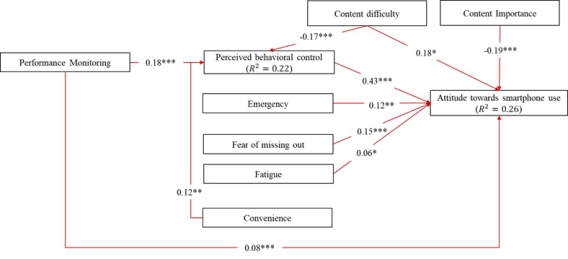
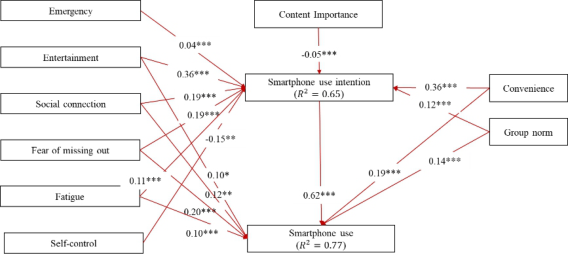
Figure 2: Structural model results for students’ attitude towards smartphone use in the classroom.Figure 3: Structural model results for students’ smartphone use in the classroom.Equation reproduced from the original PDF.
408 Tang and Gao
According to the structural model results for students’ attitude towards smartphone use in the classroom (Figure 2), the impact of perceive behavioral control on attitude is strong (β = 0.43, p<.01), while performance monitor- ing affects perceive behavioral control (β = 0.18, p<.01). Content difficulty (β = 0.18, p<.1), content importance (β = 0.19, p<.01) and fear of missing out (β = 0.15, p<.01) are also correlated with students’ attitude. They jointly explain 26% of the variance in students’ attitude towards smartphone use in the classroom.
According to the structural model results for students’ smartphone use intention and smartphone use (Figure 3), the smartphone use intention is affected mostly by entertainment (β = 0.36, p<.01), social connection (β = 0.19, p<.01), fear of missing out (β = 0.19, p<.01), convenience (β = 0.36, p<.01). Along with other variables, they jointly explain 65% of the variance in smartphone use intention. As for smartphone use, it is affected mostly by smartphone use intention (β = 0.62, p<.01), fear of missing out (β = 0.20, p<.01), and convenience (β = 0.19, p<.01). along with other variables, they jointly explain 77% of the variance in smartphone use.
DISCUSSION AND CONCLUSION
Discussion
Overall, our results supported existing research showing the influence of con- sumer value, habit, and self-efficacy on smartphone use in the classroom. According to results, students’ attitude towards smartphone use in the class- room can be mainly predicted from the difficulty and the importance of the course. When the course is difficult, students tend to be positive about smart- phone use. This may because that they view smartphone use as an aid for learning (Wang et al., 2023). When the course is important, students tend to have a negative attitude, which reflects that students are aware of the poten- tial negative effect of smartphone use on academic performance (Amez & Baert, 2020). Perceived behavioral control positively affects students’ atti- tude, which means that rules and norms from the teacher and class plays an important role (Zhou et al., 2022). Lastly, if students use smartphone for some emergencies, their attitude will become positive as they obtain values from that (Olufadi, 2015b).
Students’ intention to use smartphones can be predicted from enter- tainment, social connection, convenience, and self-control. The factors of entertainment and social connection are found to be significant in previous study (Fu et al., 2021; Olufadi, 2015b). The emotional need for belonging might be one of the reasons students’ use their smartphones in class and this may be satisfied by their ability to be constantly connected. In addition, how smartphones are convenient for students to use is found to be important, which indicates that strengthening the rules or monitoring may be a good way to decrease students’ attention to use smartphones.
As we expected, self-control significantly affect students’ intention and use, which highlight the importance of teaching and training students to keep good learning habits (Fabio et al., 2022; Troll et al., 2021). Find- ings from the previous studies have reported that students continue to use
Factors Influencing Chinese College Students’ Simultaneous Smartphone 409
their smartphones in the classroom even in classes where its use is ban (Imhof et al., 2007; Scornavacca et al., 2009) and they continued this habit despite acknowledging it is distracting them (Barry et al., 2015). These results indicate the complicated relationship among these factors.
Overall, teachers and policymakers can explore how to better manage smartphone use in the classroom, such as establishing clear rules and stan- dards, providing more learning resources and interactive activities to attract students’ attention and interest. At the same time, we can also encourage students to maintain self-control and follow classroom rules when using smartphones to ensure classroom order and learning effectiveness.
Conclusion
The current study indicates that students’ intention to use smartphones in the classroom can be influenced from a series of factors, such as entertainment, social connection, convenience, and self-control. Their use of smartphones can also be influenced from those factors, while students’ attitude towards smartphone use in the classroom may be affected by another group of fac- tors, such as course difficulty, course importance, and perceived behavioral control. The values of smartphone use in the classroom are mainly from entertainment, fear of missing out, social connection, and emergency, which represents the values of smartphone. The convenience blurs the boundary between the class and the other time, which promotes smartphone use in the classroom to some extent. Overall, understanding the factors that influence smartphone use can help individuals and institutions make informed deci- sions about when and how to use these devices. By balancing the benefits and drawbacks of smartphone use, we can create a positive and productive learning environment for students.
Limitations There are several limitations to the current study. First, we did not differenti- ate the usage of smartphone use in the classroom. Course-related smartphone use and distractive smartphone use are influenced by different factors, which can be a future direction. Second, learning settings changes much with the development of technology and the COVID-19. Online live learning and massive online learning appear for many years, where students may use smartphone more often. Future research can explore the factors in differ- ent learning settings. Third, the current study collected data from students’ self-report survey. Future research should utilize multiple sources for data collection, which would allow an examination of possibly different pictures regarding student behaviour.
ACKNOWLEDGMENT
This study received no external funding.
410 Tang and Gao
REFERENCES
Amez, S., & Baert, S. (2020). Smartphone use and academic performance: A literature review. International Journal of Educational Research, 103, 101618. https://doi.org/10.1016/j.ijer.2020.101618 Bagozzi, R. P. (1981). Evaluating structural equation models with unobservable
variables and measurement error: A comment. Barry, S., Murphy, K., & Drew, S. (2015). From deconstructive misalignment to constructive alignment: Exploring student uses of mobile technologies in university classrooms. Computers & Education, 81, 202–210. Bollen, K. A. (1989). Structural equations with latent variables (Vol. 210). John Wiley
& Sons. Busch, P. A., & McCarthy, S. (2021). Antecedents and consequences of problematic smartphone use: A systematic literature review of an emerging research area. Computers in Human Behavior, 114, 106414. Chin, W. W., & Gopal, A. (1995). Adoption intention in GSS: Relative importance
of beliefs. ACM SIGMIS Database: The Database for Advances in Information Systems, 26(2–3), 42–64. Chiu, C.-M., Hsu, M.-H., Lai, H., & Chang, C.-M. (2012). Re-examining the influence of trust on online repeat purchase intention: The moderating role of habit and its antecedents. Decision Support Systems, 53(4), 835–845. Fabio, R. A., Stracuzzi, A., & Lo Faro, R. (2022). Problematic smartphone use
leads to behavioral and cognitive self-control deficits. International Journal of Environmental Research and Public Health, 19(12), 7445. Fornell, C., & Larcker, D. F. (1981). Evaluating structural equation models with unobservable variables and measurement error. Journal of Marketing Research, 18(1), 39–50. Fu, E., Gao, Q., Wei, C., Chen, Q., & Liu, Y. (2021). Understanding student simul-
taneous smartphone use in learning settings: A conceptual framework. Journal of Computer Assisted Learning, 37(1), 91–108. https://doi.org/10.1111/jcal.12471 Glass, A. L., & Kang, M. (2019). Dividing attention in the classroom reduces exam performance. Educational Psychology, 39(3), 395–408. Harris, B., Regan, T., Schueler, J., & Fields, S. A. (2020). Problematic mobile phone
and smartphone use scales: A systematic review. Frontiers in Psychology, 11, 672. Imhof, M., Vollmeyer, R., & Beierlein, C. (2007). Computer use and the gender gap: The issue of access, use, motivation, and performance. Computers in Human Behavior, 23(6), 2823–2837. Junco, R., & Cotten, S. R. (2012). No A 4 U: The relationship between multitasking
and academic performance. Computers & Education, 59(2), 505–514. Kim, I., Kim, R., Kim, H., Kim, D., Han, K., Lee, P. H., Mark, G., & Lee, U. (2019).
Understanding smartphone usage in college classrooms: A long-term measurement study. Computers & Education, 141, 103611. https://doi.org/10.1016/j.comped u.2019.103611 Kuznekoff, J. H., Munz, S., & Titsworth, S. (2015). Mobile phones in the classroom: Examining the effects of texting, Twitter, and message content on student learning. Communication Education, 64(3), 344–365. Le Roux, D. B., & Parry, D. A. (2018). In-lecture media use and academic per-
formance: Investigating demographic and intentional moderators. South African Computer Journal, 30(1), 87–107. McCoy, B. R. (2016). Digital distractions in the classroom phase II: Student classroom use of digital devices for non-class related purposes.
Factors Influencing Chinese College Students’ Simultaneous Smartphone 411
O’Bannon, B. W., & Thomas, K. M. (2015). Mobile phones in the classroom: Preservice teachers answer the call. Computers & Education, 85, 110–122. Olufadi, Y. (2015a). A configurational approach to the investigation of the multiple
paths to success of students through mobile phone use behaviors. Computers & Education, 86, 84–104. Olufadi, Y. (2015b). Gravitating towards mobile phone (GoToMP) during lecture periods by students: Why are they using it? And how can it be measured? Computers & Education, 87, 423–436. Patterson, M. C. (2017). A naturalistic investigation of media multitasking while
studying and the effects on exam performance. Teaching of Psychology, 44(1), 51–57. Raykov, T., & Marcoulides, G. A. (2011). Introduction to psychometric theory.
Routledge. Scornavacca, E., Huff, S., & Marshall, S. (2009). Mobile phones in the classroom: If you can’t beat them, join them. Communications of the ACM, 52(4), 142–146. Troll, E. S., Friese, M., & Loschelder, D. D. (2021). How students’ self-control
and smartphone-use explain their academic performance. Computers in Human Behavior, 117, 106624. Wang, J. C., Hsieh, C.-Y., & Kung, S.-H. (2023). The impact of smartphone use on learning effectiveness: A case study of primary school students. Education and Information Technologies, 28(6), 6287–6320. Zhou, D., Liu, J., Ye, G., Wang, T., Xia, X., & Liu, J. (2022). Relationships among
Problematic Smartphone Use, Mathematics Achievement, Teacher–Student Rela- tionships, and Subjective Well-Being: Results from a Large-Scale Survey in China. Behavioral Sciences, 12(11), 454.
LISTED IN THE AHFE DIGITAL BOOKSTORE CATALOGUE
Explore the complete digital volume
Usability and User Experience
Read this individual research paper free through the original publisher, or explore the full digital proceedings book.
ISBN 978-1-964867-32-8
Explore this ISBN in the AHFE Bookstore ↗Listed in the July 2026 bookstore catalogue; search by ISBN to confirm current availability · Digital book purchase optional