Chieh-ju Huang, Pin Ju Chen, Jyun Ting Lin, Hsiang-yu Chang (2024). User Experience Evaluation for AR Learning Platform on Endangered Animals in Taiwan. In: Usability and User Experience. AHFE Open Access, vol. 156, pp. 31–37. https://doi.org/10.54941/ahfe1005412
The study emphasizes enhancing the online learning experience for Taiwanese elementary school students by integrating innovative technology into knowledge acquisition. By incorporating Augmented Reality (AR) to present interactive animations of endangered animals, the researchers aimed to create a more engaging and enriching learning environment. The AR interactive animations were integrated into elementary school natural science supplementary materials, forming an online learning website. To cater to the stylistic preferences of elementary school children, the study utilized playful illustrations for visualizing knowledge. The incorporation of AR aimed to add an element of fun to the learning process, deepening the learners' impressions of biodiversity and fostering an understanding of the importance of animal conservation.The research employed scenario-based tasks and the System Usability Scale (SUS) for evaluation, involving ten elementary school students in testing and assessment. The results indicated that the design of the app, combining AR with vivid illustrative visualizations of endangered animals, significantly improved the overall user experience for elementary school children, thereby enhancing the enjoyment of the learning process.
Taiwan currently faces a crisis with over a hundred vertebrate species at risk of extinction. To protect biodiversity, the Forestry Bureau has initiated conservation plans for 22 endangered and rare species, including terrestrial mammals like the Formosan flying fox, otters, Formosan black bears, and leopard cats. Enhancing the promotion and understanding of biodiversity’s importance requires educational efforts. Knowledge gained solely from text- books is limited and less impactful without real-world interaction. Utilizing smart learning technologies in everyday life can help students understand ecology more deeply and tangibly, boosting their motivation to learn.
Using AR as a supplementary technological tool or integrating it into teaching aids allows learners to interact smoothly, providing opportunities to enjoy unique educational benefits. Not only does it facilitate smooth operation of the teaching tools by learners (Dunser & Billinghurst, 2011). The application of AR in education can enhance learning interest, provide
immersive and sensory play opportunities, and improve learning outcomes. Numerous studies advocate that AR possesses these various advantages, with research results showing learning effectiveness (Billinghurst et al., 2003; Cascales et al., 2012; Lee et al., 2017).
The application of Augmented Reality (AR) is increasingly common in various fields, including education, where it adds value to learning experi- ences. Compared to traditional textbook methods, AR can immerse students in diverse ecological worlds, blending virtual and real-world experiences. This connection with animals can foster curiosity and learning motivation. This study aims to combine AR with ecological conservation, enhancing awareness of endangered species protection. The study’s objectives are as follows:
1. Use illustrations of Taiwanese conservation species to increase user inter- est and willingness to learn. 2. Allow users to understand the current status of Taiwan’s conservation ecology through AR through user experience design. 3. Assess if AR designs can help users comprehend knowledge related to Taiwan’s endangered species.
RESEARCH AND DESIGN PROCESS Work Items and Contents
The project’s main content and work items are organized in Table 1 according to the design and production sequence.
Table 1. Work items and design contents.
Table available in the original PDF paper.
Work Items Contents User Experience Design User Experience Design, Interface Content Confirmation Interface Layout Design Interface Design Animals Illustration Style Determination, Animal Drawing AR Animals Modelling Animal Style Determination, 3D Model Building, Skeleton Setting, Animation Production APP Development Interface Programming, Backend Programming, API Integration User Test Using User Experience Surveys to Test and Evaluate APP Results
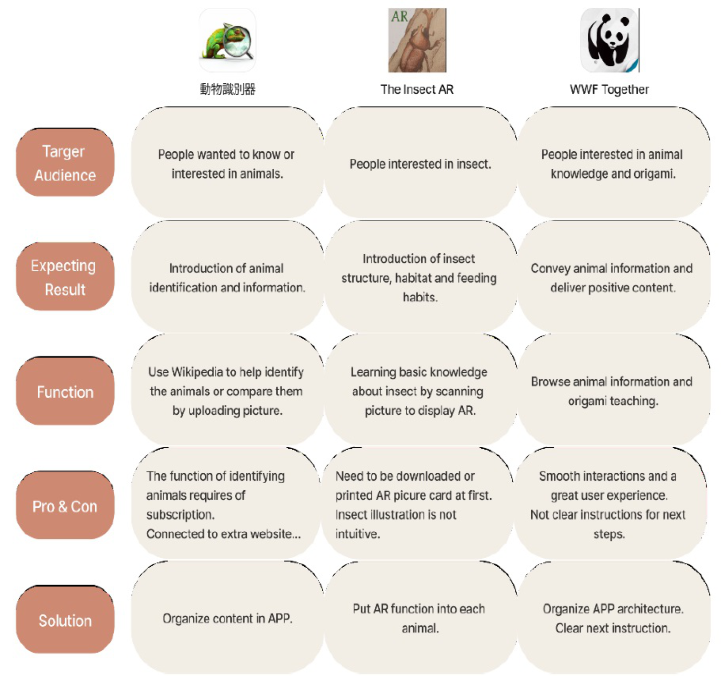
Related Works Analysis We analyze three animal-themed augmented reality (AR) apps available in the market, identifying their strengths and areas for improvement to incorporate into our app.
User Experience Evaluation for an AR Learning Platform on Endangered Animals in Taiwan 33
Figure 1: The analysis from 3 related works.
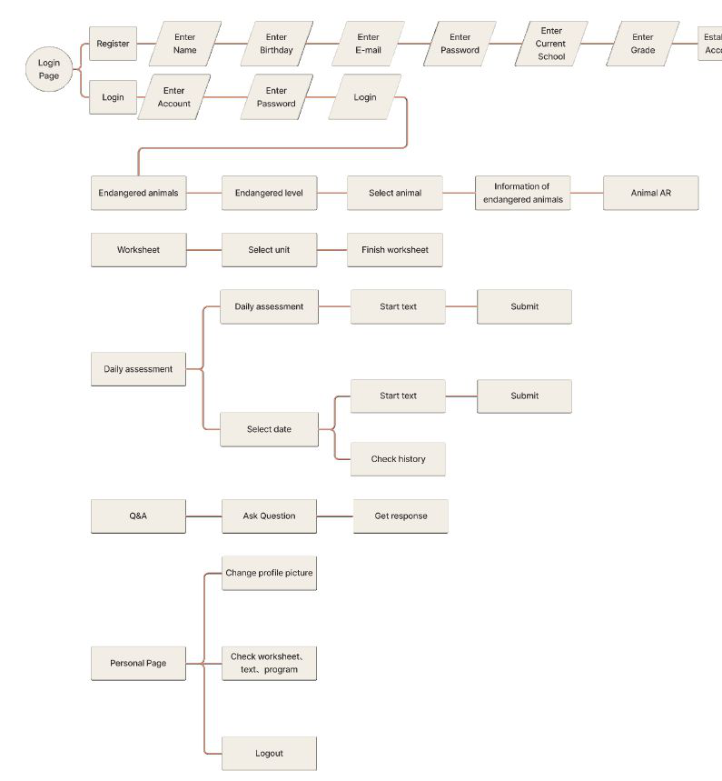
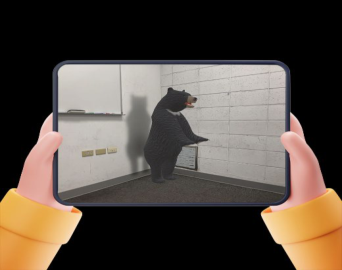
User Flow The main workflow of the app is showed in Figure 2. Users, upon opening the app, can choose the content they wish to view. Within each endangered animal’s description, there is an option to activate the augmented reality fea- ture for that particular animal. This augmented reality functionality allows users to observe the animal’s form, appearance, and behaviours.
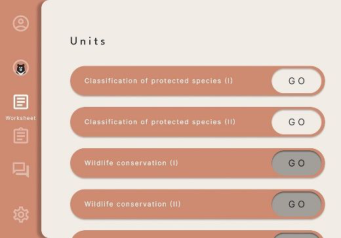
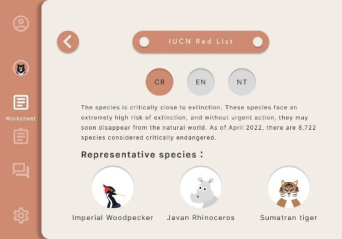
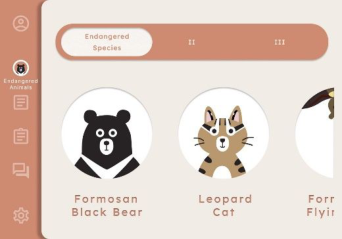
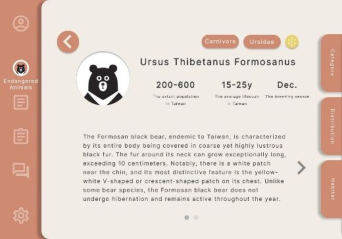
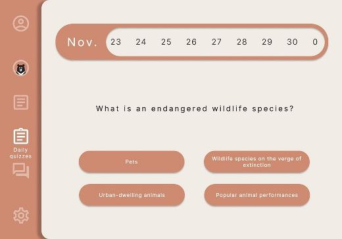
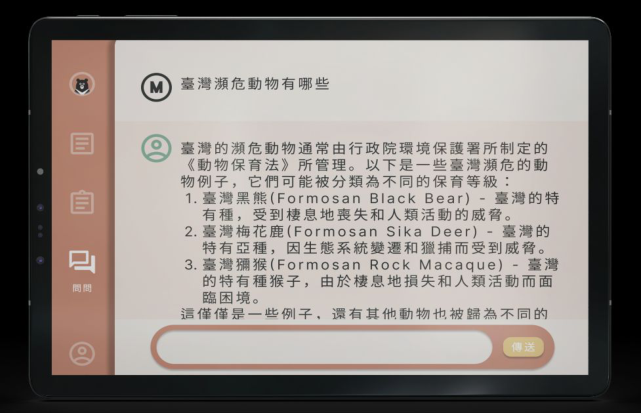
UI Design Users can access learning units and contents on their mobile devices. By click- ing on the avatars of endangered animals, they can learn about the animals’ introductions and descriptions, as well as view the animals in augmented reality. In addition, users can understand the effectiveness of their learn- ing through educational quizzes. The app also integrates the application of ChatGPT, allowing users to ask questions about relevant knowledge within the app. The UI design according to the functions and contents are show in Figure 3 to Figure 9.
Figure 2: Flow chart.Figure 3: Learning units.
User Experience Evaluation for an AR Learning Platform on Endangered Animals in Taiwan 35
Figure 4: Endangered animals in the world.Figure 5: Endangered animals in the Taiwan.Figure 6: Introduction page for the endangered animal.Figure 7: AR for the endangered animals.Figure 8: Quiz after learning.Figure 9: Q&A by ChatGPT in Chinese. (The question is about asking ChatGPT for what endangered animals in Taiwan are.)
RESULTS
The evaluation of this project primarily involves having participants operate the completed app and then fill out a questionnaire to assess its effectiveness. The questionnaire mainly uses the System Usability Scale (SUS). Theses 10 questions are from the SUS questionnaire, and a score is calculated using its algorithm, and the scores of each questions are with the highest being 5 and the lowest being 1. There are 12 participants from the elementary school students and the scoring details are shown in Table 2.
Table 2. System usability scale scoring list.
Table available in the original PDF paper.
Participants A B C D E F G H I J K L M Average SUS Scores 62.5 60 90 82.5 82.5 72.5 90 80 67.5 77.5 77.5 50 50 74.38
User Experience Evaluation for an AR Learning Platform on Endangered Animals in Taiwan 37
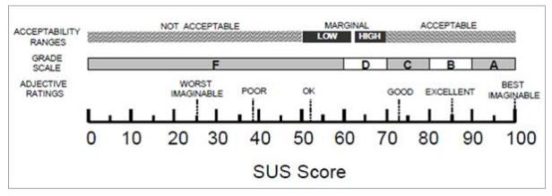
Based on the scores from SUS, the overall usability is rated as good (Figure 10). Therefore, the usability of the app for students to learn about endangered animals through Augmented Reality is high.
Figure 10: SUS questionnaire content.
CONCLUSION
The results indicated that the design of the online app, combining AR with vivid illustrative visualizations of endangered animals, significantly improved the overall user experience for elementary school children, thereby enhancing the enjoyment of the learning process.
Future design suggestions are as follows:
1. Increase the number of animals to enrich the content. 2. The AI function sometimes responds incorrectly, which may lead to misinformation especially for elementary school students. 3. For first-time users of the app, add tutorials or guiding instructions to enhance explanations for each feature.
ACKNOWLEDGMENT
The authors would like to thank National Science and Technology Council, for financially supporting this research under Contract No. NSTC 112-2410- H-155-025 - and under College Student Research Scholarship Contract No. 112-2813-C-155-026 -H.
REFERENCES
Billinghurst, M., Belcher, D., Gupta, A., & Kiyokawa, K. (2003). Communication Behaviors in Co-located Collaborative AR Interfaces. International Journal of Human-Computer Interaction, 16(3), 395–423. doi: 10.1207/ S15327590IJHC1603_2. Cascales, A., Laguna, I., Pérez-López, D., Perona, P., & Contero, M. (2012).
Augmented Reality for preschoolers: An experience around Natural Sciences educational contents. Spdece (June), 113, 122. Dunser, A., & Billinghurst, M. (2011). Evaluating Augmented Reality Systems. In B Frht (ed.), Handbook of Augmented Reality, (pp. 289–307). NY: Springer. Forestry and Nature Conservation Agency (2016). Nature Conservation. Website:
https://conservation.forest.gov.tw/EN. Lee, L. K., Chau, C. H., Chau, C. H., & Ng, C. T. (2017). Using augmented reality to teach kindergarten students english vocabulary. In 2017 International symposium on educational technology (ISET), 2017, 53–57. http://doi.org/10. 1109/ISET.2017.20
LISTED IN THE AHFE DIGITAL BOOKSTORE CATALOGUE
Explore the complete digital volume
Usability and User Experience
Read this individual research paper free through the original publisher, or explore the full digital proceedings book.
ISBN 978-1-964867-32-8
Explore this ISBN in the AHFE Bookstore ↗Listed in the July 2026 bookstore catalogue; search by ISBN to confirm current availability · Digital book purchase optional