Chieh-Ju Huang (2023). Effects of Design Thinking on Learning User Experience and User Interface Design. In: Usability and User Experience. AHFE Open Access, vol. 110, pp. 254–261. https://doi.org/10.54941/ahfe1003198
User experience design is more essential and important for the planning then visual interface design. In this research, design thinking integrated in “User-Interface Design for Mobile Device” course for making the students to investigate the user requirements from the related tools. Both the group of design and the group of technology students will have interdisciplinary groups and do the research about the user requirements according to spectacular topics from related workshops in the class. Later on, they will learn how to do the interface design prototype with related software and also concern about the visual style. It will help the students understand the point of how to execute project and practice it. Also, the experts are invited to the class for giving talks and suggestion about the students’ projects and sharing the ideas of design innovation and experiences. User test is required after the students finish their design project, beside set up several tasks with scenarios for the participants to see what kind problems they would have during the investigation of the prototype of the service app. The students can learn and practice four phases of design thinking. There are several evaluating methods of teaching and learning in this research: descriptive statics, reliability analysis, and independent sample t-test. The students gave positive feedback for the general questionnaires, and the reliability is high for the value of Cronbach’ alpha. For the arrangement and teaching method in this course, expert critics are helpful for implementation of related design projects, and the students can get more advices from this teaching method. In the future study, more experts from the industry will be invited for different advices and feedbacks according to the types from students’ projects for practical and integral learning experiences.
This project starts from the user experience practice in the actual classroom, students will understand how to explore the content of user experience design from related methods for user needs. In addition, students can learn by doing in the classroom through the introduction of the case and the operation of the software, and they will become familiar with the key points and methods of visual interface design. Finally, the students’ works can be trimmed and optimized to make them more complete through the sharing and suggestions of industry experts, as well as user testing methods. Beside classroom lectures,
Effects of Design Thinking on Learning User Experience and User Interface Design 255
workshop exercises, and hands-on operations, the teaching method also uses after-class discussions to understand the effectiveness of students’ learning, so that teachers can supplement relevant information before the next class.
When students try to become designers, learning how to become desi- gners is an important project; at the same time, practicing and observing the behavior of designers can also assist their learning (Budge, 2016). And design-related courses provide students with the ability to provide design cre- ativity (Sawyer, 2017). In the method of design teaching, it is not only about imparting knowledge in the classroom, but also needs to consider the culti- vation of creativity and design behaviour. The design teaching method of this research considers the characteristics of user experience and interface design. In addition to basic theoretical knowledge, it also focuses on the process of learning by doing, and uses different themes to allow students to create rele- vant design project. The purpose is also to cultivate students’ relevant design capabilities and meet the needs of the industry.
Design thinking focuses on developing solutions to problems, and it is well suited to the interdisciplinary research of innovations (Liedtka, 2015). Design thinking is a user-centered design method to achieve design innovation (Brown, 2008). Innovation is achieved by observing users and understanding their needs for life. Design thinking is quite helpful for designers in innovative thinking and problem solving (Carlgren et al., 2016). In the field of design development and research, design thinking is a basic tool for simplifying tedi- ous processes and humanized development, and it is an indispensable core competence (Kolko, 2015). The British Design Council proposed a double diamond design process model, which is divided into four stages: Disco- ver, Define, Develop, and Deliver (Council, 2005). User experience design is a theoretical approach to understand the elements of user experience, pro- ducts, services, and their integrated systems, and analyse the touch points and characteristics of each element from the perspective of users (Coxon et al., 2019). “The Elements of User Experience” proposed the prototype of user experience design (Garrett, 2002). Garrett uses the field of web design, in user experience design, according to the two categories of interface and interaction, and must consider related design elements at the same time in Table 1.
It can be clearly understood from the above table that the interface system is a part of the user experience design of the webpage, and the hypertext hyperlink system of the Internet must be considered. Interface design is mainly to allow users to understand the front-end display, and it includes visual, interactive, functional and other related design work. The current design related to online mobile devices can also be discussed using the rele- vant principles. Whether it is task-oriented and service-related APP design, or information-oriented and large-scale website-related design, interaction design and interface design need to be considered user need. In addition to focusing on the visual design of the interface design, it is also necessary to explore the needs of users from the perspective of user experience. It also makes the design of related mobile devices with different orientations more practical and complete.
256 Huang
Table 1. The elements of user experience in webpage design.
Table available in the original PDF paper.
Category Function Elements Interface Task-Oriented Visual Design Interface Design Interaction Design Functional Specifications User Needs, Site Objects Hypertext Information-Oriented Visual Design Navigation Design, Information Design Information Architecture Content Requirements User Needs, Site Objects
It aims to integrate design thinking into user experience and user interface in this project of this course “Visual Interface Design for Mobile Devices”, and the research purposes are:
1. By using “Learning from Doing” in projects, the students can practice the process of user interface design. 2. The practice of user experience tools allows the students to know the user needs and to fulfil the workflow of developing the mobile device projects from the perspective of design thinking. 3. From the suggestions of industry experts and results of user test, the works from students’ project can be more refined and optimized in order to meet the requirements from the industry.
RESEARCH METHOD AND PROCESS Research Design and Structure
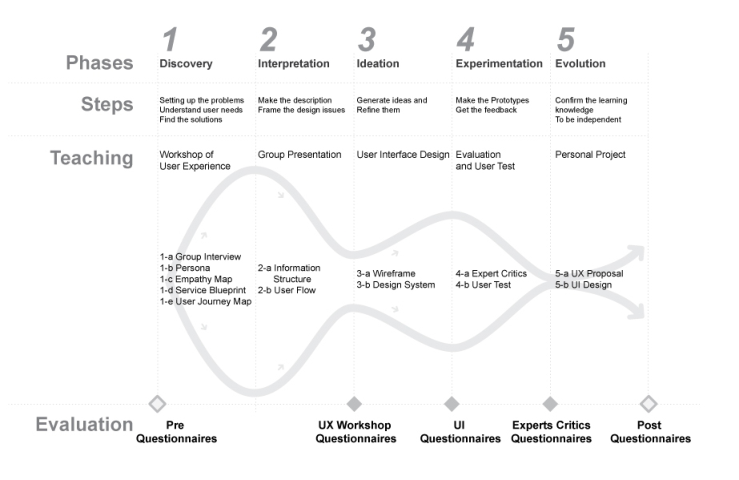
It integrates design thinking method into the teaching and research in this study. According to the instructional design and curriculum arrangement, as well as the implementation of teaching evaluation, the integrated research design and structure are shown in Figure 1.
1. Phases and steps
(1) Discovery: Setting up the problems, understand user needs, and find the solutions (2) Interpretation: Make the description according to the scenario and frame the design issues (3) Ideation: Generate ideas and Refine them (4) Experimentation: Make the Prototypes and get the feedback from it (5) Evolution: Confirm the learning knowledge and have the ability to be independent
Effects of Design Thinking on Learning User Experience and User Interface Design 257
Figure 1: Research design and structure.
2. Teaching
(1) Workshop of User Experience: Set up the topics and use relevant tools to investigate user requirements (2) Group Presentation: Integrate each design concept and find the possible solutions (3) User Interface Design: develop high-fidelity user interface (4) Evaluation and User Test: Verify the feasibility of the projects from the students through critics from experts and user test (5) Personal Project: try to implement the project of UX development and UI design individually
3. Evaluation
(1) Pre and Post Questionnaires: understand the learning gap of the students from pre and post questionnaires (2) Questionnaires for Each Phases: These questionnaires are for under- standing the learning cognition, the appropriateness of each course, the cultivation of core ability, and learning effects from the feedbacks of the students for each phases.
Teaching Research and Objects Both the group of design and the group of technology students were joined in this class for interdisciplinary groups in this research. There are 52 objects: 24 students are from the group of design (46%), and 28 students are from the group of technology (54%). It means the difference in the number of the students in the two groups was little.
258 Huang
Teaching Process
1. Workshop of User Experience
According to the themes of “Health Care”, “Learning and Educa- tion”, and “Leisure and Entertainment”, students were divided into mixed groups for 4–8 people in each group. They practiced user expe- rience tools like: group interviews, persona, empathy map, service blueprint, and user journey map. 2. Online Critics from Experts After reviewing the presentation and UI wireframe of each group pro- ject, the experts had critics online. Each group had 12–15 munities presentation, and the experts gave the feedbacks on their perspective. Then the experts also gave the suggestions for improving the UI. In the end, students and experts conducted two-way communication to clarify the details.
RESULTS
The Results from Post Questionnaire It aims to describe the post questionnaire results from the students in this paper (Table 2). Questions are answered in the form of Likert scale, with 1 to 5 representing very agree, agree, okay, disagree, and strongly disagree. The following is the analysis result table of the learning feedback questionnaire. The participants were 52, and the Cronbach’s Alpha value is 0.969(>0.7), which means a high level of reliability.
The significant results from Independent Sample t-test for both students from the group of design and the group of technology is indicated as following descriptions (p-value of significant level <0.05):
1. UX design taught from this class is helpful for my related ability (p- value = 0.033) 2. UI design taught from this class is helpful for my related ability (p- value = 0.031) Therefore, it shows the students from the group of design have a stron- ger understanding of user experience design and user interface design then the students from the group of technology in the teaching of the course, although all the teaching content are designed for interdisciplinary integration.
Feedback from the Students The overall feedback from the students shows that expert critics are helpful for implementation of related design projects, and the students can get more advices from this teaching method. The students would like to apply the pro- jects finished from this class to the portfolio for applying the related jobs as the internship.
Effects of Design Thinking on Learning User Experience and User Interface Design 259
Table 2. Descriptive Statistics from the Post Questionnaire.
Table available in the original PDF paper.
Scales Questions Mean Standard Deviation
1.87 .627
User Experience 1. UX design taught from this class is relevant to the future related work.
1.77 .645
2. UX design taught from this class is helpful for my related ability.
1.83 .550
3. The arrangement of UX design taught from this class is based on the Instruction Objective.
1.85 .607
4. We have the opportunities to practice UX. 1.69 .579 5. UX workshop is helpful for us to use in future work.
1.85 .607
6. The tools from UX workshop is clearly for us to practice.
1.98 .610
7. I know how to use “Empathy Map” 1.94 .608 8. I know how to use “Persona” 1.88 .646 9. I know how to use “Customer Journey Map”
1.87 .627
10. I know how to use “Service Blueprint” 2.00 .657 User Interface 1. UI design taught from this class is relevant to the future related work.
1.79 .536
2. UI design taught from this class is helpful for my related ability.
1.87 .561
3. UI design taught from this class is helpful for my related ability.
1.85 .500
4. We have the opportunities to practice UI. 1.69 .506 5. The principles from UI is clearly for us to practice.
1.85 .538
6. The process from UI design is clearly for us to practice.
2.83 .985
7. I know how to use the software: Figma 1.81 .561 8. I know how to use the software: Adobe XD
2.02 .671
User Test and Design Thinking
1. User test taught from this class is relevant to my project.
1.90 .603
2. User test taught from this class is relevant to the future related work.
1.87 .658
3. I know how to do user test 1.96 .656 4. I understand the feedback from the user test should be the items for improving my project.
1.87 .658
5. I know the critics from the experts are helpful to my project.
1.96 .656
6. I know the principles and focus for midterm and final projects.
1.81 .627
7. I can learn a lot from other classmates” projects.
260 Huang
Table 2. Continued.
Table available in the original PDF paper.
Scales Questions Mean Standard Deviation
1.77 .645
The Relationship between UX and UI
1. I know the relationship between UX and UI after this class.
1.75 .556
2. I think UX design is helpful for me to do the planning and research before I do UI design
2.12 .808
3. I would like to do the work related to UX and UI after graduation if there is some opportunities.
CONCLUSION
The students understood better for the requirements of the industry from the experts critics, and they could conduct UX and UI projects through the tools and principles taught in the class. The process of design thinking allows the students to develop and complete these related design works, and get improvement from the feedback. Because the students would have the inter- disciplinary group while UX workshop, they could learn to work together through the relevant tools for divergent thinking and to explore the possibi- lity of design concepts. Even more, the students are taught to use simple task settings to analyse users behaviours when user testing, and try to improve the projects from it. In the future study, more experts from the industry will be invited for different advices and feedbacks according to the types from students’ projects for practical and integral learning experiences.
ACKNOWLEDGMENT
The author would like to thank the Ministry of Education of Taiwan, for financially supporting this research under Contract No. PHA1100841.
REFERENCES
Brown, T. (2008). Design Thinking. Harvard Business Review. Budge, K. (2016). Learning to Be: The Modelling of Art and Design Practice in University Art and Design Teaching. International Journal of Art & Design Education, 35(2), 243–258. https://doi.org/https://doi.org/10.1111/jade.12060 Carlgren, L., Rauth, I., & Elmquist, M. (2016). Framing Design Thinking: The
Concept in Idea and Enactment. Creativity and Innovation Management, 25(1), 38–57. https://doi.org/https://doi.org/10.1111/caim.12153 Council, D. (2005). The Design Process: What is the Double Diamond? Retrieved 01/01 from https://www.designcouncil.org.uk/news-opinion/design-process-wha t-double-diamond Coxon, S., Napper, R., & Richardson, M. (2019). Urban Mobility Design (Vol. 1).
Elsevier. https://doi.org/https://doi.org/10.1016/B978-0-12-815038-2.00005-0 Garrett, J. J. (2002). The Elements of User Experience: User-Centered Design for the Web.
Effects of Design Thinking on Learning User Experience and User Interface Design 261
Kolko, J. (2015). Design Thinking Comes of Age: The approach, once used primarily in product design, is now infusing corporate culture.. Harvard Business Review, (September 2015), 4–7. https://hbr.org/search?term=R1509D Liedtka, J. (2015). Perspective: Linking Design Thinking with Innovation Outcomes
through Cognitive Bias Reduction. The Journal of Product Innovation Manage- ment, 32(6), 925–938. https://doi.org/https://doi.org/10.1111/jpim.12163 Sawyer, R.K.(2017). Teaching creativity in art and design studio classes: A systematic literature review. Educational Research Review, 22, 99–113. https://doi.org/https: //doi.org/10.1016/j.edurev.2017.07.002
LISTED IN THE AHFE DIGITAL BOOKSTORE CATALOGUE
Explore the complete digital volume
Usability and User Experience
Read this individual research paper free through the original publisher, or explore the full digital proceedings book.
ISBN 978-1-958651-86-5
Explore this ISBN in the AHFE Bookstore ↗Listed in the July 2026 bookstore catalogue; search by ISBN to confirm current availability · Digital book purchase optional