Tushar Tiwari, Vikas Kumar Sharma, Pranab Kumar Dan (2024). Reliability and Safety Embedded Design Thinking and Frugal Engineering-based Approach in Assistive Product System Engineering. In: Safety Management and Human Factors. AHFE Open Access, vol. 151, pp. 69–77. https://doi.org/10.54941/ahfe1005303
Product system engineering, the mainstay in providing utility, is an integral part of system engineering, where reliability and safety remain indispensable considerations, which is more pronounced in the present case of an assistive product system of the wheelchair extended with the sit-to-stand feature, closely bound with the users. Product system engineering involves designing and developing sit-to-stand wheelchairs that meet user-specific requirements and goals [25]. It defines the requirement and objective of the assistive product that consists of conceptual design, feasibility assessment, detailed design, and safety and reliability compliance with quality assurance [13]. System reliability and safety are critical aspects of assistive mobility products engineering, including sit-to-stand wheelchairs, these products are essential to protect the well-being and independence of the users from being addressed by risk assessment analysis, safety standards regulation, and durability of the material with testing and validation. Due to affordability issues, the wheelchair could not be made available to a large proportion of the wanting population in emerging economies, that is, in developing countries, and a type of assistive mobility device (wheelchair) is the quintessence and archetype in this article, and with a proposed cost-efficient design and therefore affordable. This research evaluates design feasibility, reliability, and safety for an assistive mobility device in keeping with affordability engineering, that is ‘frugal innovation and engineering’ precepts in tandem with the ‘design thinking’ paradigm. The development of a ‘sit-to-stand’ wheelchair, an assistive mobility variant is selected for objectification, as there is a need to engineer this category, as gathered from various reports [2,3], since this permits to access the ‘height’, such as racks, independently by disabled people and this also circumvents the postural confinement of constant sitting that creates a physiological condition causing restricted blood flow in the body resulting in cardiovascular diseases, sores and ulcer due to unrelieved pressure exerted by body weight, [25,26] etc. So, ‘Sit-to-Stand’ is an indispensable feature in a wheelchair, and researchers attempt solutions scantily [13-15] as elaborated in literature, which, however, do not address affordability. The shortcomings of the extant designs are analysed, and this article conceives a new mechanism and design that reduces the effort required as well as cost, for including this functionality in a wheelchair. The required effort force and system reliability are intersected in the design and operation of systems, mainly when human operators are involved. Reducing excessive effort forces, considering ergonomic factors, and ensuring that effort-related tasks do not compromise system reliability [21] are essential considerations in assistive product design and maintenance. These factors collectively contribute to the overall effectiveness and dependability of a product system engineering [7]. This feature also empowers people and aids in performing jobs in workplaces, in an unassisted manner that helps to support the livelihood of a wheelchair-bound person and thence restores self-esteem as well as relieves a disabled from social stigma. Furthermore, a substantial cost reduction for the feature in the proposed solution is highly beneficial for users from emerging economies, which has high potential in terms of improvement in healthcare.
Designing an equipment-bearing interaction with the user belongs to a cate- gory of system engineering for products or devices where reliability and safety considerations remain integral to the process (Lardeur et al., 2003). These two factors are more pronounced in the case of an assistive product system, which in the present study is a sit-to-stand enabling wheelchair. The exigence of the system’s reliability and safety in the design of any assistive product is paramount as the device/ product has to protect for the physicals of disabled persons, ensuring unassisted independence. The design has got to be user- centric, ergonomic for comfort, adhering ease of use, for varying physical mobility levels, and even so affordable. The ability of a complex device or process to reliably and consistently carry out its intended task under prede- termined conditions over a time period is referred to as its system reliability (Kaur, 2023). It nevertheless includes the ‘dependability’ from the perspective of structural engineering of system hardware components as well as the pro- cedures borne by operators/user’s capacity to function, which is taken into consideration when discussing the dependability of product system engineer- ing in this article (Martin, 2020; Kossiakoff et al., 2020). Product system engineering concepts must be applied during the design and development process for assistive technology to be reliable and secure.
The innovation route is greatly guided by the ‘design thinking’ precepts integrating ‘safety’ and ‘dependability’ into it and the tenets of ‘frugal engi- neering’ as the unification is crucial for product development and so is attempted in this article (Dabi´c et al., 2022). It is crucial and decisive that the digression from the fitting product development should be arrested since it requires substantial investment and expenses for commercialization. There appears a dearth in studies that combine paradigms, like design thinking with frugal engineering, efficacious for the generation of product innova- tion concepts that are feasible, economical and value-sensitive (Neumann and Gassmann, 2022; Fabri, 2015; Dan et al., 2022). As mentioned earlier, in addition to technological and design considerations, affordability engineering plays a critical role in the selection of an assistive technology product, such as the incumbent case of a ‘sit-to-stand’ wheelchair, especially sought after in the healthcare sector, in emerging nations. The feature of ‘standing assis- tance’ has functional significance; it improves body and bone health through proper blood circulation attributed to physiological reasons, increases the user’s sense of independence, and improves productivity by enabling them to get access to regular real-life work areas. Adequate blood circulation, strongly tied to breathing, enhances physical bodily function (Alam and Ben Hamida, 2014). Standing elevates the heart rate, blood pressure, and circu- lation. All of these are advantages that come with standing. Through the design of a sit-to-stand wheelchair and an analysis of the mechanism using stress, load, and effort calculations, the present endeavour aims to address the aforementioned problems.
The effort, that is, the force required to lift the body weight from sit- ting to a standing position in a sit-to-stand wheelchair, is a critical factor in system reliability assessment as it is combined device-user performance
Reliability and Safety Embedded Design Thinking and Frugal Engineering 71
dependent for such assistive equipment-product (Fussell, 1975). User/ oper- ator discomfort due to contra-ergonomic high-effort demands might result in lower performance and unsustained reliability issues (Eti et al., 2006). It may also be unsafe for excessive effort might be on a limb if users are unable to exert the necessary force quickly enough, hence, force requirements for reliability and safety-critical systems must be suitably constructed (Dhillon, 1999), even though achieving high system reliability often requires addressing and optimizing human performance through training, procedures, and design considerations to reduce the risk of errors and failures (Galetto, 2005). There- fore, This work presents this aspect through developing a hybridized unifying model for product design, combining the aforementioned appropriate factors and delineating the impact of effort required in operating an assistive product from the systems engineering perspective.
LITERATURE REVIEW
The system reliability and safety embedded with product design objectives include optimizing resource utilization, reducing manufacturing and mate- rial costs, and making the product’s overall cost-effective. It entails reducing costs without sacrificing quality, performance, or user comfort (Galetto, 2005). The Articles containing Sit-to-Stand assistive mobility devices are Shaikh-Mohammed et al. (2021) presented ‘Design journey of an affordable manual standing wheelchair’ that mentioned the standing mechanism and functionality of the wheelchair with facile outdoor mobility, affordability, and customizability, and is aesthetically pleasing. The author Churchward (1985), ‘The Development of standing wheelchair’ includes the first standing wheelchair with a complex mechanism and bulky size. No customization is available for the user’s requirement and it requires much effort to lift the body weight. The author Dawar et al. (2019) ‘Design of a modular wheelchair with posture transformation capabilities from sitting to standing’ investigated the modular design of a standing wheelchair with large amount of effort required for lifting. The Rösch et al. (2023) ‘Design thinking for innovation: context factors, process, and outcomes’ proposes a framework that identifies individ- ual and organizational context factors, the stages of a typical design thinking process, and its underlying principles and tools. Neumann and Gassmann (2022), ‘Frugal innovations: context and factors such as new product devel- opment, ease of use, the performance of frugal innovations, strategy, and sustainability. Eti et al. (2006) explain about the reduction of the cost of pre- ventive maintenance (PM) through adopting a proactive reliability-focused culture. Kaur (2023) elaborates on the system reliability, availability, and maintainability of product system engineering. A viable strategy to tackle the issues of reliability, safety, and affordability in assistive product sys- tem engineering is to use design thinking and frugal engineering. Through an emphasis on user requirements, contextual relevance, and resource effi- ciency, this methodology can aid in the creation of assistive products that improve the quality of life for people with disabilities, regardless of their location or the resources at their disposal. To further aspects of assistive
product system engineering, future studies should explore and refine these approaches.
MOTIVATION AND RESEARCH GAP Due to affordability issues in developing countries, wheelchairs could not be provided to a vast proportion of the wanting populace, and nearly 80 million people in the world who need assistive mobility devices wheelchair cannot afford them, only 5-15% have access, according to a report by the World Health Organisation (WHO-2023) (World Health Organization, 2023). There is hardly any model available for efficacious design guidance that combines the primordial aspects, namely, Design Thinking (DT) and Frugal Engineering (FE) for human-centric considerations for user-device interface systems engineering, embedding affordability facet.
RESEARCH OBJECTIVE To develop a hybridized unified product-system design model, combining human-centered design thinking precepts, and the frugal engineering tenets in structuring an assistive mobility device, exemplified with a Sit-to-Stand wheelchair. Here, the effort (force) required in the product structure needs to be factored in for the reliable operation of the device system.
METHODOLOGY
The process of designing and maintaining a system or product with a focus on quality is known as ‘product system reliability safety engineering’ which outlines the parameters of the product to be created together with its reliabil- ity and safety objectives (Galetto, 2005; Dai et al., 2018). In order to ensure that a product is safe and dependable for its consumers, this technique, prod- uct system dependability, and safety may be methodically addressed across a product’s full lifespan, from its original development to its final retire- ment. Any product designed with a variety of methodology considerations in mind, including requirements definition, risk assessment analysis, relia- bility objectives and metrics, design for reliability, testing and simulation, reliability-centered maintenance, and regulatory compliance, is likely to be more reliable (Crowe and Feinberg, 2017; Ryu, 2012). The foundation of the Sit-to-Stand wheelchair design is the idea of aligning inexpensive engineering with incorporated front-end design thinking stages for safety and depend- ability. The first three phases of the design thinking model (Stanford model) - empathize, define, and ideate for innovation are held as the front end of the process (Fabri, 2015; Dan et al., 2022).
A user-device system, such as a wheelchair as a case in the present study that facilitates a ‘sit’ to a standing position and back again securely and com- fortably is known as a sit-to-stand model. They are intended for those who have limited mobility. When utilizing sit-to-stand wheelchairs, it is crucial to ensure users’ dependability and safety. A significant safety issue concern- ing preserving stability during the sitting-to-standing and standing-to-sitting movements is stability during transition, without toppling due to self-weight
Reliability and Safety Embedded Design Thinking and Frugal Engineering 73
weight and dynamic movements, and the device (wheelchair) should pro- vide support and balance throughout this process (Jasso et al., 2023; Gartz et al., 2017). User harm is possible due to unintended shifts in standing or sitting positions caused by unreliable safety locks and systems. Moving and mechanical parts are subject to wear and tear over time. Routine maintenance is required to avoid reliability problems and replace worn-out components (Dhillon, 1999; Lindquist et al., 2010).
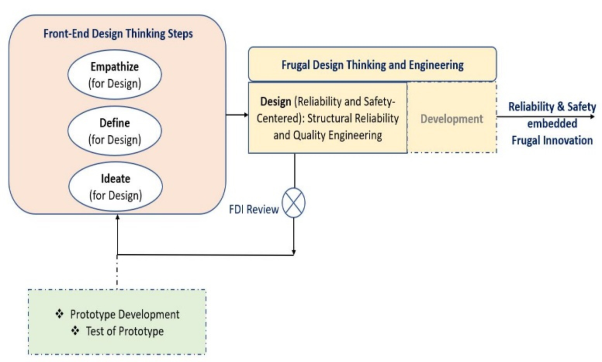
Fig. 1 shows the front-end and frugal engineering schema of the relia- bility and safety-centered design thinking model. The schema outlines the three primary stages of design thinking as follows: Empathise for Design, Define for Design, and Ideate for Design. These stages are linked to Fru- gal Design Thinking and Engineering, which are further divided into two sub-components: ‘Design (centered on reliability and safety); Structural Reli- ability, and Quality Engineering’, and the Development part, which is not part of the present work but it will take for further prototype consideration denoted by the dotted block in the mentioned model (Fig. 1). After achieving the desired result through a positive approach to frugal design thinking and engineering, the product design process provides final reliability and safety embedded frugal innovation for new product development; if the approach taken by the product design process is negative, it proceeds to a review of frugal design innovation (FDI) and then back to the front end of design thinking steps for initial ideation. The author does not consider the proto- type’s creation and testing in this paper, which primarily concentrates on the design stage of the dependability and safety-centered product. Following the product’s final design assessment, it will consider additional steps.
Figure 1: Reliability and safety-centered DT and FE-based schema.
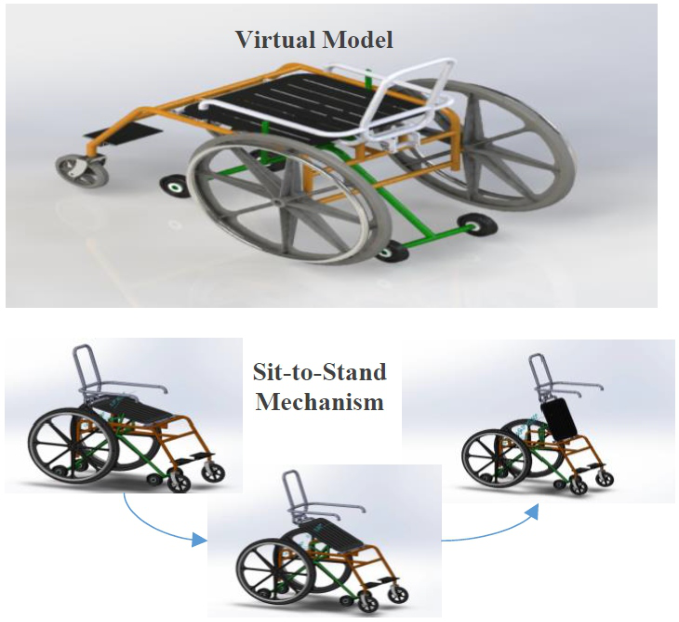
Proposed Design of Sit-to-Stand Wheelchair Design of a sit-to-stand wheelchair, the mechanism to lift the body weight of disabled people from sitting to standing position and standing to sitting
position is depicted in Fig. 2; the wheelchair consists of a lever-shaft with rev- olute joints and lever-shaft, Gear-box with a gas spring arrangement between the seat and chassis of the wheelchair. This study tests the mechanism with three different architectures elaborated in Table (I); in case 1, the standard lever shaft mechanism with a revolute joint between them and checked the lifting effort required to lift the body weight from sitting to standing. In case 2, the gear-box arrangement between the lever and shaft with gear ratios 10:1 to check the lifting effort applied by disabled people independently. In case 3, the two gas springs of 30 kg each have a gear-box arrangement between the lever and shaft with a gear ratio of 10:1 to minimize the effort of lifting the body weight and the comparison between all three cases to get the opti- mum lifting force required for the disabled person to lift their body weight independently through the selected mechanism is elaborated in Table I.
Figure 2: Design of Sit-to-Stand Mechanism.
Design specifications required for the Sit-to-Stand wheelchair are (Shaikh- Mohammed et al., 2021); Total height (sitting) 900 mm, Total height (standing) 1290 mm, seat length 400 mm, seat width 380 mm, armrest 220 mm, front caster wheel diameter 152 mm, rear driving wheel 600 mm, maxi- mum human body weight 120 kg, weight of lifting part of wheelchair 10 kg, total maximum lifting weight 130 kg and wheelchair weight 25 kg.
Reliability and Safety Embedded Design Thinking and Frugal Engineering 75
RESULTS AND DISCUSSION
The idea here is to lift a disabled person sitting in a wheelchair with the help of a lever and shaft mechanism, with minimum effort required as input from the person. The effort level is computed to ensure that its requirements are limited and are not unassisted and high, then the system will lose its reliability [18]. This is why the effort assessment is necessary, and the assessment and computation are presented here.
Maximum Human Weight = 120 kg Weight of the part of the wheelchair to be lifted (seat and backrest) = 10 kg Total weight (W) = 130 kg The idea here is to lift a disabled person sitting in a wheelchair with the help of a lever and shaft mechanism, with minimum effort required as input from the person.
So, the maximum force required to lift the person (F) = W x g = 130 × 9.81 = 1275.3 N The comparison of the final effort force required to lift the body weight at different angle positions in the sit-to-stand wheelchair is depicted in Table I.
Table 1. Final effort force required for lifting the body weight at different angle position.
Table available in the original PDF paper.
Force requirements for Sit-To-Stand Wheelchair (Force in N) Seat angle (
Hence, as seen from the above result, the minimum effort required to lift the body weight from sitting to standing is in case 3, which is 40.54 N (∼40 N). So, finally, the selection would be the lever-shaft mechanism with a gear- box assembly (10:1) and two 300 N gas springs to develop the Sit-to-Stand mechanism of the wheelchair. This optimized effort force increases the relia- bility of the sit-to-stand wheelchair device that is consistently applied over a large period of time without any failure of the components of the wheelchair. It is essential for safety considerations because the standing position is up to 77 degrees. It cannot topple the front due to optimized effort force applied during sit-to-stand operation with a safety belt strap and knee support to balance the weight.
CONCLUSION
The proposed design of the Sit-to-Stand mechanism in the wheelchair, utiliz- ing a lever shaft, ratchet with a gearbox (10:1), and two gas springs (300 N each), substantially reduces the effort to only about 40 N for a person weigh- ing 120 kg. Considering extreme order cases, which is a decent solution. So that if reliability and safety are to be ensured, the strength is well enough to withstand the load and can function without abrupt failure. Furthermore,
based on a modest estimation, this design is cost-efficient, affordable, and nearly 30% less than the available products. In the field of assistive product system engineering, where the objective is to improve the quality of life for people with impairments, combining design thinking and frugal engineering principles with reliability and safety is a revolutionary and exciting strategy. The conceptual model developed in this study provides a solution approach in assistive-product development system engineering, which is expected to be useful for industry and for the research community in the healthcare system development domain.
ACKNOWLEDGMENT
The work has been done using facilities at the Product Analytic and Modelling Lab (PAM Lab) at Rajendra Mishra School of Engineering Entrepreneurship, IIT Kharagpur, India.
REFERENCES
Alam, M. M., & Ben Hamida, E. (2014). Surveying wearable human assistive technology for life and safety critical applications: Standards, challenges and opportunities. Sensors, 14(5), 9153–9209. Churchward, R. (1985). The development of a standing wheelchair. Applied
ergonomics, 16(1), 55–62. Crowe, D., & Feinberg, A. (Eds.). (2017). Design for reliability. CRC press. Dabi´c, M., Obradovi´c, T., Vlaˇci´c, B., Sahasranamam, S., & Paul, J. (2022). Frugal innovations: A multidisciplinary review & agenda for future research. Journal of Business Research, 142, 914–929. Dai, W., Chi, Y., Lu, Z., Wang, M., & Zhao, Y. (2018). Research on reliability
assessment of mechanical equipment based on the performance–feature model. Applied Sciences, 8(9), 1619. Dan, P. K., Tiwari, T., & Basu, P. (2022, November). Fuzzy Front End and Design Thinking Integrated Frugal Innovation Framework for Feature Concept Genera- tion in a Product: Portrayal for a Wheelchair. In Interdisciplinary Conference on Innovation, Design, Entrepreneurship, And Sustainable Systems (pp. 301–316). Cham: Springer International Publishing. Dawar, G., Kejariwal, A., & Kumar, D. (2019). Design of a modular wheelchair
with posture transformation capabilities from sitting to standing. Disability and Rehabilitation: Assistive Technology. Dhillon, B. S. (1999). Design reliability: fundamentals and applications. CRC press. Eti, M. C., Ogaji, S. O. T., & Probert, S. D. (2006). Reducing the cost of preventive maintenance (PM) through adopting a proactive reliability-focused culture. Applied energy, 83(11), 1235–1248. Fabri, M. (2015). Thinking with a New Purpose: Lessons Learned from Teach-
ing Design Thinking Skills to Creative Technology Students. Lecture Notes in Computer Science, 32–43. doi:10.1007/978-3-319-20886-2_4 . Fussell, J. B. (1975). How to hand-calculate system reliability and safety characteristics. IEEE Transactions on Reliability, 24(3), 169–174. Galetto, F. (2005). Reliability analysis in product development. In AMST’05
Advanced Manufacturing Systems and Technology: Proceedings of the Seventh International Conference (pp. 713–724). Springer Vienna. Gartz, R., Goldberg, M., Miles, A., Cooper, R., Pearlman, J., Schmeler, M.,... & Hale, J. (2017). Development of a contextually appropriate, reliable and valid basic Wheelchair Service Provision Test. Disability and Rehabilitation: Assistive Technology, 12(4), 333–340.
Reliability and Safety Embedded Design Thinking and Frugal Engineering 77
Goher, K. M. (2013, August). Modeling and simulation of a reconfigurable wheelchair with a sit-to-stand facility for a disabled child. In 2013 18th Interna- tional Conference on Methods & Models in Automation & Robotics (MMAR) (pp. 430–434). IEEE. Jasso, V., Torres, F. J., Martínez, I., Núñez, D. A., & Hernández, M. (2023, April). Design of a Mechanism to Assist the Standing Up and Sitting Down of a Wheelchair User. In Frontiers in Biomedical Devices (Vol. 86731, p. V001T09A012). American Society of Mechanical Engineers. Kaur, K. (2023). System Reliability, Availability, and Maintainability. Availability,
and Maintainability (September 23, 2023). Kossiakoff, A., Biemer, S. M., Seymour, S. J., & Flanigan, D. A. (2020). Systems engineering principles and practice. John Wiley & Sons. Lardeur, E., Bocquet, J. C., & Auzet, C. (2003). Systems engineering used in products
and manufacturing systems development: Case of automotive industry. Recent Advances in Integrated Design and Manufacturing in Mechanical Engineering, 359–368. Lindquist, N. J., Loudon, P. E., Magis, T. F., Rispin, J. E., Kirby, R. L., & Manns, P.
J. (2010). Reliability of the performance and safety scores of the wheelchair skills test version 4.1 for manual wheelchair users. Archives of physical medicine and rehabilitation, 91(11), 1752–1757. Martin, J. N. (2020). Systems engineering guidebook: A process for developing systems and products. CRC press. Mobin, M., Li, Z., Cheraghi, S. H., & Wu, G. (2019). An approach for design
verification and validation planning and optimization for new product reliability improvement. Reliability Engineering & System Safety, 190, 106518. Neumann, L., & Gassmann, O. (2022). Frugal Innovation: Context, Theory, and Practice. In Oxford Research Encyclopedia of Business and Management. Rösch, N., Tiberius, V., & Kraus, S. (2023). Design thinking for innova-
tion: Context factors, process, and outcomes. European Journal of Innovation Management, 26(7), 160–176. Ryu, D. (2012). Improving reliability and quality for product success. Crc Press. Sage, A. P. (1992). Systems engineering (Vol. 6). John Wiley & Sons. Shaikh-Mohammed, J., Dash, S. S., Sarda, V., & Sujatha, S. (2021). Design journey of an affordable manual standing wheelchair. Disability and Rehabilitation: Assistive Technology, 1–11. Wasson, C. S. (2015). System engineering analysis, design, and development:
Concepts, principles, and practices. John Wiley & Sons. World Health Organization. (2023). Wheelchair provision guidelines. World Health Organization.
LISTED IN THE AHFE DIGITAL BOOKSTORE CATALOGUE
Explore the complete digital volume
Safety Management and Human Factors
Read this individual research paper free through the original publisher, or explore the full digital proceedings book.
ISBN 978-1-964867-27-4
Explore this ISBN in the AHFE Bookstore ↗Listed in the July 2026 bookstore catalogue; search by ISBN to confirm current availability · Digital book purchase optional