Magdalena k. Wyrwicka, Maciej Ciszewski (2024). Assessment of the validity of implementing the Shopfloor Management (SFM) method. Methodology and its application. In: Human Aspects of Advanced Manufacturing, Production Management and Process Control. AHFE Open Access, vol. 146, pp. 60–67. https://doi.org/10.54941/ahfe1005151
Manufacturing companies in the third decade of the 21st century are facing rapid economic changes, pressure to adapt to new technologies, and rising customer expectations. Management boards of organizations see the possibility of maintaining competitiveness through the implementation of Lean Production (LP) tools.The Lean concept is a holistic philosophy of eliminating waste, derived from the principles of the Toyota Production System (TPS), one of the foundations of which is visual management. The seventh of the fourteen management principles of TPS is to "use visual control so that no problem remains hidden." In the context of manufacturing companies, visualization is a communication system that uses visual elements to effectively communicate relevant data both to management at various levels and to employees directly involved in production processes.One of the visualization methods that derives from the principles of Lean Production and supports a culture of continuous improvement is Shopfloor Management (SFM). The main goal of SFM applications is the effective verification and presentation of production results, enabling better cooperation between production units and production supervision, in order to eliminate errors right at the point of their occurrence and improve the efficiency of the process. Thanks to the transparency of results and a clear presentation of goals, SFM can strengthen cooperation and competition among employees. However, much depends on the organizational culture of the company and the attitude of employees towards disclosing the results of their work.According to the literature on the subject, SFM is an effective tool for reorganizing and ordering the production area in a situation of diversity and time pressure created by the market. However, the implementation of the SFM method does not always produce the desired results and is not always accepted by the company's staff. Excess information can lead to disorganization, and then finding important data by an employee leads to a waste of time - which is a classic waste. Moreover, there is a risk of misinterpretation of data and excessive emphasis on analysis rather than on core activities. For SFM to become a useful tool for stimulating continuous improvement, its use should be justified.Based on a review of the literature on the subject, the high effectiveness of the SFM method (supported by post-implementation research and analyzes) and, at the same time, a low number of applications in Polish companies were demonstrated. Research on the implementation of visualization in enterprises is carried out to a relatively small extent and does not always have practical values. The publications do not provide useful guidance on when implementing the SFM method is appropriate. Therefore, an original methodology was developed for assessing the validity of SFM implementations, which was successfully used in a medium-sized manufacturing company.The checklist associated with the methodology enables a numerical assessment of the validity of the implementation and offers valuable output information supporting management decisions in the context of SFM implementation.The study presents both the methodology for assessing the validity of SFM implementation and an example of its application.
Shopfloor Management (SFM) is one of the instruments of Lean Production (LP) tools related to the visualization of production results. LP is a holis- tic philosophy of waste elimination derived from the principles of the Toyota Production System (TPS). According to TPS, the seventh of the fourteen man- agement principles requires ‘to use visual control so that no problem remains hidden’ (Liker, 2005).
Visualization is a set of practices that simplify managing of the produc- tion process by effectively presenting results and quickly detecting anomalies and problems on the production floor (Ingaldi and Klimecka-Tatar, 2015). Visual management plays a key role in streamlining production processes
Assessment of the Validity of Implementing the Shopfloor Management (SFM) Method 61
by improving flow of information and reporting. As a result, both produc- tion employees and management gain improved control over processes and can make more informed decisions (Ciarniene and Vienazindiene, 2015). Visualization is a tool that can improve production efficiency by increas- ing transparency of processes and effective communication in the sphere of production units of various complexity levels (Bullinger, 1999; Kubis, 2005). Indicators and charts serve as informative tools for current production outcomes, enabling employees and management to continuously monitor progress and identify any deviations from established standards (Knopp, 2016). Visualized work outcomes aligned with goals and plans enhance employee engagement and accountability. Furthermore, visualization facili- tates superior internal communication, as it allows employees to convey their insights and feedback clearly (Tezel, Koskela, Tzortzopoulos, 2010), directly fostering more effective team collaboration.
Visual management facilitates the making of rational decisions by provid- ing clear communication that enables quick situational recognition. It also enhances work safety, develops employee competencies, and reduces errors in operations (Kubik, 2010; Kandler, May, Kurtz, Kuhnle, Lanza, 2022; Parry and Turner, 2006). Nevertheless, its implementation can present challenges, including the organization of excess information, temporary disorganization, and the need to change established habits.
Within the LP concept, Shopfloor Management (SFM) is considered a method of effectively visualizing results and shaping appropriate employee attitudes. It is a method of verifying and presenting production results, which contributes to coupling the initiative of direct production units with produc- tion supervision in order to jointly strive to eliminate errors and improve the efficiency of the process (Suzaki, 1993). Thanks to the transparency of results and a clear presentation of goals, SFM can strengthen cooperation and com- petition among employees. According to the literature on the subject, SFM is an effective tool for reorganizing and ordering the production area in a situation of diversity and time pressure created by the market (Imai, 2006; Krishnamurthy, Yauch, 2007, Hertle, Siedelhofer, Metternich, Abele, 2015; Ciszewski and Wyrwicka, 2020).
However, the implementation of the SFM method does not always produce the desired results, and is not always accepted by the company’s staff. Too much information can cause an employee to waste time finding the right data - and this is a classic waste. Moreover, there is a risk of incorrect interpreta- tion of data and focus excessive attention on analysis instead of core activities (Knop, 2016). For SFM to become a useful tool for stimulating continuous improvement, its use should be justified.
Therefore, the goal was to develop a methodology for assessing the validity of SFM implementations in manufacturing enterprises in Poland, dedicated to the metal industry. The choice of the metal sector is justified due to its high contribution to Polish GDP and specific challenges, such as financial and organizational constraints, which may delay adaptation to new management methods, including SFM.
62 Wyrwicka and Ciszewski
METHODOLOGY FOR ASSESSING THE VALIDITY OF IMPLEMENTING THE SFM METHOD Research Procedure
The development of an original methodology for assessing the validity of implementing the SFM method began with preliminary research and con- ducting structured, in-depth interviews with production directors in three production companies in the metal industry. Based on the results of the inter- views, a list of factors influencing the validity of implementing SFM was prepared.
The next stage was to conduct surveys on a representative sample of 300 practitioners associated with the production department (e.g., production workers, managers, foremen, etc.) in various manufacturing companies. The survey results facilitated the identification and refinement of implementa- tion factors. Ultimately, sixteen determinants of SFM implementation validity were identified.
Then, the identified factors underwent network analysis using the Net- work Thinking Methodology of Probst and Gomez (Gomez, Probst, 1987) to determine the mutual interactions between the factors and to identify the factors that can be managed from the point of view of production manager. The result was a set of five key implementation validity factors:
Managerial and foreman competencies,
Production shortages,
Problem source analysis,
Implemented LP tools,
Integration of management IT systems.
The key factors influencing validity became the basis for developing an original methodology called ‘the methodology for assessing the validity of the implementation of the Shopfloor Management method’ for use in medium-sized enterprises. This methodology consists of a validity assessment algorithm and a checklist.
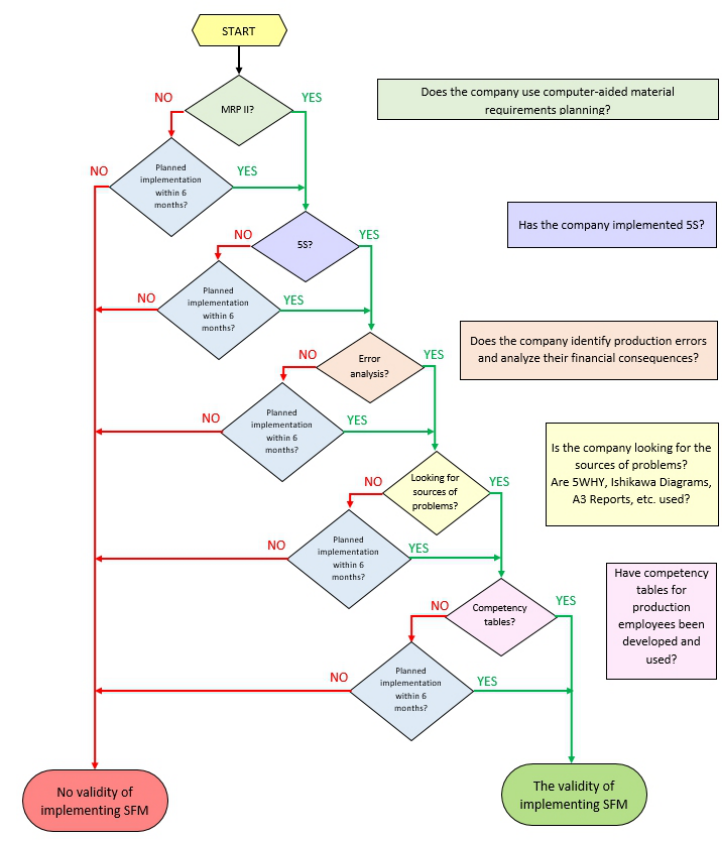
MOZ-SFM Algorithm The algorithm of the methodology for assessing the validity of SFM imple- mentation - MOZ-SFM (Figure 1), allows the decision-maker to determine whether it is justified to start implementing the SFM method in the enterprise.
This part of the methodology steers the user through a five-step process. At each juncture, it inquires if one of the essential states for KC4SFM is achieved, following the provided guidance and instructions.
The use of the MOZ-SFM algorithm will indicate:
The absence of a valid case for implementing SFM (thus concluding the procedure without the necessity of employing the checklist),
Unconditional validation for the implementation (meeting all KC4SFM criteria),
Conditional viability for implementation (should a six-month grace period be required to fulfill the minimum criteria for any KC4SFM).
Assessment of the Validity of Implementing the Shopfloor Management (SFM) Method 63
Figure 1: MOZ-SFM algorithm.
To numerically assess the appropriateness of SFM implementation, one should use the checklist (Figure 2). Point values for individual KC4SFM components were assigned based on conclusions from the survey results.
The checklist can be used in two ways:
complete the appropriate fields on the printed form,
complete the required data in a file opened in a browser on any device - the test result will be provided automatically.
64 Wyrwicka and Ciszewski
Figure 2: Checklist belonging to MOZ-SFM.
Application of the SFM implementation validity assessment methodology, which includes the MOZ-SFM algorithm and checklist, can lead to one of six potential validity states for the SFM method implementation:
Low validity (5-10 points),
Low validity with conditions (5-10 points and required grace period),
Moderate validity (11-16 points),
Moderate validity with conditions (11-16 points and required grace period),
High validity (17-22 points),
High validity with conditions (17-22 points and required grace period ).
Assessment of the Validity of Implementing the Shopfloor Management (SFM) Method 65
PRACTICAL APPLICATION OF THE MOZ-SFM METHODOLOGY Company Profile
To validate the practicality of the MOZ-SFM methodology, inclusive of the algorithm and checklist, its utility was tested on the assessment of SFM implementation within a manufacturing context.
The subject was a medium-sized manufacturer based in Pleszew, Poland, specializing in metal processing and welded structure production for over two decades. The company employed 60 workers, 3 foremen, and 1 man- ager, engaging in activities such as precision laser cutting, metal bending, CNC machining, and boiler welding. The necessity to evaluate SFM’s appli- cability arose from a developmental crisis precipitated by rapid growth from 2018 to 2021, which had led to operational management challenges. Key issues included delays in order execution and identifying deficiencies. Although restructured into three departments - laser cutting, machining, and welding - to streamline operations, the company still faced difficulties with material, semi-product, and information flow coordination. Persistent issues in order execution reporting precipitated overproduction, delays, and significant shortages.
An analysis underscored the requirement for management methods aligned with the Lean Production philosophy, aiming not only to solve coordination problems but also to elevate production manager competencies for adopt- ing modern management techniques and fostering a culture of continuous improvement.
In response, the management sought to adopt the SFM method as a means to synchronize information exchange and probe into production shortfalls. Prior to its full-scale adoption, an evaluation of the method’s validity was deemed essential.
Assessment of the Validity of Implementing the SFM Method Using the MOZ-SFM Algorithm On May 16, 2023, the owner of the company personally conducted an assess- ment to determine the validity of implementing the SFM. The evaluation utilized printed materials featuring the MOZ-SFM algorithm and the asso- ciated checklist. The assessment process comprised the following: reviewing the methodology manual (20 minutes), conducting an interview with the pro- duction manager (20 minutes), examining the quality management system documentation (30 minutes) and going through the MOZ-SFM algorithm’s steps and filling out the checklist (30 minutes).
Applying MOZ-SFM indicated a moderate conditional validity for imple- menting the SFM method. This classification, following the methodology’s guidelines, stemmed from scoring 15 points on the checklist. The ‘con- ditional’ status arose due to the need for the ‘tables of competences of production employees’ to be implemented within a six-month period.
A notable benefit of MOZ-SFM methodology was its user-friendliness and efficient framework, which enabled the decision-maker to establish a moder- ate, conditional implementation validity in only 100 minutes. Users described the methodology as intelligible and straightforward.
66 Wyrwicka and Ciszewski
The practical test of the methodology in an authentic manufacturing environment affirmed its efficacy and applicability, yielding critical data to facilitate decision-making for SFM method implementation.
LIMITATIONS The MOZ-SFM method was developed for the specific needs of enterprises in the metal industry (strong price competition, high dependence on raw material prices, limited financial resources and low production automation). Industry restrictions mean that MOZ-SFM may not be suitable for com- panies operating in industries other than metal due to differences in their functioning.
Universalization of the method would require additional research that could reveal new validity factors (e.g. resulting from the specificity of the industry) or other connections between them.
CONCLUSION
To meet the practical needs of decision-makers in manufacturing companies, this study presents the MOZ-SFM methodology, including both an algo- rithm and a checklist, as a systematic approach to assessing the validity of implementing Shopfloor Management (SFM).
The effectiveness of the MOZ-SFM method has been proven through its application in real operating conditions.
This method is intended for metal industry enterprises, and its wider appli- cation in other sectors of the economy would require additional research.
REFERENCES
Borkowski, S., Knop, K., & Rutkowski, T. (2011). Meaning of Visual Control Types in Production Improvement. Chapter 9, 117–128. Bullinger, H. J. (Ed.). (1999). Effizientes Informationsmanagement in dezentralen
Organisationsstrukturen. Berlin/Heidelberg/New York: Springer. ˇCiarnien˙e, R., & Vienažindien˙e, M. (2015). An empirical study of lean concept manifestation. Procedia-Social and Behavioral Sciences, 207, 225–233. Ciszewski, M., & Wyrwicka, M. K. (2020). Shopfloor management (SFM) as a tool
for improving control of production and visualization of results. LogForum, 16(2). Gomez, P., & Probst, G. J. (1987). Vernetztes Denken im Management: eine Methodik des ganzheitlichen Problemlösens. Schweizerische Volksbank. Hertle, C., Siedelhofer, C., Metternich, J., & Abele, E. (2015). The next gen-
eration shop floor management–how to continuously develop competencies in manufacturing environments. Imai, M. (2006). Gemba kaizen: zdroworozsa˛dkowe, niskokosztowe podej´scie do zarza˛dzania. Wydawnictwo MT Biznes. Ingaldi, M., & Klimecka-Tatar, D. (2015). Analiza elementów domu Toyoty. Zeszyty
Naukowe. Quality. Production. Improvement. Kandler, M., May, M. C., Kurtz, J., Kuhnle, A., & Lanza, G. (2022). Development of a human-centered implementation strategy for industry 4.0 exemplified by digital shopfloor management. In Towards Sustainable Customization: Bridging Smart Products and Manufacturing Systems: Proceedings of the 8th Changeable, Agile, Reconfigurable and Virtual Production Conference (CARV2021) and the 10th
Assessment of the Validity of Implementing the Shopfloor Management (SFM) Method 67
World Mass Customization & Personalization Conference (MCPC2021), Aal- borg, Denmark, October/November 2021 8 (pp. 738–745). Springer International Publishing. Knop, K. (2016). Zarza˛dzanie wizualne jako istotny element w doskonaleniu firmy produkcyjnej. Zeszyty Naukowe. Organizacja i Zarza˛dzanie/Politechnika ´Sla˛ska, (87), 237–250. Kornicki L., Kubik S. (2008). Identyfikacja marnotrawstwa na hali produkcyjnej.
ProdPublishing, Wrocław. Krishnamurthy, R., & Yauch, C. A. (2007). Leagile manufacturing: a proposed corporate infrastructure. International Journal of Operations & Production Man- agement, 27(6), 588–604. Kubis, N. (2005). Narzedzia lean management. Zagadnienia techniczno- ekonomiczne, 50(2-3), 291–303. Liker, J. K. (2005). Droga Toyoty: 14 zasad zarza˛dzania wioda˛cej firmy produkcyjnej
´swiata. Wydawnictwo MT Biznes. Liker, J. K., Kowalczyk, M., & Hoseus, M. (2009). Kultura Toyoty: serce i dusza filozofii Toyoty. Mt Biznes. Parry, G. C., & Turner, C. E. (2006). Application of lean visual process management
tools. Production planning & control, 17(1), 77–86. Suzaki, K. (1993). New shop floor management: empowering people for continuous improvement. Simon and Schuster. Tezel, B. A., Koskela, L. J., & Tzortzopoulos, P. (2010). Visual management in
construction: Study report on Brazilian cases.
LISTED IN THE AHFE DIGITAL BOOKSTORE CATALOGUE
Explore the complete digital volume
Human Aspects of Advanced Manufacturing, Production Management and Process Control
Read this individual research paper free through the original publisher, or explore the full digital proceedings book.
ISBN 978-1-964867-22-9
Explore this ISBN in the AHFE Bookstore ↗Listed in the July 2026 bookstore catalogue; search by ISBN to confirm current availability · Digital book purchase optional