Jun Zhou, Wudi Hong (2024). Brand Gene-Informed Artificial Intelligence Generated Content (AIGC) for the Styling Design of Motorcycle Headlights. In: Interdisciplinary Practice in Industrial Design. AHFE Open Access, vol. 144, pp. 79–89. https://doi.org/10.54941/ahfe1005120
This study aims to utilize Artificial Intelligence Generated Content (AIGC), specifically using the Stable Diffusion model to enhance the headlight design of CFMOTO's SR series motorcycles in China. The study focuses on a design strategy anchored in the brand's genetic makeup, the research delves into the visual and cultural DNA of the SR series, extracting both explicit and implicit brand genes. These insights guide the AI to both continue the brand's lineage and diversify the product design.The effectiveness of AI-generated design samples is evaluated using the entropy weight TOPSIS method. Empirical results suggest that AIGC, when guided by brand genes, more accurately captures and extends the brand's core design and values, providing new creative perspectives for motorcycle headlight design.
With the continuous advancement of Artificial Intelligence Generated Con- tent (AIGC) technology, its application in the field of industrial design is set to expand further. This is especially true in the niche market of motorcycle head- light design, which balances functionality with aesthetics, the introduction of AIGC is becoming an innovative trend. The design of motorcycle head- lights not only reflects the brand’s design philosophy and style, but specific designs have become synonymous with the brand, distinguishing motorcycle brands in the market. Well-designed headlight designs reinforce the emo- tional bond between consumers and brands and trigger purchasing impulses, making headlight design crucial in brand image and value communication.
This paper focuses on extracting deep motorcycle brand genes to guide and transform AIGC tools. This enables AI to more accurately capture and per- petuate the brand’s core design concepts and values. It simultaneously drives innovation in motorcycle headlight design, meeting the growing consumer expectations for personalization and functionality.
BRAND GENE THEORY AND ITS APPLICATION Brand genes represent the core elements forming a brand’s unique iden- tity and value proposition, serving as the DNA that embodies the brand’s inception, growth, and continuous development. These genes are not only an internal manifestation of personality, values, stories, and history but also convey core messages and characteristics to consumers.
Researchers have applied brand gene theory to various segments within the transportation industry. For instance, Hu Wei-feng and colleagues classi- fied automotive brand genes into explicit and implicit attributes, conducting a case study on Hongqi cars to validate the mechanism of brand gene genera- tion. Dong-Ming proposed a twin-hull yacht design method based on brand genes.
The existing research provides valuable insights for this study, although research on motorcycle brand genes is still scarce. With the trend of using AIGC tools in various industries, guiding these tools with brand genes to create stable, brand-value-aligned designs is crucial and presents both opportunities and challenges for the motorcycle industry.
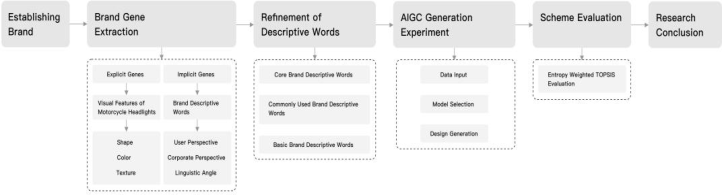
AI DESIGN STRATEGY BASED ON BRAND GENES This study focuses on analyzing and extracting brand genes for the headlight design of CFMOTO’s SR series, refining brand descriptive words through statistical methods for input into AIGC tools. After multiple iterations, the final design samples are evaluated using the entropy weight TOPSIS method. Based on the data, conclusions are drawn, with practical suggestions and future research directions proposed for the field.
Figure 1: AI design strategy based on brand genes: A case study of motorcycle headlight design.
MOTORCYCLE HEADLIGHT BRAND GENE EXTRACTION This research focuses on the headlight design of CFMOTO’s popular models, 250SR and 450SR, a leading enterprise in China. CFMOTO, with its differ- entiated development strategy and designs catering to young consumers, has made the 250SR and 450SR models leaders in the large-displacement motor- cycle market in China, also achieving significant sales growth internationally.
In March 2020, CFMOTO launched the 250SR, the first domestic sports replica motorcycle, which became a market leader for two consecutive years
due to its high cost-performance ratio and attractive design. The 2022 launch of the 450SR, catering to beginners transitioning to more advanced mod- els, showed stable monthly delivery growth and high social media attention, proving its market appeal.
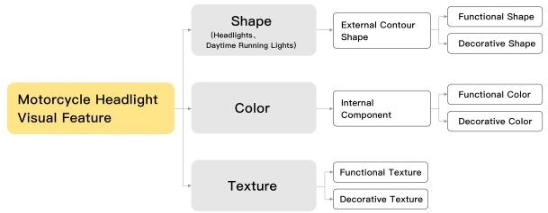
(1) Extraction of Explicit Genes - Motorcycle Headlight Visual Feature Explicit brand gene carriers mainly include physical product elements per- ceptible to the human sensory system, such as shape, color, pattern, material, and texture. Researchers like Li Wen-Jia and Zhao Jiang-Hong have devel- oped a visual feature framework for car headlights, including shape, color, and texture. Given the uniqueness of motorcycle headlights, this framework is adapted to optimize motorcycle headlight design, focusing on the main headlight and daytime running lights, as shown in Figure 2.
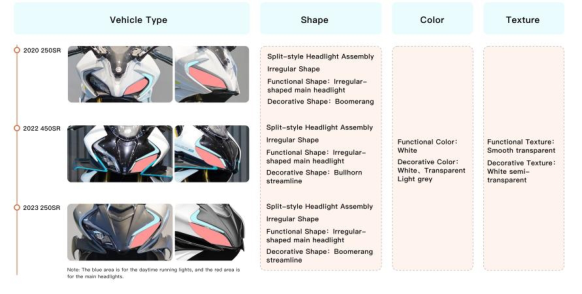
Analyze the visual features of the headlights of CFMOTO’s 250SR and 450SR models from three aspects: shape, color, and texture, as shown in Figure 3.
Figure 2: Motorcycle headlight visual feature framework (adapted from Li Wen-Jia et al., 2015).Figure 3: Analysis of visual features of the SR series headlights.
Shape: The headlight design of motorcycles primarily consists of a combi- nation of main headlights and daytime running lights. CFMOTO’s SR series features a split-style headlight design, with symmetrical shapes on both the left and right sides. The primary shape of the function-focused main head- light is irregular, while the decorative daytime running lights are primarily
82 Zhou and Hong
based on a “Boomerang” shape, evolving into “bullhorn streamlined” and “Boomerang streamlined” designs.
Color: Color in vehicles like cars and motorcycles is an external form exhibited for driving safety, information transmission, and styling, which refers to the color of the vehicle lights. In the SR series, the main headlights, which are function-focused, are primarily white, while the decorative day- time running lights are also white LEDs, using transparent, white, and light gray covers.
Texture: The texture elements of motorcycle headlights include functional and decorative textures. The functional texture of the headlight aims to optimize light performance through the layout and sequencing of the light assembly, while the surface treatment of the headlight cover contributes to the decorative texture. The SR series models primarily feature smooth transparent and white semi-transparent textures for the headlight covers.
(2) Extraction of Implicit Genes Implicit brand genes, which are not intuitively perceptible by the visual system, can be described and expressed through language or behavior, encapsulating core corporate values and cultural concepts. For CFMOTO motorcycles, user interviews and questionnaires were combined to collect user needs and brand semantics from SR users, potential riders, and mar- keters. Additionally, brand semantic keywords were organized from the company’s website, advertisements, and various SR model review videos and articles, with core and significant brand keywords identified through frequency analysis.
Table 1. Frequency analysis of brand keywords.
Table available in the original PDF paper.
Descriptors Frequency Percent(%) Streamlined 13 17.1% Boomerang 16 21.05% Flowing headlights 2 2.63% Muscular feel 11 14.47% Fishhook-like 1 1.31% Sense of motion 19 25.00% Future tech feel 2 3.94% Sense of power 12 15.78% Youthful and fashionable 2 2.63% Snake head 1 1.31% Combat feel 8 10.52% Sharpness 6 7.89% Competitive posture 4 5.26% Innovative design 2 2.63%
As shown in Table 1, frequency analysis reveals that the core brand key- words for the headlight design of CFMOTO’s SR series include streamlined, boomerang, muscular feel, sense of motion, sense of power, and combat feel. Significant brand keywords include sharpness, competitive posture, flowing headlights, future tech feel, youthful fashion, and innovative design.
During the interview and survey process, the headlights of the SR series models were desaturated to eliminate the influence of paint and color on user preference, allowing users to choose their favored headlight design. The outcome revealed that users highly rated the 450SR model, particularly appreciating its headlight design. This preference indicates that the 450SR model represents a successful design upgrade for CFMOTO. Future AIGC experiments will delve deeper, using the 450SR’s design as a foundational reference.
AIGC CREATIVE GENERATION Stable Diffusion (SD), a deep learning model based on Variational Autoen- coders (VAE) and Generative Adversarial Networks (GAN), is adept at generating high-quality images through training on extensive datasets. Com- pared to other AIGC tools, SD is more stable and controllable, with a diverse, open-source model selection that quickly generates numerous design options. For the CFMOTO SR series headlight design.
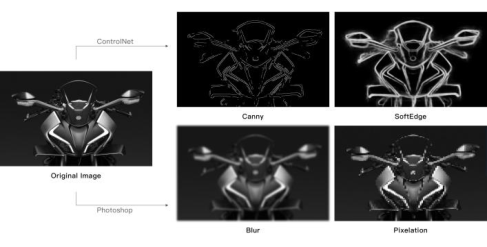
The initial phase of the study involved extracting both explicit and implicit brand genes of the CFMOTO SR series headlights, integrating explicit visual features, core brand keywords, and significant brand keywords into SD’s positive prompts. These include: “Motorcycle headlight design, biomimetic lights, boomerang feature, streamlined shape, futuristic appeal, transparent casing, high light transmittance, embedded full-spectrum RGB LED strips offering variable color effects; dynamic daytime running lights, flowing light patterns, muscular feel, sense of motion, power, combat, sharpness, futur- istic tech feel, youthful fashion, and innovative design.” Keywords placed earlier in the input sequence are more easily recognized by the model, with core brand keywords weighted between 1.0 to 1.5 to enhance brand fea- ture recognition. Conversely, weighting keywords between 0.5 to 0.9 reduces their impact. Negative prompts, sourced from Bilibili creators “秋叶aaaki” and “Nenly同学,” include “low resolution, monochrome, grayscale, poor anatomical structure, text, errors, superfluous numbers, cropping, poor qual- ity, low quality, standard quality, jpeg artifacts, signatures, watermarks, usernames, blurring,” aiming to eliminate low-quality learning samples for optimal AI output. Further-more, image prompts involved processing 450SR headlight images with the ControlNet plugin for Candy and Soft line drawing treatments. To prevent ControlNet from limiting AI creativity and producing designs too similar to the original, images were further blurred and pixelated in Photoshop, as shown in Figure 4.
To achieve the research objective of creating realistic effect images, the study opts for the realistic large model “Deliberate” and builds upon the “Anything V5” model with an overlay of a personal training model in a realistic style. The generation experiments are primarily conducted using the large model “Deliberate” or a combination of the large model with a realistic motorcycle style using the Lora model “Cyberhelmet”.
During the generation process, high-quality images aligned with the intended direction are selected over multiple iterations. These images are then preprocessed using ControlNet’s Canny or SoftEdge techniques, followed by
84 Zhou and Hong
adjustments in keyword weights and parameters to generate more innova- tive design proposals. This approach enables AI to continuously maintain the product’s brand DNA while iteratively innovating new solutions.
Figure 4: Stable diffusion - controlnet and photoshop image processing.
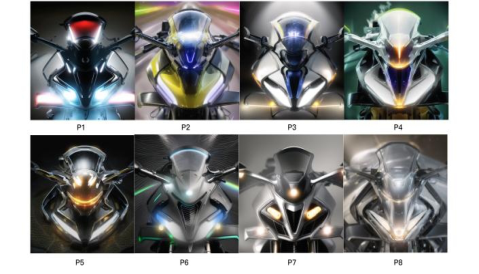
After several rounds of AI sample generation and iteration, low-quality images that do not meet the desired effect are excluded. Ultimately, eight dif- ferent design proposals are produced and numbered (P1, P2, etc.), as shown in Figure 5. This approach ensures a systematic and efficient generation of design alternatives, aligning closely with the brand’s identity and market expectations.
Figure 5: AI design samples.
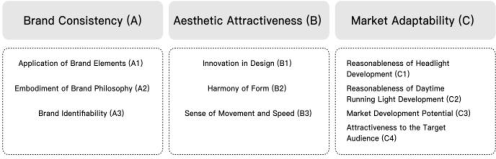
CONSTRUCTING AN EVALUATION INDEX SYSTEM The primary objective of this study is to use the entropy weight TOPSIS method to evaluate the design samples of CFMOTO’s SR series motorcycle headlights generated by SD. The evaluation focuses on three core dimen- sions: brand consistency, aesthetic appeal, and market adaptability. A 1–5 matrix scale is established for each indicator to assess user satisfaction with the design samples, as illustrated in Figure 6.
Motorcycle modification practitioners, mechanical engineers, profes- sional designers, users of CFMOTO’s SR models, and potential motorcycle enthusiasts—a total of 36 individuals (21 males and 15 females, with an average age of 27.69)—were invited to evaluate the eight AI design sam- ples. The evaluation information regarding the indicators is as follows in the subsequent Table 2.
ENTROPY WEIGHT TOPSIS EVALUATION The entropy weight TOPSIS method combines entropy weighting and TOP- SIS for ranking alternatives based on different criteria. It uses entropy to objectively weigh criteria, reducing subjective bias, and ranks alternatives by their distance from an ideal solution, considering both optimal and worst-case scenarios.
(1) The steps of the traditional entropy weight method are as follows: Data Standardization: Normalize the data for each indicator to obtain standardized values Y =
yij
m×n.
yij = xij −min {xi} max {xi} −min {xi} (1) Calculate the weight pij of the i evaluation object under the j criterion.
Equations and mathematical formulas are available in the original paper PDF.
86 Zhou and Hong
Compute the entropy value for the j criterion.
m X
Where, if pij = 0, then pij ln pij = 0. Compute the coefficient of variation for the j criterion.
Compute the objective weight for the j criterion.
(2) The traditional TOPSIS method steps are as follows: For a given category of decision-making problem, the decision matrix is defined as:
[Equation or mathematical symbol available in the original paper PDF]
Equations and mathematical formulas are available in the original paper PDF.
In this context, m represents the number of evaluation objects, and n signifies the number of evaluation criteria.
Normalization of the decision matrix: First, the decision matrix F is normalized, and the normalization processing is as follows:
Here, Zij denotes the value of the j criterion for the i evaluation object after undergoing normalization, After the normalization process, the decision matrix is transformed into a normalized matrix denoted as Z =
zij
m×n. Constructing a Normalized Weighted Decision Matrix involves utilizing the normalized matrix Z and the weight matrix for each criterion to create a weighted decision matrix Z′ =
z′ij
In this context, wj represents the weight of the j criterion. Constructing Positive and Negative Ideal Solutions involves using the maximum-minimum principle to determine the positive ideal solution Z+ and the negative ideal solution Z−for the decision problem. For the positive
index, the choice of positive and negative ideal solutions is as follows:
max
1 , z+ 2 , · · · , z+ n
i z′ij
min
1 , z− 2 , · · · , z− n
i z′ij
i and d−
i for each alternative to the positive and negative ideal solutions, respectively. The distance formula uses the following Euclidean distance:
2
n X
d+
(10)
z′ij −z+
2
n X
d−
(11)
z′ij −z−
Calculate the Relative Closeness to the Ideal Solution: Determine the rel- ative closeness Ci of each alternative to the ideal solution based on their positive and negative ideal distances.
(12)
i d−
i + d+ i
EMPIRICAL RESULTS The results pertaining to the indices’ information entropy, coefficient of vari- ation, and weights are displayed in Table 3. The TOPSIS values for each alternative, calculated through the TOPSIS method, are presented in Table 4.
From the ranking results, it can be observed that the TOPSIS value of P1 is the highest at 0.6011, followed by P6 at 0.5573, and then P8 and P4 in sequence. The lowest performance is observed in P7 at 0.1193. This indicates that P1 exhibits superior overall performance across various evalu- ation criteria, aligning more closely with the ideal solution in terms of brand consistency, aesthetic appeal, and market adaptability, followed by P6 and P8.
The assessment using the entropy weight TOPSIS method provides a sci- entific basis for decision-making in the design of CFMOTO’s SR series motorcycle headlights. It aids decision-makers in understanding the strengths and characteristics of each design sample and offers the design team reference points for improving existing designs or developing new ones.
CONCLUSION
This research not only reveals the vast potential of AI-generated content (AIGC) in the field of motorcycle headlight design, enabling rapid iteration and exploration of design diversity, but also provides new perspectives for the future styling of the CFMOTO SR series. The study contemplates the impli- cations of AIGC tools within the broader context of motorcycle aesthetics, brand shaping, and market trends. Under this framework, AI can more accu- rately capture and extend the core design and value proposition of the brand. Utilizing AI in design assistance leads to a more dynamic and responsive design process, aligning with the evolving consumer preferences and tech- nological advancements, offering practical cases and methods for designers and engineers. The findings enrich the academic discourse on the combina- tion of brand genes with AIGC application, presenting a forward-looking training method for AIGC tools in enhancing brand design, and providing a theoretical foundation and practical cases for future research in related fields.
REFERENCES
Cheng Wan-Han. Method Products Based on AHP-Entropy Weight TOPSIS Research Design of Hotel Room Disinfection[D]. Hubei University of Technology, 2021. Hu Wei-Feng, Chen Li, Liu Su. et al. Extraction and Visualization of Automobile
Brand Modeling Gene[J]. Machine Design and Research, 2011, 27(2): 65–68. Hu Wei-Feng, Hu Yue, Wang Dong-Dong. Research Status and Progress of the Product Brand Gene[J]. Packing Engineering, 2021, 42(16): 61–71. Karjalainen, TM (Karjalainen, Toni-Matti). It Looks Like a Toyota: Educa- tional.Approaches to Designing for Visual Brand Recognition. International Journal Of Design, 1(1), 67–81.
Keuzbauer, R., & Malter, A. J. (2005). Embodied cognition and new product design: Changing product form to influence brand categorization. The Journal of Product Innovation Management, 22(2), 165–176. Li Wen-Jia, Zhao Jiang-Hong, et al. Research on visual feature and modeling design
of vehicle headlamp[J]. Machine Design, 2015, 32(5): 122–125. Ma Dong-Ming, Wang Ying-Ying, Qian Hao. Catamaran Yacht Based on Brand Gene Design Modelling Study[J]. Design, 2023, 36(01): 62–65. Manavis, A., Kakoulis, K., & Kyratsis, P. (2023). A brief review of computational
product design: A brand identity approach. Machines, 11(2), 232. Mc Cormack JP, Cagan J., Speaking the Buick language: Capturing understanding and exploring brand identity with shape grammars, Design Studies, 2004.1, pp. 1–29. Zhan Du-Ying. Construction of Characteristic Town ubder Brand Effect[D]. Hangzhou: Zhenjiang University of Technology, 2016. Zhang Lin-Hao. Method of Continuation and Renewal of Product Image Based on
Read this individual research paper free through the original publisher, or explore the full digital proceedings book.
ISBN 978-1-964867-20-5
Explore this ISBN in the AHFE Bookstore ↗Listed in the July 2026 bookstore catalogue; search by ISBN to confirm current availability · Digital book purchase optional