Matthia Leyendecker, Christian Zagel (2024). Concept and prototypic implementation of a tangible user interface for psychosocial interventions in the context of dementia. In: The Human Side of Service Engineering. AHFE Open Access, vol. 143, pp. 167–177. https://doi.org/10.54941/ahfe1005095
Demographic developments are not only increasing the proportion of older people in society, but also the number of people with physical and/or mental impairments becoming dependent on support, for example in nursing homes. Dementia is one of the most common and consequential psychiatric diseases among elderly. The progressive decline in cognitive and motor skills significantly impairs the quality of life of dementia patients. This also poses a great challenge for caregivers, especially in terms of communication and social interaction. Within the framework of psychosocial interventions, they try to maintain the cognitive performance and improve the emotional well-being of those affected. Music and reminiscence therapy have proven to be effective approaches in this context. While digital media are hardly used in practice so far, research already shows approaches how corresponding therapies can be supported by their use. This paper shows how tangible user interfaces (TUI) can be designed and used not only to support care work, but also to promote active participation and self-determined use by dementia patients. A first prototype is presented and shows the potentials of use and for future research.
As a result of demographic change, the proportion of older people in Ger- many is constantly increasing (Flor, 2019; Statistisches Bundesamt, 2023). As the number of older people grows, so does the number of the disabled and sick. Aging is the greatest risk factor for the occurrence of various diseases associated with physical, cognitive and/or psychological impair- ments, as well as for multimorbidity (Böhm et al., 2009; van den Bussche et al., 2011). This risk is significantly higher in people over the age of 80 (Böhm et al., 2009; Kuhlmey, 2008; Wurm et al., 2010). One of the most common and most consequential psychiatric illnesses in older age is demen- tia (Weyerer & Bickel, 2007). 65 percent of dementia cases are a result of Alzheimer’s disease (Bundesministerium für Gesundheit, 2021; Kurz et al.,
2019; Weyerer & Bickel, 2007) which in 2019 was the seventh most common cause of death worldwide (Gauthier et al., 2021).
The so-called dementia syndrome is characterized by a variety of different symptoms, including significant impairments in memory, language, com- prehension, orientation and judgment (World Health Organization, 1992). Cognitive, motor, emotional and social skills are strongly influenced, so that people with dementia (PwD) are confronted with challenges in various areas of daily life that negatively affect their overall well-being and quality of life. This goes hand in hand with increasing dependence on others (Andersen et al., 2004; Cipriani et al., 2020). As a result of these developments, the pressure on the healthcare system is growing as well. As people are getting older, the number of those in need of support to cope with their everyday lives increases as well. Since 2000, the number of people in need of care has more than dou- bled and rose to almost five million in 2021 (Statistisches Bundesamt, 2022). Consequently, the need for nursing and caregiver staff is rising, although there is already a shortage of skilled workers (Robert Koch-Institut, 2015; Ziegert et al., 2023). Up to 80 percent of PwD enter a long-term care facility over the course of their illness (Weyerer & Bickel, 2007) The physical and social care of PwD is particularly stressful. The cogni- tive and motor skills of those affected vary depending on the stage of the illness and their daily form (Deutsche Gesellschaft für Psychiatrie und Psy- chotherapie, Psychosomatik und Nervenheilkunde und Deutsche Gesellschaft für Neurologie, 2017; Kurz et al., 2019). In the context of caring for PwD in nursing homes, so-called psychosocial interventions aim to train the remain- ing abilities and improve the mental well-being of the residents (Kurz et al., 2019). Reminiscence therapy, also known as memory therapy, and music therapy have proven to be particularly effective. In reminiscence therapy, per- sonal memories of past times are awakened through conversations, pictures or objects, thus activating cognitive performance. Music therapy involves singing or making music, moving to music, or simply listening to music. Compared to other forms of therapy, these two particularly strengthen the emotional well-being of those affected, promote social interaction and can alleviate behavioural symptoms. Reminiscence therapy in particular is said to lead to a statistically significant increase in independence and communica- tion skills. More specifically, the opportunity to build relationships, engage in social interaction and actively participate is crucial for strengthening the well-being and general quality of life of PwD (Beerens et al., 2018; Cacioppo et al., 2006; Theurer et al., 2015). However, due to the dynamic and fluc- tuating clinical picture and individual life histories, social interaction and communication with those affected pose a major challenge for caregivers.
Over the last few decades, research and practice have already dealt with the use of so-called Assistive Technologies (AT), which are intended to pro- vide support for the care of PwD. AT include any devices or systems that help maintain or improve a person’s ability to perform everyday activities (Alzheimer’s Society, n.d.). However, the majority of AT focuses on the impairments of PwD, using systems to ensure their safety (e.g. monitor- ing systems for fall detection or location tracking) or to aid memory, e.g. reminder apps for medication (Evans et al., 2015; Orpwood et al., 2010;
Concept and Prototypic Implementation of a Tangible User Interface 169
Topo, 2009). It is only in recent years that there was a focus shift to person- centred approaches with the aim of enhancing remaining abilities of PwD (Lazar et al., 2014; Lazar et al., 2018; Morrissey et al., 2017) and supporting caregivers within the context of psychosocial interventions (Pappadà et al., 2021; Schall et al., 2022). According to the Eighth Age Report of the Federal Ministry for Family Affairs, Senior Citizens, Women and Youth in Germany (Bundesministerium für Familie, Senioren, Frauen und Jugend, 2020), digital technologies are considered to have considerable potential to support various levels of care and especially social care for PwD. The aim is to help them gain a sense of self-determination and success and to take a more active role in communication and interaction (Newell et al., 2002; Outi & Päivi, 2009). In the context of AT, Lazar et al. (2018) emphasize the importance of making a system as accessible and usable as possible for PwD to strengthen their sense of competence by enabling them to use and to control it independently. Even if it is a matter of interactions, no matter how small, the opportunity for PwD to actively participate is the decisive factor (ebd.).
In terms of an easy and natural way of interacting with digital media, Tangible User Interfaces (TUI) have emerged. TUI, also called “graspable” UI (Fitzmaurice et al., 1995; Ishii & Ullmer, 1997), are user interfaces that allow interaction with digital content through physical objects. The objects thus function as physical representations of digital data. By connecting the physical and the digital world, interaction with technologies should be made easier, as interface elements become more direct and manipulable through the use of physical artifacts (ebd.). By doing so, TUI can be used to make concepts accessible in a practical way that would normally be beyond the user’s capabilities, as the physical interaction reduces the cognitive load of the interaction (Klemmer et al., 2006; Shaer & Hornecker, 2009). Due to their advantages as well as their ability to ‘disguise’ the technology, the con- cept of Tangible Interaction is often applied in sectors where users do not match the stereotypical, tech-savvy profile, e.g. children or people impaired in their cognitive or motor skills (Galiev et al., 2017; Klemmer et al., 2006; Shaer & Hornecker, 2009; Ullmer & Ishii, 2000). In the context of dementia, especially in psychosocial interventions, there are so far only comparatively few approaches to using TUI (Bong et al., 2018; Zhou et al., 2022). However, existing concepts already indicate that TUI offer a promising opportunity for PwD to interact with digital media.
This paper aims to build on these findings and presents a TUI-based pro- totype of a system for care work with PwD in nursing homes. The TUI is intended to support caregivers in carrying out psychosocial interventions and to enable PwD to actively participate and experience small successes and positive emotions through self-determined use.
PROTOTYPE DESIGN: TUI-BASED SYSTEM FOR DEMENTIA CARE An in-depth literature review on dementia, psychosocial interventions and the use of technology in the context of dementia revealed a list of require- ments that seem to be important when designing a system for memory and music-related activities for care work and especially for PwD as active users.
170 Leyendecker and Zagel
Crucial aspects were identified when conducting contextual inquiries in nurs- ing homes while talking to caregivers and observing PwD. When mapping the requirements found in related work against those identified within the empir- ical context of use analysis, a broad consensus was found. The following features and requirements are found to be of particular importance: flexibil- ity and adaptability, robustness, a large selection of media, and the presence of haptic components. Furthermore, a quick and location-independent use and suitability for both, group and individual interventions, were also key requirements on the part of the caregivers.
In addition to identifying the general requirements, the main challenge when designing the system was to determine how it could be technically implemented as a TUI considering the suitability for PwD. It should offer interaction with digital content via tangible objects, without the technology being perceptible. There is a variety of ways in which such a system can be implemented, e.g. using image recognition or wireless sensor and communica- tion technologies. The use of (depth) cameras and projectors which can track the position and orientation of objects using visual markers on a mostly hori- zontal surface is widespread (Follmer et al., 2013; Kaltenbrunner & Bencina, 2007; Ullmer & Ishii, 1997; Weiss et al., 2009; Wilson, 2007). Tracking objects using capacitive sensors on touchable surfaces or (electro)magnetic sensors are also possible techniques (Jansen et al., 2012; Liang et al., 2013; Paradiso et al., 2001). The individual technical realization usually depends on the respective task: which information of a physical object should be recorded and what should be controlled with it. For example, the presence of objects, their identity, their position, their exact orientation in space, their movement (discrete/continuous), the interrelation of objects and events on the object might be recorded (Ullmer & Ishii, 2000; Ullmer, 2002).
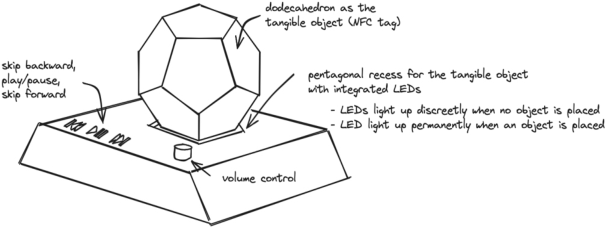
In order to realize a location-independent system with maximum flex- ibility and robustness a simple and cost-effective type of interaction was implemented using NFC Tags that can be hidden in physical objects (Hornecker, 2004; Riekki et al., 2012; Takama et al., 2015). The tags act as a simple trigger without the need of position-, orientation-, movement- or relation-tracking. The result is a tangible, NFC-enabled object that serves as an input device by tracking its presence and identity. Hence, each object can act as a trigger for a specific digital action using its unique ID. Assigning media to IDs enables the linked medium to be activated depending on the respective tag. This makes it easy to monitor and control media and enables quick and easy access. The following concept was considered: The system continuously searches for NFC tags and lights up in blue colour. If a user places a TO on top of the system, it checks whether the tag ID is known. If so, the corresponding media is played, and the system lights up in white colour. The content is presented on a display and/or via speakers, depend- ing on whether it is audio, visual or audio-visual content. Buttons for media control (play/pause, skip forward, skip backward) offer caregivers the pos- sibility to control the selection and display duration of the media as well as the flow of conversation. To stop playback completely, the TO simply has to be removed from the system and the system switches to idle mode. Light
Concept and Prototypic Implementation of a Tangible User Interface 171
and colours help to attract the attention of PwD and visually support interac- tion (Ly et al., 2015). The possibility to link different media types to one TO helps to flexibly respond to the different interests and needs of the residents. By assigning certain tags to certain people, it is possible to realize individ- ual media collections. Hence, content can be adapted to different users to meet their individual needs and biographies. The possibility to change, add or delete content any time addresses a primary challenge of dementia syndrome: interests, memory, and cognitive abilities of PwD are constantly changing as the disease progresses. This is realized using a media-platform to access the digital content.
Even if it is advisable to test low-fidelity prototypes with the target group early on in the design process, they are not suitable in every context and/or for every design goal (Nielsen, 2003; Pernice, 2016). They require a high level of imagination and abstraction on the part of the test subjects, especially when it comes to novel products or systems. However, this ability is severely limited in PwD. Therefore, high-fidelity prototypes are the better choice to realistically depict interactions with the system and thus minimize the cog- nitive load on the subjects. This process has also proven successful in prior research (Uhlig et al., 2018). Therefore, a realistic, yet fast and cost-effective prototype implementation was realized.
A Raspberry Pi 3 model B acts as the basic platform. A MFRC522 mod- ule acts as the NFC reader, which communicates via SPI (Serial Peripheral Interface) at a frequency of 13.56 MHz. Thin NFC stickers which are used to identify the object using their individual ID were chosen for inconspicu- ous attachment to the physical object. A Neopixel RGB LED ring WS2812B 12-bit realizes the lighting effects. Two 3W speakers connected to an audio amplifier with a potentiometer for volume control were integrated for the audio output. An interference suppression filter is used to reduce noise. This in turn is connected to an external USB sound card communicating with the Raspberry Pi via USB. TTP223 touch sensors have been integrated to con- trol media playback. To enable visual content the system is connected to a screen via an HDMI cable. For the prototype implementation, an external 15.6-inch display was connected. Ultimately, the system requires a power supply. A power bank with a nominal capacity of 20.000 mAh powers both the Raspberry Pi and the audio amplifiers.
Figure 1: Conceptual design of the system.
172 Leyendecker and Zagel
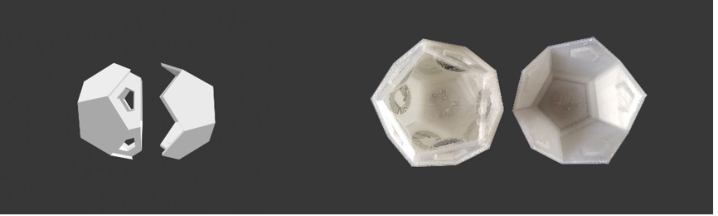
During the observations in the nursing homes, it was noticeable that care- givers used a soft tennis ball for initial activation of the residents, evokoing positive emotions when being held. This resulted in the insight, that the TO should not only be used for a direct interaction with the system, but also for social interaction by passing it forth and back between the residents. To ensure a stable position on the system this object was realized using poly- hedrons (geometric bodies consisting of many flat surfaces). A polyhedron that resembles the shape of a ball is a dodecahedron. As a platonic solid, a dodecahedron is characterized by the greatest possible symmetry in the form of polygons that are both equilateral and equiangular. In addition, all faces are congruent and have the same angle. In total, a dodecahedron has twelve identical faces, each of which represents an equilateral pentagon. These find- ings in mind, the TO as well as the case for the microcontroller system were designed and 3D printed. The design and size of the main system was cho- sen to resemble a small radio (see Figure 1). The TO on the other hand was chosen to be as big as an average human hand in order to provide an easy and pleasant grip. The model of the TO was created in two halves making it easier to print and offering the possibility to invisibly place the NFC tags on the inner surface (see Figure 2).
Figure 2: Tangible object: NFC-enabled dodecahedron (CAD model and printed object).
The recess on the surface of the system serves as an affordance and signifier to make clear that each side of the dodecahedron fits in the pentagonal recess and is thus intended to facilitate interaction (Norman, 2016). Thoolen et al. (2020) also identified a recess as an indication of placement which is ben- eficial in terms of mental understanding and the physical ability of PwD to interact with the system. The LEDs serve as an additional signifier by drawing attention to the recess.
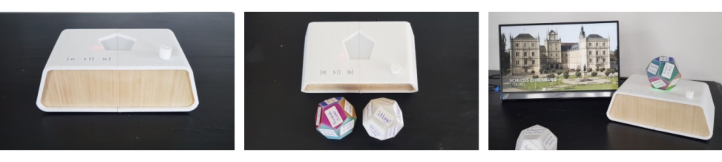
An advantage of the dodecadic shape is the option to integrate multiple tags at once. Opposing sides of the TO should be linked to the same media and labelled identically to avoid incorrect use of the system. This results in six different media per dodecahedron. A reduced media variety also makes sense regarding self-determined use by PWD as a too large variety of media might overwhelm PwD, especially in later stages of the disease. Figure 3 shows the final prototype of the system.
Concept and Prototypic Implementation of a Tangible User Interface 173
Figure 3: Physical prototype of the interactive system.
CONCLUSION
Literature review has emphasized the importance of psychosocial interven- tions, especially of reminiscence and music therapy, as an integral part of dementia care in nursing homes. The contextual inquiries conducted in differ- ent care facilities as well as the observational participation in a psychosocial intervention showed that practice does not clearly distinct between memory- and music-related activities. Instead, caregivers focus on the general cogni- tive stimulation and activation of PwD. The main challenge of care work is to individually and spontaneously react to different situations in dependence of the respective stage of dementia. Past research shows initial approaches on how digital technology can be used in care work. However, researchers primarily focus on caregivers as the active user group while PwD are often pushed into a passive role. Related work addressing the use of TUI in the dementia context addresses this by focusing more on PwD and promoting their active participation and self-determination. A literature analysis identi- fied functional and design-related properties which are able to influence the suitability of a system for music and memory-related care work as well as self-determined use by PwD. A simple, easy-to-understand operation as well as a large selection of media along with adaptability and flexibility (regard- ing different interests, abilities, purposes and locations) could be revealed as the most important criteria. Likewise, related work has shown that a nostal- gic or familiar design, haptic elements and light can increase PwDs interest. Based on the insights gained by the empirical research methods as well as the literature analysis, a prototype was designed and implemented. A field evaluation within three nursing homes showed that the concept in general and the implemented system have great potential to both support caregivers within psychosocial interventions as well as to promote the active participa- tion of PwD. Nevertheless, it is to be expected that the benefit of the system heavily depends on how much freedom caregivers give the residents for self- determined interaction. The success of the system therefore might not only depend on its design and functions, but rather on its adequate integration into care work.
As the aim of person-centred care is to tailor it as closely as possible to the interests and preferences of the residents, future research should investigate how the usage behaviour of the system can be tracked and analysed. Artificial intelligence could be used to analyse behavioural patterns and media data to automatically create profiles for each resident. This could lead to lasting relief for nursing staff and thus support and strengthen the health care system through technology despite the shortage of skilled workers.
174 Leyendecker and Zagel
REFERENCES
Alzheimer’s Society. (n.d.). What is assistive technology? https://www.alzheimers.org .uk/get-support/staying-independent/what-assistive-technology Andersen, C. K., Wittrup-Jensen, K. U., Lolk, A., Andersen, K., & Kragh-Sørensen,
P. (2004). Ability to perform activities of daily living is the main factor affecting quality of life in patients with dementia. Health and Quality of Life Outcomes, 2(1), 52. Beerens, H. C., Zwakhalen, S. M. G., Verbeek, H., E. S. Tan, F., Jolani, S., Downs, M., De Boer, B., Ruwaard, D., & Hamers, J. P. H. (2018). The relation between mood, activity, and interaction in long-term dementia care. Aging & Mental Health, 22(1), 26–32. Böhm, K., Tesch-Römer, C., Ziese, T. & Lampert, T. (Eds.). (2009). Gesundheit und
Krankheit im Alter. Robert Koch-Institut. Bong, W. K., Chen, W., & Bergland, A. (2018). Tangible User Interface for Social Interactions for the Elderly: A Review of Literature. Advances in Human- Computer Interaction, 2018, 1–15. Bundesministerium für Gesundheit (BMG). (2021). Diagnose Demenz: Krankheits-
bild und Verlauf. https://www.bundesgesundheitsministerium.de/themen/pflege/ online-ratgeber-demenz/krank-heitsbild-und-verlauf.html Bundesministerium für Familie, Senioren, Frauen und Jugend (BMFSFJ). (2020).
Achter Altersbericht: Ältere Menschen und Digitalisierung. Cacioppo, J. T., Hughes, M. E., Waite, L. J., Hawkley, L. C., & Thisted, R. A. (2006).
Loneliness as a specific risk factor for depressive symptoms: Cross-sectional and longitudinal analyses. Psychology and Aging, 21(1), 140–151. Cipriani, G., Danti, S., Picchi, L., Nuti, A., & Fiorino, M. D. (2020). Daily functioning and dementia. Dementia & Neuropsychologia, 14(2), 93–102. Deutsche Gesellschaft für Psychiatrie und Psychotherapie, Psychosomatik und Ner-
venheilkunde (DGPPN), & Deutsche Gesellschaft für Neurologie (DGN) (Eds.). (2017). Leitlinie Demenzen. Springer Berlin Heidelberg, 3. Evans, J., Brown, M., Coughlan, T., Lawson, G., & Craven, M. P. (2015). A Systematic Review of Dementia Focused Assistive Technology. In M. Kurosu (Eds.), Human-Computer Interaction: Interaction Technologies, HCI 2015, Lecture Notes in Computer Science, (9170. Springer International Publishing, 442–449. Fitzmaurice, G. W., Ishii, H., & Buxton, W. A. S. (1995). Bricks: Laying the foun-
dations for graspable user interfaces. Proceedings of the SIGCHI Conference on Human Factors in Computing Systems - CHI ’95, 442–449. Flor, W. (2019). Alter (n) und Gesundheitsförderung. Leitbegriffe der Gesundheitsförderung und Prävention. Glossar zu Konzepten, Strategien und Methoden. Follmer, S., Leithinger, D., Olwal, A., Hogge, A., & Ishii, H. (2013). inFORM:
Dynamic physical affordances and constraints through shape and object actua- tion. Proceedings of the 26th Annual ACM Symposium on User Interface Software and Technology, 417–426. Gauthier, S., Rosa-Neto, P., Morais, J. A., & Webster, C. (2021). World Alzheimer Report 2021: Journey through the diagnosis of dementia. Alzheimer’s Disease International. Galiev, R., Rupprecht, D., & Bomsdorf, B. (2017). Towards Tangible and Distributed
UI for Cognitively Impaired People. In M. Antona & C. Stephanidis (Eds.), Uni- versal Access in Human–Computer XI Interaction. Designing Novel Interactions (10278). Springer International Publishing, 283–300.
Concept and Prototypic Implementation of a Tangible User Interface 175
Hornecker, E. (2004). Tangible User Interfaces als kooperationsunterstützendes Medium [Dissertation, Universität Bremen]. Katalog der Deutschen Nationalbib- liothek. Ishii, H., & Ullmer, B. (1997). Tangible bits: Towards seamless interfaces between
people, bits and atoms. Proceedings of the ACM SIGCHI Conference on Human Factors in Computing Systems, 234–241. Jansen, Y., Dragicevic, P., & Fekete, J.-D. (2012). Tangible remote controllers for wall-size displays. Proceedings of the SIGCHI Conference on Human Factors in Computing Systems, 2865–2874. Kaltenbrunner, M., & Bencina, R. (2007). reacTIVision: A computer-vision frame-
work for table-based tangible interaction. Proceedings of the 1st International Conference on Tangible and Embedded Interaction, 69–74. Klemmer, S. R., Hartmann, B., & Takayama, L. (2006). How bodies matter: Five themes for interaction design. Proceedings of the 6th Conference on Designing Interactive Systems, 140–149. Kuhlmey, A. (2008). Gesundheit und Gesundheitseinbußen. In A. Kuhlmey & D.
Schaeffer (Eds.), Alter, Gesundheit und Krankheit. Verlag Hans Huber, 85–96 Kurz, A., Freter, H.-J., Saxl, S. & Nickel, E. (2019). Demenz. Das Wichtigste (8. Ed.).
Deutsche Alzheimer Gesellschaft. Lazar, A., Thompson, H., & Demiris, G. (2014). A Systematic Review of the Use of Technology for RemIniscence Therapy. Health Education & Behavior, 41 (1), 51–61. Lazar, A., Thompson, H. J., & Demiris, G. (2018). Design Recommendations for
Recreational Systems Involving Older Adults Living with Dementia. Journal of Applied Gerontology, 37(5), 595–619. Liang, R.-H., Cheng, K.-Y., Chan, L., Peng, C.-X., Chen, M. Y., Liang, R.-H., Yang, D.-N., & Chen, B.-Y. (2013). GaussBits: Magnetic tangible bits for portable and occlusion-free near-surface interactions. Proceedings of the SIGCHI Conference on Human Factors in Computing Systems, 1391–1400. Ly, N. T., Hurtienne, J., Tscharn, R., Aknine, S. & Serna, A. (2015). Towards Intel-
ligent and Implicit Assistance for People with Dementia: Support for Orientation and Navigation. Paper presented at the Proceedings of the XVI International Conference on Human Computer Interaction. Morrissey, K., McCarthy, J., & Pantidi, N. (2017). The Value of Experience-Centred Design Approaches in Dementia Research Contexts. Proceedings of the 2017 CHI Conference on Human Factors in Computing Systems, 1326–1338. Newell A. F., Carmichael A., Gregor P., Alm N. (2002). Information technology
for cognitive support. In J. A Jacko., A. Sears (Eds.), The Human-Computer Interaction Handbook (2. Ed.). L. Erlbaum Associates Inc, 464–481. Nielsen, J. (2003). Paper Prototyping: Getting User Data Before You Code. Nielsen Norman Group. Orpwood, R., Chadd, J., Howcroft, D., Sixsmith, A., Torrington, J., Gibson, G., &
Chalfont, G. (2010). Designing technology to improve quality of life for people with dementia: User-led approaches. Universal Access in the Information Society, 9(3), 249–259. Outi M. & Päivi T. (2009). User needs and user requirements of people with dementia: Multimedia application for entertainment. In P. Topo, B. Östlund (Eds.), Dementia, design and technology: Time to get involved. IOS Press, 61–75. Pappadà, A., Chattat, R., Chirico, I., Valente, M., & Ottoboni, G. (2021). Assistive
Technologies in Dementia Care: An Updated Analysis of the Literature. Frontiers in Psychology, 12, 644587.
176 Leyendecker and Zagel
Paradiso, J. A., Hsiao, K., & Benbasat, A. (2020). Tangible Music Interfaces Using Passive Magnetic Tags. Pernice, K. (2016). UX Prototypes: Low Fidelity vs. High Fidelity. Nielsen Norman
Group. https://www.nngroup.com/articles/ux-prototype-hi-lo-fidelity/?lm=paper- prototyping&pt=article Robert Koch-Institut (RKI). (2015). Welche Auswirkungen hat der demografische Wandel auf Gesundheit und Gesundheitsversorgung? Riekki, J., Sanchez, I., & Pyykkonen, M. (2012). NFC-Based User Interfaces. 2012
4th International Workshop on Near Field Communication, 3–9. Schall, A., Tesky, V. A., & Pantel, J. (2022). Nichtpharmakologische Interventionen bei Demenz: Eine Übersicht unter besonderer Berücksichtigung digitaler Angebote. DMW - Deutsche Medizinische Wochenschrift, 147(04), 165–171. Shaer, O. & Hornecker, E. (2009). Tangible User Interfaces: Past, Present, and Future
Directions. Foundations and Trends in Human–Computer Interaction, 3(1–2), 1–137. Statistisches Bundesamt (Destatis). (2022). Anzahl der Pflegebedürftigen in Deutschland in den Jahren 1999 bis 2021 (in 1.000). Statista. https://de.statista.com/ statistik/daten/studie/2722/umfrage/pflegebeduerftige-in-deutschland-seit-1999/ Statistisches Bundesamt (Destatis). (2023). Bevölkerungsstand: Bevölkerung nach
Altersgruppen. https://www.destatis.de/DE/Themen/Gesellschaft-Umwelt/ Bevoelkerung/Bevoelkerungsstand/Tabellen/bevoelkerung-altersgruppen- deutschland.html Takama, Y., Ito, T., & Ishikawa, H. (2015). NFC-based Tangible User Interface for Information Curation and Its Application to Analogy Game. Procedia Computer Science, 60, 1263–1270. Theurer, K., Mortenson, W. B., Stone, R., Suto, M., Timonen, V., & Rozanova,
J. (2015). The need for a social revolution in residential care. Journal of Aging Studies, 35, 201–210. Thoolen, M., Brankaert, R., & Lu, Y. (2020). Designing Sentic: Participatory Design with People Living with Dementia. In R. Brankaert & G. Kenning (Eds.), HCI and Design in the Context of Dementia (S. 269–288). Springer International Publishing. Topo, P. (2009). Technology Studies to Meet the Needs of People with Dementia and
Their Caregivers: A Literature Review. Journal of Applied Gerontology, 28(1), 5–37. Ullmer, B. (2002). Tangible interfaces for manipulating aggregates of digital information. [Dissertation, Massachusetts Institute of Technology]. Massachusetts Institute of Technology. Ullmer, B., & Ishii, H. (2000). Emerging frameworks for tangible user interfaces.
IBM Systems Journal, 39(3-4), 915–931. Van Den Bussche, H., Koller, D., Kolonko, T., Hansen, H., Wegscheider, K., Glaeske, G., Von Leitner, E.-C., Schäfer, I., & Schön, G. (2011). Which chronic diseases and disease combinations are specific to multimorbidity in the elderly? Results of a claims data based cross-sectional study in Germany. BMC Public Health, 11(1), 101. Weiss, M., Wagner, J., Jansen, Y., Jennings, R., Khoshabeh, R., Hollan, J. D., &
Borchers, J. (2009). SLAP widgets: Bridging the gap between virtual and physical controls on tabletops. Proceedings of the SIGCHI Conference on Human Factors in Computing Systems, 481–490. Weyerer, S. & Bickel, H., (2007). Epidemiologie psychischer Erkrankungen im höheren Lebensalter. Kohlhammer.
Concept and Prototypic Implementation of a Tangible User Interface 177
Wilson, A. D. (2007). Depth-Sensing Video Cameras for 3D Tangible Tabletop Interaction. Second Annual IEEE International Workshop on Horizontal Interactive Human-Computer Systems (TABLETOP’07), 201–204. World Health Organization (WHO). (1992). The ICD-10 classification of mental
and behavioural disorders: Clinical descriptions and diagnostic guidelines. Wurm, S., Schöllgen, I. & Tesch-Römer, C. (2010). Gesundheit. In A. Motel- Klingebiel, S. Wurm & C. Tesch-Römer (Hrsg.), Altern im Wandel. Befunde des Deutschen Alterssurveys (DEAS). Kohlhammer, 90–117 Zhou, M., Sabran, K., & Ahmad Zahari, Z. (2022). Designing User Interface
for People with Dementia: A Systematic Literature Review. Proceedings of the 2nd International Conference on Design Industries & Creative Culture, DESIGN DECODED 2021, 24–25 August 2021, Kedah, Malaysia. Ziegert, N., Ross, S. D., & Rodriguez, F. S. (2023). Identifikation relevanter psychosozialer Maßnahmen in der Entstehung, Behandlung und Versorgung von Menschen mit Demenz. Deutsches Zentrum für Neurodegenerative Erkrankungen (DZNE).
LISTED IN THE AHFE DIGITAL BOOKSTORE CATALOGUE
Explore the complete digital volume
The Human Side of Service Engineering
Read this individual research paper free through the original publisher, or explore the full digital proceedings book.
ISBN 978-1-964867-19-9
Explore this ISBN in the AHFE Bookstore ↗Listed in the July 2026 bookstore catalogue; search by ISBN to confirm current availability · Digital book purchase optional